How to Plan for the New Year Without Repeating Mistakes

As the year ends, many people start thinking about how to plan for the new year. Most, however, move straight into goal setting. They rarely pause to ask what actually worked, what did not, and why.
As a result, the same mistakes reappear. Only the calendar changes.
Good planning is not about motivation or ambition. It is about clarity. Before setting goals for the year ahead, you must position yourself properly. Without this step, even well-intentioned plans tend to fade within weeks.
Why New Year Planning Often Repeats the Same Mistakes
Most New Year plans fail by February. This is not because people lack discipline. It is because planning is treated as a task, not a thinking process.
Goals are written down. Lists are made. Action starts quickly.
What is missing is reflection.
Research published by Harvard Business Review shows that change efforts often fail when people rush into execution without reviewing past behaviour. When insight is missing, effort simply recreates old results.
Common problems include:
- Setting goals without reviewing patterns
- Carrying forward habits that no longer help
- Adding priorities instead of removing friction
How to Plan for the New Year by Reviewing What Actually Worked
If you want to know how to plan for the new year properly, start with reflection.
Reflection is not about regret. It is about accuracy.
It helps you see:
- What worked consistently
- What required too much effort
- What created unnecessary pressure
This builds on earlier work discussed in Building Momentum for 2026. Consistency drives progress. Reflection tells you which behaviours deserve that consistency.
The Reflection Step Most New Year Planning Misses
Many people reflect emotionally. Few reflect strategically.
Strategic reflection focuses on patterns, not isolated events. It looks at trends over time. It separates effort from impact.
Without this step, planning becomes guesswork.
With it, planning becomes intentional.
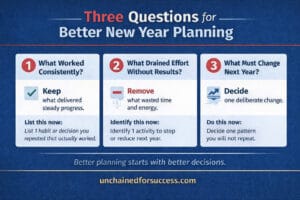
Three Questions That Improve New Year Planning Decisions
Before writing a single goal, answer these questions honestly.
Identify What Worked Consistently Last Year
Consistency matters more than intensity. Look for actions you repeated even when motivation was low. These are the behaviours you can build on.
This aligns with the principle explored in Small Steps, Big Impact, where progress comes from repeatable actions, not bursts of effort.
Remove What Drained Energy Without Results
Some activities consume time without producing value. Identifying them creates space. Progress often increases when you remove friction, not when you add more goals.
Decide What Must Change for the New Year
If the same pattern continues, results will not change. At least one deliberate shift is required. Planning without change is repetition.
How to Plan for the New Year Using the Unchained Framework
In Unchained, planning follows a clear sequence. The order matters.
The framework moves through:
- Purpose
- Direction
- Beliefs
- Habits
- Goals
Most people start with goals. That is why they repeat mistakes.
Beliefs play a quiet but powerful role. As discussed in Breaking Free: Identifying Limiting Beliefs, unexamined assumptions can undermine even strong plans. When beliefs are misaligned, goals rely on willpower alone.
Willpower rarely lasts.
What to Carry Forward in Your New Year Planning
Treat planning as a handover, not a reset.
Carry forward:
- Habits that produced clear results
- Systems that reduced effort
- Relationships that supported accountability
These are assets. Do not discard them.
What to Leave Behind When Planning the New Year
Letting go is strategic.
Research discussed in Psychology Today shows that lasting change often depends on consciously releasing unhelpful patterns, rather than adding more goals.
Leave behind:
- Goals that felt impressive but misaligned
- Constant busyness without direction
- Assumptions that limited consistency
New Year Planning Is a Decision, Not a Document
Good plans are simple. They are clear. They are sustainable.
If you want to plan for the new year without repeating mistakes, slow down. Reflect first. Decide what truly deserves your energy.
Next week’s blog will move from planning into execution. It will explore why self-sabotage often appears after goals are set, and how to prevent it early.
References
- Kwegyir-Afful, C. (2023). Unchained: Success Unlocked – A Proven Framework for Achieving Your Goals
- Harvard Business Review. Why Change Programs Don’t Produce Change
- Psychology Today. Why Can’t I Stop Repeating the Same Stupid Behaviours?