Hidden Beliefs That Undermine Your Goals

Introduction
Beliefs That Undermine your progress rarely announce themselves. Instead, they sit quietly beneath your goals, shaping how you think, decide, and act. You may have a clear vision. You may even have a structured plan. However, if your underlying beliefs conflict with that goal, execution will always weaken.
Hidden beliefs that undermine your goals do not usually sound dramatic. They appear as reasonable thoughts:
- “I am not ready yet.”
- “People like me do not succeed at this level.”
- “I have tried before.”
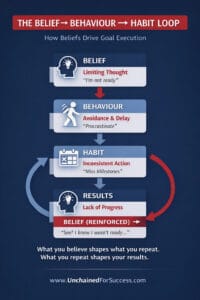
Because they feel logical, you rarely question them. Yet over time, they influence behaviour. Behaviour forms habits. Habits determine results.
This is why effort alone is not enough. Structure matters. Belief matters more.
In this article, you will learn how to identify the hidden beliefs that undermine your goals, understand where they come from, and replace them with beliefs that support consistent execution. When belief aligns with action, your goals move from possible to achieved.
What Are Beliefs and Why They Matter
Beliefs are assumptions you accept as true. They may be accurate. They may not. However, once accepted, they influence how you interpret reality.
A belief is not just an idea. It becomes a filter.
For example, if you believe you are disciplined, you look for evidence that confirms it. You notice days you followed through. You minimise the days you did not. Conversely, if you believe you lack discipline, you will interpret minor lapses as proof.
Over time, these interpretations compound.
Neuroscience supports this pattern. The brain constantly scans for safety and predictability. When a goal feels uncertain or threatening, the emotional centre reacts first. As a result, logical planning weakens. You avoid risk. You delay action. You rationalise inaction.
Therefore, beliefs shape behaviour long before conscious strategy begins.
This is why two people can set the same goal yet experience different outcomes. One believes growth is possible. The other believes change is difficult. The structure may be identical. The internal programming is not.
Beliefs matter because they influence:
- The goals you dare to set
- The effort you sustain
- The risks you tolerate
- The habits you repeat
In the Unchained framework, beliefs sit beneath mindset, emotions, behaviour, and habits. When beliefs are aligned with your goal, action feels natural. When they are not, friction increases.
Hidden beliefs that undermine your goals do not stop you from starting. They weaken consistency. They create hesitation at critical moments.
Understanding this distinction is the first step towards execution.
How Beliefs That Undermine Affect Execution
Beliefs That Undermine your goals rarely stop you from setting them. Instead, they interfere with execution.
You may begin with enthusiasm. You create a plan. You define milestones. However, when action becomes uncomfortable, your underlying belief system activates.
For example:
- You set a goal to grow your business revenue.
- You schedule strategic outreach.
- You prepare your message.
Then a thought appears:
“I am not credible enough for this level.”
That belief shapes the next decision. You delay the call. You soften the message. You reduce the ask. Execution weakens.
Over time, this pattern compounds.
In the Unchained self-management sequence, the flow is clear:
Belief → Mindset → Emotion → Behaviour → Habit → Result
If the belief is limiting, the emotional response becomes cautious. Caution reduces intensity. Reduced intensity affects behaviour. Behaviour, when repeated, forms habits. Habits determine whether goals are achieved.
Therefore, Beliefs That Undermine operate quietly but consistently.
They often show up as:
- “This isn’t realistic for me.”
- “I don’t have the time.”
- “I have tried before.”
- “Now is not the right moment.”
Notice that these statements sound practical. That is why they are dangerous. They rarely feel like sabotage. They feel sensible.
However, sensible thoughts can still block execution.
When belief and goal are misaligned, friction increases. You rely heavily on willpower. Motivation fluctuates. Discipline feels forced. Eventually, inconsistency appears.
By contrast, when belief aligns with the goal, behaviour feels natural. You do not debate action daily. You execute.
This is why structure alone is insufficient. Strategy without belief alignment creates resistance. Strategy with aligned belief creates momentum.
The critical question is not whether you have a plan.
It is whether your beliefs support that plan.
Where Hidden Beliefs Come From
Hidden beliefs rarely form overnight. They develop gradually, often without conscious awareness.
In the Unchained framework, belief formation follows a predictable pattern.
1. Exposure
Beliefs begin with input. Parents, teachers, media, culture, and early experiences introduce ideas about what is possible. For example, if you repeatedly hear that business is risky or that success is reserved for a certain type of person, those messages leave an imprint.
2. Acceptance
Repeated exposure makes an idea feel true. Over time, familiarity becomes credibility. You stop questioning it. The belief settles quietly into your thinking.
3. Reinforcement
Life experiences then confirm the belief. If you attempt something ambitious and encounter resistance, you may interpret that event as proof. Even neutral outcomes get filtered through the existing belief.
4. Identity Integration
Eventually, the belief becomes part of how you describe yourself. It shifts from “This is difficult” to “I am not good at this.” At that stage, the belief is no longer external. It feels personal.
This process explains why hidden beliefs that undermine your goals can feel deeply rooted. They are often reinforced over years. However, duration does not equal accuracy.
Importantly, many undermining beliefs are protective in origin. They developed to reduce perceived risk or emotional discomfort. Avoiding visibility, avoiding rejection, or avoiding failure once felt safer.
However, what once protected you may now limit you.
Therefore, the task is not to criticise yourself for holding these beliefs. It is to surface them, examine them, and decide whether they still serve your goals.
Understanding where beliefs come from reduces their power. Once a belief is seen clearly, it becomes changeable.
Identifying the Beliefs That Undermine Your Goals
You cannot change what you have not identified.
Beliefs That Undermine your goals often reveal themselves just before action. They appear at the point of discomfort. Therefore, the most reliable way to identify them is to observe your hesitation.
Ask yourself:
- What thought appears when I am about to act?
- What do I tell myself when I delay?
- What explanation do I use when I reduce effort?
- What feels “true” about why this goal may not work?
Be precise. Vague answers protect the belief. Specific language exposes it.
For example:
- “I am not senior enough.”
- “I do not have the right background.”
- “I always lose momentum.”
- “I am not consistent.”
Notice the pattern. These are identity-level statements. They are not temporary observations. They describe who you believe you are.
Another useful diagnostic tool is friction analysis. Look at where execution breaks down:
- Do you avoid visibility?
- Do you underprice your value?
- Do you procrastinate on strategic tasks?
- Do you redesign the plan instead of executing it?
Behaviour leaves clues. Repeated friction points to belief misalignment.
Importantly, separate facts from interpretations. A missed milestone is a fact. “I lack discipline” is an interpretation.
When you isolate the interpretation, you uncover the belief.
In your journal, write:
Goal:
Where execution breaks:
What I tell myself in that moment:
That final line is often the hidden belief.
Once articulated clearly, the belief loses ambiguity. It becomes visible. And what is visible can be challenged.
Rewriting Beliefs for Execution
Identifying a limiting belief is not enough. Awareness creates insight. It does not create change.
To replace Beliefs That Undermine your goals, you need a structured process.
In the Unchained framework, belief change follows four deliberate steps:
1. Awareness
Name the belief precisely.
Not “I struggle.”
Instead: “I believe I am not consistent enough to achieve this.”
Clarity weakens vagueness.
2. Disruption
Interrupt the old narrative. Ask:
- Is this always true?
- What evidence contradicts this belief?
- Who would I be without this assumption?
Research from Stanford University on growth mindset shows that when individuals challenge fixed identity statements, performance improves significantly. The belief shift changes effort patterns.
Therefore, disruption must be intentional.
3. Reframe
Replace the belief with one that supports execution.
Not unrealistic positivity.
Not “I am perfect.”
But constructive accuracy.
For example:
Old belief: “I am inconsistent.”
New belief: “Consistency improves when I design the right structure.”
This aligns with a previous blog, Reset Your Beliefs for a Stronger Second Half, where belief redesign preceded measurable behavioural change.
The new belief must support action.
4. Reinforcement
A belief becomes strong through repetition and evidence.
This is where habits matter.
As explored in Micro Habits for Maximum Growth, small daily actions reinforce identity faster than motivation alone. Each completed process goal provides proof that the new belief is valid.
Belief change without behavioural reinforcement fades.
Belief change with structured repetition stabilises.
At this stage, internal alignment begins to form. However, belief alone is not enough. It must translate into daily execution.
That brings us to the final connection.
From Belief to Habit: Closing the Execution Gap
Beliefs That Undermine create friction whereas aligned beliefs reduce friction.
However, execution becomes consistent only when belief connects to process.
In the Unchained model:
Belief → Mindset → Behaviour → Habit → Result
When you adopt a supporting belief, the next step is to design a process goal that proves it.
For example:
Belief rewrite: “I am becoming disciplined through structure.”
Process goal: “Work on strategic outreach for 30 minutes at 7am Monday to Friday.”
This structure removes negotiation. It removes daily debate. It converts belief into behaviour.
Research highlighted by Harvard Business Review repeatedly shows that structured implementation intentions significantly increase follow-through compared to intention alone.
Therefore, the real shift is not emotional. It is structural.
When belief and process align:
- Motivation stabilises.
- Resistance reduces.
- Execution becomes boring but effective.
That is the goal.
Hidden beliefs that undermine your goals thrive in ambiguity. They weaken under clarity, structure, and repetition.
If your execution feels inconsistent, do not first question your ability.
Question your belief alignment.
Because when belief supports action, progress compounds.
Conclusion: From Hidden Belief to Consistent Execution
Hidden Beliefs that undermine your goals do not shout. They whisper. They sound practical. They feel protective. However, over time, they weaken execution more than any external obstacle.
You can have a clear purpose.
You can define a strong goal.
You can design a detailed plan.
Yet if your belief system conflicts with that goal, friction will remain.
The solution is not more motivation. It is alignment.
When you identify the belief, disrupt it, replace it, and reinforce it through daily process goals, execution stabilises. Small repeated actions then confirm the new identity. Over time, what once felt difficult becomes natural.
This is the shift from meaning to execution.
If your goal is stalling, do not immediately redesign the strategy. First, ask:
What belief might be undermining this goal?
Clarity changes direction. Structure sustains it.
Call to Action
Which belief has been quietly limiting your progress?
Write it down. Challenge it. Replace it. Then attach it to a daily process.
If this article has helped you, share it with someone who may be working hard but struggling with consistency.
For deeper application, explore:
- Reset Your Beliefs for a Stronger Second Half
- Micro Habits for Maximum Growth
- Living Your New Beliefs: How to Embed Change for Life
You do not lack ability.
You may simply need belief alignment.
References
- Blackwell, L. S., Trzesniewski, K. H., & Dweck, C. S. (2007). Implicit theories of intelligence predict achievement across an adolescent transition: A longitudinal study and an intervention. Child Development, 78(1), 246–263.
- Gollwitzer, P. M., & Sheeran, P. (2006). Implementation intentions and goal achievement: A meta-analysis of effects and processes. Advances in Experimental Social Psychology, 38, 69–119.
- Grant, H. (2014). To Achieve Your Goals, Use “If-Then” Planning. Harvard Business Review.
- Kwegyir-Afful, C. Unchained: Success Unlocked – A Proven Framework for Achieving Goals.
- Milkman, K. L., Beshears, J., Choi, J. J., Laibson, D., & Madrian, B. C. (2011). Following through on good intentions: The power of planning prompts. Proceedings of the National Academy of Sciences, 108(30), 12419–12424.
- Yeager, D. S., & Dweck, C. S. (2020). What can be learned from growth mindset controversies? American Psychologist, 75(9), 1269–1284.