Year-End Reflection: Turning Lessons into 2026 Momentum

Introduction
As 2025 draws to a close, the noise of deadlines and celebrations often drowns out the quiet wisdom the year leaves behind. A year-end reflection is more than a pause to reminisce—it’s an intentional reset that transforms lessons into fuel for your next chapter. Within the Unchained Goals Framework, reflection is where belief meets awareness. When you look back with purpose, you move forward with clarity.
In this post, you’ll learn five practical ways to translate what 2025 taught you into sustained momentum for 2026.
1. Why Year-End Reflection Matters
Reflection gives your experiences meaning. Research from the Harvard Business Review – Translating Insights to Action shows that taking time to review performance improves long-term results and innovation. When you slow down to evaluate what worked and what didn’t, your brain consolidates learning, strengthening the link between belief and behaviour.
However, reflection without translation leads to stagnation. To connect insight with action, start by resetting limiting thought patterns. Revisit our earlier blog Reset Your Beliefs for a Stronger Second Half to realign your mindset before building next year’s plan.
2. Capture Honest Insights
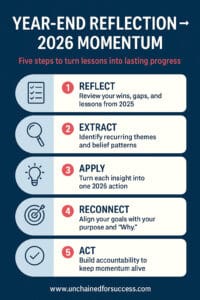
Begin by journaling three lists: Wins, Gaps, and Lessons.
- Wins remind you what consistency created.
- Gaps reveal where systems or beliefs failed.
- Lessons turn both into wisdom.
Look back through your 2025 calendar or project notes. Identify one breakthrough and one disappointment each month. For example:
“Completing the client presentation under pressure showed that preparation builds calm.”
Fifteen minutes of daily reflection this week will give you more clarity than a full day of planning without it.
3. Identify Themes and Patterns
When you review your lessons, patterns emerge—perhaps you hesitated because of self-doubt, or thrived when accountability was present. These are signals from your belief system.
As discussed in From Limiting to Liberating: How to Rebuild Your Belief System, awareness reshapes your neural pathways through neuroplasticity. Recognising repeated behaviours helps you rewire limiting beliefs into liberating ones.
Group your insights into themes such as:
- Mindset and Confidence
- Relationships and Collaboration
- Habits and Structure
- Growth and Innovation
Each theme becomes a foundation for next year’s improvement.
4. Convert Lessons into 2026 Action
Reflection gains power when it becomes motion. Translate every insight into a tangible step. According to Forbes – Learning from Setbacks, successful leaders use failures as feedback loops.
Create a simple two-column list:
| 2025 Lesson | 2026 Action |
| “I over-committed and lost focus.” | “Limit top priorities to three per quarter.” |
| “I thrived when routines were consistent.” | “Block 90 minutes each morning for deep work.” |
| “Delegating improved team outcomes.” | “Train two new leads by March.” |
This process grounds reflection in execution—the same principle that drives every pillar of Unchained.
5. Reconnect to Your ‘Why’
Momentum without meaning is motion without direction. Before setting 2026 goals, revisit your Why—the driving reason behind what you do. When purpose fuels your habits, consistency follows naturally.
Write or refresh a short purpose statement beginning with:
“I am committed to…”
Read it aloud daily. When decisions arise, ask, “Does this align with my Why?” That question alone will protect your focus throughout 2026.
6. Build Accountability Systems
Sustaining momentum requires structure. Create a rhythm of accountability using three levels:
- Personal: Weekly self-check—What progress did I make?
- Peer: Partner with a trusted colleague or friend who challenges you to stay consistent.
- Organisational: Integrate reflections into team reviews to embed learning at work.
If you struggle with follow-through, use digital habit trackers or a reflection reminder in your calendar. The discipline of review becomes your growth engine.
7. Real Example: Reflection into Renewal
A project manager I once coached discovered through structured reflection that she often missed deadlines because she hesitated to delegate. When she reviewed her notes, the pattern was clear—her need for control was slowing progress. Together, we introduced a weekly “handover hour” where she intentionally assigned key tasks to her team. Within one quarter, her delivery improved, and her stress levels dropped dramatically.
Reflection didn’t expose weakness—it revealed opportunity. When you examine your patterns with honesty, growth becomes intentional instead of accidental.
Conclusion: From Reflection to Momentum
Reflection is not about reliving the past but releasing its wisdom. The year-end reflection process turns experience into advantage—helping you start 2026 grounded, grateful, and goal-focused.
Take 10 minutes today to write one clear insight from 2025 and one action for January. That small step signals to your mind that growth is your default.
Share one lesson you’re taking into 2026 in the comments or tag #UnchainedForSuccess to inspire others.
References
- Kwegyir-Afful, C. (2023). Unchained: Success Unlocked – A Proven Framework for Achieving Your Goals.
- Harvard Business Review – “Translating Insights to Action.”
- Forbes – “Learning from Setbacks.”
- Psychology Today – “The Science of Reflection and Growth.”
#UnchainedForSuccess #GoalFramework #YearEndReflection #2026Goals #PurposeDrivenLife

You may also like


Hidden Beliefs That Undermine Your Goals

Why Clear Goals Don’t Get Executed