
Embracing Change: Innovation Mindset for Success
Introduction: Change as Your Launchpad
Change is no longer occasional — it’s the constant backdrop of our lives, careers, and organisations. According to the World Economic Forum’s Future of Jobs Report 2025, over half of the global workforce will need to re-skill by 2030 to stay competitive. The question isn’t whether change will come — it’s whether you’re prepared to embrace it with an innovation mindset.
An innovation mindset is the key to thriving in disruption. It’s not about resisting change or merely surviving it — it’s about turning change into a catalyst for creativity, resilience, and growth.
If you want to explore how beliefs shape your ability to handle change, our earlier blog Breaking Free: Identifying Limiting Beliefs shows how to uncover the hidden thoughts that hold you back. Understanding those beliefs is the first step toward building an innovation mindset.
For a wider perspective, Harvard Business Review highlights why adaptability is now considered the new competitive advantage in business — proving that individuals and organisations who adapt faster consistently outperform their peers.
What Is an Innovation Mindset?
An innovation mindset is the belief that every challenge is an opportunity to reimagine, improve, or create something new. While a fixed mindset resists change and a growth mindset welcomes learning, an innovation mindset goes further: it actively seeks change as the spark for progress.
This mindset blends curiosity, courage, and creativity with resilience. Leaders, entrepreneurs, and individuals with an innovation mindset don’t ask, “How do I survive this?” Instead, they ask, “How can I use this to grow?”
To understand how this applies to future careers, Innovation Training outlines the skills needed for success in fast-changing environments. Their research shows that adaptability and innovation will remain the top skills for tomorrow’s leaders.
Why Embracing Change Demands an Innovation Mindset
Disruption is inevitable. Markets evolve, technology advances, and personal circumstances shift. However, the difference between those who thrive and those who stall lies in mindset.
An innovation mindset empowers you to:
- See disruption as opportunity rather than threat.
- Pivot quickly when strategies stop working.
- Find creative solutions where others see dead ends.
Companies like Apple and SpaceX are famous for transforming setbacks into innovations that changed industries. On a personal level, Nelson Mandela’s ability to turn hardship into resilience and hope is a powerful reminder of the strength of mindset.
If you want to see what skills will matter most in the coming years, the World Economic Forum’s Future of Jobs Report 2025 provides data-driven insights into the changing demands of the global workforce.
The Four Pillars of an Innovation Mindset: How to Adapt & Thrive
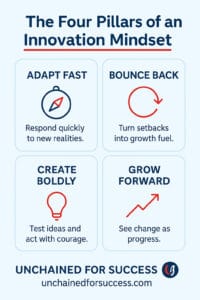
To bring innovation to life, focus on these four pillars:
- Adapt Fast– Respond quickly to new realities without paralysis. For example, leaders who adjust strategies early often outpace competitors.
- Bounce Back– Turn setbacks into springboards for growth. Failure becomes fuel for resilience.
- Create Boldly– Generate ideas, test them, and act on what works. In addition, creativity sparks breakthroughs others miss.
- Grow Forward– Treat every change as a chance to move closer to your vision.
How to Build Your Innovation Mindset: 5 Practical Steps
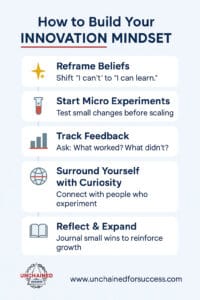
Here’s how to start cultivating innovation daily:
- Reframe Your Beliefs
Replace “this won’t work” with “what can I learn from this?” Our blogDaily Practices to Strengthen Empowering Beliefsprovides a toolkit of daily actions to strengthen belief systems and make your mindset more adaptable. - Start Micro Experiments
Test small changes before scaling. For example, writing 300 words a day can grow into a full book. To learn more about the power of small, consistent actions, seeMicro Habits for Maximum Growth. - Track Feedback Rapidly
Build quick review loops. Always ask, “What worked? What didn’t?” - Surround Yourself with Curious People
Join communities and networks that encourage experimentation. - Reflect and Expand
Journal your wins, no matter how small. Reflection reinforces an innovation mindset.
Innovation Mindset in Organisations: Culture & Strategy
For teams and organisations, an innovation mindset isn’t optional — it’s essential for survival. Cultures that encourage experimentation, psychological safety, and adaptability consistently outperform those that cling to outdated models.
Harvard Business Review explains why adaptability must be embedded in corporate strategy, especially in times of uncertainty. Meanwhile, Deloitte’s 2024 Human Capital Trends report shows that 80% of executives now rank adaptability as the most critical skill for the future (Deloitte Insights).
Even Google’s Project Aristotle confirmed that psychological safety — the freedom to experiment without fear — is the number one predictor of team success.
Practical ways to embed an innovation mindset at work include:
- Encouraging “fail fast, learn fast” pilots.
- Rewarding problem-solving over hierarchy.
- Creating cross-functional teams to spark new thinking.
When was the last time your team turned a failure into a lesson that accelerated growth?
Conclusion: Thrive Through Innovation Mindset
Change will keep coming. But with an innovation mindset, change transforms from something to fear into fuel for growth.
Whether in your personal life, projects, or organisation, embracing change with adaptability, resilience, creativity, and a forward focus ensures you stay relevant and thrive.
Action Step: Start today with one micro-experiment. Journal what you learn, share your experience, and revisit your belief system blogs for guidance.
If this inspired you, share it with someone who’s facing change — and subscribe to Unchained for more tools on thriving through mindset.
Related Blogs for Deeper Reading:
- Mindset Reset: Tools to Reframe Your Thinking– practical techniques to shift your perspective in real time.
- Small Steps, Big Impact– shows how small consistent actions compound into big transformation.
References
- Kwegyir-Afful, C. (2023).Unchained: Success Unlocked – A Proven Framework for Achieving Your Goals.
- Dweck, C. (2006).Mindset: The New Psychology of Success.
- Harvard Business Review (2011).Adaptability: The New Competitive Advantage.
- World Economic Forum (2025).Future of Jobs Report 2025.
- Innovation Training (2024).Innovation Skills for the Future.
- Harvard Business Review (2022).In Uncertain Times, the Best Strategy Is Adaptability.
- Deloitte Insights (2024).Human Capital Trends.

You may also like


Why Goals without Purpose Feel Empty

How to Find Your Life Purpose
