How to Rebuild Self-Trust After Broken Promises

Introduction
Rebuild self-trust by replacing emotional promises with structural commitments you can keep consistently.
When you break a promise to yourself, the damage is rarely confined to the missed outcome. Over time, repeated inconsistency reshapes identity. You begin to question whether you can rely on your own word, and that quiet doubt reduces future action even before you start. However, self-trust is not rebuilt through motivation or intensity. Instead, it is rebuilt through evidence created by disciplined structure.
This article explains how to rebuild self-trust using the architecture of the Unchained Goals Framework, supported by behavioural science and practical execution principles.
What Self-Trust Actually Represents
Self-trust is personal credibility with yourself.
It is the internal confidence that you will act on what you committed to, even when conditions are imperfect. Importantly, this confidence does not originate from emotion; rather, it accumulates from repeated behavioural proof. Therefore, if inconsistent behaviour weakened self-trust, consistent behaviour can restore it.
In leadership research, trust develops when reliability and competence align over time, not through declarations alone (Harvard Business Review, “Begin with Trust”). The same principle applies internally.
Why Self-Trust Breaks After Broken Promises
Most people assume that broken promises reflect weak discipline. In reality, they usually reflect structural errors.
Several common breakdowns occur:
- The goal was vague and lacked measurable process.
- The goal depended on external change rather than personal control.
- The ambition was too large to sustain daily.
- There was no protection plan for predictable obstacles.
- Limiting beliefs activated under pressure.
When execution fails repeatedly, the mind generates identity statements such as, “I never follow through.” Consequently, the issue appears personal. However, according to the Goals Framework principle, if you do not follow through, the issue is structure, not ability.
In practical terms, broken promises are rarely character flaws. They are design flaws.
Rebuild Self-Trust Through Structural Redesign
To rebuild self-trust, you must redesign the commitment across five components: Goal, Why, Belief, Plan and Habit. Each part protects execution.
1. Strengthen the Goal Through the Quality Gate
First, ensure your goal is fully under your control, measurable weekly, and actionable immediately. This distinction between outcome, performance and process goals is critical. While outcomes may inspire, only process goals rebuild reliability because they are directly executable.
For example, instead of promising to “be healthier,” define a process such as “Train for 30 minutes at 6am on Monday, Wednesday and Friday.” The latter reduces ambiguity and lowers threat perception in the brain.
Clarity reduces cognitive resistance. Control reduces avoidance.
2. Reinforce the Why Engine
Next, clarify why the commitment matters internally. External drivers such as approval or comparison lose power quickly. In contrast, identity-aligned reasons sustain behaviour under stress.
Ask:
- What does keeping this promise say about who I am becoming?
- What is the cost of breaking it again?
- Which part of my long-term vision does this protect?
This alignment stabilises execution because meaning reduces emotional volatility.
3. Repair Limiting Beliefs Before They Activate
Broken promises often embed subtle identity programming:
- “I start but don’t finish.”
- “I always lose momentum.”
- “I have tried before.”
These thoughts typically appear moments before avoidance. Therefore, belief repair must precede execution. Replace the identity-level narrative with one that is immediately testable, such as, “I follow through on small commitments under my control.”
If you want a structured approach to belief redesign, you may find it helpful to revisit how to reset your beliefs for sustained execution.
4. Protect Execution With If–Then Planning
Even well-defined goals collapse under predictable obstacles unless you pre-decide your response. Research on implementation intentions shows that linking a specific trigger to a predefined action significantly improves follow-through.
For example:
- If I feel tired after work, then I will complete the minimum version.
- If I miss the morning slot, then I will reschedule for 7pm.
- If I want to skip entirely, then I will commit to five minutes before deciding.
By pre-committing responses, you reduce negotiation at the moment of resistance.
5. Build a Habit Small Enough to Win Consistently
Consistency, not intensity, rebuilds self-trust.
Research from University College London indicates that habit formation depends primarily on repetition over time rather than on effort spikes (Lally et al., 2009). Therefore, create a minimum viable process that you will not skip.
For instance:
- Write one paragraph.
- Walk for ten minutes.
- Read one page.
Meanwhile, keep the broader ambition intact. However, do not demand maximum output daily. Small completions accumulate psychological credibility. This principle aligns with the concept of micro habits for long-term growth.
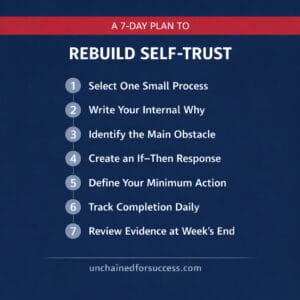
A 7-Day Plan to Rebuild Self-Trust
Over the next seven days:
- Select one small process fully under your control.
- Write one clear internal reason.
- Identify the main obstacle you expect.
- Create a single if–then response.
- Define the minimum version you will never skip.
- Track completion daily.
- Review evidence at the end of the week.
At the end of seven days, measure reliability, not transformation. Ask whether you kept your commitment, regardless of intensity.
Evidence changes identity.
A Practical Illustration
Consider an executive who repeatedly promised to “improve fitness.” Each January, he committed to five sessions per week. However, work pressures inevitably disrupted the routine. Within three weeks, sessions declined. Consequently, he reinforced the belief that he lacked discipline.
Instead of increasing intensity, he redesigned structure.
The revised goal became: “Walk for 20 minutes after dinner daily.” The internal reason was clarity and energy for leadership decisions. The obstacle identified was late meetings. The if–then response was clear: if dinner occurred late, the walk would happen indoors immediately afterward. The minimum version was ten minutes.
During the first week, all seven sessions were completed. During the second week, five full sessions and two minimum versions were logged. By week four, the identity statement had shifted from “I always stop” to “I execute daily processes.”
The body changed gradually. Self-trust returned first.
Conclusion: Structural Evidence Restores Personal Credibility
You do not rebuild self-trust through intensity. You rebuild self-trust through repeatable structure.
When you protect execution with clear goals, aligned meaning, repaired beliefs, obstacle planning and daily habits, reliability becomes predictable. Over time, that predictability restores identity-level confidence.
Therefore, if you want to rebuild self-trust after broken promises, begin with one small commitment you can keep this week. Let evidence replace doubt.
References
- Lally, P. et al. (2009). How are habits formed: Modelling habit formation in the real world. European Journal of Social Psychology.
- University College London. “How long does it take to form a habit?”
- Gollwitzer, P.M. (1999). Implementation Intentions research summaries (NIH behavioural science resources).
- Frei, F.X. & Morriss, A. “Begin with Trust.” Harvard Business Review.
- Kwegyir-Afful, C. Unchained: Success Unlocked – A Proven Framework for Achieving Goals.