How Trade-Offs Create Progress
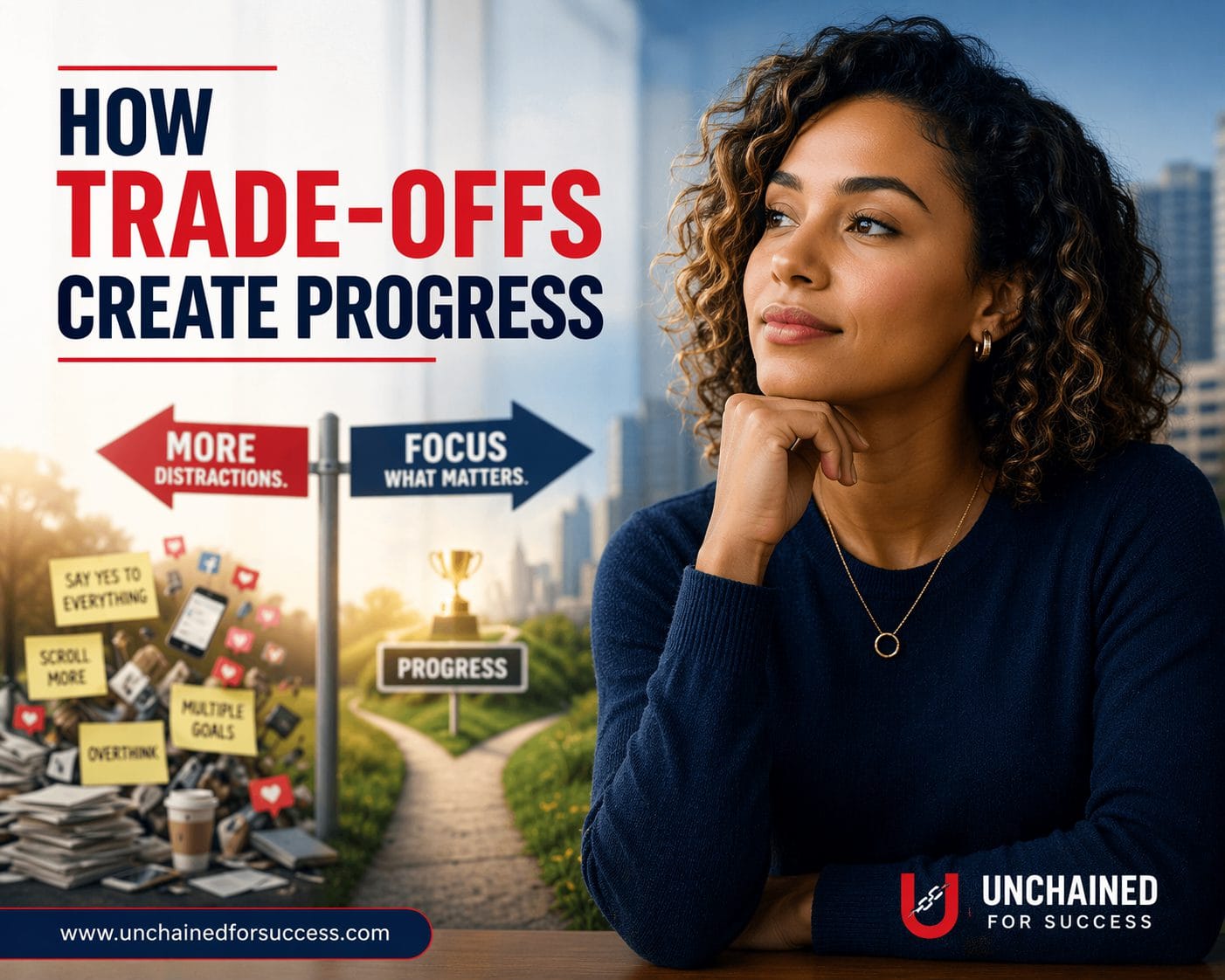
Trade-offs create progress. Yet most people resist them.
Instead, they try to do everything at once. They chase more goals, more tasks, and more options. On the surface, this feels productive. In reality, however, it leads to scattered effort and slow results.
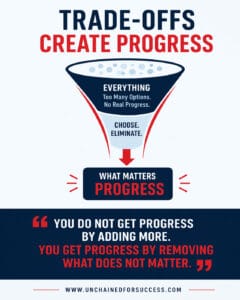
“You do not get progress by adding more. You get progress by removing what does not matter.”
Progress does not come from doing more. Rather, it comes from choosing what matters most and letting the rest go. As a result, this simple shift changes everything about how you work and live.
In this blog, you will learn why trade-offs matter. In addition, you will see how they fit within the Unchained goals framework. Finally, you will get a clear process to start using them today.
Why Trade-Offs Create Progress in Real Life
Every big goal needs focus. Because of this, focus needs exclusion. Time, energy, and attention are all limited. When you spread them too thin, nothing moves forward fast enough.
As a result, progress stalls across every area of your life. Things feel busy, but outcomes stay flat. This is what happens when you avoid choosing.
Trade-offs fix this. They answer one clear question: what am I willing to give up to reach this goal?
Without that choice, effort stays weak. With it, effort becomes sharp and direct. That is exactly why trade-offs create progress. They push your resources towards what truly counts.
Michael Porter made this case in his well-known Harvard Business Review article. He argued that good strategy depends on trade-offs. In short, a strong position means choosing what not to do (Porter, 1996). This rule applies to personal goals just as much as it does to business.
“Strategy is not what you choose to do. It is what you choose not to do.”
The Hidden Cost of Avoiding Trade-Offs
Avoiding trade-offs feels safe at first. Options stay open. Hard choices get pushed back. It is easy to tell yourself that you can handle it all.
Over time, however, the cost builds up. First, your attention splits in too many directions, which causes a loss of focus. If this sounds familiar, our blog How to Stay Focused on Your Goals offers useful ways to fix this. Second, nothing gets enough effort, so progress slows everywhere. Third, too many open choices drain your mental energy over time.
Research by Roy Baumeister and colleagues backs this up. Their work shows that every choice draws from the same pool of willpower. As a result, each new choice leaves less energy for the next one (Baumeister et al., 1998). In other words, the more choices you keep open, the worse your later decisions become.
This ties to a common goal-setting trap: treating everything as equally important. When everything matters, nothing gets the depth it needs. Therefore, refusing to make trade-offs is itself a costly choice.
How Trade-Offs Create Progress in the Unchained Framework
Trade-offs are not separate from the Unchained goals framework. On the contrary, they sit at the very centre of it. Each part of the framework either needs or supports a trade-off. The book Unchained: Success Unlocked sets out this approach in full (Kwegyir-Afful, 2023).
Goal: The First Trade-Off You Make
A strong goal already holds a trade-off inside it. It picks one outcome over others. If a goal does not force you to give something up, it is too vague. As a result, being specific matters because it narrows your focus and demands a clear sacrifice.
For more on this, read The Importance of Specificity in Goal Setting.
Why: The Engine Behind Every Trade-Off
Your “why” decides if the trade-off is worth it. If your reason is weak, you will not keep up the sacrifice. This is where many people fail. They set goals without grasping the true cost. Because of this, they quit at the first sign of pain.
Ownership: Accepting the Trade-Off Fully
Ownership means accepting what comes with your choices. If you pick a goal, you must also accept what you are letting go. This removes blame. In turn, it gives you a real sense of control. Moreover, it stops you from resenting the trade-off later.
Plan: Choosing What to Exclude for Progress
A strong plan is not just about what you will do. More importantly, it is about what you cut out on purpose. For example, this might mean saying no to certain chances, dropping low-value tasks, or blocking out time-wasting habits.
Habits: Reinforcing Trade-Offs Every Day
Habits lock in trade-offs on a daily basis. Each time you follow your process, you pick your goal over other options. Over time, this builds steady results. As a result, the trade-off becomes automatic rather than a daily struggle.
Practical Examples of How Trade-Offs Create Progress
How Trade-Offs Create Progress for Individuals
Think about someone who wants to get healthier. The trade-off means early gym sessions instead of extra sleep. It also means meal prep instead of fast food. Without accepting these trade-offs, the goal stays a wish.
How Trade-Offs Drive Business Progress
Likewise, a business owner who wants growth must make tough calls. For instance, they might focus on one core offer instead of chasing ten ideas. In addition, they spend time doing rather than just planning. Our blog Mastering Execution: Closing the Gap Between Plan and Action goes deeper into this. As a result, depth replaces distraction.
Trade-Offs and Progress in Projects
In project work, trade-offs are clear and well known. The classic tension is time versus cost versus quality. Improving one usually means adjusting another. Therefore, progress comes from making these calls early rather than ducking them.
How to Make Trade-Offs That Create Progress
Good trade-offs do not happen by accident. Instead, they need a clear process. Here are five steps to follow.
- Define the goal clearly. Make sure it is specific, easy to measure, and within your control. The sharper the goal, the easier it is to spot what must change.
- Identify what competes for your time. List everything that takes your energy and attention right now. This step shows where your resources are leaking.
- Decide what to cut or reduce. Be honest with yourself here. If everything stays the same, nothing changes. This step is the heart of the trade-off.
- Check it against your why. Confirm that the goal is worth the sacrifice. If the reason feels too weak, either strengthen it or rethink the goal.
- Commit and execute. Do not revisit the trade-off each day. Instead, decide once and then stay the course. Remember, strategic trade-offs drive progress only when you hold the line.
Common Mistakes That Prevent Trade-Offs Creating Progress
A few common habits slow people down and weaken their results. First, trying to soften every trade-off leads to half measures. Second, keeping too many options open gives the illusion of progress with no real forward movement.
On top of this, choosing comfort over progress is a quiet but damaging trap. It feels safe now, yet it builds up into stagnation. Finally, changing direction too often kills momentum before it has a chance to build. In short, steady action beats scattered effort every time.
Conclusion: Why Trade-Offs Create Progress
Trade-offs create progress because they force focus and cut out distraction. Every real result needs a clear choice to put one path above another. Without that choice, effort spreads thin and outcomes stay small.
Progress is not about doing more. Instead, it is about doing what matters and dropping what does not. The Unchained framework gives you the structure to make these choices with clarity.
If you want to move from possible to achieved, start with one question: what am I willing to give up to make this goal happen?
Progress is not built on what you add. It is built on what you are willing to leave behind.
Ready to Take Action?
If this blog has changed how you think about your goals, share it with someone who is trying to do too much at once. For a deeper look at the full goals framework, pick up a copy of Unchained: Success Unlocked by Clement Kwegyir-Afful.
Follow www.unchainedforsuccess.com, Unchainedforsuccess on Facebook and Unchained4success on Instagram for more useful insights on reaching your goals.
References
- Baumeister, R.F., Bratslavsky, E., Muraven, M. and Tice, D.M. (1998). “Ego Depletion: Is the Active Self a Limited Resource?” Journal of Personality and Social Psychology, 74(5), pp. 1252–1265. Available at: https://faculty.washington.edu/jdb/345/345%20Articles/Baumeister%20et%20al.%20(1998).pdf
- Kwegyir-Afful, C. (2023). Unchained: Success Unlocked – A Proven Framework for Achieving Your Goals. London: Unchained for Success.
- Kwegyir-Afful, C. (2024). “The Importance of Specificity in Goal Setting.” Unchained for Success, 22 July. Available at: https://unchainedforsuccess.com/the-importance-of-specificity-in-goal-setting/
- Kwegyir-Afful, C. (2025). “How to Stay Focused on Your Goals.” Unchained for Success, 2 July. Available at: https://unchainedforsuccess.com/how-to-stay-focused-on-your-goals/
- Kwegyir-Afful, C. (2025). “Mastering Execution: Closing the Gap Between Plan and Action.” Unchained for Success, 7 August. Available at: https://unchainedforsuccess.com/mastering-execution-closing-the-gap-between-plan-and-action/
- Porter, M.E. (1996). “What Is Strategy?” Harvard Business Review, November–December, pp. 61–78. Available at: https://hbr.org/1996/11/what-is-strategy