Process Goals: How to Turn Effort Into Results

Process goals turn effort into results when structure is present
Many people put in effort but struggle to see consistent results. They work hard, stay busy, and remain committed to their goals. Yet progress is slow or unpredictable.
This is where process goals become critical.
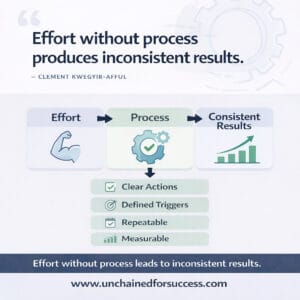
Effort on its own is not enough. Without structure, effort becomes inconsistent. And when effort is inconsistent, results are unreliable.
As discussed in Why Consistency Fails, behaviour breaks down when it depends too heavily on intention. Process goals provide the structure that allows effort to be repeated and sustained.
What are process goals
Process goals are the actions you control and repeat consistently.
They focus on behaviour rather than outcomes. Instead of aiming directly for a result, process goals define the steps that lead to that result.
For example:
- Outcome goal: lose weight
- Process goal: train three times per week
The outcome may take time. However, the process can begin immediately and be repeated consistently.
This distinction is important because outcomes are not always within your control. Process goals are.
Why effort alone does not lead to results
Effort often feels productive. However, effort without structure does not guarantee progress.
People can:
- work long hours
- take on many tasks
- stay busy throughout the day
Yet still fail to move meaningfully forward.
This happens because effort is not directed consistently. It depends on mood, time availability, and competing priorities.
As a result, progress becomes irregular. This reinforces the idea explored in How to Build Habits That Actually Stick: repetition, not intensity, drives results.
Why process goals improve consistency
Process goals improve consistency by reducing decision-making.
When actions are clearly defined:
- there is less hesitation
- fewer decisions are required
- behaviour becomes easier to repeat
This aligns with research on implementation intentions by Peter Gollwitzer (1999), which shows that defining when and how an action will occur increases the likelihood of follow-through.
Similarly, research by Lally et al. (2010) demonstrates that repetition in a stable context leads to habit formation over time.
In practice, process goals create the conditions where consistency becomes more likely, not forced.
Examples of process goals in practice
Process goals apply across individuals, projects, and organisations.
Individuals
- Train at a fixed time three times per week
- Write for 30 minutes every morning
- Review priorities every Monday
Projects
- Hold a weekly progress review
- Complete defined deliverables each sprint
- Track milestones at fixed intervals
Organisations
- Standardise key operational routines
- Conduct regular performance reviews
- Maintain consistent reporting structures
In each case, the focus is not on the outcome alone, but on the actions that produce it.
How to set effective process goals
Setting process goals requires clarity and simplicity.
A strong process goal should include:
- A clearly defined action
What exactly will be done - A fixed trigger
When or under what condition it will happen - A realistic frequency
How often it will be repeated - A simple way to track completion
So progress is visible
For example:
- Write for 30 minutes at 7am every weekday
- Review financials every Sunday evening
The goal is to remove ambiguity. The clearer the process, the easier it is to repeat.
Why process goals are more reliable than outcomes
Outcomes are important, but they are not always controllable.
For example:
- securing a promotion
- winning a contract
- achieving a specific financial target
These outcomes depend on multiple factors. Under the Unchained Goals Framework, the above outcomes are considered as dreams and not goals as they do not come under the control of the individual or organisation.
Process goals, however, remain within your control. They focus on what you can do consistently, regardless of external conditions.
Over time, consistent execution increases the likelihood of achieving the desired outcome. This is why process goals are more reliable.
They shift the focus from hoping for results to building them.
Process goals and meaningful progress
Process goals play a central role in achieving meaningful goals.
They convert intention into action. They provide a bridge between what you want and what you do.
Without process goals:
- goals remain abstract
- effort becomes inconsistent
- progress is difficult to sustain
With process goals:
- actions are clear
- behaviour is repeatable
- progress becomes visible
This is how meaningful goals are achieved in practice.
Conclusion: process goals make effort count
Process goals turn effort into results by making behaviour consistent and repeatable.
Effort is necessary, but it is not sufficient. Without structure, effort becomes unreliable.
Process goals provide that structure. They define what to do, when to do it, and how to repeat it.
If you want better results, do not rely on effort alone. Build the process that supports it.
A practical next step
Choose one goal that matters to you.
Then define one process goal:
- the action
- the timing
- and how you will track it
Start there.
If you want to design this more effectively across your goals, this is exactly what we work through in the Goals Design & Execution Workshop, where the focus is on building systems that sustain results.
References
- Gollwitzer, P. M. (1999). ‘Implementation intentions: Strong effects of simple plans’. American Psychologist, 54(7), pp. 493–503.
- Lally, P., van Jaarsveld, C. H. M., Potts, H. W. W. and Wardle, J. (2010). ‘How are habits formed: Modelling habit formation in the real world’. European Journal of Social Psychology, 40(6), pp. 998–1009.
- Kwegyir-Afful, C. (2023). Unchained: Success Unlocked – A Proven Framework for Achieving Goals. Unchained for Success.