How to Refine Your Vision Without Changing

The vision was right when you wrote it. You may still need to refine your vision today. Yet read it aloud now and something has changed: the words sound like they belong to someone else. The examples feel dated. One phrase has quietly lost its meaning. And the person you have become would never describe the destination that way. Nothing about the direction is wrong. The description of it has simply gone stale.
That gap has a cost. After all, a vision guides decisions only while it is clear, current and compelling. Let the words fade and the direction fades with them. You did not change your mind; the vision simply stopped speaking clearly enough to be used.
The remedy, however, is not a dramatic rethink. It is the quieter discipline of learning to refine your vision. Sharpen the language, update the detail and fold in what you have learned. Do this regularly while the destination stays exactly where it is.
The short answer: refine your vision at every scheduled review that confirms your direction. First, rewrite it in today’s words. Then sharpen what success looks like with what the year has taught you, and test it on someone who was not there when you wrote it. This post unpacks that answer for individuals, organisations and projects, and shows why refinement is maintenance, not doubt.
What It Means to Refine Your Vision
A vision is the committed long-term position you have chosen within your Purpose. For example, it may describe the kind of business you are building, the contribution your career will make or the lasting position a project is intended to create. It answers the question every weekly task should ultimately serve: where is all this taking us?
To refine your vision is to improve how that position is described without moving the position itself. You tighten the wording. Next, you replace vague terms with observable ones. You also update examples and numbers that time has dated. Finally, you fold in what experience has taught you about what the destination really looks like. Through all of it, the commitment underneath does not move.
That makes refinement quite different from reassessment. Reassessing direction asks whether the long-term position is still the right one. That is a rare and serious question, and it deserves real evidence. By contrast, refining your vision assumes the position is right and asks a humbler question: does the description still do its job?
Last month’s post made the case for a long-term perspective. Last week’s post showed when to question your direction. This one covers the far more common case, where the direction survives the review and the words need work. If you are unsure which situation you are in, the answer decides which post you need.
A Running Example: One Consultant, One Sentence
Return to the consultant from last week’s post, whose purpose is developing people and organisations to achieve meaningful goals. The first version of her vision, written three years ago, read: “build a respected nationwide coaching business that helps people achieve meaningful goals.” It pointed in the right direction, but the words were soft. Respected by whom? Which people? And what does helping them actually produce?
Two refinements later, the same commitment reads: “build a nationally recognised coaching business that helps individuals across the UK achieve meaningful goals through consistent action.” Yet the direction never moved.
“Respected” became “nationally recognised”, a claim she can test. Likewise, “nationwide” became “across the UK”, the same geography in plainer words. “Helps people achieve” became “helps individuals across the UK achieve meaningful goals through consistent action”, which clarifies the audience and method while preserving the intended result. In the end, the market, the activity and the long-term position all stayed put. Only the wording became clearer.
That picture rests on three ideas:
Refinement is maintenance, not doubt. Rewriting the description of a destination is not the same as questioning it. A vision that is regularly refined is being taken seriously, the way anything load-bearing gets maintained.
Every vision was written by a past self. You wrote it knowing what you knew then, in the language you used then. The commitment may be durable; the description never is.
Clarity is a performance factor, not a cosmetic one. A vision guides decisions only when people can tell what it means. Vague words at the top become vague choices all the way down.
Why You Need to Refine Your Vision Regularly
Is regular refinement really necessary, or is a well-written vision done? The evidence shows why regular refinement matters in three different settings.
For Individuals: You Will Change More Than You Think
People are poor judges of how much they will change. Research published in Science involved more than 19,000 people aged 18 to 68. Participants reported how much their personality, values and preferences had changed over the past decade, or predicted how much they would change over the next one.
The result was the same at every age. People predicted far less future change than people ten years older said they had actually experienced. The researchers called this the “end of history illusion”. It is the sense that who you are now is, at last, the finished version.
The study measured personality, values and preferences rather than goals, so the transfer is an inference. Even so, the implication for any long-term vision is hard to ignore. The person who wrote your vision believed they were writing from a settled vantage point. They were wrong in a predictable direction.
A vision reviewed and refined regularly keeps pace with the person you are actually becoming. In contrast, one written once and framed on the wall describes the ambitions of someone who no longer quite exists.
For Organisations: Clear Vision Supports Performance
It is tempting to treat the wording of a vision as decoration and the strategy as the substance. The research suggests otherwise. A longitudinal study published in the Journal of Applied Psychology followed 183 entrepreneur-CEO and employee pairs. It found that the attributes of the vision, including its clarity, and the content of the vision affected subsequent venture growth. Moreover, the effect worked both directly and through how the vision was communicated in writing and in speech.
The study covered one industry sector, so generalising calls for care. Even so, the finding lands on exactly the territory refinement owns: the quality of the vision’s expression, not just the ambition behind it, showed up in growth. Time spent making the words sharper and more communicable is not polish. On this evidence, it is performance work.
For Projects: Unclear Objectives Put Delivery at Risk
Projects show what happens when clarity is neglected at the level below vision. In PMI’s 2017 Pulse of the Profession infographic, 37 per cent of respondents named a lack of defined objectives and milestones as a reason for failure. It was the most frequently cited of the three reasons shown.
This is survey evidence rather than a causal test. Even so, the pattern is clear: when the definition of success blurs, delivery follows.
Objectives inherit their clarity from the vision above them. As a result, a project team cannot define crisp milestones against a fuzzy destination. Refining the vision is not a leadership indulgence. It is upstream maintenance on every objective that depends on it.
Why Visions Go Stale
If refinement is this valuable, why do most visions get written once and left alone? Three reasons come up again and again.
First, a finished statement feels finished. The work of writing a vision is real, and completing it feels like crossing a finish line. Nothing about the framed result suggests it has a shelf life, and no reminder ever arrives to say the words have started to date.
Second, familiarity wears the words smooth. Indeed, repeat any phrase often enough and it stops producing a picture. The vision still gets recited, in the deck, in the onboarding pack, at the January kick-off. But nobody hears it any more, and nobody notices that nobody hears it.
Third, touching the vision looks like doubting it. Leaders worry that reopening the wording will be read as wavering on the commitment. So the words stay frozen out of respect, while their grip on daily decisions quietly weakens. The irony is that the opposite habit signals confidence: only a direction you are sure of can bear regular rewording.
None of these habits serves a commitment measured in years. So a vision on that scale deserves the same maintenance as anything else you intend to keep.
How to Refine Your Vision Within the Unchained Goals Framework
In the Unchained Goals Framework, Purpose defines your domain of responsibility, and Vision is Direction: the committed long-term position you have chosen within it. Vision is designed on purpose, not found by accident, and the framework expects most scheduled reviews to end by confirming it.
That “confirm” verdict is precisely where refinement lives. A review that ends with “the direction stands” has not finished its work if the vision goes back in the drawer untouched. Confirming the position is the moment to refine the wording. The evidence is fresh, the year’s learning is in the room, and the gap between what the vision says and what you now know is at its most visible. Refinement gives the most common review outcome a useful ending.
The framework’s deeper machinery stays exactly where last week’s post put it. That includes the diagnostic sequence and the decision to reassess Direction itself. Of course, refinement never substitutes for that discipline. It simply keeps the vision in working order between the rare occasions when the bigger question is genuinely earned.
How to Refine Your Vision: Five Practices
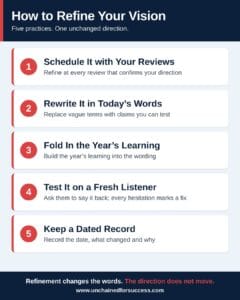
The good news: you can refine your vision with nothing more than a calendar, a pen and one honest listener. Here are five practices you can start at your next review.
1. Put Refinement on the Same Calendar as Review
Do not create a separate ritual. Attach refinement to the reviews you already schedule. When a quarterly or annual review confirms your direction, take fifteen more minutes and work on the wording while the evidence is still on the table. The rhythm matters more than the occasion. Therefore, a vision refined a little every review cycle never drifts far enough from reality to need a rescue.
2. Refine Your Vision in Today’s Words
Read the vision aloud and test every phrase: would someone meeting it for the first time understand exactly what it commits you to? Has any word become furniture, present but no longer meaning anything specific? Replace soft claims with observable ones, as the consultant did when “respected” became “nationally recognised”. If a sentence cannot survive being read aloud slowly, it is not yet finished.
3. Fold In What the Year Taught You
Experience keeps sharpening your picture of the destination, and the vision should collect that sharpening. If the year revealed which clients you serve best, which signs would show that you are recognised or which language now describes your field more accurately, write that learning into the wording. A structured review of each goal generates exactly this kind of learning; refinement is where it gets banked instead of forgotten.
4. Test It on Someone Who Was Not There
Explain your vision in one minute to someone who did not help write it, then ask them to say it back. Every hesitation and every mistranslation marks a phrase that needs work. This is the cheapest test available. The research above suggests it targets what matters: a vision earns its keep partly through how well it communicates. The listener’s frown is data.
5. Keep a Dated Record of Every Refinement
Keep each version of your vision with the date and a line on what changed and why. The record does two jobs. It shows newcomers how the thinking matured, which builds confidence rather than undermining it. And it protects the boundary this post depends on. If successive refinements keep pulling at the position itself rather than the wording, the record will show it. That pattern is evidence for last week’s deeper question, not more polishing.
How to Refine Your Vision as a Team
For organisations and project teams, the same five practices apply; the refinement simply becomes shared. Rewrite the words together, so the vision lives in the language the current team actually speaks. Let the newest member be the listener in practice 4; they hear what the veterans no longer can.
Keep the shared record visible, so refinement stays an open act of maintenance rather than a quiet edit. A team refreshing its vision is also protecting the pace that long-term work demands. People sustain effort far longer for a destination they can still see clearly.
Refine Your Vision: Frequently Asked Questions
How often should you refine your vision? Attach it to your existing review rhythm: a light pass at each quarterly or annual review that confirms your direction, and another pass when major learning arrives. In short, refinement should feel like light maintenance. If every review produces a major rewrite, the question is no longer about wording.
Is refining your vision the same as changing direction? No. Instead, refinement sharpens the description of the same long-term position: clearer words, current language, better-defined success. Changing direction replaces the position itself. That decision deserves the evidence thresholds and disciplined review covered in the reassess-direction post, not a quiet series of edits.
What if refining your vision keeps turning into bigger rewrites? Treat that as a signal, not a failure. When the words refuse to settle because the position underneath no longer convinces you, refinement has done its job as a warning. Stop polishing and ask the deeper question properly, with the evidence in front of you.
Refine Your Vision and Keep the Words Alive
A vision does its work through its words. When they are sharp and current, every decision beneath them inherits that clarity. When they fade, the direction fades with them, long before anyone decides to change course. Refining your vision is how you prevent the second outcome without ever confusing it with the first. The destination stays fixed. The description stays alive. That is the whole discipline.
So take out your vision before the next review and read it aloud. Mark every word a stranger would misread and every claim you could not test. Then refine your vision until it says exactly what you now know you mean.
Share the word or phrase you changed in the comments.
When did you last read your vision aloud, and did every word still say exactly what you mean?
Sources
- The End of History Illusion by Quoidbach, Gilbert & Wilson, Science
- A Longitudinal Study of the Relation of Vision and Vision Communication to Venture Growth in Entrepreneurial Firms by Baum, Locke & Kirkpatrick, Journal of Applied Psychology
- Pulse of the Profession: Elevate Success infographic from the Project Management Institute