Sustainable Success: What Pushing Too Hard Really Costs

You set a meaningful goal. You threw everything at it. And somewhere along the way, the thing that was meant to energise you started to drain you. Goal-setting conversations often overlook sustainable success. In short, it means pursuing your purpose and vision at a pace you can actually keep up. Your energy, your health and your relationships stay intact. Ignore it, and the price is rarely small.
This post looks at what that price really is for individuals, organisations and projects, and how to stop paying it.
What sustainable success actually means
Most of us learned to treat achievement as a sprint. Set the goal, push hard, rest later. However, meaningful goals are rarely sprints. A meaningful vision usually takes years to realise, not weeks.
Sustainable success means making meaningful progress you can keep making. It does so without steadily wearing down the people, resources or systems you need to continue. It does not mean working slowly. Nor does it mean avoiding discomfort or removing periods of intense effort. Stretched goals can demand exceptional effort. So the test is simple: is the intensity deliberate, time-limited and properly resourced? Does recovery follow? Or has intensity become the normal operating condition?
That definition rests on three ideas:
The normal operating pace must be repeatable. You may sometimes need exceptional effort. However, it should be deliberate, time-limited and supported by planned recovery.
The people and systems must retain the capacity to continue. Health, energy, relationships, capability and organisational knowledge are not fuel to burn without limit. Instead, they are conditions the plan must consider and the Control System must protect.
Progress must compound rather than depend on repeated rescue efforts. Steady, suitably demanding work is usually more reliable than heroic bursts that end in exhaustion and lost momentum.
In other words, how you pursue a goal matters as much as the goal itself. That’s the part most plans leave out, and it’s exactly where the hidden costs creep in.
The real cost of ignoring sustainable success
What happens when we ignore the “how”? The bill arrives in three places.
For individuals: the burnout tax
Burnout is not evidence of weak character. In the occupational context, the World Health Organization classifies it as a phenomenon resulting from chronic workplace stress that has not been successfully managed. Its recognised signs are exhaustion, growing cynicism or mental distance from work, and reduced professional effectiveness. Outside work, chronic overload can still produce exhaustion, declining engagement and reduced capacity. However, the WHO does not formally classify these experiences as burnout.
Here’s the cruel irony: highly committed people can be especially at risk, because they may override their own early warning signs. So the cost isn’t only the goal abandoned. It’s also the months of recovery afterwards, and the fear of aiming high again.
For organisations: the quiet exodus
Organisations pay the price in people. Gallup’s research links frequent burnout to higher absence and lower confidence in performance. Moreover, it found that employees experiencing frequent burnout were 2.6 times as likely to be actively seeking another job. An organisation that pursues its mission unsustainably does not merely tire its people. It raises the risk of losing them.
There’s a reputational cost too. Teams talk. As a result, a purpose-driven organisation that quietly burns through its staff undermines the very purpose it exists to serve.
For projects: the graveyard of good intentions
Projects can fail from unsustainable pacing even when the underlying idea is sound. The pattern is familiar: an energetic start, long hours, and declining decision quality. Then come more errors, more rework, and growing dependence on a few committed people. Momentum then stalls as capacity runs out. The project may not end in a visible crisis. Instead, it can decline gradually as deadlines slip, quality falls and key people disengage. Indeed, the UK Health and Safety Executive notes that excessive workload can slow performance and increase slips, lapses and mistakes.
Every abandoned project also carries an invisible cost: everyone involved becomes a bit more sceptical about the next one.
Why we ignore sustainable success anyway
If the costs are this clear, why do so many of us keep paying them? Three reasons come up again and again.
First, urgency feels like virtue. Busyness is visible; sustainability is not. Pushing through looks like commitment. Meanwhile, people can mistake a steady pace for a lack of ambition.
Second, the hustle myth is loud. Popular culture celebrates the all-nighter and the relentless grind. It rarely shows the effects on health, judgement and performance.
Third, the costs are delayed. Unsustainable effort works, at least briefly. The early results reward the very behaviour that later destroys the goal. Consequently, by the time the bill arrives, the operating pattern may already have taken hold.
None of these reasons survive contact with a long-term vision. If your goal matters enough to take years, it deserves a way of working that lasts years.
Sustainable success in the Unchained Goals Framework
In the Unchained Goals Framework, sustainability is not a separate component you add to a goal. Rather, it is evidence that the execution architecture is working. Your Why defines the cost you can justify; it does not justify unlimited cost. Planning must provide enough capacity and resources. Habit Conversion turns controllable behaviours into repeatable execution. Meanwhile, the Control System detects when performance, quality or the capacity to continue starts to fall.
How to build sustainable success into your goals
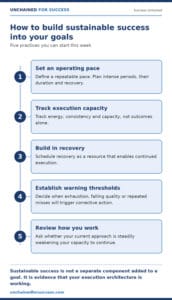
The good news: sustainable success is a set of practices, not a personality trait. Here are five you can start this week.
- Set an operating pace, not just a deadline. For every goal, define a normal operating pace that your available time, capability and resources can support. If you know you will need exceptional effort, decide three things: when it will happen, how long it will last, and how you will recover.
- Put execution capacity on the scorecard. If the outcome looks on track while the capacity to continue is falling, the execution system is becoming unstable. For individuals, useful signals include energy, sleep and consistency. For organisations and projects, watch overtime, absence, staff turnover, errors, rework, delayed decisions and dependence on key people.
- Build recovery into the plan. Rest is not merely a reward for finishing; it is one of the resources that enables continued execution. Therefore, schedule it with the same seriousness as your milestones, and treat energy management with the same discipline you give your calendar.
- Establish warning thresholds. Define the warning signs and thresholds that will trigger a correction. One difficult week may not require Diagnose Mode. However, sustained exhaustion, declining quality, repeated missed process goals or rising rework should prompt a response.
- Review the method as well as the result. In every progress review, personal or organisational, ask one extra question: can we continue working this way without progressively weakening the people, resources or systems on which the goal depends? If the honest answer is no, review and correct the execution system before capacity falls further. If drift has already set in, here is how to diagnose and recover a drifting year.
Sustainable success for teams
For organisations and project teams, the same five practices apply; the scorecard simply becomes shared. In fact, a team that reviews its capacity alongside its progress is better positioned to retain people and momentum.
The choice in front of you
Every meaningful goal comes with two price tags. One is the effort it genuinely requires. The other is the needless cost of chasing it unsustainably: the burnout, the exodus, the graveyard of stalled projects. You must understand and justify the first. However, you should never accept the second as inevitable.
In the end, sustainable success is a question of respect: for your vision, and for the person or team who has to carry it. So choose a pace you can keep. Protect the energy that powers the work. Then your goals stop being things you survive and become things you sustain.
Which goal are you pursuing in a way that is steadily reducing your capacity to continue? That is where your review should begin.
Sources