Long-Term Perspective: Why Progress Needs Direction
You checked the numbers, and progress looked fine. Tasks were getting done, activity was rising and the team kept hitting its weekly targets. Yet six months later, the organisation had weakened customer trust and drifted from the position it wanted to hold. The dashboard recorded movement. It did not show the change of direction. A long-term perspective means judging today’s effort against the vision it serves, not only against last week’s numbers. Without it, progress can quietly mislead you.
This post explains why progress needs direction, for individuals, organisations and projects. It also shows how to build the long view into the way you review your goals.
What a long-term perspective actually means
Most of us learned to manage goals by tracking progress. Set the target, measure the movement, celebrate the ticks. Progress answers a useful question: are we moving? Yet it cannot answer the question that decides whether a goal succeeds. Are we moving towards the vision, at a cost we can justify?
A long-term perspective supplies that second answer. It is the practised habit of stepping back from the current week. You lift your eyes and see the whole journey. Where did this goal come from? Where is it taking you? And does today’s effort still serve that destination?
That definition rests on three ideas:
Direction outranks speed. Fast movement in the wrong direction is not progress; it is expensive drift. So check direction before you celebrate pace.
Measurement needs context. Metrics show whether something is changing. Yet you must read them against the goal, Purpose and Vision they serve. A number can improve while the wider result gets worse. For example, a business can lift sales through heavy discounts while weakening profit, customer expectations and its long-term market position. The sales figure improves, yet the business may still be moving in the wrong direction.
Time reveals patterns that short reporting periods can miss. Capability, relationships and reputation often grow slowly. So they need longer review periods alongside your weekly and monthly measures.
The three tests of a long-term perspective
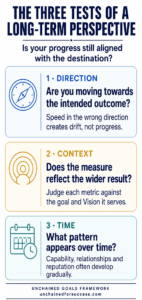
In other words, progress tells you that you are moving. Perspective tells you whether the movement serves the destination. That distinction is where many goal reviews fall short. It is also exactly where the long view earns its keep.
Why progress needs a long-term perspective
Is this just philosophy? Not at all. The evidence for the long view shows up in three places.
For individuals: the view that steadies you
Up close, a bad week looks like failure. From a year away, it looks like a data point. Psychologists call this shift “temporal distancing”, and research shows that it can reduce emotional distress. Across seven published studies, researchers found that people felt better when they viewed a stressful event from an imagined future. The reason was simple: distance drew their eyes to the fact that the trouble would pass.
Progress data stays valuable; the long view does not replace it. Yet a longer time horizon can stop you treating one poor week as proof that the whole goal has failed.
For organisations: the long view pays
Organisations feel the difference in their results. McKinsey Global Institute research examined 615 large and medium-sized listed US companies. From 2001 to 2014, the firms that managed with a long-term view grew cumulative revenue 47 per cent more than the others. Their cumulative earnings grew 36 per cent more. Moreover, from 2001 to 2015 they added nearly 12,000 more jobs on average.
The research shows a link rather than proof of cause. Even so, the findings suggest that repeatedly putting short-term results first can weaken investment, growth and value creation over time.
For projects: distance improves decisions
Priority calls shape how projects turn out. Here, too, perspective matters. Research from Ohio State University found that people prompted to think in big-picture terms made decisions that created the most overall value from limited resources. That distance helped them see consequences clearly, rather than grabbing the nearest visible win.
The research did not examine projects directly. Even so, it points to a decision principle that applies to them. A project team without that distance keeps sprinting towards whatever is loudest. As a result, activity rises while the outcome that justified the project slips further away.
Why we lose the long view anyway
If the long view is this valuable, why do so many of us lose it? Three reasons keep coming up.
First, progress is visible; perspective is not. A finished task earns a satisfying tick. Meanwhile, an hour spent reconnecting with your vision gives you nothing to screenshot.
Second, urgent tasks shout; the vision whispers. Each day brings fresh demands with deadlines attached. The destination, by contrast, never sends a reminder.
Third, short-term wins train short-term thinking. Each quick result rewards the behaviour that produced it. As a result, the horizon shrinks a little more with every sprint.
These habits make sense. Yet none of them serves a vision that takes years. A goal on that scale deserves a long-term perspective to match.
Long-term perspective in the Unchained Goals Framework
In the Unchained Goals Framework, long-term perspective is not a separate component. It emerges from the way the architecture connects present action to long-term direction. Purpose defines the domain of responsibility. Vision establishes the committed long-term position within that Purpose. Outcome, performance and process goals then translate that direction into measurable results and controllable action.
The Control System (Feedback system) monitors whether habits, processes and performance are producing the intended outcomes. Used properly, it also helps prevent an isolated setback from being mistaken for complete failure. When a genuine pattern of underperformance appears, Diagnose Mode works backwards through the architecture, starting with habit consistency, to identify where the system has broken down.
How to build a long-term perspective into your goals
The good news: a long-term perspective can be strengthened through repeatable practices. Here are five you can start this week.
- Match the review to the correct horizon. Use weekly reviews to check habits, processes and immediate performance. Then use monthly or quarterly reviews to check whether the goal still supports the Vision and Purpose. Each review level answers a different question, so keep them distinct.
- Test important decisions against the destination. When priorities compete, ask which option best protects or advances the goal and the Vision it serves. Match the horizon of the question to the goal itself. A three-month goal, a one-year goal and a ten-year Vision each deserve their own test.
- Track direction as well as distance. Pair every progress measure with an alignment question. Is this movement serving the outcome, the performance standard or the Vision behind it? If the honest answer is unclear, run a proper persist-or-change review before investing another quarter.
- Zoom out when the week goes wrong. After a setback, ask how this moment will look from a year ahead. This is temporal distancing in practice. It does not deny the problem; instead, it restores the proportion the problem stole. One caution: zooming out restores proportion, but it should never excuse a problem that keeps repeating.
- Protect the pace the long view demands. A perspective measured in years cannot survive on a pace measured in all-nighters. So treat sustainable success as part of perspective: the long view only helps if you last long enough to enjoy it.
A long-term perspective for teams
For organisations and project teams, a long-term perspective works through the same five practices; the vision simply becomes shared. A team that reviews direction together, not just tasks, gives every member the same map. Shared perspective then makes shared decisions easier to explain, defend and sustain.
Keep progress connected to direction
Every meaningful goal offers you two things to watch: the movement and the destination. Progress measures movement, but it does not by itself confirm that the movement remains aligned with the destination. Interpreted without context, it can reward drift. It can make one bad week look decisive and shrink your horizon to the next sprint. Progress still matters; without it, perspective achieves nothing. Yet a long-term perspective keeps that progress pointed at the result you truly want. It is a reliable vantage point from which progress finally makes sense.
So step back before you step forward. Reconnect with the destination, then let the numbers serve it. Your goals stop being a scoreboard you chase and become a journey you steer.
When did you last look at your goal from a year away, rather than a week away? That view is where your next review should begin.
Sources
- This Too Shall Pass: Temporal Distance and the Regulation of Emotional Distress — Bruehlman-Senecal & Ayduk, Journal of Personality and Social Psychology
- Where companies with a long-term view outperform their peers — McKinsey Global Institute
- How looking at the big picture can lead to better decisions — Ohio State University