Long-Term Thinking in a Short-Term World: 5 Practices

The offer arrived on a quiet Tuesday, and it was hard to refuse. Good money, an immediate start and a client who wanted an answer by Friday. It also pointed away from the position you have spent three years building. Long-term thinking is what notices that second fact before the invoice carries you past it.
After all, short-term pressure rarely announces itself as a change of direction. Instead, it turns up as an offer that seems too good to decline.
That pressure is relentless. Deadlines, dashboards, quarterly numbers and a phone that rewards whatever happened in the last hour. Each demand is reasonable on its own. Together, however, they pull your attention to the near horizon until the far one fades.
An earlier post in this series made the case for a long-term perspective and showed why progress needs direction. This post asks the harder question that follows. How do you keep long-term thinking alive when almost everything around you is paid, measured and praised by the week?
The short answer: protect long-term thinking with structure rather than willpower. First, name the time horizon of a decision before you make it. Next, describe your long-term position clearly enough to compete with today’s reward.
Then defend one block of long-horizon work in the diary. Also check that the current Outcome Goal still serves your committed Direction. This post unpacks that answer for individuals, organisations and projects.
What Long-Term Thinking Means in Practice
Long-term thinking is the practice of judging a decision by the position it builds, not only by the return it produces this week. It is a rule for weighing choices. It matters most when the reward in front of you is real.
Notice what it does not mean. Long-term thinking does not ask you to ignore this month’s income, this quarter’s numbers or Friday’s deadline. Those things matter, and pretending otherwise makes the discipline useless. Rather, it asks a second question once the first is answered: what does this choice do to where I am heading?
That question needs a destination to point at. In the Unchained Goals Framework, Purpose is your domain of responsibility. Vision is Direction: the committed long-term position you have chosen within it.
Without a stated Direction, every choice gets judged on its own merits alone. After all, nothing else is there to judge it against.
This picture rests on three ideas:
Long-term thinking is a judgement rule, not a personality trait. Nobody is born with it, and nobody keeps it by trying harder. You apply it, or you do not, one decision at a time.
Short-term pressure is built in, not personal. Pay cycles, reporting dates, alerts and deadlines all reward the near horizon. So willpower alone is the wrong tool against a system that never gets tired.
The long term is built entirely from short-term decisions. No separate long-term department exists. The position you hold in five years is the sum of the ordinary choices you made on quiet Tuesdays.
Long-Term Thinking in Action: The Consultant and the Convenient Contract
Return to the consultant from earlier posts in this series. Her Vision reads: “Build a nationally recognised coaching business that helps individuals across the UK achieve meaningful goals.” She refined that wording last quarter, and the Direction held.
Then a corporate client offered her six months of training work. The fee was excellent and the work was easy. Yet it built nothing towards national recognition as a coach.
Long-term thinking did not tell her to refuse. Instead, it made the trade visible. Six months of capacity would go somewhere other than the position she has chosen.
So she negotiated three months rather than six. She also ring-fenced two days each week for coaching clients. The bill got paid. Moreover, the Direction survived.
Why Long-Term Thinking Is Hard in a Short-Term World
Is short-termism really that strong, or is this just a matter of discipline? Evidence from three settings suggests the pull is stronger than most people assume.
Long-Term Thinking for Individuals: A Future Self Who Feels Like a Stranger
People discount the future heavily. One reason may be simple distance. The person you will become can feel like a stranger. In research published in the Journal of Marketing Research, people across four studies met age-progressed images of themselves. Each one saw their own face decades older.
The authors report a consistent result. Across all four studies, interaction with an aged version of oneself shifted choices towards later monetary rewards rather than immediate ones. These were controlled studies of money choices, not of goal setting. So the transfer to your vision is an inference.
Even so, the mechanism travels well. When the future feels vivid and personal, the near horizon loses some of its grip. So anything that makes your long-term position concrete is doing real work on your choices.
Long-Term Thinking for Organisations: Reporting Cycles Reward the Near Horizon
Executives face the same pull, and a calendar sharpens it. Researchers surveyed 401 financial executives and published the results in the Journal of Accounting and Economics. In that survey, 80 per cent said they would cut discretionary spending to meet an earnings target. The cuts they named covered research, advertising and upkeep.
In addition, 55.3 per cent said they would delay starting a new project. That held true even where the delay meant a small sacrifice in value.
This is survey evidence. People said what they would do; nobody watched them do it. Even so, the pattern is hard to wave away.
The other side is just as striking. McKinsey Global Institute’s Corporate Horizon Index used data from 615 large and mid-cap US-listed companies between 2001 and 2015. For the 2001 to 2014 comparison, cumulative revenue growth among firms classified as long term was 47 per cent higher and less volatile than among other firms.
The index measures association rather than proving cause. Even so, it suggests the near-horizon bargain is a poor one.
Long-Term Thinking for Projects: Delivery Ends Before the Benefits Arrive
Projects show the same pattern at a different scale. A project closes when the output is handed over, yet the value it was funded to create usually appears months or years later.
PMI’s 2018 Pulse of the Profession drew on more than 5,000 responses from practitioners, executives and PMO directors. It reports that one in three organisations reports high benefits realisation maturity.
The report also names a common pattern. Many companies manage projects only on outputs such as time, scope and budget. As a result, organisations may fail to track consistently whether those projects help achieve their wider strategic goals.
Again, this is survey evidence rather than a causal test. All the same, it names short-termism well. Attention stops at the handover, just where long-term thinking should begin.
Three Habits That Crowd Out Long-Term Thinking
If the case is this clear, why does the near horizon keep winning? Three habits do most of the damage.
First, urgency gets treated as importance. Anything with a deadline feels like the priority, because it announces itself. Meanwhile, the work that shapes your position in three years never arrives with a due date.
Second, the measurable crowds out the meaningful. Weekly numbers are easy to produce and easy to praise. Progress towards a long-term position is slower and harder to show. So it drops off the agenda first.
Third, long-term thinking is left to good intentions. People plan to think about direction when things calm down. Yet things never calm down. The intention then expires quietly, and nobody notices.
How the Unchained Goals Framework Protects Long-Term Thinking
Within the framework, Purpose sets the domain of responsibility. Vision defines the committed long-term position within that Purpose. The directional execution spine then connects Outcome Goals to Performance Goals, Process Goals and the habits that make the required behaviours repeatable.
That structure makes long-term thinking practical. A weekly action should serve a Process Goal; the Process Goal should support the required Performance standard; and that standard should move the Outcome Goal that serves Direction. The Control System keeps those connections under review. When progress weakens, it checks the execution structure rather than assuming the Direction itself is wrong.
Routine reviews should therefore concentrate on execution. You reassess Direction only when repeated, material evidence shows that the committed long-term position no longer serves Purpose.
Long-term thinking inside the framework is not a mood you summon. It is built into the architecture.
Five Practices to Strengthen Long-Term Thinking
The good news: you can protect the long view with a calendar, one page and a short weekly habit. Here are five practices you can start this week.
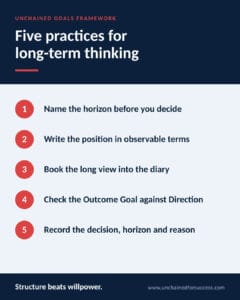
1. Name the Horizon Before You Decide
Before any major choice, say which horizon owns it. Is this a this-week decision, a this-year decision, or one that shapes your long-term position? The naming takes seconds, and it changes the question you ask. An operational choice may be judged mainly by immediate execution. However, a choice that changes capacity, commitments or Direction must also be tested against the long-term position.
2. Make Your Future Position Concrete
Vague destinations lose to vivid rewards. So write your long-term position in observable terms: what will exist, who you will serve and what would prove it. Refining that wording is not decoration. The research above suggests a clear picture of the future competes better against the offer in your inbox today.
3. Give Long-Term Thinking a Place in the Diary
Intentions expire; appointments do not. Book one weekly block for work that only pays off later. Treat it as you would treat a client meeting. Two hours a week is enough to start. Above all, protect the block when the week gets busy, because that is the week it was created for.
4. Measure the Near Term Against the Far One
Place the current Performance measure beside one alignment question: does the current Outcome Goal still serve the committed Direction? The measure shows whether execution is working. The alignment question shows whether the work is producing the right result.
Read the two together in each structured goal review. Strong weekly performance on a misaligned Outcome Goal is an early warning, not progress.
5. Keep a Decision Record You Will Reread
For each major choice, record the date, the horizon you named and the reason you chose. The record makes hidden drift visible. If it shows a run of near-horizon choices, you have evidence of drift that needs to be examined. If the record provides repeated, material evidence that the committed position no longer serves Purpose, that is the trigger to zoom out and reassess Direction.
Long-Term Thinking as a Team
For teams, the same five practices apply, with one addition. Name the horizon out loud in meetings. Ask which horizon a plan serves before anyone argues about its merits. Then the trade-off gets discussed rather than assumed.
Put the alignment question on the standing agenda beside the weekly Performance measures. Also protect the pace this needs. Pushing too hard creates the tired decision-making that short-termism feeds on. Teams under long strain pick the nearest horizon every time.
Long-Term Thinking: Frequently Asked Questions
What is long-term thinking in practice? It is judging a decision by the position it builds, not only by the return it produces this week.
In practice it means naming the time horizon a decision belongs to. Then you check the choice against your committed Direction before you accept the reward.
How do you balance long-term thinking with short-term pressure? Do not treat them as rivals.
Instead, meet the short-term obligation and then cap it. Limit its scope, its duration or the capacity it consumes, as the consultant did by taking three months rather than six. In short, the aim is to pay this month’s bills without spending next year’s position.
Does long-term thinking mean never changing direction? No. It means you change on evidence rather than on pressure.
A committed long-term position should survive a hard quarter. However, when repeated, material evidence shows that the position no longer serves Purpose, changing Direction becomes a considered response rather than short-termism.
Long-Term Thinking Is a Structure, Not a Mood
The short-term world is not going to relent. Deadlines, dashboards and easy offers will keep arriving. Every one of them will look reasonable. What decides your position in five years is not how strongly you believe in the long view. It is whether long-term thinking has somewhere to live in your week.
So give it one. Name the horizon on your next big decision. Book the block, add the alignment question and start the record on Monday.
Share the decision you almost made for short-term reasons in the comments.
Which horizon is really making your decisions this week?
Sources
- Increasing Saving Behavior Through Age-Progressed Renderings of the Future Self by Hershfield, Goldstein, Sharpe, Fox, Yeykelis, Carstensen & Bailenson, Journal of Marketing Research
- The Economic Implications of Corporate Financial Reporting by Graham, Harvey & Rajgopal, Journal of Accounting and Economics
- Where Companies With a Long-Term View Outperform Their Peers from the McKinsey Global Institute Corporate Horizon Index
- Pulse of the Profession 2018: Success in Disruptive Times from the Project Management Institute