Why Being Busy Doesn’t Mean Progress: 5 Signs and Fixes
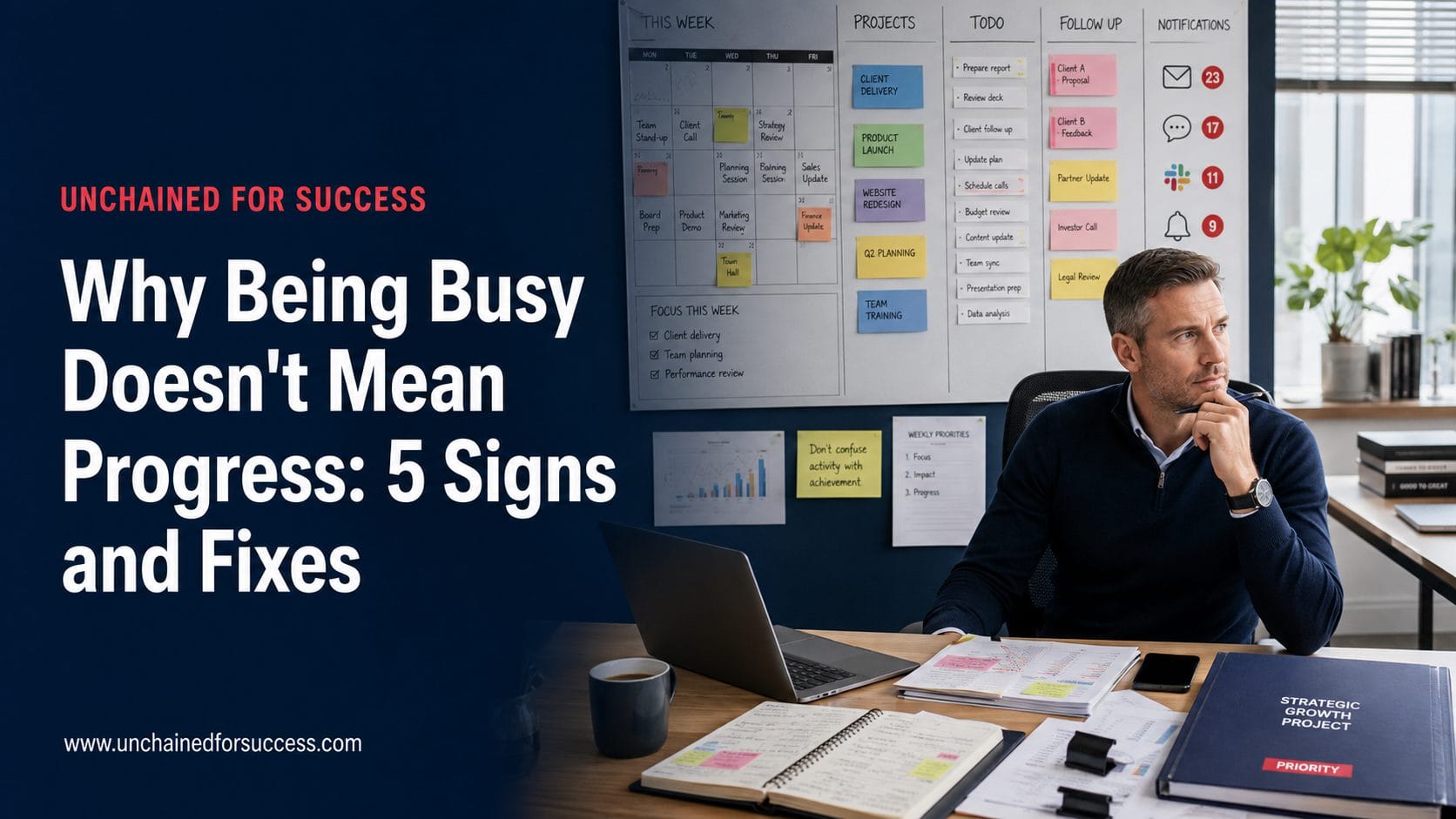
Her week was full. Fourteen calls, two networking events, a rebuilt lead magnet and an inbox cleared twice. By Friday she was tired and quietly pleased. Yet the Outcome Goal she had set three months earlier sat exactly where she left it. Being busy had filled the week. It had not built anything.
That gap stings, because effort feels like it should count for something. After all, activity is the easiest thing in the world to produce. Progress is not.
An earlier post in this series argued that progress needs a long-term perspective to mean anything. This post takes the next step and asks a blunter question. What does a full week actually cost you, and what did you buy with it?
The short answer: being busy is a price, not a performance. It spends capacity, attention and evidence. So the discipline is not working less. Instead, it is knowing what each commitment costs before you accept it, and checking what the spending produced. The five signs and five fixes below will help you price commitments, protect goal-moving work and judge whether a full week produced measurable movement.
What Being Busy Really Costs
Being busy means you have committed your available capacity. That is all it means. It says nothing about direction, quality or result. A full diary is a statement about your inputs, not your outcomes.
The trouble is that busyness charges you on three separate accounts, and only one of them is visible.
The capacity cost. Hours are the one resource you cannot recover. Each commitment you accept removes the chance to spend that time on the work that moves your goal.
The attention cost. Fragmented work is more expensive than the clock suggests. Switching, catching up and restarting all take effort that never shows on a task list.
The evidence cost. This one is the quietest and the most damaging. When activity data fills your reviews, result data gets crowded out. So you lose the very data you need to judge whether the effort worked.
In the Unchained Goals Framework, Purpose defines your domain of responsibility. Vision is Direction: the committed long-term position you have chosen within that Purpose. Being busy sits below both, in execution. Measure it as spending. Do not treat it as movement.
The Consultant and the Full Diary
Return to the consultant from earlier posts. Her Vision reads: “Build a nationally recognised coaching business that helps individuals across the UK achieve meaningful goals through consistent action.” She recently refined the wording, and the Direction held.
Her current Outcome Goal is to create and launch a six-module online course by 30 November. The Performance Goal is one module completed and approved every fortnight. Yet her week fills with podcast administration, event logistics and a website rebuild. Each task is defensible. Together, however, they consume the capacity the course requires.
So she priced the week rather than defending it. Of 34 committed hours, six served the Process Goals designed to produce the required Performance. The evidence did not point first to a lack of effort. It pointed to weak allocation: being busy had consumed the capacity assigned to the goal.
Why Being Busy Feels Like Progress
If the cost is this real, why does a full week still feel like a good one? Part of the answer is social.
Researchers have studied how other people interpret a busy life. Bellezza, Paharia and Keinan set out their findings in the Journal of Consumer Research. They report that a busy, overworked life, rather than a leisurely one, has become an aspirational status symbol.
The authors link the status to beliefs about competence, ambition and scarcity. They also find that culture shapes it. The pattern held more strongly in their North American samples than in their European ones.
These were studies of how people judge others, not of goal achievement. So the transfer to your own reviews is an inference. Even so, the mechanism matters. When busyness signals worth, a full diary starts to feel like a result in itself.
For Individuals: The Attention You Never Get Back
Interruption is where busyness charges you twice. In a controlled experiment reported at CHI 2008, 48 people worked through sets of email tasks. Some worked without interruption. Others were interrupted as they went. Here is the surprising part. The interrupted group finished faster than the baseline group.
The authors are clear about the trade. Working faster with interruptions came at a cost: participants reported higher workload, more stress, greater frustration, more time pressure and more effort. This was a laboratory task rather than a year of goal work. All the same, it names the illusion precisely. Speed under pressure can look like productivity while the price is paid somewhere you are not measuring.
Focus time is scarce in practice too. Microsoft’s 2023 Work Trend Index surveyed 31,000 workers in 31 markets. In that survey, 68 per cent said they do not have enough uninterrupted focus time in the workday. People were reporting how the day feels, not logging what they did. Even so, the direction is hard to ignore. It also explains why long-term thinking struggles to find room in an ordinary week.
For Organisations: Coordination Consumes the Day
Organisations pay the same bill at scale. Asana’s Anatomy of Work Global Index 2023 surveyed 9,615 knowledge workers in six countries. The fieldwork ran in November 2022. Those workers reported spending 58 per cent of the day on what the report calls work about work. That means coordination, not skilled or strategic work.
Bain and Company’s research with the Economist Intelligence Unit points the same way. It drew on a survey of more than 300 senior executives and two dozen organisational audits. The average company, it reports, loses more than 20 per cent of its productive capacity to organisational drag. That is more than a day each week.
These findings are not equivalent forms of evidence. Asana’s 58 per cent is self-reported, while Bain’s estimate combines an executive survey with two dozen organisational audits. Neither should be treated as a universal measured constant, but together they show how coordination and organisational drag can consume capacity. Being busy becomes the default state, and the work that changes position gets whatever is left.
For Projects: Output Rises, Outcome Waits
Projects show the sharpest version of the problem. Activity is easy to see in delivery. Tasks, milestones and burn-down charts all exist to display it.
PMI’s 2018 Pulse of the Profession, drawing on more than 5,000 responses, names the resulting pattern. Many companies manage projects only on outputs such as time, scope and budget. As a result, organisations may fail to track consistently whether those projects help achieve their wider strategic goals.
Again, this is survey evidence rather than a causal test. Still, it captures the trap. A project team can be fully occupied, fully reported and fully on schedule while the benefit it exists to create stays untouched. Being busy shows up in every status report. The benefit does not.
Five Signs Being Busy Has Replaced Progress
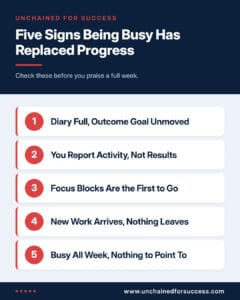
How do you tell the difference in your own week? Five signs show when being busy has taken the place of movement. None of them is proof on its own; together they are a pattern worth examining.
- The diary is full and the Outcome Goal is unmoved. If the Outcome is unchanged, check whether Performance is moving within the expected range. If neither has moved through a month of full weeks, the spending may be going elsewhere or the Process may be invalid.
- You report activity rather than results. Listen to how you answer “how is it going?” Tasks completed, meetings held and emails cleared are inputs.
- Focus blocks are the first thing to go. Whenever pressure rises, the protected work disappears first. That tells you which work the system actually values.
- New commitments arrive and nothing leaves. Capacity is fixed. So each new task without a removal is a quiet cut somewhere else.
- You finish the week unable to name what changed. This is the clearest signal. A productive week leaves evidence you can point to: a required behaviour completed, a Performance indicator moved or an Outcome advanced.
How the Framework Separates Being Busy From Progress
The Unchained Goals Framework handles this through structure rather than willpower. Purpose sets the domain of responsibility. Vision defines the committed long-term position within that Purpose. The directional execution spine then runs from Outcome Goal to Performance Goal to Process Goal to Habit. That chain ties what you do each day to the result it is meant to produce.
That connection is the first test, not proof of progress. Trace each activity to a Process Goal. Then trace that Process Goal to the named Performance standard it is designed to produce. A Process Goal that serves no standard is activity. Even a connected Process still requires evidence. Consistent execution should move Performance, and Performance should indicate trajectory towards the Outcome.
The Control System monitors measured Performance against agreed operating ranges. It also retains enough Process and Habit evidence to diagnose a deviation. When a below-range signal meets its trigger, Diagnose Mode follows a fixed order. That order runs through Habit consistency, Process validity, Performance metric validity, Plan, Beliefs, Ownership, Why, and finally the Outcome control boundary. Vision and Purpose are examined only where the evidence is systemic, repeated or part of formal recovery.
A run of full weeks with no movement is therefore evidence to be examined, not a verdict on your discipline. Being busy is a signal to examine, not a diagnosis in itself. When the evidence meets a trigger, Diagnose Mode begins with Habit consistency.
Five Fixes for Being Busy Without Progress
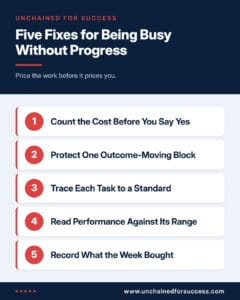
The good news: this is fixable with a calendar, one page and a short weekly routine. Here are five fixes you can start this week.
1. Price What Being Busy Will Cost You
Before accepting any commitment, name the hours it will take and the work those hours will displace. Say the trade out loud: “this is six hours that will not go to client delivery.” The point is not to refuse. Rather, it is to make the price visible while you can still negotiate it, as the consultant did by capping the website rebuild at eight hours.
2. Protect One Outcome-Moving Block
Book a single weekly block for the work that moves the Outcome Goal, and defend it like a client meeting. Two hours is enough to begin. Above all, protect it in the week you least want to, because that is the week it was created for. Protect the pace as well: pushing too hard produces the tired decisions that busyness feeds on.
3. Trace Every Activity Through the Spine
Take this week’s task list. Mark each item with the Process Goal it serves. Then mark the Performance standard that Process Goal is designed to produce. Anything unattached goes in a second column. Some of it will be necessary cost, such as invoicing and compliance. The rest is activity without trajectory.
4. Read Being Busy as Evidence, Not Effort
Place each Performance indicator beside its agreed operating range. Add Process and Habit evidence only to answer the diagnostic questions. Did the required behaviour happen? Was the Process valid? Is the Performance metric valid? High activity with flat or below-range Performance is an early-warning signal. It is not evidence for questioning Direction before the lower layers have been tested.
Read those answers together in each structured goal review.
5. Record What the Week Bought
Each Friday, write three lines: hours committed, hours serving the goal’s Process Goals, and what changed as a result. Treat this as a capacity record, not a Performance measure. If activity stays high while Performance remains flat, use the record as context for Diagnose Mode. Only wider, repeated and material evidence that Vision no longer serves Purpose should extend the review as far as reassessing Direction.
Apply the Capacity Test as a Team
Teams need one addition. Report the split, not just the workload. Next to the weekly Performance measures, state how many committed hours served Process Goals linked to the Outcome Goal. Then the conversation moves from who is stretched to what the stretching bought. Ask for a removal whenever anyone proposes an addition, because a team that only adds is choosing its priorities by accident.
Being Busy: Frequently Asked Questions
Is being busy always a bad sign? No. Busyness is neutral until you know what it bought.
A full week of consistent execution may be sound. Even so, the Control System must still run two tests. Does the Process produce the required Performance? Does that Performance indicate trajectory towards the Outcome? A full diary is evidence of capacity used, not proof of progress.
How do I tell activity from progress? Trace the work upwards.
Ask which Process Goal a task serves, which Performance standard that Process Goal supports, and which Outcome Goal that standard moves. A connection is necessary, but evidence must validate it. In short, progress is activity performed through a valid Process. That Process should produce the expected movement in Performance and, over time, in the Outcome.
What if the busy work is genuinely unavoidable? Then price it and cap it.
Invoicing, compliance and admin all have to happen. However, they should occupy a stated share of your capacity rather than an open-ended one. Once the share is fixed, the remaining hours can be defended for the work that changes your position.
Being Busy Is a Cost, Not a Measure
Calling drift laziness does not identify which part of the system failed. People drift because a full week feels like a good week, and because nothing in an ordinary diary asks what the fullness bought. Being busy will always be easier to produce than progress, and far easier to display.
So change what you check. Price the next commitment before you accept it, book the block, and write the three-line record on Friday. To build the complete structure that connects a committed Vision to measurable weekly action, explore the Unchained Goals Framework.
Share the busy work you are going to cap this week in the comments.
What did last week actually buy you?
Sources
- Conspicuous Consumption of Time: When Busyness and Lack of Leisure Time Become a Status Symbol by Bellezza, Paharia & Keinan, Journal of Consumer Research
- The Cost of Interrupted Work: More Speed and Stress by Mark, Gudith & Klocke, Proceedings of CHI 2008
- Will AI Fix Work? 2023 Work Trend Index Annual Report from Microsoft
- Anatomy of Work Global Index 2023 from Asana
- Great Companies Obsess Over Productivity, Not Efficiency by Mankins & Garton, Bain & Company with the Economist Intelligence Unit
- Pulse of the Profession 2018: Success in Disruptive Times from the Project Management Institute