


Her week ended with a delivered draft, a paid invoice and a quiet client. Three months later the same work came back for rebuilding. Nobody had written down what good looked like. Standards define outcomes, and an undefined standard defines nothing.
That idea sits badly at first, because effort feels like the thing that counts. Yet effort has no direction of its own. A standard gives it one.
An earlier post in this series showed that being busy spends capacity without proving movement. Another argued that progress needs a long-term perspective to mean anything. This post asks the question underneath both. What does "done well" mean here, and who wrote it down?
The short answer: standards define outcomes because the standard is the measure. Set it before the work starts and you can judge the result. Leave it unset and you will judge the result by how the week felt. The five tests below will help you write a standard you can measure, place and review.
What It Means to Say Standards Define Outcomes
A standard is a written description of what good looks like, agreed before work begins. It names the level, not the effort. "Fast enough" is an opinion. "Answered within one working day" is a standard. Some teams call this a definition of done. The name matters less than the act of writing it first.
So this is a mechanical point, not a moral one. The quality of the result you accept at the end is shaped by the standard you set beforehand. Change the standard and you change what you will accept.
Note the difference between a standard and a target. A target names how much. A standard names how good. Both are short. Both are cheap to write. Yet most of us write only the first.
In the Unchained Goals Framework, Purpose defines the domain of responsibility you accept. Vision is Direction: the committed long-term position you have chosen within that Purpose. Standards sit lower, in execution, where they turn intention into something you can check. The framework glossary sets out each term in full.
The Consultant and the Undefined Standard
Return to the consultant from earlier posts. Her Vision reads: "Build a nationally recognised coaching business that helps individuals across the UK achieve meaningful goals through consistent action." She refined the wording recently, and the Direction held.
Her Outcome Goal states the required result: create and launch a six-module online course by 30 November. The Performance Goal defines the operating standard needed to reach it. Complete one module every fortnight. Each module must score at least four out of five against the quality checklist, with no critical review actions left open.
Her Process Goal names the controllable behaviours. She holds course sessions every Monday, Wednesday and Friday. She sends the script, video and worksheet by alternate Fridays. Habit Conversion then keeps those behaviours consistent. Each session begins at 9.00 am, with the task list open and distractions removed.
None of that existed in July. "Approved" simply meant that she liked the module, so the level moved with her mood. Nothing about her effort changed when she wrote the standard down. Her results did, because standards define outcomes and hers now sat in the right layer.
Why Standards Define Outcomes More Reliably Than Effort
Research on goal setting points the same way. Locke and Latham summed up 35 years of research in the American Psychologist. Across that work, specific and difficult goals produced higher performance than the familiar instruction to do your best.
Notice what "specific" is doing there. We read it as a standard sitting inside the goal. That reading is ours, not a finding of the study. Even so, it explains the gap: "do your best" tells you nothing about when you have arrived.
The same paper makes a second point. A goal, the authors write, does two jobs at once. It gives you an object or outcome to aim for, and it gives you a standard for judging satisfaction.
Standards Define Outcomes for Individuals: Judging Without Guesswork
Without a written level, you grade your own work on feeling. A tiring week feels productive. An easy week feels lazy. Neither impression tells you much about quality.
A standard removes that guesswork. It also stops endless polishing, which is the opposite error. Standards define outcomes at both edges: they say when the work is good enough, and they say when to stop. When the standard names a script, a video and a worksheet, you stop at three. Long-term thinking then becomes possible, because each week ends with a decision rather than a mood.
Standards Define Outcomes for Organisations: Clarity at Scale
Organisations rarely lack effort. Instead, they lack agreement about the level. Ask five people what good looks like here. You may well get five answers. Gallup's employee engagement indicator reports that, as of May 2026, 49 per cent of US employees strongly agreed that they know what is expected of them at work. That measures strong agreement in a survey, not the presence of written standards. Even so, it suggests that many people are not sure what good looks like.
Other research looks at clarity more widely. Tubre and Collins reviewed the earlier studies in the Journal of Management. Their meta-analysis found role ambiguity linked to weaker job performance, at a correlation of minus 0.21. Job type and rating source both moderated that link. Role conflict showed a negligible relationship at minus 0.07.
Role ambiguity covers far more than a missing quality standard. So read it as support for the value of clarity, not as proof that written standards raise performance. All the same, the authors conclude that role ambiguity ought not to be dismissed as an unimportant variable in the job performance domain. When nobody names the level, each person guesses. The work then drifts.
The organisational version of the framework calls this cascade failure. Targets pass down unchanged, and nobody sets the level at each layer.
Standards Define Outcomes for Projects: Stopping Rework Early
Projects show the cost most clearly, because rework carries a price tag. Rework is a bill for a standard nobody set. The UK's Get It Right Initiative puts the total cost of error in the range of 10 to 25 per cent of project cost, or £10bn to £25bn a year across the sector.
Its research report puts the total near 21 per cent of industry spend. That is the sum of the categories in the report's cost chart. Those categories rest on a Delphi study of experts and on self-reported survey data, not on audited accounts. Treat the number as an informed estimate.
Now look at a case with a hard outcome. Haynes and colleagues tested a 19-item surgical safety checklist in eight hospitals across eight cities. They set out the results in the New England Journal of Medicine. They compared 3,733 patients before the checklist with 3,955 after it. The death rate fell from 1.5 per cent to 0.8 per cent, while inpatient complications fell from 11.0 per cent to 7.0 per cent.
This was a before-and-after study in very different hospitals, not a randomised trial. The authors name the limits themselves: wider trends over the period could have contributed, and teams knew that observers were watching them.
They introduced a standardised checklist and team confirmation at three fixed points. The improvement that followed does not prove that the checklist alone caused the change, but it shows why consistent, checkable processes deserve serious attention.
Where Standards Define Outcomes Sit in the Framework
The Unchained Goals Framework handles this through structure rather than willpower. Purpose sets the domain of responsibility. Vision defines the committed long-term position within that Purpose.
Every Goal in the Unchained Goals Framework must be Stretched, Specific, Measurable, Time-bound and Under your control. Within the execution spine, however, each type of Goal performs a different function. The Outcome Goal states the required result. Beneath it, the Performance Goal defines the operating standard needed to achieve it. The Process Goal identifies the controllable behaviours expected to produce that Performance, while Habit Conversion makes those behaviours consistent.
Standards define outcomes from inside the Performance Goal. They do not sit in the Outcome Goal above it, nor in the Process Goal below it.
Connection is the first test, not proof of progress. Trace each activity to a Process Goal, then trace that Process Goal upwards to the Performance standard it should produce. A Process Goal that serves no standard is activity. Even a connected Process still requires evidence. Consistent execution should move Performance, and Performance should indicate trajectory towards the Outcome.
The Control System compares actual Performance with the agreed operating range. It also keeps enough Process and Habit evidence to explain a deviation. Whenever a below-range signal meets its trigger, Diagnose Mode follows a fixed order. That order runs through Habit consistency, Process validity, Performance metric validity, Plan, Beliefs, Ownership, Why, and finally the Outcome control boundary. Vision and Purpose come under review only where the evidence is systemic, repeated or part of formal recovery.
How Standards Define Outcomes in Practice: Five Tests
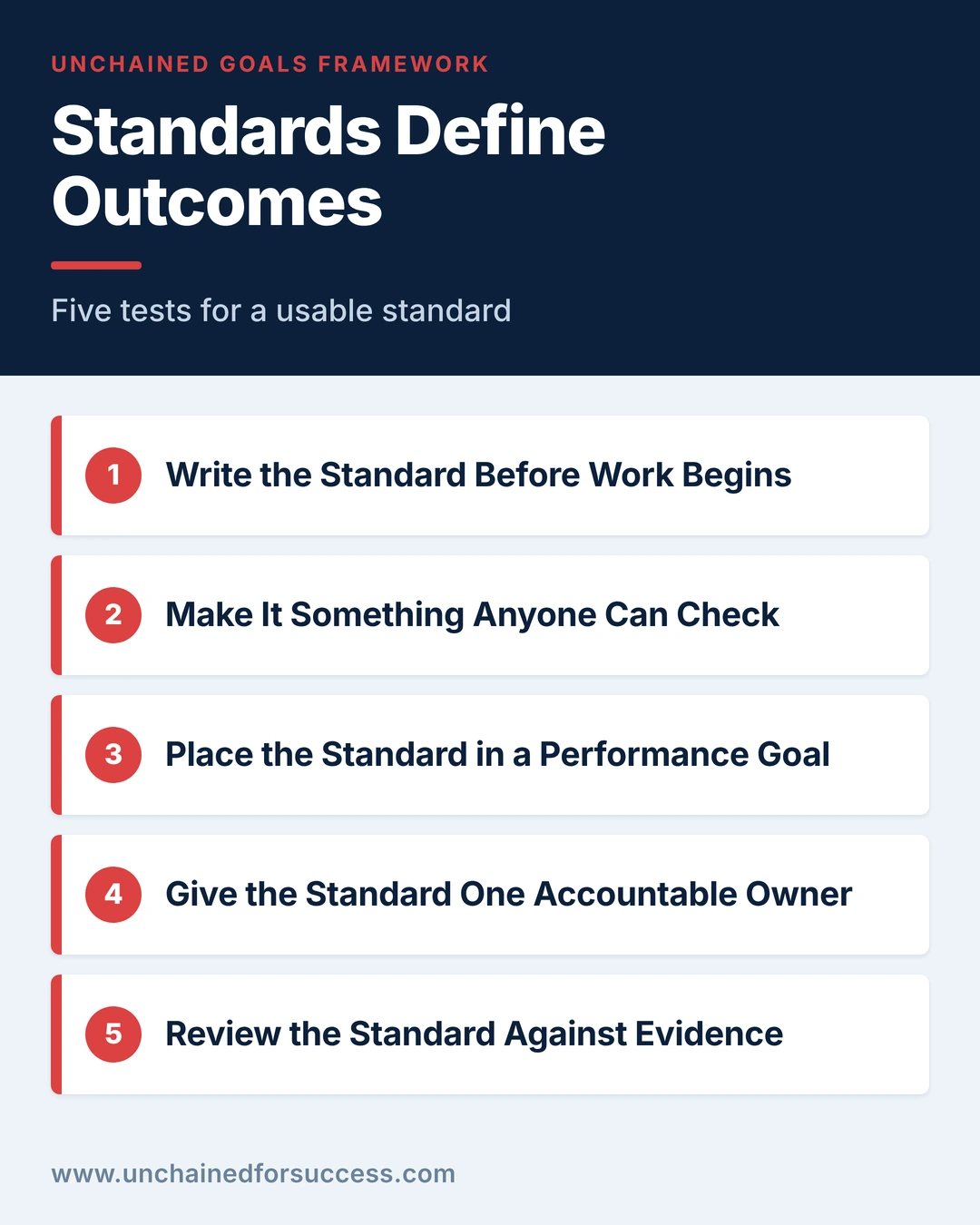
The good news: this takes one page and twenty minutes, not a new system. Here are five tests you can apply this week.
1. Standards Define Outcomes Only Once You Write Them Down
Say a standard out loud and it stays an opinion. Write it and it becomes a test. Written down, someone else can check it too. Use one line, in plain words, kept where the work happens. The SSMTC Goal Design Canvas gives you somewhere to put it. "Every module carries a script, a video under 20 minutes and a worksheet" will do. Above all, write it first, because a standard written afterwards simply describes what you did.
2. Standards Define Outcomes Anyone Can Check
Read your standard back and ask one question. Could two people check this and agree? "High quality" fails that test. "Scores at least four out of five against the checklist, with no critical actions open" passes it. Numbers help, though they are not the only route. A named checklist, a named reviewer and a named limit all work.
3. Place the Standard in a Performance Goal
Place the standard inside the Performance Goal, where the required level belongs. Then identify the Process Goal that should produce that Performance, and the Habit that will keep the Process consistent. If you cannot trace the Process upwards to the Performance standard and the Outcome, it is activity rather than structured execution. That trace also answers what a full week bought, which is the question pushing too hard never answers on its own.
4. Standards Define Outcomes With One Accountable Owner
Every standard needs one name against it. Not a team, not a department: one accountable owner. Separate that role from the review, though. An independent person can judge the evidence. The owner still carries the Outcome. Shared ownership sounds generous. In practice, though, nobody holds the line in the week when holding it costs something.
5. Standards Define Outcomes You Review Against Evidence
Set the review date when you set the standard. Then check two things at each structured goal review. Did the work meet the standard, and does the standard still support the Outcome?
Standards define outcomes over time only if you keep checking them. Do not raise a standard merely because it feels easy. Adjust it when measured Performance shows that the current standard no longer supports the Outcome, or when you have deliberately stretched the Outcome itself. Only wider, repeated and material evidence that Vision no longer serves Purpose should extend the review as far as reassessing Direction.
Apply the Standard as a Team
Teams need one addition, and the team version of the framework sets out the rest.
Publish the standard where the work happens, rather than in a folder nobody opens. Read it aloud when the work starts, and name its accountable owner in the same breath. Standards define outcomes for a team only when everyone can see them. Then ask one question at handover: does this meet the standard we wrote? A team that answers weekly rarely needs a rescue plan later.
Standards Define Outcomes: Frequently Asked Questions
Is a standard the same as a target? No. A target names how much, while a standard names how good.
Both belong in the spine, though they sit in different places. The Outcome Goal states the required result. The Performance Goal carries the operating standard, and that is the half people forget to write.
What if the work is creative and hard to pin down? Then define the conditions rather than the taste.
A creative standard can name the audience, the length, the number of drafts and the reviewer. It does not need to score the beauty of the result. Standards define outcomes by fixing what you will check, not by removing judgement.
Who should set the standard? The person accountable for the Outcome Goal, with input from whoever does the work.
Standards handed down without that conversation get quietly ignored. A standard developed with the people applying it is more likely to be understood and used.
Standards Define Outcomes Before Anyone Starts Work
Many goals begin to fail before the work starts, in the quiet moment when nobody says what good looks like. Effort then fills the gap, and the result becomes whatever effort happened to produce. Standards define outcomes in advance, which is the only place a definition of quality is any use.
So write the line first. It takes five minutes. Name the level, place it in the Performance Goal, give it an accountable owner and set the date you will review it. To see how your own goals are designed, executed and governed, take the Goals Readiness Score. It runs to 18 questions and takes under five minutes.
Share the one standard you are going to write down this week in the comments.
What does "done well" mean in the work you start on Monday?
Sources
- Building a Practically Useful Theory of Goal Setting and Task Motivation: A 35-Year Odyssey by Locke & Latham, American Psychologist
- Jackson and Schuler (1985) Revisited: A Meta-Analysis of the Relationships Between Role Ambiguity, Role Conflict, and Job Performance by Tubre & Collins, Journal of Management
- A Surgical Safety Checklist to Reduce Morbidity and Mortality in a Global Population by Haynes et al., New England Journal of Medicine
- Get It Right Initiative: A Call to Action from the Get It Right Initiative
- Global Indicator: Employee Engagement from Gallup
Continue Your Journey
Explore more resources from the Unchained Goals Framework: