


You set a meaningful goal. You threw everything at it. And somewhere along the way, the thing that was meant to energise you started to drain you. Goal-setting talk often overlooks sustainable success. In short, it means pursuing your purpose and vision at a pace you can actually keep up. Your energy, your health and your relationships stay intact. Ignore it, and you pay for it.
This post looks at what that price really is for individuals, organisations and projects, where sustainable success sits in the Unchained Goals Framework, and how to stop paying it.
What Sustainable Success Actually Means
It is easy to treat achievement as a sprint. Set the goal, push hard, rest later. But a goal that takes years cannot be run as a sprint. A vision worth having is measured in years, not weeks.
Sustainable success means making real progress you can keep making. It does so without slowly wearing down the people, resources or systems you need to carry on. It does not mean working slowly. Nor does it mean avoiding discomfort or removing periods of hard effort.
A goal that stretches you may still need a planned period of extra effort. So the test is simple. Is the push planned, time-limited and properly resourced? Does rest follow? Or has the push become the normal way of working?
That definition rests on three ideas.
The normal working pace must be repeatable. You may sometimes need a big push. But it should be planned, time-limited and followed by planned rest.
The people and systems must keep the capacity to carry on. Health, energy, relationships, skill and shared know-how are not fuel to burn without limit. Instead, they are conditions your plan must allow for and your reviews must protect.
Progress must build on itself rather than depend on repeated rescues. Steady, demanding work is more reliable than heroic bursts, because a burst that ends in exhaustion also spends the momentum it built.
In other words, how you pursue a goal matters as much as the goal itself. That is the part a plan can leave out, and it is exactly where the hidden costs creep in.
The Real Cost of Ignoring Sustainable Success
What happens when we ignore the "how"? The bill arrives in three places.
For Individuals: Sustainable Success or the Burnout Tax
Burnout is not evidence of weak character. The World Health Organization includes it in the 11th revision of the International Classification of Diseases as an occupational phenomenon, not a medical condition. It describes a syndrome resulting from chronic workplace stress that has not been successfully managed, with three dimensions: exhaustion, growing mental distance or cynicism about the job, and reduced professional efficacy.
The WHO applies the term only to work. Outside work, chronic overload can still produce exhaustion, falling engagement and reduced capacity, even though the WHO does not call those experiences burnout.
Here is the cruel irony: highly committed people can be especially at risk, because they may override their own early warning signs. So the cost is not only the goal abandoned. It is also the months of recovery afterwards, and the fear of aiming high again. An earlier post on protecting your health covers the warning signs in more detail.
For Organisations: Sustainable Success or a Quiet Exodus
Companies pay the price in people. In 2018 Gallup surveyed nearly 7,500 full-time employees. Those who said they felt burned out very often or always were 63 per cent more likely to take a sick day and 2.6 times as likely to be actively seeking a different job. They were half as likely to discuss how to approach performance goals with their manager, and they reported 13 per cent lower confidence in their performance.
These are survey findings, and they show a link rather than a cause. Even so, the pattern is clear. A company that chases its mission at a pace it cannot keep does not merely tire its people. It raises the risk of losing them. There is a reputational cost too. Teams talk. As a result, a purpose-driven firm that quietly burns through its staff undermines the very purpose it exists to serve.
For Projects: Sustainable Success Beats the Heroic Sprint
Projects can fail from a pace they cannot keep even when the idea is sound. The pattern is familiar: an energetic start, long hours, and worse decisions as people tire. Then come more errors, more rework, and growing dependence on a few committed people. Momentum stalls as capacity runs out.
The project may not end in a visible crisis. Instead, it can decline slowly as deadlines slip, quality falls and key people disengage. The UK Health and Safety Executive notes that excess workload can slow task performance and lead to errors such as slips, lapses or mistakes. An abandoned project also carries a hidden cost: the people involved may become a little more doubtful about the next one.
Why We Ignore Sustainable Success Anyway
If the costs are this clear, why do we keep paying them? Three reasons stand out.
First, urgency feels like virtue. Busyness is visible; a steady pace is not. Pushing through looks like commitment. Meanwhile, people can mistake a steady pace for a lack of ambition. A related post explains why being busy does not mean progress.
Second, the hustle myth is loud. Popular culture cheers the all-nighter and the relentless grind. It rarely shows the effects on health, judgement and performance.
Third, the costs are delayed. A pace you cannot keep works, at least briefly. The early results reward the very behaviour that later destroys the goal. So by the time the bill arrives, the pattern may have taken hold.
None of these reasons survives contact with a long-term vision. If your goal matters enough to take years, it deserves a way of working that lasts years.
Sustainable Success in the Unchained Goals Framework
In the Unchained Goals Framework, a pace you can keep is not a separate component you add to a goal. Rather, it is evidence that the whole design is working. Four components carry most of the load, and the Control System keeps them under review.
Your Why explains why the goal is worth its cost; it does not justify unlimited cost. Ownership means consciously accepting that cost and the consequences of pursuing the goal within your authority, which you cannot do if the cost was never counted.
Your Plan, the route you will take within the capacity you have, must give a credible path within the capacity you can sustain, after allowing for the other goals and commitments you already carry. And Habit Conversion turns the controllable behaviours into repeatable execution, so that progress depends less on willpower each week.
The Control System, the review routine that compares your agreed measures with their operating range, then does the watching. It only sees what you put on the scorecard. So if capacity is to be protected, define one or two capacity signals as agreed measures with a range and a trigger, next to the measures of progress.
When a measure falls outside its range and meets the trigger you agreed, the response is diagnosis in a fixed order, starting with whether the planned behaviours happened, rather than more effort applied to a structure that is already failing.
Where to Look When Sustainable Success Slips
Once you have checked that the planned behaviours happened, that the Process can produce the required standard and that the Performance measure is valid, work through the supporting layers in order: Plan, Beliefs, Ownership and Why.
Two design questions deserve early attention there. Did the Plan assume capacity that was never there? And did the owner ever accept what holding the goal would cost? Earlier posts on capacity before goals and on the signs you have outgrown your capacity show what each looks like before it becomes a crisis.
How to Build Sustainable Success Into Your Goals
The good news: sustainable success is a set of practices, not a personality trait. Here are five you can start this week.
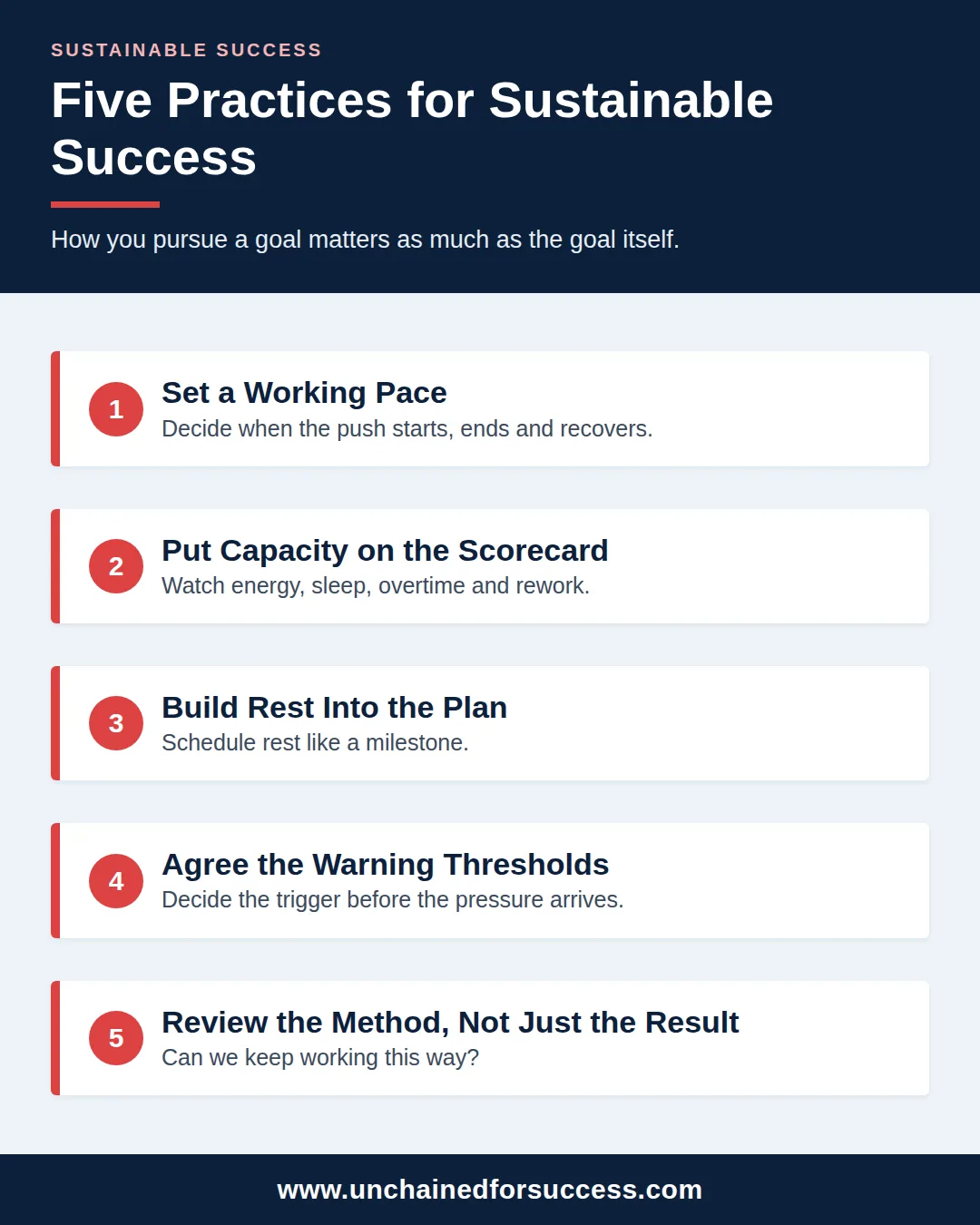
1. Set a Working Pace, Not Just a Deadline
For every goal, define a normal working pace that your time, skill and resources can support. If you know you will need a big push, decide three things: when it will happen, how long it will last, and how you will recover. A deadline without a pace is a wish.
2. Put Capacity on the Sustainable Success Scorecard
If the outcome looks on track while the capacity to carry on is falling, the way you work is becoming unstable. For individuals, useful signals include energy, sleep and consistency. For teams and projects, watch overtime, absence, staff turnover, errors, rework, delayed decisions and dependence on key people.
3. Build Rest Into the Plan
Rest is not merely a reward for finishing; it is one of the resources that keeps execution going. So schedule it with the same care as your milestones. Treat energy management with the same discipline you give your calendar, and design recovery habits that run without a decision.
4. Agree the Warning Thresholds for Sustainable Success
Define the warning signs and thresholds that will trigger a diagnosis. One hard week may not need a full diagnosis. But sustained exhaustion, falling quality, repeated missed Process Goals (the behaviours you committed to) or rising rework should prompt one. Decide the threshold before the pressure arrives, because under pressure the instinct is to push harder.
5. Review the Method, Not Just the Result
In every progress review, personal or shared, ask one extra question: can we keep working this way without slowly weakening the people, resources or systems the goal depends on? If the honest answer is no, review and correct the way you work before capacity falls further. If drift has already set in, here is how to diagnose and recover a drifting year.
Sustainable Success for Teams
For teams and projects, the same five practices apply; the scorecard simply becomes shared. In fact, a team that reviews its capacity alongside its progress is better placed to keep its people and its momentum. It also makes it safer for one person to say that the pace cannot last, before the evidence forces the point.
Sustainable Success: Frequently Asked Questions
Does sustainable success mean lowering my ambition? No. It means matching the pace to the ambition. A goal that stretches you may still need a period of extra effort; the difference is that the push is planned, time-limited and followed by rest, rather than becoming the permanent way of working. The post on growth without burnout draws that line in detail.
How do I tell a healthy push from a pace I cannot keep? Ask the three questions from the definition. Was the push planned? Does it have an end date? And is it properly resourced, with rest to follow? If any answer is no, review the workload and recovery arrangements before assuming the pace can continue, however good the current results look.
What should I do if I am already burning out? Stabilise first: pause decisions you cannot reverse, protect what capacity you have left and the essential activity, and keep the scheduled reviews. Then diagnose in order, starting with whether the planned behaviours are happening, before you change the goal. The post on handling setbacks without losing direction walks through that sequence.
Sustainable Success Is the Choice in Front of You
Every meaningful goal comes with two price tags. One is the effort it truly requires. The other is the needless cost of chasing it at a pace you cannot keep: the burnout, the exodus, the graveyard of stalled projects. You must justify and accept the first. But you should never accept the second as inevitable.
In the end, sustainable success is a question of respect: for your Vision, the long-term position you have committed to, and for the person or team who has to carry it. So choose a pace you can keep. Protect the energy that powers the work. Then your goals stop being things you survive and become things you sustain.
If you want an outside view of how your goals are designed, executed and governed, the Goals Readiness Score is an optional next step: 18 questions, under five minutes.
Share one capacity signal you will add to your next review in the comments.
Which goal are you pursuing in a way that is slowly reducing your capacity to carry on? That is where your review should begin.
Sources
• Burn-out an "occupational phenomenon": International Classification of Diseases, World Health Organization, 28 May 2019
• Employee Burnout, Part 1: The 5 Main Causes by Wigert and Agrawal, Gallup, 2018
• Workload, UK Health and Safety Executive, Human Factors topics
Continue Your Journey
Explore more resources from the Unchained Goals Framework: