


June puts an honest question to the goals you set in January. Some are moving. Others have quietly stalled. A mid-year goal review exists to answer one question about each of them: persist, or change direction.
That question often gets answered through frustration, fatigue or instinct rather than evidence. This post replaces the guesswork with a mid-year goal review you can apply to any goal this week.
Why a Mid-Year Goal Review Matters
Six months is long enough to reveal a pattern and short enough to act on it, which is what makes a mid-year goal review worth the hour it takes.
You now hold real evidence: what you have done, what you have avoided, and where momentum drained away. Sometimes a stall reflects stretched capacity rather than a wrong goal, a pattern covered in Outgrown Your Capacity.
The earlier post on reviewing your goals and resetting the plan covered how to reassess each goal. This one takes the next step, because every honest correction eventually comes down to one choice.
The midpoint also carries a risk. Tiredness and disappointment push people toward two opposite errors. Either they abandon a sound goal too early, or they defend a failing plan far too long.
A structured mid-year goal review protects against both, because it turns a mood into a judgement.
Persistence and Stubbornness Can Look the Same From Outside
Both involve holding on under pressure. They come from opposite places.
Persistence keeps the destination and upgrades the route. You stay committed to the goal while improving the method.
Stubbornness defends the route even as it leads nowhere. You protect a failing plan because changing it would mean admitting it failed.
This is where capable people lose months. They mistake loyalty to a plan for commitment to a goal, then pour more time and money into an approach the evidence already rejected.
So a mid-year goal review does not ask whether you are committed. It asks what you are committed to.
What the Evidence Says About Holding On
Both sides of this have evidence, and both come with limits worth stating.
Why Sticking With a Failing Plan Feels Right
In a 1976 experiment, 240 business undergraduates acted as a company's finance director, deciding how to allocate research funding across two divisions. Half had made the earlier allocation themselves. The other half inherited it from a predecessor. Crossed with that, the division they had backed either improved or declined further.
Commitment to the original course ran highest in one specific cell: where the person had made that choice themselves and it had since gone badly (Staw, 1976).
Read the condition carefully. Responsibility on its own was not sufficient: the study found no reliable escalation from it, which is not the same as showing it has none. Escalation appeared where personal responsibility met bad news, and the significant result was that interaction. This was also a hypothetical paper allocation by undergraduates, so carry the mechanism across rather than the size.
Writing in Harvard Business Review, Vermeulen and Sivanathan make a parallel argument about organisations, where sunk costs and personal identification keep failing strategies alive (2017). That is a practitioner argument rather than a study, and it addresses organisational strategy, not personal goals.
Why Holding On Is Sometimes Correct
The other side carries evidence too. Duckworth and colleagues found that grit, defined as perseverance and passion for long-term goals, predicted achievement beyond talent across six studies, including 1,218 and 1,308 West Point cadets and 175 Scripps spelling bee finalists (2007).
Temper that with the review that followed. Across 88 separate samples and more than sixty-six thousand people, grit's link to performance turned out to be modest, and it overlapped so heavily with conscientiousness that the two are close to the same thing (Credé, Tynan and Harms, 2017).
The two halves of grit also behave differently. Sticking at the effort carried most of what the idea is worth. Keeping the same interests year after year carried very little. So the useful half is the effort, and persistence is no licence to grind on regardless.
How the Framework Decides: Persist or Change
The Unchained Goals Framework has nine components, and a mid-year goal review works through them in order. The framework does not ask whether you feel motivated today. It asks which part of the goal system is failing.
Does the Goal Still Belong to You?
Purpose comes first, as the foundational constraint. It is the problem you accept responsibility for, and it decides which goals are legitimate. If a goal no longer belongs to that problem, no amount of effort makes it worth finishing.
Vision tests trajectory. Purpose defines the domain; Vision is the long-term position you hold within it. A goal that no longer fits that position is a candidate for change, whatever it has already absorbed.
Goals examine the target itself. Revisit SSMTC: is the Outcome still Stretched, Specific, Measurable, Time-bound and Under your control? A goal leaning on factors outside your control is a direction problem rather than a discipline one, as stretch goals sets out.
Is the Goal Structurally Sound?
Why, Ownership, Beliefs and Plan do not move a goal forward. They keep it from collapsing when the cost becomes real, and a mid-year goal review is incomplete without them.
Why is the justification for the cost: whether this outcome is still worth its specific price.
Ownership is the decisive component here. It is the conscious acceptance of the cost and the consequences of pursuing the goal, inside what you actually control. Genuine ownership makes persistence powerful, because you improve the method instead of defending it. It also makes a change of direction clean, because you stop paying for sunk costs out of pride.
Beliefs come next, and they can disguise themselves as strategy. "I never quit" keeps a failing plan alive. "This will never work" kills a sound one early.
Plan is where many persistence decisions are actually settled. The goal can be right while the plan needs rebuilding. A weak plan looks exactly like a wrong goal until you redesign it.
What Carries It Through Execution?
Habits are the final execution test. Ask whether the critical behaviour has stabilised through repetition, so that execution depends less on fluctuating motivation than it did in January.
The Control System governs all of it. It reviews measured Performance at defined cadences and triggers a response when results move outside the agreed range. If your review is happening in June because you finally noticed, that is itself a finding about this component.
A Mid-Year Goal Review in Practice: Three Examples
Three short illustrations of a mid-year goal review, one per scale. None is a client case.
Individual: persist. A professional wants a promotion and has not received one. Her review finds the real fault in her own goal design: a promotion is granted by other people, so it fails the last of the five tests above. It is not hers to control.
So she keeps the ambition and redesigns the Outcome into something she can deliver through her own actions: completing two defined pieces of work inside her own remit and submitting a documented case for promotion by the year end. Every part of that is hers to do. The promotion stays as the hoped-for consequence.
Her review then shows steady skill growth and weak visibility, which is a Plan fault, so she keeps the redesigned goal and changes the method.
Business: change. A founder's product has struggled for a year. Customers are polite and rarely return, and the market has shifted. Here the goal itself is the issue rather than the effort. He changes direction, keeping the purpose of serving those customers while building something different.
Project: persist. A team is running behind on a critical delivery. The objective still matters, but priorities keep shifting and focus is fragmented.
Shifting priorities is not an execution fault, and calling it one skips the diagnosis. Nobody holds the authority to refuse new work, so this is Ownership, with a Plan that was never protected against it. The team names a single owner for the commitment list, gives that owner the authority to refuse, and rebuilds around fewer commitments.
What a Mid-Year Goal Review Decides: Persist or Change
A mid-year goal review starts with one question: does the destination still deserve the rest of the year? The answer then resolves into one of the four decisions set out above. Persist when the destination is right and the route needs improving. Four signals line up: the goal still serves your Purpose, the Why still holds, some progress is visible, and the main obstacle is consistency rather than the goal itself.
Change direction when the destination no longer deserves the cost. Any one of three signals is enough to force that question: the goal no longer fits your Vision, new information has changed the picture, or the outcome depends on things outside your control.
A failed plan is not on that list, and putting it there is the most common way a sound goal gets abandoned. A plan that has been properly tested and has not worked is a signal to rebuild the plan. It becomes a direction signal only when the rebuilt plan fails too, or when no plan you could actually run would get you there.
Changing direction on those grounds is not failure. It is a deliberate reallocation of time and energy, and a mid-year goal review exists to make that call on evidence rather than mood.
A Mid-Year Goal Review Has Four Outcomes, Not Two
Persist or change is the question. It is not the whole answer, because "change" covers three different decisions and they are not interchangeable.
1. The goal holds and execution has slipped. Keep the goal and repair the habit or the plan.
2. The goal holds and the method has failed a fair test. Keep the goal and try a different method.
3. The result still matters, but the target is wrong or it depends on things you do not control. Redesign the Outcome Goal.
4. The goal no longer serves your Purpose or Vision, or the cost is no longer justified. Retire it and move the resources.
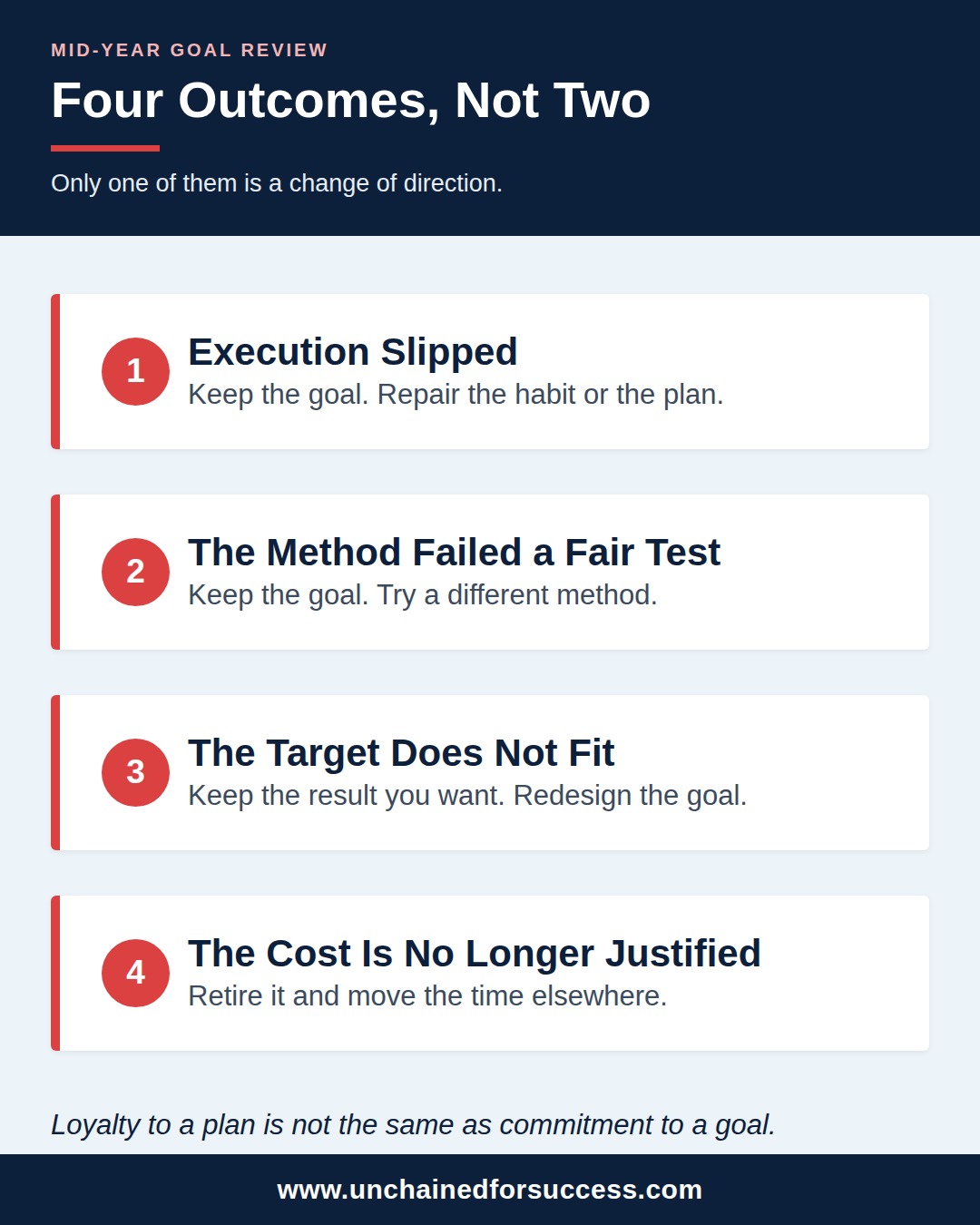
Only the fourth is a change of direction. The middle two are the ones people mistake for it, and that mistake is what costs a sound goal its second half of the year.
Your Mid-Year Goal Review Checklist
Work through these questions for each goal, and be honest, because the value of a mid-year goal review lies entirely in its honesty.
5. Purpose. Does this goal still belong to the problem I accepted responsibility for?
6. Vision. Does it still fit the long-term position I am holding?
7. Goals. Does the Outcome still meet SSMTC: Stretched, Specific, Measurable, Time-bound and Under my control?
8. Why. Is this outcome still worth its specific price?
9. Ownership. Am I still willing to carry the cost and the consequences that are actually mine?
10. Beliefs. Is an assumption distorting my verdict in either direction?
11. Plan. Have I genuinely tested the plan, or only judged the goal?
12. Habits. Has the critical behaviour stabilised, or does it still run on willpower?
13. Control System. Would I have caught this drift earlier with a defined review cadence and trigger?
14. Decision. On the evidence, do I persist or change?
Common Mistakes in a Mid-Year Goal Review
Five traps catch careful people in a mid-year goal review.
Treating effort as evidence. Hard work proves commitment, not direction. A goal can absorb enormous effort and still be wrong.
Confusing a plan with a goal. When results disappoint, people scrap the whole goal when only the plan needed rebuilding. Test the plan first.
Letting sunk costs decide. You cannot recover time and money already spent, so neither should drive the choice.
Reviewing in a low moment. A bad week is not a fair judge of a year. Choose a calm, rested moment, which is part of what makes the mid-year reset worth scheduling rather than improvising.
Reviewing without deciding. A review that ends in a vague intention to keep going changes nothing. Close it with a choice.
Frequently Asked Questions
What if the answer is genuinely unclear? Then the plan has probably not had a fair test yet, and that is your answer for now. Set one defined trial with a date and a standard, and let the result decide rather than your mood in three weeks.
Can a mid-year goal review end in both persisting and changing? You can keep the Outcome and replace the Plan, which is what persistence means in practice. What you cannot do is hold both the goal and the failing method and call it commitment.
How is this different from getting a drifting year back on track? This review asks whether the goal still deserves the second half of your year. Recovery asks which layer broke and repairs it. Decide first, then diagnose.
So here is the question worth sitting with, and the comments are open if you want to answer it.
Which goal will your mid-year goal review show you are carrying out of loyalty to the plan rather than commitment to the outcome?
If you would like an outside view of how your goals are designed, executed and governed, the Goals Readiness Score scores each of the nine components separately and names the weakest one. The SSMTC Goal Design Canvas and the Control System Dashboard are both free.
Sources on the Mid-Year Goal Review
- Staw, B. M. (1976). Knee-deep in the Big Muddy: a study of escalating commitment to a chosen course of action. Organizational Behavior and Human Performance, 16(1), 27 to 44. https://doi.org/10.1016/0030-5073(76)90005-2 One experiment, a two-by-two between-subjects design, 240 business undergraduates with 239 analysed, hypothetical paper allocations. The escalation effect was the interaction, F(1,235) = 5.56, p < .019.
- Vermeulen, F., and Sivanathan, N. (2017). Stop doubling down on your failing strategy. Harvard Business Review, 95(6), November to December 2017, reprint R1706H. https://hbr.org/2017/11/stop-doubling-down-on-your-failing-strategy A practitioner article rather than empirical research. Page numbers are omitted because library records and the printed pagination disagree.
- Duckworth, A. L., Peterson, C., Matthews, M. D., and Kelly, D. R. (2007). Grit: perseverance and passion for long-term goals. Journal of Personality and Social Psychology, 92(6), 1087 to 1101. https://doi.org/10.1037/0022-3514.92.6.1087
- Credé, M., Tynan, M. C., and Harms, P. D. (2017). Much ado about grit: a meta-analytic synthesis of the grit literature. Journal of Personality and Social Psychology, 113(3), 492 to 511. https://doi.org/10.1037/pspp0000102 584 effect sizes from 88 independent samples, 66,807 participants. Grit against academic performance rho = .18; against conscientiousness rho = .84. Facets: perseverance of effort rho = .26, consistency of interests rho = .10.
- Kwegyir-Afful, C. (2023). Unchained: Success Unlocked: A Proven Framework for Achieving Your Goals.
Continue Your Journey
Explore more resources from the Unchained Goals Framework: