Why Consistency Fails: Even With Good Intentions

Why consistency fails; is usually not about effort
Why consistency fails; is a question many people quietly ask themselves after a strong start begins to fade. They set clear goals, make sincere commitments, and genuinely want to follow through. Yet, within weeks, the behaviour becomes irregular or disappears altogether.
At first, it is tempting to blame motivation, discipline, or lack of commitment. However, that explanation is often too shallow. In most cases, the real issue is not desire. It is design.
Consistency rarely fails because people do not care. It fails because the system supporting the behaviour is too weak to survive normal life.
Why consistency fails without a reliable system
Many people treat consistency as if it were a personality trait. They assume some people are naturally consistent while others are not. In practice, consistency is usually the result of structure.
When behaviour depends on daily willpower, it becomes unstable. Each action has to be re-decided, re-justified, and re-started. As a result, small interruptions quickly become broken routines.
A reliable system changes that. It reduces the number of decisions required. It makes the next step clear. It lowers the effort needed to begin.
This is one reason why consistency fails for so many people. They rely on intention, but they do not build a structure strong enough to carry that intention forward.
Why consistency fails even with good intentions
Good intentions matter, but they do not create repetition on their own.
For example, someone may intend to:
- train four times a week,
- write every morning,
- review finances every Sunday,
- or complete key project tasks before the week becomes reactive.
Those intentions are genuine. Nevertheless, if there is no fixed trigger, no protected time, and no simplified starting point, the action competes with everything else. Eventually, urgency wins.
That is why consistency fails even when people mean well. Intention sets direction, but structure determines whether behaviour survives pressure.
Habits reduce the decisions that break consistency
Habits matter because they reduce friction.
When a behaviour is tied to a clear trigger and repeated in a predictable context, it becomes easier to start. Over time, less mental effort is required. This is important because inconsistency often begins long before failure. It starts when actions become negotiable.
For example:
- going to the gym immediately after work removes the daily debate,
- writing at the same desk at the same time creates rhythm,
- reviewing priorities every Monday morning reduces drift before the week takes over.
In other words, habits reduce the number of moments where behaviour can be abandoned.
This blog builds naturally on How to Build Habits That Actually Stick, because habit design is one of the strongest answers to the question of why consistency fails.
Why process beats motivation over time
Motivation can help people begin. It cannot be trusted to keep them going.
Motivation rises and falls. It is affected by stress, sleep, pressure, workload, and emotion. Therefore, any system that depends too heavily on motivation will eventually become unstable.
Process works differently. A process tells you what to do, when to do it, and how to begin, which aligns with research on implementation intentions by Gollwitzer (1999)
That is why process goals matter so much. They shift the focus away from mood and back to action. Instead of asking, “Do I feel ready?”, the person asks, “What is the next step?”
This is also why process goals are central to meaningful execution. If you want long-term consistency, the process must be clearer than the emotion of the day.
How to remove friction from daily execution
Friction is one of the most overlooked reasons why consistency fails.
Friction appears in simple forms:
- the task is unclear,
- the first step is too big,
- tools are not prepared,
- timing is inconsistent,
- the behaviour takes too much effort to start.
As a result, behaviour that seems small becomes difficult to repeat.
Reducing friction is often more effective than increasing pressure. For instance:
- prepare gym clothes the night before,
- decide the exact writing topic before the session,
- place your review document where it is immediately visible,
- schedule recurring actions before the week fills up.
These changes may look minor. However, they change the likelihood of repetition significantly.
A practical example of why consistency fails
Take someone who wants to exercise regularly.
Their intention is good. Their goal is clear. They may even be highly motivated in January. Yet, by March, the routine has become inconsistent.
Why?
Usually, it is not because they suddenly stopped valuing health. More often:
- they did not choose a fixed training time,
- they relied on “when I get time”,
- they made starting too difficult,
- or they failed to connect the habit to a stable routine.
The problem is not the goal. The problem is the design around the goal.
This same pattern appears in business, projects, finances, and personal development. People often know what matters. What they lack is a repeatable system strong enough to survive normal life.
How to build a system that makes consistency easier
If you want to solve the problem of why consistency fails, build for repetition, not intensity.
A stronger system usually includes:
- one clearly defined behaviour,
- one consistent trigger,
- one realistic time or context,
- one way of tracking completion,
- and one simplified first step.
This approach is especially powerful because it removes emotional negotiation. The behaviour becomes part of a designed routine rather than a hopeful ambition.
That is also why this article connects strongly with How Process Goals Turn Effort Into Results. Process protects action when energy and enthusiasm change.
Why consistency fails less when progress is visible
People persist more easily when progress can be seen.
Visible progress:
- reinforces effort,
- strengthens self-trust,
- and reduces the temptation to quit too early.
This does not require complex tracking. A simple checklist, calendar mark, notebook, or progress board is often enough. What matters is that repeated action becomes visible.
When effort disappears into memory, consistency becomes harder to sustain. When effort leaves evidence, consistency becomes easier to protect.
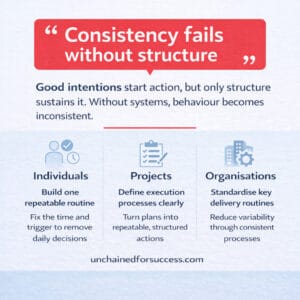
Conclusion: consistency is a design issue
Why consistency fails is not a mystery. In most cases, it is a design problem.
Good intentions are valuable, but they are not enough. Motivation helps, but it is unstable. What makes the difference is structure: clear habits, simple processes, reduced friction, and visible progress.
When those elements are present, execution becomes easier. When they are absent, consistency starts to break down, even when the goal still matters.
If you want more consistent results, do not ask only whether the goal is good. Ask whether the system around it is strong enough to survive real life.
A practical next step
Choose one important behaviour that keeps breaking down.
Then define:
- the exact action,
- the exact trigger,
- the exact time or context,
- and the simplest possible starting point.
That one change will usually do more than another burst of motivation.
If you want to work through that process in a more structured way, this is exactly the kind of issue we unpack in the Goals Design & Execution Workshop, where the focus is not just on setting goals, but on designing execution that lasts.
References
- Clear, J. (2018).Atomic Habits: An Easy & Proven Way to Build Good Habits & Break Bad Ones. London: Penguin Random House.
- Gollwitzer, P. M. (1999). ‘Implementation intentions: Strong effects of simple plans’.American Psychologist, 54(7), pp. 493–503.
- Lally, P., van Jaarsveld, C. H. M., Potts, H. W. W. and Wardle, J. (2010). ‘How are habits formed: Modelling habit formation in the real world’.European Journal of Social Psychology, 40(6), pp. 998–1009.
- Harvard Business Review(2020). ‘To Build Habits That Stick, Start with Tiny Behaviours’. Available at: https://hbr.org (Accessed: 2026).
- Duhigg, C. (2012).The Power of Habit: Why We Do What We Do in Life and Business. New York: Random House.
- Kwegyir-Afful, C. (2023).Unchained: Success Unlocked – A Proven Framework for Achieving Goals. Unchained for Success.