Saying No Strategically: The Key to Real Progress

Introduction
Saying no strategically is the discipline most ambitious people never learn, and it is the one that most reliably separates those who deliver meaningful goals from those who remain permanently busy. It is not a personality trait. It is not a mood. It is a design decision applied under pressure.
Most people who struggle to make real progress are not lazy. They are overcommitted. They have a goal worth pursuing, a plan worth following, and the ability to deliver. Yet week after week, the work that matters most gets pushed aside by everything else that feels urgent, reasonable, and hard to refuse.
This is the April Series Finale of our series on Focus, Trade-Offs, and Strategic Choice. In How Trade-Offs Create Progress, we established that every meaningful result requires a deliberate choice. In The Hidden Cost of Yes, we examined how unchecked agreement quietly erodes the execution those choices depend on. This week, we close the series by looking at saying no as the active discipline that protects the architecture of meaningful achievement.
Why Saying No Strategically Matters
Saying no is not about being difficult. It is about being directed.
The problem for most ambitious people is not a shortage of effort or ideas. It is a shortage of boundaries. They have more opportunities than they can honour, more requests than they can absorb, and more commitments than their best work can survive. So they run hard, spread thin, and wonder why the most important things keep finishing last.
Every yes carries a hidden cost. It claims time. It consumes mental space. It creates obligations that generate further obligations. And it often pulls you into work that was never part of the plan and is difficult to undo once started.
One extra commitment, taken alone, looks harmless. Accumulated across weeks and months, those small yeses quietly dismantle the structure that sustained progress depends on.
Sull, Homkes and Sull studied this pattern directly in their research for the Harvard Business Review on why strategy execution unravels. Across more than 400 companies, they found that execution does not fail from insufficient effort. It fails because priorities become scattered and focus is never properly protected.
That finding holds just as true for individuals and project teams as it does for large organisations. Real progress requires concentration. It requires your best effort going to the right things, consistently, over time. That does not happen by accident. It happens by design.
What It Actually Costs to Say Yes When You Should Not
Before looking at what saying no strategically builds, it helps to see clearly what the absence of it destroys.
Consider a programme director leading a complex regulatory change across four business units. Midway through delivery, a senior stakeholder invites her to co-lead a separate working group on a related but distinct topic. The ask is flattering. The relationship matters. The work is genuinely interesting.
She says yes.
Over the following six weeks, the working group absorbs two afternoons a week, two of her most capable team members, and most of her political capital with the executive sponsor. The original programme does not collapse. But it drifts. Deadlines begin slipping by days, then weeks. The quality of the core deliverables drops in ways that are hard to recover from.
Six months later, the working group produces a report that is quickly shelved. The programme delivers, but well below its original standard. The director spends the following quarter managing the consequences.
The working group was not a bad idea. It was a yes at the wrong time, to the wrong thing, for understandable but structurally expensive reasons.
This is what the absence of saying no strategically actually costs. Not a dramatic failure. A quiet erosion of the thing that mattered most.
Saying No Strategically as a Design Decision
At its core, saying no strategically is a question of deliberate control. It asks a single question: who is deciding how my time, attention, and delivery capacity are spent right now?
Every yes is a silent no to something else. When you agree to a meeting that does not move your goal forward, you have quietly cancelled the deep work that would have. When you absorb a task that belongs to someone else’s priorities, you have postponed your own. When you say yes to the interesting but misaligned opportunity, you have said no to the focused execution your plan depends on.
This is not about being unhelpful or withholding. It is about recognising that strategic focus is not the absence of generosity. It is the presence of design discipline.
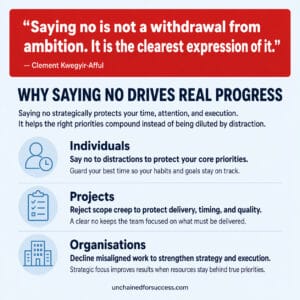
Saying no is not a withdrawal from ambition. It is the clearest expression of it.
The Unchained Goals Framework, developed in Unchained: Success Unlocked by Clement Kwegyir-Afful, treats meaningful goal achievement as a design problem, not an emotional one. The framework orders its components into a defined sequence where each layer has explicit inputs, explicit outputs, and an explicit position in the architecture. Saying no strategically is one of the primary mechanisms that holds that architecture in place when pressure mounts.
How Saying No Strategically Protects the Unchained Goals Framework
The Unchained Goals Framework is a structured architecture arranged in a defined sequence. Its components are ordered from the foundational layer outwards: Purpose, Vision, Goals, Why, Ownership, Beliefs, Planning, and Habit Conversion. Each layer has a defined role, and each depends on the integrity of the layers around it.
Saying no strategically protects that architecture at every layer where pressure typically causes drift.
It protects the Goal from dilution. When you keep accepting competing commitments, your primary goal loses its central position. It becomes one of many priorities rather than the priority. The goal does not disappear. It stops receiving the sustained attention it needs to move.
It protects the Why from erosion. Your justification for pursuing a goal loses its stabilising power when it is constantly overridden by requests that feel urgent but are not aligned. A disciplined no keeps your reasoning clear and accessible, especially when pressure rises.
It protects Ownership from becoming assumed rather than explicit. In the framework, ownership is the structural point where intention converts into responsibility under cost. Every yes you give to work that is not yours to carry quietly transfers ownership of someone else’s priorities onto your shoulders and weakens your ability to own what genuinely matters.
It protects the Plan from overload. A plan that is constantly revised to absorb new additions stops functioning as a plan. It becomes a record of what people asked for rather than a guide to what you decided mattered.
It protects Habit Conversion from disruption. Consistent habits are the mechanism by which effort stabilises into repeatable execution. Every misaligned interruption weakens the rhythm those habits depend on. Habits that are repeatedly broken do not compound. They restart.
Reflection: Which of these layers is most at risk in your current goal? That question is worth sitting with before you move on.
For a deeper look at how focus holds this architecture together under pressure, see Why Focus Drives Results and Busyness Doesn’t.
These protections become clearer when you see saying no strategically applied in practice.
Three Examples of Saying No Strategically in Practice
Individual: The Manager and the Qualification
A senior manager was working towards a chartered management qualification while leading a team of twelve. Each week brought new invitations: optional steering groups, mentoring requests, cross-functional task forces, social committees. Every one of them was legitimate. Any one of them, accepted without thought, would have cost her four to six hours she could not spare.
She drew a clear line. No meetings where she was not a decision maker. No mentoring requests outside her immediate team. No cross-functional work that could be delegated. Yes to her qualification module each morning before her inbox opened.
Twelve months later, she passed with distinction. Her team reported higher satisfaction scores than the previous year. She had not retreated from her organisation. She had redirected her best time to where it compounded most.
Business: The Consultancy That Chose One
A specialist consultancy was offered three new client engagements in a single quarter. Each looked commercially attractive. The leadership team applied one question before responding to any of them: does this client and this project align with the positioning we are building for the next three years?
One did. Two did not. They accepted one and declined two, explaining their reasoning clearly and without apology.
Six months later, the accepted engagement had generated two strong referrals, a compelling case study, and an invitation to tender for a larger follow-on piece. One of the declined engagements had ended in a contractual dispute with the firm that took it on.
Saying no was not a loss of revenue. It was a protection of direction and reputation.
Project: The Programme Manager Who Held the Line
A programme manager was delivering a compliance change across five regulated departments with a hard statutory deadline. Eight weeks from go-live, two senior stakeholders submitted scope additions. Both were reasonable ideas. Neither was within scope. Neither could be absorbed without risk to the deadline.
She said no to both. She logged the requests formally for a planned phase two and kept the team focused on the core deliverable.
The programme went live on schedule, meeting its statutory deadline in full. Phase two was scoped and resourced properly three months later. Had she said yes midway through delivery, the compliance deadline would have been missed, carrying significant regulatory and reputational risk for the organisation.
The no was not a refusal to help. It was a refusal to fail.
The Unchained Focus Filter: Five Questions Before You Say Yes
You do not need a complicated system to practise saying no strategically. You need a simple, consistent filter you will actually use in the moment before you respond.
Before accepting any new request, opportunity, or commitment, pause and ask five questions:
- Does this move my main goal forward?
- If I accept this, what am I implicitly promising beyond the obvious?
- Does this support my daily process or disrupt it?
- What will this cost in time, attention, or consistency?
- What important thing am I indirectly saying no to if I accept this?
That fifth question is often the most revealing. Many weak decisions survive only because their real cost stays invisible until the damage is already done.
Once you have worked through the filter, respond with clarity. A short, respectful no closes the conversation without damage to the relationship. A long, apologetic explanation invites renegotiation and signals that the boundary is negotiable. A clear, warm no protects both the relationship and your focus at the same time.
Four Mistakes People Make When Learning to Say No
Even people who understand the value of saying no strategically often apply it poorly at first. These four mistakes appear most consistently.
The delayed no. Agreeing in the moment and withdrawing later costs more energy and more credibility than a clean no at the outset. It creates disruption, signals unreliability, and wastes the time of everyone involved. If the answer is no, give it early and clearly.
The apologetic no. Wrapping a no in excessive justification is an invitation to negotiate. You do not owe anyone a detailed defence of your priorities. A direct, respectful no is a complete and sufficient answer.
The inconsistent no. Declining a request this week and accepting the same type of request next week tells people that your boundaries are negotiable. Over time, this teaches others to keep asking and to expect eventual compliance. Consistency is what gives strategic focus its credibility.
The total no. Swinging from saying yes to everything to saying no to everything is not discipline. It is a reaction. The goal is a principled, selective no, grounded in a clear framework, not blanket refusal that damages relationships and closes doors that genuinely matter.
Sull, Sull and Yoder found in their Harvard Business Review research on setting strategic priorities that leaders who decline without a clear rationale lose credibility with their teams. Leaders who decline from a clear, communicated strategic position earn deeper trust and stronger results. The Unchained Focus Filter is what provides that rationale.
Conclusion
Saying no strategically is not encouragement. It is architecture. It is the discipline that holds the integrity of your goals in place when everything around you is asking for a piece of your attention.
Every meaningful goal needs protection. Your time, attention, and delivery capacity are finite. The moment you stop deciding where they go, everything else will decide for you. What fills that space is rarely your best work. It is almost always someone else’s priorities.
Real progress does not come from doing more. It comes from designing the architecture that allows the right things to compound, and then defending that architecture consistently under pressure.
Do not only review what you need to start. Review what you need to stop accepting. That is often where real progress begins.
Next week we open a new series on Growth Without Burnout, starting with why growth feels uncomfortable before it feels rewarding. The two themes are more connected than they appear.
Progress is not protected by ambition. It is protected by the courage to say no.
Ready to Take Action?
Before the end of today, identify one commitment on your calendar or task list that is not serving your main goal. Run it through the Unchained Focus Filter. If it does not pass, say no to it this week. Then take the time, attention, or energy you have just recovered and invest it directly into the one process that matters most to your progress right now.
Real change begins the moment a vague no becomes a specific one.
If this article helped you, share it with someone who is busy but not yet moving. For the complete framework, get your copy of Unchained: Success Unlocked by Clement Kwegyir-Afful at unchainedforsuccess.com.
Follow #UnchainedForSuccess and www.unchainedforsuccess.com for more practical insights on achieving meaningful goals.
Saying no is not a withdrawal from ambition. It is the clearest expression of it.
— Clement Kwegyir-Afful, Unchained: Success Unlocked
#UnchainedForSuccess #StrategicFocus #GoalFramework #SayingNo #Leadership #Productivity #GoalSetting
References
- Kwegyir-Afful, C. (2023). Unchained: Success Unlocked – A Proven Framework for Achieving Your Goals. London: Unchained for Success.
- Kwegyir-Afful, C. (2026). “How Trade-Offs Create Progress.” Unchained for Success, April. Available at: https://unchainedforsuccess.com/trade-offs-create-progress/
- Kwegyir-Afful, C. (2026). “The Hidden Cost of Yes Is Bigger Than You Think.” Unchained for Success, April. Available at: https://unchainedforsuccess.com/cost-of-yes/
- Kwegyir-Afful, C. (2026). “Why Focus Drives Results and Busyness Doesn’t.” Unchained for Success, April. Available at: https://unchainedforsuccess.com/focus-drives-results/
- Sull, D., Homkes, R. and Sull, C. (2015). “Why Strategy Execution Unravels and What to Do About It.” Harvard Business Review, March. Available at: https://hbr.org/2015/03/why-strategy-execution-unravels-and-what-to-do-about-it
- Sull, D., Sull, C. and Yoder, J. (2017). “A Better Way to Set Strategic Priorities.” Harvard Business Review, 7 February. Available at: https://hbr.org/2017/02/a-better-way-to-set-strategic-priorities