How to Build Habits That Stick
Introduction
How to build habits is a question many people ask when motivation fades and good intentions fail to become daily action. Most people do not struggle because they lack ambition. They struggle because the habit was never built to survive normal life. It was too big, too vague, or too dependent on feeling inspired.
That is why some habits begin with energy and end within days, while others quietly become part of a person’s life. Lasting habits are not built on excitement alone. They are built on structure, repetition, and clarity.
In the Unchained Goals framework, goals are not achieved by desire alone. They are achieved through a system. Habits are part of that system. They are the repeated process actions that carry a meaningful goal forward. Without them, the goal remains an intention rather than an outcome.
If you want real progress, you need more than a strong start. You need a habit that can hold firm on ordinary days.
Why Learning How to Build Habits Matters
People often miss goals because they are inconsistent in the small things, not because the goal itself was wrong. They know what they want, but they do not have a repeatable process that keeps them moving when energy is low, life is busy, or distractions rise.
This is why habits matter. A habit reduces the number of decisions you need to make. Instead of asking yourself every day whether you feel ready, you create a pattern that makes action easier and more natural.
Over time, repeated behaviour in a stable context becomes easier to perform. That matters because most people do not fail for lack of information. They fail because intention never becomes routine.
A good habit closes that gap.
How to Build Habits That Stick
If you want to know how to build habits that stick, begin with a habit that is easy to start, clear to follow, and worth repeating. Lasting habits are not built by intensity. They are built by repeatability.
Start With a Clear Outcome
A habit should support something meaningful. If there is no clear outcome behind it, the habit becomes easy to ignore.
For example, “I want to get fit” is vague. “I want to improve my fitness so I have more energy, protect my health, and stay strong for the future” is far clearer. The second statement gives the habit a reason to exist.
This is where the why matters. When a habit is connected to a meaningful goal, it becomes more resilient. It is no longer a random act of self-improvement. It becomes part of a wider direction.
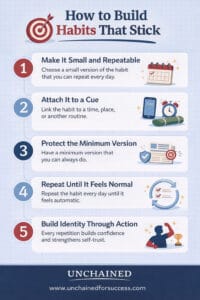
Make the Habit Small Enough to Repeat
One of the biggest reasons habits fail is that people start too big. They choose a version of the habit that only works under ideal conditions. Then, as soon as pressure rises, the habit breaks.
A better approach is to start smaller than your ambition. Small habits are easier to repeat, and repetition is what builds strength over time.
Instead of saying, “I will read for one hour every night,” begin with, “I will read two pages after dinner.” Instead of saying, “I will train six days a week,” begin with, “I will do ten minutes of movement on Monday, Wednesday, and Friday.”
Small does not mean weak. It means sustainable.
Attach the Habit to a Clear Cue
Habits stick more easily when they are linked to a reliable cue. A cue is the trigger that tells your mind and body it is time to act. That cue may be a time, a place, or another routine that already happens.
For example:
- after brushing your teeth, stretch for two minutes
- after dinner, review tomorrow’s priorities
- when you sit at your desk, write your top task before opening emails
Without a cue, a habit relies too much on memory and willpower. With a cue, it has a consistent starting point.
Define the Minimum Version
This is one of the most practical ways to protect consistency.
Every habit should have a minimum version that you can still complete on a poor day. The minimum version stops you from thinking that if you cannot do the full version, there is no point doing anything.
Examples include:
- write one paragraph
- walk for five minutes
- read one page
- review one line of your plan
- do one set of an exercise
The minimum version is not the target. It is the floor. It keeps the habit alive and protects your self-trust.
Repeat Until It Feels Normal
At the start, a new habit often feels unnatural. That is normal. Many people quit too early because they expect a habit to feel automatic after a few days.
In reality, most useful habits feel deliberate at first. That does not mean they are failing. It means they are still new.
Keep repeating the behaviour. In many cases, consistency comes first and ease comes later. What feels forced today can become normal over time.
Why Most Habits Fail to Last
Most habits do not fail because people are lazy. They fail because the design is weak.
A habit usually breaks for one or more of these reasons.
First, it is too vague. “Exercise more” is not a habit. It is only a loose intention.
Second, it is too large. People build habits for their best day rather than their real life.
Third, there is no clear cue. The action is left to chance.
Fourth, there is too much friction. The habit requires too many steps, too much setup, or too much emotional effort.
Fifth, the person relies on motivation. Motivation rises and falls. A good habit must still function when motivation is low.
Finally, the habit is not supported by belief or identity. If someone keeps telling themselves, “I never stick to anything,” that internal message makes consistency harder.
That is why lasting habits need both structure and belief.
Build Habits Around Cues, Routine, and Reward
A simple way to design a habit is to think in three parts: cue, routine, and reward.
The cue starts the behaviour.
The routine is the behaviour itself.
The reward is the benefit or positive signal that helps reinforce repetition.
For example:
Cue: After breakfast
Routine: Write tomorrow’s top three priorities
Reward: A clearer mind and less stress later in the day
Or:
Cue: When you get home from work
Routine: Change into training clothes and do ten minutes of exercise
Reward: A sense of progress and completion
The reward does not have to be dramatic. In many cases, the reward is simply the relief of getting it done, the satisfaction of staying consistent, or the growing confidence that you are becoming someone who follows through.
Belief and Identity Make Habits Stronger
A habit is not only behavioural. It is also psychological.
People tend to act in ways that fit the story they believe about themselves. If someone believes they are disorganised, inconsistent, or always failing, that belief quietly works against the habit. On the other hand, when they begin to see themselves as someone who follows through, the habit gains support.
This is why self-trust matters. Every completed repetition becomes evidence. Even a small action sends a powerful message: I do what I said I would do.
Over time, repeated follow-through strengthens identity. The habit is no longer just something you are trying to do. It becomes something that fits who you are becoming.
Use Process Goals Instead of Waiting for Results
One reason people abandon habits is that they focus too much on results and too little on process.
Results matter, but they often take time. Habits are the process goals that move you towards the result. If you only look for immediate outcomes, you may miss the value of repeated action.
For example, if your goal is to write a book, the process goal may be to write 300 words each morning. If your goal is to improve your health, the process goal may be to walk for 20 minutes after lunch. If your goal is to strengthen a team, the process goal may be a weekly review meeting that always ends with named actions and deadlines.
The result may take time to appear, but the process is within your control today. That is why process-based execution is far more reliable than waiting for motivation or instant progress.
A Simple Example of How to Build Habits in Real Life
Consider someone who wants to build a writing habit.
The weak version sounds like this: “I will write for an hour every day.”
It sounds serious, but it has several problems. It is large, it has no clear cue, and it leaves too much room for delay.
A stronger version looks like this:
Goal: Write consistently and finish a manuscript by December 21st
Cue: Sit at desk after morning coffee
Routine: Write for 15 minutes
Minimum version: Write one paragraph
Expected obstacle: Feeling tired or uninspired
Response: Open the draft and improve one sentence if nothing else comes
This version works better because it is clear and repeatable. It lowers the barrier to starting. It also anticipates resistance instead of pretending resistance will not come.
That is how habits become practical. They stop being hopes and start becoming designed responses.
How to Make Your Habits Last Over Time
Starting matters, but sustaining matters more.
To make a habit last, expect disruption. There will be busy days, travel, illness, competing priorities, and changes in routine. That does not mean the habit has failed. It means life changed.
What matters is how quickly you return.
A few simple rules help:
- protect the cue
- protect the minimum version
- reduce friction
- review the habit when life changes
- expand only after the basic pattern is stable
It is usually better to keep a habit modest and alive than ambitious and broken.
Long-term consistency is rarely about perfection. It is about returning quickly and continuing with clarity.
Final Thoughts on How to Build Habits That Stick
How to build habits is not really a question of motivation alone. It is a question of design.
Habits stick when they are tied to a meaningful goal, made small enough to repeat, linked to a clear cue, and supported by belief and identity. They grow stronger through repetition, especially when the action is simple enough to survive ordinary days.
Do not wait until you feel ready. Build a process that works even when you do not feel at your best. That is how habits stop being intentions and start becoming part of who you are.
If you want lasting progress, start with one habit. Make it clear. Make it small. Make it repeatable. Then let consistency do its work.
References
- Lally, P., van Jaarsveld, C. H. M., Potts, H. W. W., and Wardle, J. How are habits formed: Modelling habit formation in the real world.
- Wood, W. Psychology of Habit.
- Wieber, F., Thürmer, J. L., and Gollwitzer, P. M. Promoting the translation of intentions into action by implementation intentions.
- Unchained: Success Unlockedby Clement Kwegyir-Afful