Growth Without Burnout: How to Grow Through Discomfort

Introduction
Growth without burnout is one of the most misunderstood goals in modern life. Many people believe meaningful progress requires constant pressure. They push harder, sleep less, and treat exhaustion as proof of commitment. The result is predictable. Energy collapses, motivation fades, and the goal that once felt exciting becomes a burden.
There is a better way. You can pursue ambitious goals and stretch your capacity without destroying the energy needed to sustain progress. By the end of this article, you will know how to spot the difference between healthy stretch and harmful overload. You will also have a system that supports lasting growth.
Why Growth Without Burnout Matters
Growth is often confused with overwork. Long hours, packed diaries, and constant pressure are treated as evidence of progress. They are not.
Busy people can still be ineffective. Tired people can still be avoiding the work that matters. Pushing harder does not always mean moving forward.
Sustainable growth requires energy, clarity, and consistency. If the pursuit of a goal destroys the very capacity you need to sustain it, the system is broken. This builds on the principle explored in Why Focus Drives Results and Busyness Doesn’t. Activity is not achievement. Real progress comes from focusing energy on the right goal, with the right structure, at the right pace.
Growth without burnout is not a softer ambition. It is a smarter way to pursue meaningful goals.
Discomfort and Burnout Are Not the Same
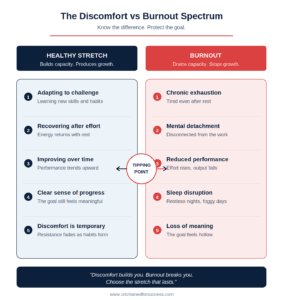
Every meaningful goal requires discomfort. New habits feel awkward. Old beliefs get challenged. Better choices cost something. That kind of stretch is part of becoming who you need to be to achieve the goal.
However, discomfort is not burnout.
The World Health Organization defines burnout as a syndrome resulting from chronic workplace stress that has not been managed. Three signs stand out. Energy depletion. Mental distance from the work. Reduced effectiveness.
Healthy discomfort produces learning. Burnout produces deterioration. One stretches you. The other strips you. Knowing which is which protects you from confusing pain with progress.
“Discomfort builds you. Burnout breaks you. Choose the stretch that lasts.”
The Unchained View on Growth Without Burnout
In the Unchained framework, goals are not achieved by desire alone. Five elements work together to make progress sustainable: a meaningful goal, a strong why, a clear plan, helpful beliefs, and repeatable habits. When any one of these is missing, pressure builds and burnout becomes more likely.
A meaningful goal gives direction. The strong why provides endurance when motivation fades. With a clear plan, ambition becomes manageable steps. Helpful beliefs reduce internal resistance. Repeatable habits replace daily willpower battles with structure.
Growth without burnout depends on all five working together. Remove the why and the work feels hollow. Without a plan, the days drift. Strip out the habits and motivation carries the weight alone, which it cannot do for long.
Why Growth Without Burnout Still Feels Hard
Even when you build the right system, growth still feels uncomfortable at first. The reason sits inside the brain.
Familiar habits feel safer because they use less energy. New behaviours cost more thought, more discipline, and more emotional effort. So when you start waking up earlier, having difficult conversations, learning new skills, or saying no to distractions, your mind resists. That resistance is not failure. It is the cost of becoming someone new.
In the Unchained framework, beliefs and habits influence behaviour most strongly during the difficult middle of a goal journey. The early excitement has faded. The end result feels far away. This is where most people quit, not because the goal is wrong, but because the discomfort feels permanent.
It is not. Discomfort fades as the new behaviour becomes a habit. Burnout deepens if it is left unmanaged. Knowing which one you are facing changes the response entirely.
Growth Without Burnout in Practice
Growth Without Burnout for Individuals
Sarah is a manager who wants to advance her career. She believes she must say yes to every project to prove her value. Six months in, her diary is full but her strategic work is invisible. She is exhausted and resentful.
Applying growth without burnout, Sarah identifies the belief driving the overload. She redefines her goal around two strategic deliverables instead of unlimited availability. She builds a habit of declining one request each week to protect focus time. The shift is uncomfortable but not destructive. Within three months, her visible impact grows while her hours reduce. This is the principle explored in The Hidden Cost of Yes Is Bigger Than You Think. Every yes carries a cost, and unmanaged costs become burnout.
Growth Without Burnout for Businesses
A growing consultancy wins more clients than the team can deliver. Leaders push the team to absorb everything. Quality drops. Two senior consultants leave within four months. Revenue grows on paper, but capacity collapses underneath it.
Applying growth without burnout, leaders pause new client onboarding for one quarter. They map delivery capacity, hire one additional consultant, and introduce weekly capacity reviews. Growth slows briefly, then resumes on a stable foundation. The choice mirrors the lesson in How Trade-Offs Create Progress. Sustainable growth requires saying no to some opportunities so that others can succeed.
Growth Without Burnout for Projects
A digital transformation project keeps adding scope. Every department wants its requirement included. The original 12-month timeline now stretches across 24 months with a team that has not grown. Morale is low. Delivery dates keep slipping.
Applying growth without burnout, the project leadership renegotiates scope around the critical path. Three lower-priority workstreams are moved to phase two. Sequencing is clarified. Weekly reviews remove blockers instead of adding pressure. Delivery resumes on a realistic timeline, and the team recovers its capacity to perform.
How to Apply Growth Without Burnout
Building sustainable growth into your week does not require a complete life overhaul. It requires five disciplined practices.
Define Growth Under Your Control
Pressure rises when goals depend on factors outside your control. Approval, market conditions, and other people’s behaviour are not yours to manage. The process is. Define your goal around actions you can repeat: training sessions per week, client outreach calls per day, words written before lunch. Process under your control reduces anxiety and increases consistency.
Separate Healthy Stretch From Burnout Overload
Ask three questions weekly. Am I adapting or declining? Is this discomfort temporary or chronic? Is my performance improving or am I just surviving? Stretch produces learning. Overload produces decay. The honest answer points you toward the next adjustment.
Reduce the Growth Goal to a Repeatable Habit
Big goals overwhelm. Small habits compound. Replace “get fitter” with “45 minutes of training every Monday, Wednesday, and Friday before work.” Replace “grow the business” with “three client conversations every Tuesday and Thursday before 10am.” Specificity reduces the daily negotiation with yourself.
Protect Recovery to Sustain Growth Without Burnout
Recovery is not a reward for finishing everything. It is a requirement for sustained performance. Harvard Business Review argues that managing energy, not just time, is the foundation of consistent high performance. Build recovery into your week deliberately. Sleep. Movement. Quiet. Connection. Without these, the system runs on borrowed energy until it cannot.
Review Growth Weekly and Adjust
Pressure builds quietly when no one is checking the system. A 20-minute weekly review answers six questions. What worked? Where did the week feel too heavy? Which habits should continue? Are there activities to stop? How can the plan be simplified? Finally, what is the next controllable step? This habit alone prevents most burnout before it starts.
Common Mistakes That Block Growth Without Burnout
Even with good intentions, three mistakes derail sustainable progress.
The first is confusing motion with progress. Filling the calendar feels productive but rarely moves the goal forward. Track outcomes, not activity.
The second is treating recovery as weakness. The American Psychological Association warns that unmanaged chronic stress damages cognition, immune function, and decision quality. Skipping recovery is not commitment. It is a slow withdrawal from the energy reserves you need to finish the goal.
The third is absorbing every new request without removing anything. Capacity is finite. If you keep adding without subtracting, the system collapses, regardless of how meaningful each addition seemed.
Conclusion: Growth That Lasts Beats Growth That Breaks
Growth will stretch you. It will challenge old habits, expose limiting beliefs, and force better decisions. That discomfort is part of the journey, not a sign you are doing something wrong.
Burnout, however, is not the price of success. It is the price of an unmanaged system. The Unchained framework offers a different path: a meaningful goal, a strong why, a clear plan, helpful beliefs, and repeatable habits. Build these well, and growth becomes sustainable. Skip them, and even the right goal will eventually break you.
Growth that costs you everything is not growth. It is collapse with ambition attached.
Call to Action
If this article reframed how you think about growth, share it with someone trying to achieve more without burning out. Subscribe to Unchained for Success for practical guidance on goals, habits, beliefs, and sustainable progress.
SHAREABLE QUOTE
“Discomfort builds you. Burnout breaks you. Choose the stretch that lasts.” #UnchainedForSuccess #GrowthWithoutBurnout #GoalFramework #SustainableGrowth
References
- Kwegyir-Afful, C. (2024). Unchained: Success Unlocked: A Proven Framework for Achieving Your Goals.
- World Health Organization. (2019). “Burn-out an occupational phenomenon: International Classification of Diseases.” WHO, 28 May. Available at: https://www.who.int/standards/classifications/frequently-asked-questions/burn-out-an-occupational-phenomenon
- American Psychological Association. (2023). “Stress effects on the body.” APA, 1 March. Available at: https://www.apa.org/topics/stress/health
- Schwartz, T. and McCarthy, C. (2007). “Manage Your Energy, Not Your Time.” Harvard Business Review, October. Available at: https://hbr.org/2007/10/manage-your-energy-not-your-time
- Kwegyir-Afful, C. (2024). “Why Focus Drives Results and Busyness Doesn’t.” Unchained for Success. Available at: https://unchainedforsuccess.com/focus-drives-results/
- Kwegyir-Afful, C. (2024). “How Trade-Offs Create Progress.” Unchained for Success. Available at: https://unchainedforsuccess.com/how-trade-offs-create-progress/
- Kwegyir-Afful, C. (2024). “The Hidden Cost of Yes Is Bigger Than You Think.” Unchained for Success. Available at: https://unchainedforsuccess.com/the-hidden-cost-of-yes/