Why Focus Drives Results and Busyness Doesn’t

Introduction
Most people believe that working harder leads to better outcomes. However, this is rarely true in practice. Many individuals, teams, and organisations stay busy, work long hours, and still make little meaningful progress. The reason is straightforward: focus drives results, not activity.
When effort is scattered across too many priorities, outcomes become inconsistent. In contrast, when effort is deliberately aligned with a clearly defined objective, progress becomes measurable and repeatable. This distinction matters for anyone serious about achieving goals, whether personal, project-based, or organisational.
In this article, you will learn why focus is the real driver of results, why busyness creates the illusion of progress, and how to apply strategic focus in a structured, practical way using the principles behind the Unchained Goals Framework. By the end, you will have a clear process to eliminate distraction and direct your energy where it counts.
What It Means When Focus Drives Results
To say that focus drives results is to recognise that outcomes improve when attention, time, and energy are directed towards a single, clearly defined objective. This is not simply about concentration. It is about making deliberate choices. Research published in Harvard Business Review by Srini Pillay, a neuroscientist and executive coach, confirms that focused attention is a key driver of excellence, but also that the brain requires intentional management to sustain it. Without that management, attention drifts towards whatever feels urgent rather than what is genuinely important.
In practice, focused execution means choosing one priority over many, aligning daily actions with a specific outcome, and eliminating distractions that do not contribute to progress. Without this kind of directed effort, energy is diluted across competing demands. With it, effort compounds over time.
This principle sits at the heart of the Unchained Goals Framework. In my book Unchained: Success Unlocked, I explain that goals must be Stretched, Specific, Measurable, Timebound, and Under your Control (SSMTC). Each of these criteria reinforces focus by removing ambiguity. For example, a goal that is specific and measurable gives your brain a clear target and therefore a reason to filter out noise.
Moreover, the Directional Execution Spine is the structural backbone of the framework. It maps the path from Outcome to Performance to Process to Habit. Each layer narrows the focus further, converting a broad ambition into a daily, repeatable action. As a result, focus drives results because it creates a direct, traceable link between what you do each day and what you achieve over time.
For a deeper understanding of why specificity matters in this process, read our earlier blog, The Importance of Specificity in Goal Setting.
Why Busyness Fails to Produce Meaningful Results
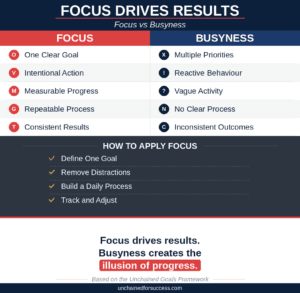
Busyness is frequently mistaken for productivity. However, being busy usually means working on too many tasks simultaneously, reacting to demands instead of acting intentionally, and avoiding difficult decisions about what truly matters.
Research from Harvard Business Review highlights that organisations rewarding the appearance of effort over actual output consistently underperform. In his article Beware a Culture of Busyness, Adam Waytz, a psychologist at Northwestern University’s Kellogg School of Management, found that cultures built around busyness do not improve organisational results and, more critically, damage the mental health of the people working within them. In addition, a study reported in Harvard Business Review on 7 Ways Managers Can Help Their Team Focus found that over 60% of employees rarely complete even one or two hours of deep, focused work each day without distraction.
Consequently, when busyness dominates, time is consumed without meaningful progress, energy is spread too thin, and outcomes remain inconsistent. In simple terms, busyness creates motion, not progress. It produces the feeling of work without the substance of achievement.
This is precisely why the Unchained Goals Framework treats Purpose as the foundational constraint. When Purpose is clear, it acts as a filter, making it easier to say no to distractions and yes to what matters. Without that clarity, people default to busyness because every task appears equally important.
Why Focus Drives Results More Than Effort Alone
Strategic focus is not accidental. It is a deliberate, structured decision to concentrate resources on what matters most. Therefore, it requires three things: defining the priority, accepting trade-offs, and committing fully to a clear direction.
This is where many people and organisations fail. They attempt to pursue multiple major goals at the same time, believing that more effort will compensate for a lack of direction. In reality, divided focus produces divided results. Understanding why focus drives results more reliably than effort alone is the first step towards changing this pattern.
In the Unchained Goals Framework, this challenge is addressed through the design sequence: Purpose, then Vision, then Goals (SSMTC), then Why, then Ownership, then Beliefs, then Planning, then Habits. Each step builds on the one before. Together, they create an architecture where strategic focus is not a one-off decision but a sustained system. Ownership, for instance, means accepting the cost of your commitment. That includes the trade-offs, the discomfort, and the discipline required to stay on course.
When these elements are in place, focus drives results because the difficult decisions about what to prioritise, what to eliminate, and how to allocate energy have already been made in advance. Consequently, daily execution becomes simpler, and consistency becomes sustainable.
For more on how to close the gap between planning and doing, see our blog Mastering Execution: Closing the Gap Between Plan and Action.
Practical Steps: How Focus Drives Results Every Day
Understanding the concept is one thing. Applying it is another. Here are four practical steps to make focused execution part of your daily routine.
First, define one clear goal. Start with a single goal that is fully under your control and can be measured weekly. Avoid vague intentions such as “do better” or “improve performance.” Instead, use the SSMTC model to create a goal that stretches you while remaining specific and measurable. For example: “Complete three client proposals per week for the next six weeks.”
Second, eliminate competing priorities. Remove or delay tasks that do not contribute directly to your primary goal. This is where trade-offs become essential. Focus requires exclusion, and exclusion requires courage. As a rule, if a task does not move you closer to your defined outcome, it should not be on your daily list.
Third, convert focus into a daily process. Translate the goal into specific daily actions with a fixed time, a defined activity, and a clear duration. For instance, block 90 minutes each morning for deep work on your primary objective before checking emails or attending meetings. Consistency in process is more important than intensity of effort.
Fourth, monitor performance and adjust. Track your results regularly, weekly at minimum. If progress stalls, adjust the process rather than abandoning the goal. This mirrors the Unchained Control System, which operates across three governance states. When Performing, you optimise. When Over-performing, you verify and scale. When Underperforming, you escalate through habits, then process, then metrics, then integrity, then outcome boundary. In other words, the system tells you exactly where to look when results are not matching expectations.
Real Example: Focus vs Busyness in Action
Consider two professionals tasked with growing their client base.
Person A responds to every inbound enquiry, attends every networking event, posts sporadically on social media, and changes approach every few weeks. They are extremely busy. However, after three months, their pipeline remains inconsistent, and they cannot identify what is working.
Person B takes a different approach. They define one clear outcome: secure five new qualified leads per month through LinkedIn content. They commit to posting three times per week, engaging with ten targeted connections daily, and tracking responses in a simple spreadsheet. After three months, Person B has a measurable, repeatable system and a growing pipeline.
The difference is not talent or effort. It is focus. Person B applied the Directional Execution Spine in practice: they defined the Outcome (five leads), set a Performance target (weekly engagement metrics), established a Process (content schedule and outreach), and built it into a Habit (daily LinkedIn routine).
This same principle applies in fitness, in project delivery, and in organisational strategy. As I discussed in High-Performance Habits: Daily Routines That Drive Success, repeatable daily processes are the engine behind every sustained result.
Common Mistakes That Destroy Focus
Even with the right intentions, focus can be undermined by several common behaviours. These include trying to pursue multiple major goals simultaneously, confusing activity with progress, avoiding necessary trade-offs, changing direction too frequently, and setting goals that are outside your control.
Each of these behaviours creates the illusion of productivity without delivering meaningful results. For example, changing approach every few weeks prevents compound progress, which is the very mechanism that makes focused execution so powerful. Similarly, setting goals outside your control introduces dependency and uncertainty, which erodes commitment over time.
In the Unchained framework, this is why the “C” in SSMTC stands for “Under your Control.” If the outcome depends on someone else’s decision, it is not a goal. It is a hope. True focus requires goals that you can directly influence through your own daily actions.
“Failure is a design problem, not a character flaw.” Unchained: Success Unlocked
When results fall short, the answer is not to question your character. It is to examine your design: your systems, your processes, and your alignment. This is how focused execution produces consistent results, by treating setbacks as design problems to be solved rather than reasons to quit.
How to Apply This Immediately
If you want to experience how focused execution transforms outcomes, start with these four commitments over the next seven days.
Choose one goal that genuinely matters to you. Define one daily process that moves you towards it. Remove at least three non-essential tasks from your schedule. Commit to consistency, even when progress feels slow or uncomfortable.
Strategic focus becomes easier when the structure is simple and clear. You do not need more hours. You need more alignment between your effort and your outcome.
Conclusion: From Busyness to Achievement
Focus drives results because it aligns effort with outcomes. Busyness, on the other hand, creates movement without direction.
When you decide what matters, remove what does not, and act consistently within a structured framework, progress becomes inevitable. The shift is powerful: from busy to effective, from scattered effort to directed execution, from intention to achievement.
This is the core principle behind the Unchained Goals Framework, and it applies equally to individuals, projects, and organisations. Whether you are pursuing a personal ambition, leading a team through a complex programme, or resetting an organisation’s strategic direction, the answer is always the same. Narrow the focus, commit to the process, and let the system do the work.
Call to Action
What is the one goal you are currently spreading too thin?
Choose one goal today. Define one process. Remove everything else.
Then commit to execution, even when it feels uncomfortable. That is where transformation begins.
Share your goal in the comments, or tag #UnchainedForSuccess on LinkedIn to join a community of people turning focus into results. For more tools and strategies, explore our full blog library at unchainedforsuccess.com/blog.
#UnchainedForSuccess #GoalFramework #FocusDrivesResults
References
- Kwegyir-Afful, C. (2023). Unchained: Success Unlocked. A Proven Framework for Achieving Your Goals.
- Waytz, A. (2023). “Beware a Culture of Busyness.” Harvard Business Review, March/April 2023. Available at: https://hbr.org/2023/03/beware-a-culture-of-busyness
- Hougaard, R. and Carter, J. (2017). “Are You Having Trouble Focusing? These Simple Strategies Will Help.” Harvard Business Review. Available at: https://hbr.org/2017/12/are-you-having-trouble-focusing-these-simple-strategies-will-help
- Pillay, S. (2017). “Your Brain Can Only Take So Much Focus.” Harvard Business Review. Available at: https://hbr.org/2017/05/your-brain-can-only-take-so-much-focus
- Allen, D. and Hale, J. (2023). “7 Ways Managers Can Help Their Team Focus.” Harvard Business Review. Available at: https://hbr.org/2023/01/7-ways-managers-can-help-their-team-focus