Why Habits Matter More Than Motivation for Success

Introduction
Why habits matter more than motivation is one of the most important lessons in achieving meaningful goals.
Many goals begin with enthusiasm. People feel energised and determined to change their lives. They start a training programme, commit to building a business, or decide to develop a new professional skill.
However, the excitement rarely lasts. After a few weeks, progress slows. Motivation fades. Eventually the goal disappears. This pattern is extremely common, yet the reason is rarely understood.
Motivation is emotional and temporary. Habits are structured behaviours that continue regardless of mood. When habits support a goal, progress becomes consistent even on difficult days.
Understanding why habits matter is therefore essential for anyone serious about achieving meaningful goals.
The Problem With Motivation
Motivation feels powerful, but it is unreliable. It rises when inspiration is high and disappears when effort becomes uncomfortable. Many people therefore rely on motivation to begin goals but struggle to sustain them.
Consider common examples:
- starting a training programme
- studying for a professional qualification
- launching a new business.
Each begins with excitement. However, the moment difficulty appears, motivation begins to decline.
Because motivation depends on emotion, it fluctuates constantly. Some days motivation is strong, and on other days it disappears completely.
Achievement cannot depend on something that changes daily. This is one of the fundamental reasons why habits matter more than motivation when pursuing long-term goals.
Why Habits Matter for Long-Term Success
Habits create consistency. Once behaviour becomes habitual, it requires far less mental effort to perform. Instead of deciding every day whether to act, the behaviour simply happens.This is another reason why habits matter. Habits remove the daily negotiation with yourself.
Behavioural research shows that repeated actions gradually become automatic patterns of behaviour. As this happens:
- resistance decreases
- effort feels lower
- consistency improves.
Achievement therefore becomes a structural outcome rather than an emotional one.
Research discussed in the Harvard Business Review highlights how consistent routines often drive performance more reliably than bursts of motivation.
Why Habits Matter: The Brain Science Behind Consistency
The instability of motivation is not only psychological. It is also neurological.
Understanding how the brain processes behaviour helps explain why habits matter so much when trying to achieve meaningful goals.
Two areas of the brain play a particularly important role:
- the Prefrontal Cortex
- the Basal Ganglia
The Prefrontal Cortex: Effortful Decision-Making
The Prefrontal Cortex is responsible for planning, reasoning, and decision-making.
When a behaviour is new, this part of the brain carries most of the workload. Every action requires conscious effort.
For example, when someone begins training at 6am, the mind repeatedly asks:
- Should I wake up?
- Should I train today?
- Is the effort worth it?
Each decision consumes mental energy. This is why motivation is often required in the early stages of a goal.
The Basal Ganglia: Automatic Behaviour
The Basal Ganglia governs habit formation.
When behaviour is repeated consistently, control gradually shifts from the Prefrontal Cortex to the Basal Ganglia.
Once this shift occurs:
- behaviour becomes automatic
- resistance decreases
- execution requires far less mental effort.
This neurological transition explains why habits matter so much in achieving goals.
A behaviour that once required motivation eventually becomes routine. Instead of debating whether to act, the action simply happens.
Research led by Wendy Wood shows that a significant proportion of daily behaviour is governed by habits rather than conscious decision-making.
Why Habits Matter in the Unchained Goals Framework
Within the Unchained Goals Framework, habits sit at the foundation of execution.
The framework follows a structured architecture:
Purpose → Vision → Goals → Why → Ownership → Beliefs → Plan → Habits
Habits convert process goals into daily behaviour.
Consider a structured example.
Goal
Reduce waist-to-height ratio from 0.54 to 0.48 within 16 weeks.
Performance Goal
Complete four training sessions per week.
Process Goal
Row for 30 minutes at 6am on Monday, Wednesday, Friday, and Saturday.
Habit
Training automatically begins at 6am on those four days.
This goal satisfies the SSMTC criteria:
- Stretched – the target requires sustained effort
- Specific – the metric is clearly defined
- Measurable – waist-to-height ratio can be calculated
- Timebound – 16 weeks
- Under your control – execution depends entirely on behaviour.
Once the habit is established, the daily debate disappears.
Execution becomes routine rather than emotional. This is exactly why habits matter in structured goal execution.
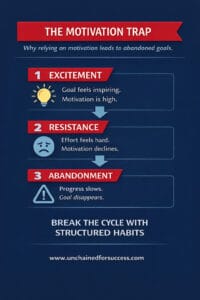
The Motivation Trap
Many people believe motivation must come before action.
This belief creates what can be called the motivation trap.
The pattern usually follows three stages.
Stage 1 – Excitement
The goal feels inspiring. Energy is high.
Stage 2 – Resistance
Effort becomes uncomfortable. Motivation begins to decline.
Stage 3 – Abandonment
Progress slows and the goal disappears.
Habits break this cycle.
When behaviour becomes routine, execution no longer depends on enthusiasm. This is another reason why habits matter when pursuing meaningful goals.
Examples of Habits in Individuals, Projects, and Organisations
Individuals
An individual who wants to improve fitness does not rely on motivation. Instead, they train at a fixed time each week.
Over time the behaviour becomes normal rather than difficult.
Projects
Successful projects rely on structured routines such as:
- weekly risk reviews
- daily progress monitoring
- structured reporting cycles.
These routines function as project habits that maintain discipline.
Organisations
High-performing organisations embed habits into their operating systems.
These include:
- regular strategy reviews
- consistent performance monitoring
- disciplined operational processes.
These organisational habits stabilise performance even when external conditions change.
How to Build Habits That Actually Work
Habits succeed when they are simple, structured, and repeatable. Most failed habits are simply too complicated. Effective habits share four characteristics.
Small enough to repeat
The behaviour must be simple enough to perform consistently.
Linked to a clear trigger
Habits work best when connected to a specific time or event.
Example:
Train at 6am every Monday, Wednesday, Friday, and Saturday.
Fully under your control
A habit must not depend on another person’s behaviour.
Directly linked to the goal
The habit must support the performance goal.
When these conditions are met, habits become stable behavioural systems.
This final point reinforces why habits matter when turning goals into daily execution.
Conclusion
Motivation may start a goal, but it cannot sustain one. Motivation depends on emotion, and emotions fluctuate. Habits operate differently. Once established, they create stability.
People who rely on motivation make progress only when they feel inspired. People who rely on habits make progress every day.
Meaningful goals are not achieved through bursts of enthusiasm. They are achieved through disciplined repetition.
This is ultimately why habits matter more than motivation.
For a deeper understanding of how small behavioural changes compound over time, see our earlier article Micro Habits for Maximum Growth on Unchained for Success.
Call to Action
If you found this article useful:
- Share it with someone working towards an important goal
- Leave a comment about the habits that have helped you most
- Explore more insights at www.unchainedforsuccess.com
#UnchainedForSuccess #UnchainedGoalFramework #HabitsForSuccess
References
- Charles Duhigg(2012). The Power of Habit: Why We Do What We Do in Life and Business. Random House.
- Wendy Wood(2019). Good Habits, Bad Habits: The Science of Making Positive Changes That Stick. Farrar, Straus and Giroux.
- James Clear(2018). Atomic Habits: An Easy and Proven Way to Build Good Habits and Break Bad Ones. Avery.
- Harvard Business Review(Various Articles). Research on behaviour change, routines, and performance.
- Edwin Locke& Gary Latham (2002). Building a Practically Useful Theory of Goal Setting and Task Motivation. American Psychologist.