The Hidden Cost of Yes Is Bigger Than You Think

The Cost of Yes: Why It Compounds Silently
The cost of yes is bigger than most professionals realise. Every new commitment draws on time, attention, energy, and delivery capacity, even when it looks harmless in isolation. However, most people never calculate this cost because each individual yes seems perfectly reasonable on its own.
This article will show you exactly where the cost of yes hides, why it compounds over time, and how to reclaim the strategic focus that turns good intentions into exceptional results.
How the Yes Trap Disguises Itself as Progress
The danger of overcommitment is that it never looks like overcommitment at the start. It looks like ambition. It looks like generosity. It looks like being a team player.
A new client project. A speaking invitation. A collaborative venture with someone you admire. Each one, in isolation, is worth doing. Therefore, we rarely pause to question them. Yet strategy is never about what is worth doing in isolation. It is about what is worth doing given everything else already on your plate.
This is exactly the distinction explored in Why Focus Drives Results and Busyness Doesn’t. Busyness creates the illusion of progress. Focus creates the reality of it. When you understand the cost of yes, you begin to see that every commitment accepted is a commitment to something else declined.
Four Hidden Costs That Damage Your Results
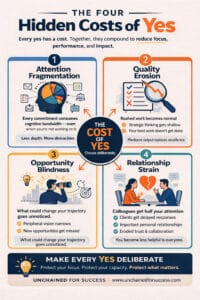
The obvious price of overcommitment is lost time. However, four less visible costs often cause far greater damage to your reputation and your results.
Attention Fragmentation
Every additional commitment takes a slice of your cognitive bandwidth. You carry it in the background, even when you are not actively working on it. Research published in Harvard Business Review by neuroscientist Srini Pillay confirms that excessive focus exhausts the brain’s focus circuits, impairing decision making and reducing self-control. Consequently, three major commitments might feel manageable. Seven feels chaotic, not because any single one became harder, but because the switching cost has quietly multiplied.
Quality Erosion
When everything must fit, nothing gets room to breathe. The proposal that needed another draft goes out as is. The strategy that required deep thinking gets surface level attention. As a result, you deliver less than you are capable of. Over time, that gap between potential and output becomes the story people associate with your name.
Opportunity Blindness
A full calendar does not just prevent you from taking on new things. It also prevents you from seeing new things. When existing commitments consume your bandwidth, your peripheral vision narrows. The transformative opportunity that could have changed your trajectory passes unnoticed because you lacked the space to recognise it.
Relationship Strain
Overcommitment affects the people around you. Colleagues receive half your attention. Clients receive delayed responses. Family and friends receive whatever remains. Ironically, many of us say yes precisely because we want to be helpful. Yet the cumulative effect is that we become less helpful to everyone.
A Real World Example
Consider a leader who agrees to join two new steering groups, mentor three rising managers, and support an extra client bid in the same quarter. None of those requests looks unreasonable on its own. Yet together they reduce thinking time, delay key decisions, and weaken execution on the priorities that actually drive results. This is the cost of yes made visible.
The Psychology Behind the Cost of Yes
Understanding the cost of yes is one thing. Changing the behaviour is another entirely. We keep agreeing to things for reasons that go deeper than poor time management.
Identity attachment. If you have built a reputation as the person who always delivers, saying no can feel like a personal crisis. It is not just declining a task. It is questioning who you are. As explored in Why Identity Limits Performance and Growth, the beliefs we hold about ourselves often dictate the choices we make before logic even enters the room. Similarly, many professionals tie their self-worth to being indispensable, which makes every no feel like a threat.
Fear of invisibility. In many industries, visibility equals viability. If you are not in the room, you are not in the conversation. Consequently, we say yes to stay visible, even when visibility comes at the expense of quality delivery.
Misunderstanding focus. We intellectually accept that focus means doing fewer things. However, we emotionally resist what that actually requires. Focus does not just mean prioritising. It means actively choosing to let some good things go undone.
This connects directly to the Unchained framework. Meaningful goals require deliberate structure, a strong why, supportive beliefs, a clear plan, and habits that protect execution. You cannot build something exceptional while saying yes to everything at once. As explored in Process Goals: How to Turn Effort Into Results, sustainable progress depends on aligning daily actions with a defined outcome rather than spreading effort across competing demands.
A Three Step Framework for Saying No Strategically
The most effective leaders are extraordinarily careful about what they commit to. Not because they lack ambition, but because they understand that ambition without focus is just activity. Here is a practical framework you can apply this week.
Step one: define your top three. Write down your three most important priorities for the quarter. Everything else is secondary. For example, if your priority is launching a new programme, then the speaking invitation that clashes with your preparation time becomes a clear no.
Step two: audit your actual capacity. Not your theoretical capacity. The version that accounts for the energy required to do your best work. Most people overestimate what they can carry because they plan for execution and forget about thinking, recovery, and the unexpected.
Step three: practise the graceful no. Saying no does not require being rude. A simple response such as “I appreciate the invitation, but I am focusing on three key commitments this quarter” is both honest and respectful. As Greg McKeown argues in Essentialism, if you do not prioritise your life, someone else will.
According to Melody Wilding in Harvard Business Review, high performers distinguish themselves not by how much they take on, but by how deliberately they choose their commitments. The cost of yes is always paid somewhere. The only question is whether you choose where, or let it choose for you.
Reducing the Cost of Yes Starts With White Space
There is a concept in design called white space. It is the empty area around content that makes the whole composition more effective. Your schedule needs white space too.
Margin is not wasted time. It is where your best thinking happens. It is where you notice the pattern you have been too busy to see. It is where the conversation that reshapes your strategy takes place.
Start today with a commitment audit. List everything you are currently committed to, including recurring meetings, informal obligations, and agreements from months ago that still quietly consume bandwidth. Then ask two questions about each item.
- If this opportunity came to me today, knowing what I now know, would I still say yes?
- What is this commitment preventing me from doing?
You will likely find that some commitments have outlived their relevance. Others were good ideas that you are no longer the right person to carry. And some were Yeses that should have been Nos from the start.
From Possible to Achieved: Make Every Yes Count
The cost of yes is not a reason to say no to everything. It is a reason to make every yes deliberate. When you commit to fewer things, you can commit fully. Full commitment brings your best thinking, your complete attention, and genuine care. That quality of engagement is increasingly rare and correspondingly valuable.
Stop treating your calendar as a measure of importance. Start treating it as a strategic tool. When you understand the true cost of yes, you begin to lead with intention rather than reaction. The space you protect today is the space where your best work will happen tomorrow.
What commitment could you release this week to create space for what truly matters? Share your answer in the comments below, or subscribe to Unchained for Success to receive weekly frameworks on strategic leadership and intentional growth.
#UnchainedForSuccess #StrategicFocus #GoalFramework
References
- Kwegyir-Afful, C. (2023). Unchained: Success Unlocked. A Proven Framework for Achieving Your Goals.
- Pillay, S. (2017). “Your Brain Can Only Take So Much Focus.” Harvard Business Review. Available at: https://hbr.org/2017/05/your-brain-can-only-take-so-much-focus
- Wilding, M. (2022). “When and How to Say No to Extra Work.” Harvard Business Review, November 2022. Available at: https://hbr.org/2022/11/when-and-how-to-say-no-to-extra-work
- McKeown, G. (2014). Essentialism: The Disciplined Pursuit of Less. Crown Business.
- Kwegyir-Afful, C. (2026). “Why Focus Drives Results and Busyness Doesn’t.” Unchained for Success. Available at: https://unchainedforsuccess.com/focus-drives-results/
- Kwegyir-Afful, C. (2026). “Why Identity Limits Performance and Growth.” Unchained for Success. Available at: https://unchainedforsuccess.com/identity-limits-performance/
- Kwegyir-Afful, C. (2026). “Process Goals: How to Turn Effort Into Results.” Unchained for Success. Available at: https://unchainedforsuccess.com/process-goals/