Grow Faster Without Losing Control
Introduction
Most ambitious professionals want to grow faster. They want stronger results, faster progress, and bigger opportunities.
Yet speed without structure rarely creates the growth they hoped for. It creates broken systems, missed commitments, declining quality, and quiet exhaustion.
The issue is not ambition. The issue is control.
This article shows how to grow faster without breaking the system that carries your growth. It applies four components of the Unchained Goals Framework: Purpose, Planning, Ownership, and Habit Conversion. It is the fourth post in the Growth Without Burnout series.
Why Learning to Grow Faster Matters
Acceleration is not the same as progress. Many professionals confuse the two. As a result, they pay a steep price, committing to more, sleeping less, and treating exhaustion as evidence of ambition. The outcome is predictable. Quality drops. Deadlines slip. Trust erodes. So speed without structure does not produce growth. Instead, it produces decline disguised as effort.
Controlled growth, however, compounds. Each gain protects the next. One commitment fits the system that has to carry it. The next layer of ambition then rests on a foundation strong enough to bear it. This is the difference between scaling and straining. In addition, this is the difference between sustainable growth, where the professional can grow faster for years, and the sprint that lasts months before resetting.
The research is clear. Sustained high performance depends on cyclical effort and recovery, not constant maximum effort (Loehr and Schwartz, 2001). The Harvard Business Review Special Issue on growth strategy also points to a similar lesson. Growth must be pursued with judgement, sequencing, resilience, and risk management, not speed alone (Harvard Business Review, 2026). So the evidence points one way. Professionals who want to grow faster over the long run must build their growth on structure.
| Speed is only useful when the system can carry it. Anything else is a managed fall. |
The Core Problem: Why You Cannot Grow Faster Without Filtering Through Purpose
Most plateaus and breakdowns share one root cause. Ambition runs ahead of the structure that delivers it. Yet the deeper problem is upstream. Frequently, too many of the wrong commitments enter the system in the first place. Purpose was not used to filter what deserved a yes. So a new goal is added before the previous one is embedded. Likewise, a new responsibility is taken before the previous one runs cleanly. In addition, new habits are layered before old ones have converted into reliable routine.
This pattern creates four predictable failures. First, the wrong things get prioritised. Second, planning becomes wishful. Third, ownership becomes performative rather than real. Fourth, habit formation stalls. Notably, each failure traces back to a single chain. When Purpose does not filter what enters, Planning, Ownership, and Habit Conversion are all overloaded by commitments that should never have been candidates.
The fix is not to slow down. It is to apply the framework in sequence.
The Four Questions That Let You Grow Faster Without Losing Control
The framework gives a simple test. To grow faster without losing control, ask four questions of every new commitment, in this order.
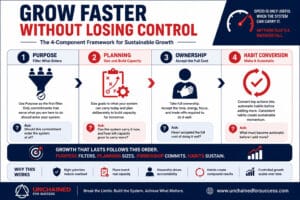
| The Four Questions That Let You Grow Faster Purpose: Should this commitment enter the system at all? Planning: Can the system carry it now, and how will capacity grow to carry more? Ownership: Have I accepted the full cost of doing it well? Habit Conversion: What must become automatic before I add more? |
These four questions are not a checklist. They are a discipline. The reader who runs them weekly will grow faster than the one who runs only some of them, no matter how hard they work. The detailed components below explain how each question operates. Each is anchored in research that confirms why the framework’s order is the right one.
Purpose: The First Filter to Grow Faster
Purpose comes first in the framework for a reason. It defines what the professional, the team, or the organisation actually exists to do. Without Purpose, every opportunity looks roughly equal. Every yes feels reasonable. The system fills with commitments that drain rather than build.
This is where the first and largest leak occurs when professionals try to grow faster. Frequently, they accept commitments that are good on their own merits. Yet those commitments are not aligned to their Purpose. As a result, busy growth goes nowhere meaningful. Importantly, the strongest no’s come from here. A clear Purpose makes saying no much easier. So the question becomes simple. Does this commitment serve what I am here to do?
So the rule is direct. Apply Purpose first as the filter. Only commitments that serve Purpose deserve to enter Planning, Ownership, or Habit Conversion at all. This single step removes most of the noise that breaks growing systems. The system never has to carry what should not have entered.
Planning: Size and Build Capacity to Grow Faster
Planning is where ambition becomes a credible path. It does two things at once. First, it sizes today’s goals to what the system can absorb. Second, it includes set goals to build capacity over time. So the ceiling rises rather than holding the professional in place. A plan is not a wish list. It is the route from current state to chosen outcome, sized to the system today and built to grow that system tomorrow.
When professionals want to grow faster, the temptation is to plan for the system they wish they had. Yet the right plan must serve the system they actually run. Equally, others under-plan. They treat current capacity as a permanent ceiling. Both fail. The HBR Spring 2026 special issue makes a related point. Successful growth comes from sequencing and judgement, not from compressing every ambition into the same window (Harvard Business Review, 2026).
So the framework gives a twofold rule. Size milestones to a density the system can carry today. Then write capacity-building goals into the plan. The system can then carry more tomorrow. This is how professionals grow faster without setting traps for themselves. It is how they keep growing faster as capacity expands. For a deeper view of why capacity must come before goals, see Part 3 of this series, Capacity Before Goals.
Ownership: Choose the Cost Before You Grow Faster
Ownership is the point where intention turns into responsibility under cost. It is not enthusiasm. It is not agreement. Above all, it is the choice to absorb the full cost of a commitment, including the cost of doing it well.
This is everything when professionals try to grow faster. Each new commitment looks light on its own. Each one carries hidden cost. When ownership is performative rather than real, the cost shows up somewhere else. It usually shows up in quality, relationships, or health. Recent HBR research confirms this. Accountability cannot be forced. It must be chosen. It only drives sustained results when ownership is real rather than imposed (Harvard Business Review, 2026).
So the rule is to apply real Ownership before the commitment is accepted, not after. Test every Purpose-aligned commitment against the actual cost it will demand. If the cost cannot be absorbed, Ownership has not occurred. The commitment is not yet real. Professionals who grow faster on terms they can sustain are those who run this check rigorously.
Habit Conversion: Embed One Habit Before You Grow Faster Again
Habit Conversion is where intention becomes automatic action. A habit is not a routine you remember to do. Instead, it is a routine that runs without willpower. Until that conversion has occurred, the system is still carrying the habit on conscious effort. Notably, conscious effort has finite supply.
When professionals try to grow faster by stacking many new habits at once, none of them embed. The research is clear on this. A systematic meta-analysis of habit formation studies found one key result. Habit strength grows only when actions are done consistently in a stable context over time (Singh et al., 2024). Likewise, a 90-day study tracking habit formation showed a similar pattern. Steady repetition, not parallel new habits, is what creates automatic action (Keller et al., 2020).
So the rule is to stage habit building. Embed one new habit at a time. Allow it to convert before adding the next. This is how professionals grow faster on a foundation that holds.
Practical Examples: How the Framework Lets You Grow Faster
These three examples show how Purpose, Planning, Ownership, and Habit Conversion work together. They cover an individual, a business, and a project that all want to grow faster.
Individual Example: How Sarah Grows Faster With the Framework
Sarah leads a regional sales team. She wants to grow her quota attainment by 40% over twelve months. In addition, she wants to move toward a senior role. Without the framework, she would add coaching calls, take a course, pursue a certification, and lead a new initiative. All in the same quarter.
Applying the framework changes the picture. First, Purpose comes first. Sarah’s Purpose is to lead high-performing sales teams. The certification is unrelated to leadership, so it does not pass the filter. As a result, it is dropped immediately. Next, Planning sizes what remains to two new commitments per quarter, not five. It also adds a capacity-building goal: developing one direct report into a deputy. That expands her bandwidth by the third quarter. Then Ownership forces her to ask which of the remaining commitments she will absorb the full cost of, not just notionally accept. Finally, Habit Conversion tells her to embed the coaching cadence first. Then she layers in the course once that habit has converted. By the end of the year, she has hit the 40% target. In addition, she is positioned for the promotion. She chose to grow faster within what the system could carry, and built that system as she went.
Business Example: How a Consultancy Grows Faster With the Framework
A mid-sized consultancy plans to double revenue in two years. Without the framework, leadership signs new contracts faster than delivery can scale. As a result, quality drops. Client trust erodes. The firm loses the very momentum it tried to build.
Applying the framework would have changed the sequence. Purpose filters first. The firm’s Purpose is to deliver senior-led strategy work. Opportunistic implementation contracts that fall outside that Purpose are declined, regardless of revenue size. Planning then matches new contract intake to delivery capacity build-out. It writes in a capacity-building goal of hiring and integrating two senior partners over the next twelve months. Ownership makes the existing partners absorb the real cost of new commitments. That includes the leadership time required to support them. Habit Conversion layers in new internal routines, like quality reviews and onboarding, before each surge. Revenue still doubles. The firm holds together. The business can grow faster again the year after.
Project Example: How a Product Team Grows Faster With the Framework
A product team wants to launch a new feature in six weeks. Without the framework, every team member adds the new work on top of existing load. Two weeks in, three other deliverables slip. Consequently, the launch ships late and incomplete.
Applying the framework, Purpose comes first. The product’s Purpose is to deliver onboarding clarity. A tempting add-on for advanced users is descoped because it does not serve that Purpose. It would have been impressive, but impressive is not the test. Planning then assesses what realistic capacity the team has, given current commitments. It writes in a capacity-building goal of automating two existing manual processes. The team then has more headroom for the next launch. Ownership forces the team to decide what they will stop doing to make room for the new work. Habit Conversion introduces the new working rhythm gradually. The team settles into it before pressure peaks. As a result, the feature launches on time, because the system was structured to carry it. This shows once again that teams grow faster when structure leads speed.
How to Apply the Framework and Grow Faster This Week
Five steps, repeated weekly, turn the framework into a sustainable practice.
Step one: Filter every commitment through Purpose. Before sizing or scheduling anything, ask whether each candidate commitment serves your Purpose. If it does not, decline it now. Most of the load that breaks growing systems is removed at this single step.
Step two: Plan against current capacity and write in capacity-building goals. Size your immediate plan to what the system can absorb today. Then add one or two goals that deliberately build capacity for next month and next quarter. The plan must serve both today and tomorrow.
Step three: Run the Ownership check on every Purpose-aligned commitment. Ask whether you will absorb the full cost of this commitment, including the cost of doing it well. If the answer is no, the commitment is not yet owned. Either decline it, defer it, or restructure something else to make room.
Step four: Stage habit introduction. Identify the single most important habit forming right now. Protect its repetition until it converts. Then, and only then, layer in the next one.
Step five: Review and adjust. At the end of each week, examine what the system actually carried. Reapply Purpose, Planning, Ownership, and Habit Conversion to the week ahead. Over time, the system grows. So does what it can safely carry. As that happens, you grow faster without breaking what carries you.
Crucially, this rhythm matters more than any single decision. The framework is not a one-off audit. It is an ongoing discipline that keeps acceleration aligned with execution.
Common Mistakes to Avoid When You Try to Grow Faster
The first common mistake is to skip Purpose. Without that filter, the framework still works. Yet it works on commitments that should never have entered the system. The Ownership check becomes a cost calculation on the wrong candidates. Planning becomes precise sizing of the wrong goals. Apply Purpose first, every time.
A second mistake is to treat Planning as a fixed fit to today’s capacity. Planning must also include goals that build capacity. The system grows rather than holding the professional in place. Without this, the ceiling never lifts.
Another mistake is to apply only one of the four parts. Purpose without Planning gives clarity without action. Planning without Ownership gives plans that never get absorbed. Likewise, Ownership without Habit Conversion gives commitment without conversion. All four must work together.
A further mistake is to skip the weekly review. Without the review, the system silently overloads. The framework’s discipline drifts into intention alone.
Finally, professionals often confuse felt busyness with real capacity. A system that feels stretched is often the same system producing little. Capacity is measured by output absorbed, not effort spent. So this difference is key for anyone who wants to grow faster on terms they can sustain.
Conclusion
Fast growth is not the enemy. Uncontrolled growth is.
When Purpose filters what enters, Planning sizes what can be carried, Ownership accepts the true cost, and Habit Conversion turns effort into rhythm, controlled growth becomes the engine of sustainable growth. The framework already names the path. It does not need to be added to. It needs to be applied.
That is how you grow faster without losing control.
| When the framework carries the speed, growth stops being a risk and starts being a rhythm. |
Apply It This Week
| Apply the Framework This Week Filter every commitment through Purpose. Plan against current capacity and write in capacity-building goals. Run the Ownership check. Stage your habits one at a time. Review on Friday. That is how you grow faster without losing control. |
For the full Unchained Goals Framework, see Unchained: Success Unlocked.
You can also build the foundations this post relies on by revisiting Capacity Before Goals and Stretch Goals Must Stay Within Your Control.
References
- Kwegyir-Afful, C. (2023). Unchained: Success Unlocked. A Proven Framework for Achieving Your Goals. Unchained for Success.
- Kwegyir-Afful, C. (2026). “Growth Without Burnout: How to Grow Through Discomfort.” Unchained for Success, 29 April. Available at: https://unchainedforsuccess.com/growth-without-burnout/
- Kwegyir-Afful, C. (2026). “Stretch Goals Must Stay Within Your Control.” Unchained for Success, 7 May. Available at: https://unchainedforsuccess.com/stretch-goals-must-stay-within-your-control/
- Kwegyir-Afful, C. (2026). “Capacity Before Goals: The Rule Most Leaders Miss.” Unchained for Success, 14 May. Available at: https://unchainedforsuccess.com/capacity-before-goals-the-rule-most-leaders-miss/
- Loehr, J. and Schwartz, T. (2001). “The Making of a Corporate Athlete.” Harvard Business Review, January. Available at: https://hbr.org/2001/01/the-making-of-a-corporate-athlete
- Harvard Business Review (2026). “Accountability Must Be Chosen, Not Mandated.” Harvard Business Review, April. Available at: https://hbr.org/2026/04/accountability-must-be-chosen-not-mandated
- Harvard Business Review (2026). New Strategies for Growth (HBR Special Issue). Spring 2026. Available at: https://store.hbr.org/product/new-strategies-for-growth-hbr-special-issue/SPSP26
- Singh, B., Kiers, S., Bennett, H., Maher, C., Olds, T., Mellow, M.L. and Smith, A.E. (2024). “Time to Form a Habit: A Systematic Review and Meta-Analysis of Health Behaviour Habit Formation and Its Determinants.” Healthcare, 12(23). Available at: https://www.ncbi.nlm.nih.gov/pmc/articles/PMC11641623/
- Keller, J., Kwasnicka, D., Klaiber, P., Sichert, L., Lally, P. and Fleig, L. (2021). “Habit Formation Following Routine-Based Versus Time-Based Cue Planning: A Randomized Controlled Trial.” Frontiers in Psychology, 11. Available at: https://www.frontiersin.org/journals/psychology/articles/10.3389/fpsyg.2020.00560/full