Stretch Goals Must Stay Within Your Control

Introduction
Stretch goals are often treated as the gold standard of ambition. Aim higher. Push further. Refuse the comfortable target. Yet most stretch goals fail quietly, not because effort is missing, but because the goal was never structured for execution. A target that sits outside your direct control creates pressure without direction, and pressure without direction does not produce progress. It produces inconsistency, frustration, and eventually disengagement.
Last week’s post, Growth Without Burnout: How to Grow Through Discomfort, explored how sustainable progress depends on managing stretch wisely. This week, the focus shifts upstream. Before energy management matters, the goal itself must be designed correctly. Stretch goals fail far more often because of poor structure than because of weak ambition. By the end of this article, you will know how to test any stretch goal against the control principle and how to convert ambition into a system you can actually execute.
Why Structured Stretch Goals Matter
Ambitious targets are everywhere. ‘Double the business.’ ‘Get promoted within the year.’ ‘Reach financial independence.’ Each sounds impressive in a leadership offsite or a New Year diary entry. Most of them collapse by the second or third week of execution. The reason is rarely a lack of will. The reason is structure.
Research published in Harvard Business Review shows that stretch goals are widely misunderstood and often misused, particularly by organisations least equipped to deliver them. The same pattern shows up in individual lives. People in difficulty reach for the largest possible goal, and the gap between intention and execution grows wider every week.
A stretch goal that cannot be executed daily cannot be improved weekly. If progress cannot be measured, it cannot be managed. The aim of this article is therefore practical, not motivational. Stretch goals are good. Unstructured stretch goals are destructive.
The Core Concept Behind Stretch Goals
A stretch goal, properly understood, is a target that pushes you beyond current capability while remaining executable through deliberate action. The stretch sits in the ambition. The discipline sits in the structure. Strip out the structure and what remains is not a goal at all. It is an aspiration.
Goal-setting research by Locke and Latham, summarised concisely on MindTools, confirms that specific and challenging goals reliably outperform vague ‘do your best’ instructions. The catch is the word specific. Specificity demands measurable inputs you can act on, not just outcomes you wish for. That is the line most stretch goals fail to cross.
A real stretch goal is therefore:
• Stretched. It demands growth and forces a higher level of capability.
• Specific. It is defined precisely enough that two people would describe it the same way.
• Measurable. Progress can be tracked weekly without subjective interpretation.
• Timebound. It carries a deadline that creates urgency rather than abstraction.
• Controllable. Execution does not depend on the cooperation of people you cannot direct.
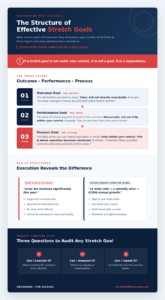
“If a stretch goal is not under your control, it is not a goal. It is a dependency.”
Stretch Goals Within the Unchained Framework
The Unchained framework is built on five elements working together: a meaningful goal, a strong why, a clear plan, helpful beliefs, and repeatable habits. Stretch goals interact with every element of that system.
Without a meaningful goal, stretch becomes performative. Without a strong why, the discomfort that stretch produces is not survivable. Without a clear plan, the stretch has no path. Without helpful beliefs, the difficulty gets interpreted as personal limitation. Without repeatable habits, the daily process collapses the moment motivation dips. Each of these elements contains the same warning: ambition is not a substitute for structure.
This connects directly to last week’s argument in Growth Without Burnout, and to the trade-off discipline explored in How Trade-Offs Create Progress. Growth becomes destructive when it lives outside a structured system. Stretch becomes destructive when it lives outside the control principle. Both failures share the same root cause: ambition has been allowed to override design.
Practical Examples of Structured Stretch Goals
For Individuals
James, a senior account manager, sets a stretch goal to ‘grow his client portfolio significantly this year.’ Six months later, he is busy, exhausted, and cannot point to a single measurable improvement. Applying the control principle, James rewrites the goal in three layers. The outcome goal becomes ‘increase managed revenue by £250,000 within twelve months.’ The performance goal becomes ‘secure two new client wins each month.’ The process goal becomes ‘complete fifteen qualified outreach calls every weekday before 10am.’ Only the process goal sits fully within his control, and that is precisely why it works.
For Businesses
A growing consultancy declares a stretch goal to ‘become the regional market leader within two years.’ Market leadership is not controllable. It depends on competitor decisions, client cycles, and economic conditions. Restructured, the goal becomes a layered system. The outcome goal is to triple recurring revenue in twenty-four months. The performance goal is to add four enterprise contracts each quarter. The process goal is to deliver two thought-leadership pieces and ten qualified pitches each week. The ambition is preserved. The execution is finally possible.
For Projects
A digital transformation programme commits to ‘deliver world-class customer experience by year end.’ The intention is admirable, but ‘world-class’ cannot be tracked on a Tuesday. Reframed, the outcome goal becomes ‘reduce average resolution time from forty-eight hours to four hours.’ The performance goal becomes ‘deploy three workflow automations per sprint.’ The process goal becomes ‘run two stakeholder interviews and one pilot test each week.’ The team now knows what to do on Monday morning, which is the only reliable way ambitious projects ever finish.
“Outcome defines the destination. Performance defines the level. Process is the only layer you control.”
How to Apply the Control Principle to Stretch Goals
Separate Outcome, Performance and Process
Every effective stretch goal has three layers. The outcome goal is the result you want. The performance goal is the level of activity that produces that result. The process goal is the daily action you can repeat regardless of mood or circumstance. Most failed stretch goals stop at the outcome layer. Most successful ones live at the process layer.
Convert Process Goals Into Habits
A process that depends on motivation will fail by Wednesday afternoon. Convert it into a habit by attaching a fixed time, a clear trigger, a simple action, and a non-negotiable rule. ‘Do more outreach’ is not a habit. ‘Send fifteen outreach emails at 9am every weekday before opening any other application’ is. Stable habits stabilise progress.
Apply the Control Test Weekly
Once a week, audit each stretch goal against three questions. Can I execute this without waiting for someone else’s decision? Can I measure progress without ambiguity? Can I repeat the underlying action consistently across the next four weeks? Any goal that fails these tests is not yet a goal. It is a dependency dressed as ambition.
Influence What You Cannot Control
External factors matter. Markets shift. Stakeholders react. Decisions get delayed. The control principle does not pretend otherwise. It simply insists that influence and control are different categories. You influence the environment by executing what you control with discipline. Reverse that order and effort dissipates into noise.
Common Mistakes That Undermine Stretch Goals
Three patterns appear repeatedly when stretch goals collapse.
The first mistake is confusing ambition with structure. A bigger number does not make a goal stronger. It makes the gap between intention and execution wider unless the structure scales with the ambition.
The second mistake is anchoring goals to outcomes that depend on other people. Promotions, market share, and client decisions are influenceable, not controllable. Anchoring identity to those outcomes guarantees periods of helplessness even when execution is excellent.
The third mistake is skipping the process layer. Outcome goals feel inspiring. Performance goals feel responsible. Process goals feel boring. Yet the process layer is the only one that survives a difficult Tuesday morning, which is where most goals are actually won or lost.
Conclusion: Structure Turns Ambition Into Achievement
Stretch goals are not the problem. Poorly structured stretch goals are. When a goal sits within your control, when it can be measured weekly, and when it is supported by a daily process you can execute regardless of mood, ambition becomes momentum. When any of those conditions is missing, ambition becomes anxiety in a different costume.
If execution is failing, the issue is rarely ability. It is almost always structure. Fix the structure and the stretch will look after itself. Control creates consistency. Consistency creates results.
“Ambition without structure is just a louder version of wishful thinking.”
Call to Action
If this article reframed how you think about stretch goals, share it with someone setting ambitious targets without a structure to deliver them. Subscribe to Unchained for Success for weekly guidance on goals, habits, beliefs, and execution that lasts.
Shareable Quote
“If a stretch goal is not under your control, it is not a goal. It is a dependency.”
#UnchainedForSuccess #StretchGoals #GoalSetting #ExecutionDiscipline #Leadership
References
1. Kwegyir-Afful, C. (2024). Unchained: Success Unlocked – A Proven Framework for Achieving Your Goals.
2. Sitkin, S. B., Miller, C. C. and See, K. E. (2017). “The Stretch Goal Paradox.” Harvard Business Review, January–February. Available at: https://hbr.org/2017/01/the-stretch-goal-paradox
3. Locke, E. A. and Latham, G. P. (2006). “New Directions in Goal-Setting Theory.” Current Directions in Psychological Science, 15(5), pp. 265–268. Available at: https://journals.sagepub.com/doi/10.1111/j.1467-8721.2006.00449.x
4. MindTools (2026). “Locke’s Goal-Setting Theory.” Available at: https://www.mindtools.com/azazlu3/lockes-goal-setting-theory/
5. Kwegyir-Afful, C. (2026). “Growth Without Burnout: How to Grow Through Discomfort.” Unchained for Success, 29 April. Available at: https://unchainedforsuccess.com/growth-without-burnout/
6. Kwegyir-Afful, C. (2026). “Saying No Strategically: The Key to Real Progress.” Unchained for Success, 24 April. Available at: https://unchainedforsuccess.com/saying-no-strategically-the-key-to-real-progress/
7. Kwegyir-Afful, C. (2026). “How Trade-Offs Create Progress.” Unchained for Success, 15 April. Available at: https://unchainedforsuccess.com/trade-offs-create-progress/