Capacity Before Goals: The Rule Most Leaders Miss
Introduction
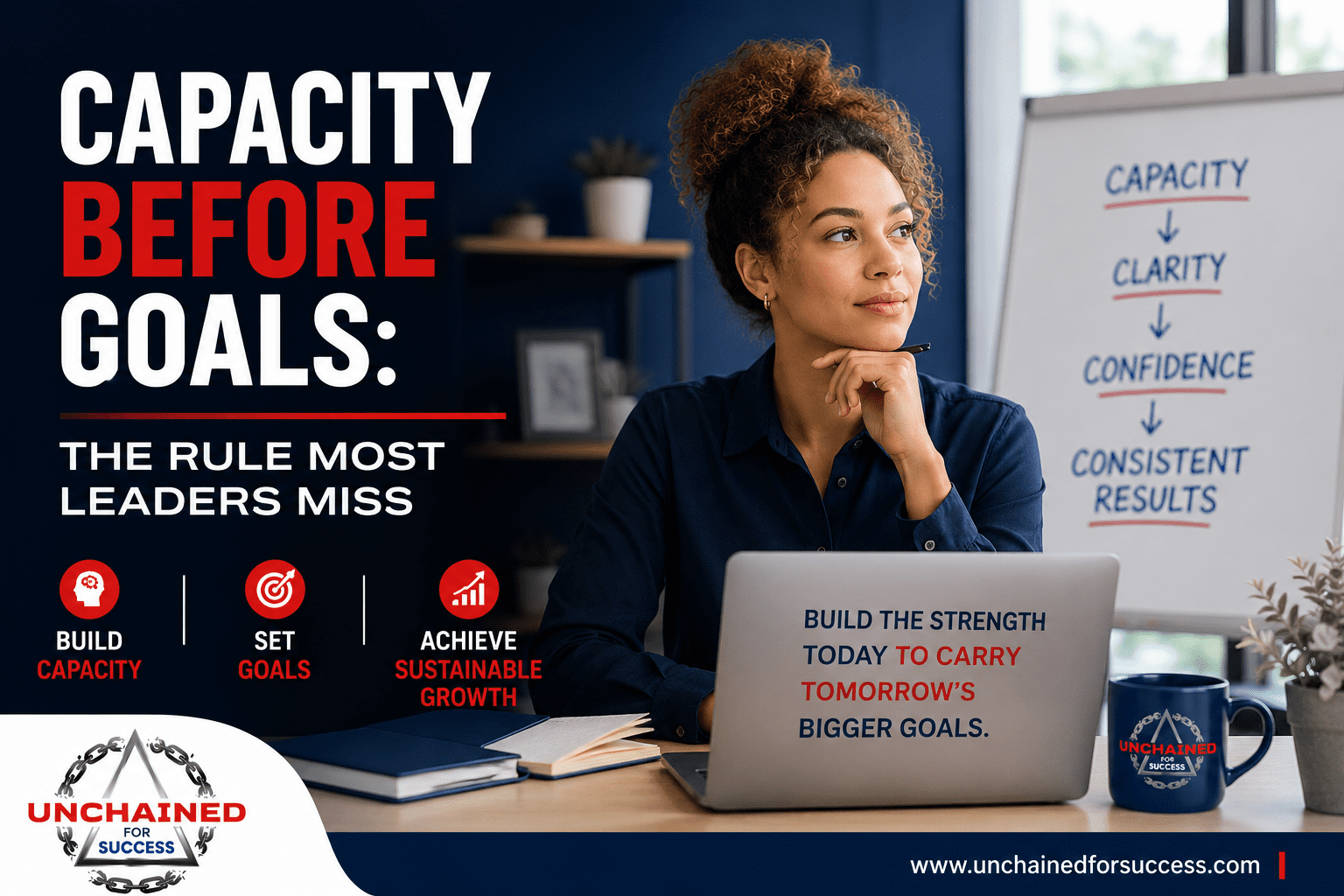
Capacity before goals is the rule most leaders miss, and it is the discipline that quietly separates ambition that delivers from ambition that burns out. Most ambitious people set bigger goals first and then scramble to build the capability to carry them. Within weeks, the workload exposes the gap. Progress stalls, energy drains, and the goal that once inspired begins to feel like a punishment. The failure is rarely the goal. The failure is sequence.
Last week’s post, Stretch Goals Must Stay Within Your Control, explored how ambition must sit within executable structure. This week, the focus moves one layer deeper. Before structure can hold a goal, the person, team, or organisation must have the capacity to carry it. By the end of this article, you will know why capacity must precede ambition, where capacity sits within the Unchained framework, and how to design earlier goals that build the capacity bigger goals will demand.
Why Capacity Before Goals Matters
Most goal-setting advice treats capacity as a given. It assumes that if the goal is clear and the plan is sharp, delivery will follow. Yet research published in Harvard Business Review shows that strategy execution fails far more often through capability shortfalls than through strategic flaws. People do not lack ideas. They lack the structural strength to carry the ideas they already have.
When leaders ignore this, three patterns emerge. They start strong and stall. They deliver one goal and burn out before the next arrives. They scale ambition without scaling the systems, skills, or stamina the ambition requires. In every case, the failure looks like a goal problem. Consequently, the real failure goes unaddressed: it is a capacity problem.
Capacity is what allows pressure to be absorbed rather than break you. Bigger goals always produce bigger pressure. The leaders who succeed are not the ones with the biggest ambitions. They are the ones whose foundations match the weight of what they have chosen to carry.
The Core Concept Behind Capacity Before Goals
The principle is straightforward. Before you set a goal that demands more than you currently carry, design earlier goals that grow what the later goal will require. To build capacity first is not to lower ambition. It is to sequence ambition intelligently so that each stage produces the strength the next stage will demand.
Goal-setting research by Locke and Latham, summarised on MindTools, confirms that specific and challenging goals reliably outperform vague intentions. Yet specificity without capacity simply produces precise failure. The discipline most leaders miss is calibrating the goal to current capacity while building deliberately toward the bigger goal.
Three forms of capacity matter most:
• Skill capacity is the technical capability to perform the work the goal requires.
• Structural capacity is the systems, teams, and infrastructure that hold the work together.
• Personal capacity is the energy, focus, and resilience you can deploy without depletion.
Bigger goals stretch all three at once. When any one falls short, the goal exposes the gap rather than closes it. This is why ambitious people often feel that success made them weaker, not stronger. They reached the target without building the structure to hold it.
“A goal without capacity is not a target. It is a tax on your future self.”
Capacity Before Goals Within the Unchained Framework
The Unchained framework is built on five elements working together: a meaningful goal, a strong why, a clear plan, helpful beliefs, and repeatable habits. Capacity is not named as an element, and rightly so. Capacity is what the framework produces when each element is applied with discipline.
The meaningful goal is where the discipline of capacity before goals operates most directly. A goal that exceeds current capacity is not meaningful. It is aspirational. The strong why provides the fuel that sustains capacity-building under discomfort. The clear plan is where capacity-building goals are sequenced before capacity-deploying goals. Helpful beliefs are what stop the gap between current and required capacity from being interpreted as personal limitation. Repeatable habits are the daily mechanism through which capacity actually compounds.
This connects directly to the argument in How Trade-Offs Create Progress and the execution discipline explored in Stretch Goals Must Stay Within Your Control. Bigger goals fail when ambition is allowed to outrun the structure that carries it. Capacity before goals is the upstream discipline that prevents the failure from beginning in the first place.
Practical Examples of Capacity Before Goals
For Individuals
Sarah, a senior project manager, sets a bigger goal to move into a director role within two years. Her instinct is to apply for every senior opportunity that appears. Six months later, she is exhausted, has been rejected four times, and has lost confidence. Applying capacity before goals, Sarah rewrites her approach. The bigger goal remains, but it is now preceded by capacity-building goals. This quarter she will lead a cross-functional initiative. This half she will mentor two junior colleagues. This year she will complete a recognised executive programme. None of these is the destination. Each one grows the skill, structural, or personal capacity the director role will demand. By the time she applies, capacity already exists. The goal becomes confirmation, not conquest.
For Businesses
A growing consultancy declares a bigger goal to triple revenue over three years. The instinct is to expand the sales pipeline immediately. Disciplined leaders apply capacity before goals and treat year one as capacity construction. They invest in operational systems, leadership depth, delivery infrastructure, and brand authority before sales targets escalate. Year one revenue grows modestly. Years two and three then produce the tripling without the business breaking under its own success. Businesses that scale revenue without scaling capacity collapse predictably. Bigger goals expose smaller systems.
For Projects
A digital transformation programme commits to a bigger goal of reducing customer resolution time from forty-eight hours to four hours within twelve months. The temptation is to launch quickly and iterate under pressure. Applying capacity before goals, the programme leader designs phase one as a capacity phase. The team is assembled, the governance is installed, the systems are tested, the users are trained. Only then does delivery begin. The goal of phase one is not output. It is readiness. Programmes that skip this phase spend phase two firefighting what phase one should have built.
How to Apply Capacity Before Goals in Leadership
Audit Capacity Before Setting the Goal
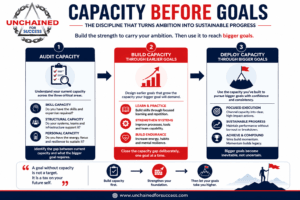
Before the bigger goal is written, run a deliberate capacity audit. List the skill capacity, structural capacity, and personal capacity the goal will demand. Be honest about where each currently sits. The gap between current and required capacity is not a weakness. It is the design brief for the goals that come first.
Design Earlier Goals That Grow Capacity
Once the gap is clear, design two or three earlier goals that close it. These capacity-building goals should be specific, measurable, and timebound. They should not feel like the destination. They should feel like the foundation. Each one must produce a measurable increase in the capacity the bigger goal will require.
Sequence Capacity-Building Before Capacity-Deploying
The order is not optional. Capacity-building goals must come before capacity-deploying goals. A capacity-building goal grows what you can carry. A capacity-deploying goal uses what you already carry to produce an outcome. Most people only set the second type and then wonder why progress stalls. Disciplined leaders sequence the first type ahead of the second, deliberately and visibly.
Review Capacity Quarterly
Capacity is not static. It expands when habits compound and contracts when systems decay. Once a quarter, review whether capacity is keeping pace with ambition. If the bigger goal still sits beyond current capacity, the next quarter must include capacity-building goals. If capacity now matches the goal, the next quarter shifts to capacity-deploying goals. The rhythm protects ambition from collapse.
Common Mistakes That Undermine Capacity Before Goals
Three patterns appear repeatedly when leaders ignore this discipline.
The first mistake is mistaking ambition for capacity. People assume that wanting a bigger goal badly enough will produce the capacity to deliver it. Motivation accelerates effort. It does not manufacture skill, structure, or stamina. Ambition is the engine. Capacity is the chassis. Engines without chassis do not travel. They vibrate violently and then break.
The second mistake is collapsing the timeline. Leaders who feel behind compress capacity-building stages and jump straight to deployment. The result is predictable. They deliver something, but they deliver it badly, and the cost of recovery exceeds the gain. Meanwhile, speed without capacity is not acceleration. It is regression at high velocity.
The third mistake is treating capacity as personal only. Many leaders work on themselves while ignoring the systems and teams around them. By contrast, sustainable leadership grows personal and structural capacity in parallel. Research published in the MIT Sloan Management Review confirms that overcommitment without structural capacity expansion is one of the most consistent predictors of organisational underperformance. Personal capacity without structural capacity is heroism, not leadership. The two must grow together.
Conclusion: Capacity Built First, Goals Delivered Next
Capacity before goals is not a slowdown. It is the sequence that allows speed to be sustained. Without it, ambition burns hot and dies young. With it, bigger goals stop being uncertain and start becoming inevitable. The leaders who last are the ones who built first. The ones who collapse are the ones who skipped the building and called it confidence.
If progress is stalling, the issue is rarely the size of the goal. It is the size of the gap between the goal and the capacity that carries it. Close the gap deliberately, sequence the goals correctly, and ambition becomes momentum rather than anxiety in a louder costume.
“Bigger goals do not need bigger dreams. They need earlier discipline.”
Call to Action
If this article reframed how you think about ambition, share it with someone setting bigger goals without the capacity to deliver them. Subscribe to Unchained for Success for weekly guidance on goals, habits, beliefs, and execution that lasts.
Shareable Quote
“Capacity before goals is the rule most leaders miss. The ones who learn it last the longest.”
#UnchainedForSuccess #CapacityBeforeGoals #GoalSetting #LeadershipDevelopment #ExecutionDiscipline #BiggerGoals
References
1. Kwegyir-Afful, C. (2024). Unchained: Success Unlocked – A Proven Framework for Achieving Your Goals.
2. Sull, D., Homkes, R. and Sull, C. (2015). “Why Strategy Execution Unravels — and What to Do About It.” Harvard Business Review, March. Available at: https://hbr.org/2015/03/why-strategy-execution-unravels-and-what-to-do-about-it
3. Birkinshaw, J. and Cohen, J. (2013). “Make Time for the Work That Matters.” Harvard Business Review, September. Available at: https://hbr.org/2013/09/make-time-for-the-work-that-matters
4. Locke, E. A. and Latham, G. P. (2006). “New Directions in Goal-Setting Theory.” Current Directions in Psychological Science, 15(5), pp. 265–268. Available at: https://journals.sagepub.com/doi/10.1111/j.1467-8721.2006.00449.x
5. MindTools (2026). “Locke’s Goal-Setting Theory.” Available at: https://www.mindtools.com/azazlu3/lockes-goal-setting-theory/
6. Kwegyir-Afful, C. (2026). “Stretch Goals Must Stay Within Your Control.” Unchained for Success, 7 May. Available at: https://unchainedforsuccess.com/stretch-goals-must-stay-within-your-control/
7. Kwegyir-Afful, C. (2026). “How Trade-Offs Create Progress.” Unchained for Success, 15 April. Available at: https://unchainedforsuccess.com/trade-offs-create-progress/
8. Kwegyir-Afful, C. (2026). “Growth Without Burnout: How to Grow Through Discomfort.” Unchained for Success, 29 April. Available at: https://unchainedforsuccess.com/growth-without-burnout/