Mid-Year Goal Review: Persist or Change Direction

June marks the midpoint of the year, and the goals you set in January now face an honest test. Some are moving well. Others have quietly stalled. The real question is whether to persist or change, but most people answer it through frustration, fear, or instinct. A mid-year goal review replaces that guesswork with evidence.
This post gives you a clear way to decide. It separates a discipline problem from a direction problem, so you stop confusing the two. More importantly, it shows when persistence is wise and when it has hardened into stubbornness. By the end, you will have a practical test you can apply to any goal this week.
Why a Mid-Year Goal Review Matters
Six months is long enough to reveal a pattern, but short enough to act on it. That timing makes a mid-year goal review uniquely valuable. You now have real data: what you have done, what you have avoided, and where momentum has drained away. Sometimes a stall reflects stretched capacity rather than a wrong goal, a pattern we explore in Outgrown Your Capacity? 7 Signs to Watch For.
However, the midpoint also carries a risk. Tiredness and disappointment can push you toward two errors. Either you abandon a sound goal too early, or you cling to a failing plan for too long. A structured review protects you from both. It turns persist or change from a guess into a judgement.
Last week’s post, Review Your Goals Mid-Year and Reset Your Plan, walked through how to reassess each goal and rebuild your plan. This post takes the next step. Every honest course correction eventually comes down to one choice: persist or change.
Persist or Change: The Real Mid-Year Question
Persistence and stubbornness look alike from the outside. Both involve staying the course under pressure. Yet they come from opposite places.
Persistence means staying committed to the goal while improving the method. You keep the destination and upgrade the route. Stubbornness means protecting a failing plan because you do not want to admit it is not working. You defend the route even as it leads nowhere.
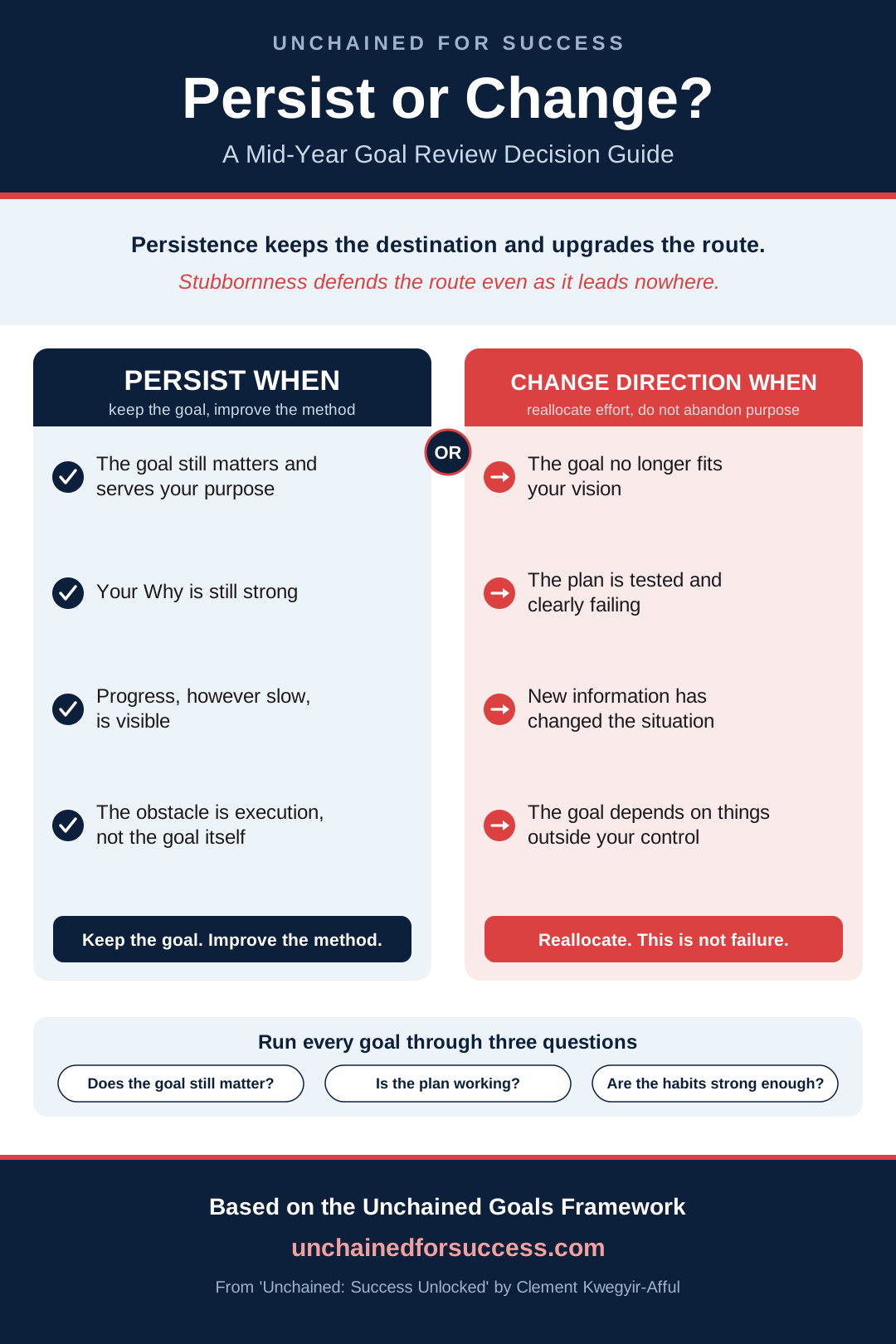
Persistence keeps the destination and upgrades the route. Stubbornness defends the route even as it leads nowhere.
This is where many capable people lose months. They mistake loyalty to a plan for commitment to a goal. As a result, they pour more time, money, and energy into an approach the evidence has already rejected.
Research gives this trap a name. In a classic study, Staw (1976) found that people committed the most resources to a failing course of action when they felt personally responsible for the original decision. In other words, the more it is “your” plan, the harder it becomes to change. Writing in Harvard Business Review, Vermeulen and Sivanathan (2017) describe the same pattern in organisations, where sunk costs and pride quietly keep failing strategies alive.
The other side carries evidence too. Duckworth and colleagues (2007) suggest that perseverance toward long-term goals predicts achievement beyond talent alone. The effect is modest, and critics note it overlaps heavily with conscientiousness, so it is no licence to grind on regardless. Still, the reminder holds: the answer to a stalled goal is often to hold on and improve the method, not to walk away.
So the mid-year question is not whether you are committed. It is what you are committed to. Persist or change is, at heart, a test of that distinction.
How the Unchained Goals Framework Frames the Decision
The Unchained Goals Framework turns this decision into a disciplined check rather than a mood. Each component asks a different question, and together they tell you whether to persist or change direction. The framework does not ask whether you feel motivated today. It asks which part of the goal system is failing.
The eight components keep their fixed order, yet they answer three larger questions. Purpose, Vision and Why test whether the goal still matters. Goals, Ownership and Planning test whether the plan is working. Habit Conversion tests whether your habits can carry it. Beliefs sit across all three, because a distorted belief corrupts every answer. Hold those three questions in mind as you read.
Purpose comes first, as the prior filter. It defines your domain of contribution: what is worth building and what achievement is legitimate. Before anything else, ask whether this goal still belongs to that domain. If the purpose has disappeared, no amount of effort will make the goal worth finishing.
Vision then tests trajectory. Purpose sets the domain; vision sets your long-term positioning within it. A goal that no longer fits that positioning is a candidate for change, however much work it has already absorbed.
Goals and Why examine the target itself. Revisit the SSMTC criteria: is the goal still Specific, Stretched, Measurable, Time-bound, and within your Control? A goal that leans on factors outside your control is often a direction problem, not a discipline one, as we argue in Stretch Goals Must Stay Within Your Control. Your Why is the conscious justification of cost: whether this outcome is still worth the sacrifice it demands.
Ownership is the decisive component here. Ownership is intention converting into responsibility under cost. In plain terms, it is where intention becomes responsibility, and it bites hardest when the cost is uncomfortable. It asks you to own the real position honestly, including the uncomfortable truth that a plan is failing. Genuine ownership makes persistence powerful, because you improve the method instead of defending it. That same ownership makes a change of direction clean, because you stop paying for sunk costs out of pride.
Beliefs come next. Limiting beliefs can disguise themselves as strategy. “I must never quit” can keep a failing plan alive, while “this will never work” can kill a sound one early. Examine the belief before you trust the verdict.
Planning is where most persistence decisions are won. Often the goal is right and only the plan needs rebuilding. A weak plan looks like a wrong goal until you redesign it.
Habit Conversion is the final test. It is where the repeated actions that drive the goal turn from deliberate effort into stabilised habit. Ask whether that conversion has actually happened. Until it does, execution stays dependent on fluctuating intention.
Applied in order, these components produce something valuable: the clarity to judge your own goals without flinching. That clarity is the real outcome of a good mid-year goal review. It is what lets you persist or change with a clear head rather than a heavy heart.
Persist or Change Direction in Practice: Three Examples
These three cases show the persist or change decision in action, one for each context.
Individual: Persist on a Stalled Promotion
Consider a professional pursuing a promotion that has not arrived. The purpose still holds, because she wants greater scope and impact, and the Why is strong. Her review shows steady skill growth but weak visibility with decision makers. This is a discipline problem, not a direction problem. She persists and changes only the method, by seeking sponsorship and higher-profile work. Persistence is the right call.
Business: Change Direction on a Failing Product
Now take a founder whose product has struggled for a year. Customers are polite but rarely return. The market has shifted, and new information has changed the picture. Here the goal itself, not the effort, is the issue. This is a direction problem, not a discipline one. Holding on would mean paying for sunk costs out of pride. So the founder changes direction, keeping the purpose of serving those same customers while building a different product. Change is the right call.
Project: Persist Through Inconsistent Delivery
Finally, consider a project team running behind on a critical delivery. The objective still matters to the organisation, and the plan is broadly sound, but priorities keep shifting and focus is fragmented. Here the problem is execution, not direction. The team persists, simplifies the plan, protects focus, and rebuilds accountability around fewer commitments. Once again, persistence wins, for the right reasons.
How to Apply a Mid-Year Goal Review
Use this persist or change test on each major goal. It works for individuals, teams, and organisations alike. Be honest, because the value of a review lies entirely in its honesty.
Loyalty to a plan is not the same as commitment to a goal.
When to Persist
Persist when the destination is still right, but the route needs improving. In practice, that shows up as four signals lining up. The goal still matters and serves your purpose. The Why remains strong. Progress, however slow, is visible. And the main obstacle is consistency, patience, or execution rather than the goal itself. When these hold, keep the goal and improve the plan that drives it.
When to Change Direction
Change direction when the destination no longer deserves the cost. That happens when the opposite signals appear. The goal no longer aligns with your vision. The plan has been properly tested and clearly is not working. New information has changed the situation. Or the goal depends too heavily on things outside your control. In these cases, changing direction is not failure. It is an intelligent reallocation of your time and energy.
Your Mid-Year Goal Review Checklist
Work through these persist or change questions for each goal:
- Purpose: does this goal still belong to what is worth building?
- Vision: does it still fit my long-term direction?
- Goal and Why: does it still meet the SSMTC criteria, and is it still worth its cost?
- Ownership: am I still willing to carry the cost and consequences of this goal?
- Beliefs: is a limiting belief distorting my verdict?
- Planning: have I genuinely tested the plan, or only judged the goal?
- Habits: have the actions become habit, or do they still rely on willpower?
- Decision: based on the evidence, do I persist or change?
Common Mistakes in a Mid-Year Goal Review
Even careful people stumble at this stage, choosing to persist or change for the wrong reasons. Watch for these traps.
The first is treating effort as evidence. Hard work proves commitment, not direction. A goal can absorb enormous effort and still be wrong.
A second mistake is confusing a plan with a goal. When results disappoint, people often scrap the whole goal when only the plan needed rebuilding. Test the plan before you judge the goal.
The third trap is letting sunk costs decide. Time and money already spent cannot be recovered, so they should not drive the choice. Vermeulen and Sivanathan (2017) suggest this bias quietly sinks strong organisations, and it sinks individual goals just as easily.
A fourth error is reviewing in a low moment. A bad week is not a fair judge of a whole year. Choose a calm, rested moment, so the verdict reflects reality rather than fatigue.
Finally, avoid reviewing without deciding. A review that ends in a vague “I will keep going” changes nothing. Close every review with a clear choice: persist or change.
Conclusion: Persist or Change With Confidence
A mid-year goal review is not a verdict on your worth. It is a moment of clarity. It asks three honest questions: does the goal still matter, is the plan working, and are the habits strong enough to carry you forward?
Answer those well, and the decision to persist or change direction becomes calm rather than fearful. You stop confusing loyalty to a plan with commitment to a goal. As a result, you free your best energy for the goals that still deserve it.
The bravest thing you can do at the midpoint is not to push harder. It is to choose, with open eyes, what truly deserves the second half of your year.
| Take the next step. Decide whether to persist or change before the year decides for you. Download the free Goals Framework Workbook and apply the full Unchained Goals Framework to every goal you carry into the rest of 2026. Then join me next Saturday for “The Mid-Year Reset Most People Avoid”, the next post in this June series. |
Shareable quote: “Persistence keeps the destination and upgrades the route. Stubbornness defends the route even as it leads nowhere.”
Hashtags: #UnchainedForSuccess #MidYearReview #GoalSetting #PersistOrChange #Leadership
References
- Kwegyir-Afful, C. (2023). Unchained: Success Unlocked. A Proven Framework for Achieving Your Goals.
- Duckworth, A. L., Peterson, C., Matthews, M. D. and Kelly, D. R. (2007). “Grit: Perseverance and Passion for Long-Term Goals.” Journal of Personality and Social Psychology, 92(6), pp. 1087-1101. Available at: https://pubmed.ncbi.nlm.nih.gov/17547490/
- Staw, B. M. (1976). “Knee-Deep in the Big Muddy: A Study of Escalating Commitment to a Chosen Course of Action.” Organizational Behavior and Human Performance, 16(1), pp. 27-44. Available at: https://www.sciencedirect.com/science/article/abs/pii/0030507376900052
- Vermeulen, F. and Sivanathan, N. (2017). “Stop Doubling Down on Your Failing Strategy.” Harvard Business Review, 95(6), November-December 2017, pp. 110-117. Available at: https://hbr.org/2017/11/stop-doubling-down-on-your-failing-strategy