Energy Management Beats Time Management Everytime
You planned this year with care. In January, the calendar looked ordered and the goals looked reachable. Now it is July, and the same plan feels heavier than it should. Halfway through the year, the quiet culprit is usually poor energy management rather than a poor schedule.
The problem is rarely a shortage of hours. It is a shortage of energy.
You can still hold the time slot in your diary and arrive at it with nothing useful left to give. That is why energy management, not time management, often decides whether your goals survive the second half of the year. This post explains why energy matters, how it affects execution, and how to protect the energy your goals actually run on.
Why Energy Management Matters More at Mid-Year
At the start of a year, motivation covers a lot of gaps. By July, that early charge has drained, and the calendar alone cannot replace it. You can still find the time slot for a goal, yet arrive at it with nothing left to give. This is the quiet failure behind most stalled plans. The hours were there, but the capacity was not.
Managing your energy addresses the resource that time management assumes but never provides. A schedule tells you when to act. It says nothing about whether you can act well when the moment comes. As a result, a full calendar can hide an empty tank, and the goal pays the price. Before you redesign your week, it helps to take the mid-year reset most people avoid, so you know which goals still deserve your energy.
| A schedule can promise the hour. Only your energy can deliver the effort inside it. |
Energy Management Versus Time Management
Time is fixed and finite. Everyone receives the same twenty-four hours, and no method adds more. Energy behaves differently. It rises and falls across the day and, crucially, it can be renewed. That single difference is why energy over time management is the stronger lever for long goals.
Time management sorts tasks into slots. Energy management governs the capacity that fills those slots with real work. This distinction is not new. Tony Schwartz and Catherine McCarthy made a similar case in the Harvard Business Review: organisations gain more by renewing energy than by squeezing more hours from people. Research on recovery points the same way. Sabine Sonnentag’s study of recovery and work engagement suggests that recovery during leisure time is linked to higher engagement and more proactive behaviour the following day.
When you manage energy, you stop treating yourself as a machine that runs at one speed. Instead, you work with your natural peaks, protect your recovery, and spend your best hours on the work that moves the goal.
How Energy Fits the Unchained Goals Framework
Every goal moves forward through four steps most people already recognise. First comes an Outcome, the result you want. A Performance standard then sets what it takes to get there. Next is a Process, the work you repeat. And that Process, repeated enough, becomes a Habit. Those four are the engine of any goal. In the Unchained Goals Framework they have a collective name, the Directional Execution Spine, and together they are the only part of the system that produces movement.
Energy is what powers that engine. A Process does not repeat itself. You have to bring the capacity to keep showing up until the behaviour becomes automatic, and that capacity is energy. When your energy stays low for too long, the Process slips. When the Process slips, it never hardens into a Habit, and the goal falls back on motivation and willpower, which rarely last.
So energy is not one more part to bolt on to the framework. It is the condition that lets every part run. Think of it as fuel rather than machinery.
The framework also builds in a way to keep watch. Its Control System governs the whole thing continuously, spotting drift early rather than waiting for a scheduled review. Read your own energy the same way. If it keeps falling on a goal, that is not a character flaw. It is a signal, telling you the load may be too high, the rest too low, or the work scheduled at the wrong time. Adjust before the goal stalls.
| In this framework, energy is not the goal. It is the fuel that lets the goal move. |
Managing Your Energy in Practice: Three Examples
Individual. A consultant sets a goal to publish weekly. She has the time blocked every Saturday morning. By July she keeps the slot but writes badly in it, because she arrives exhausted from the week. She moves the writing to a Thursday peak and guards her Wednesday evening for rest. Within three weeks the writing improved, because the slot matched her real energy rather than her leftover time.
Business. A sales team measures activity by hours logged. Numbers look healthy, yet results fade after June. The manager protects mornings for live calls and moves admin to low-energy afternoons. The team did not work longer. They moved the hardest work into the hours when they had the most capacity, and conversion climbed.
Project. A delivery team runs long days to hit a deadline. Progress looks fast, then stumbles as errors mount and people burn out. The lead cuts the day to a sustainable length and adds real recovery. As a result, the team reduced rework, protected decision quality and steadied delivery. The project landed sooner than the crash course would have allowed.
How to Apply Energy Management to Your Goals
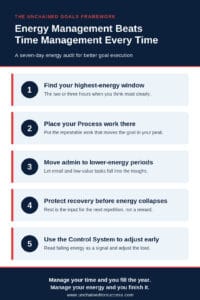
Energy management starts with a simple audit of your own rhythm. Notice the two or three hours each day when you think most clearly, and treat them as protected.
Next, match the work to the energy. Put Process, the repeatable work that drives your goal, into your peak hours. Push low-value tasks into the troughs where they do less harm.
Then protect recovery on purpose. Rest is not a reward for finishing. It is the input that makes the next repetition possible, so schedule it as seriously as you schedule the work. This is how you pursue growth without burnout rather than trading your health for short-term output.
Finally, review energy as a signal. When your energy for a goal falls week after week, read it through your Control System as data, and adjust the load before the goal stalls. If a goal has already slipped, use the same logic to diagnose and recover a drifting year.
A Seven-Day Energy Audit You Can Run
This is not a new part of the framework. It is a simple audit you can run using the framework’s execution logic.
For the next seven days, track three things:
- When your energy is highest.
- When your energy drops.
- Which tasks you keep doing during your best energy window.
Then make one change. Move the Process work that matters most into your highest-energy window, and push admin, messages and low-value tasks into the lower-energy periods.
Do not redesign your whole week. Protect one high-energy window, and put your most important goal action inside it.
Common Mistakes That Drain Your Energy
The first mistake is treating a full calendar as proof of progress. Booked hours are not the same as effective effort, and confusing the two hides the real problem.
A second mistake is spending peak energy on easy wins. Answering email at your sharpest hour feels productive, yet it wastes the very capacity your goal needs most.
A third mistake is cutting recovery to buy time. Skipping rest borrows energy from tomorrow at a punishing rate of interest, and the debt always comes due.
Your Energy Is the Year’s Real Advantage
Time management will always have its place, because the calendar still matters. Even so, the calendar cannot supply the effort that goals demand. Energy can, and good energy management renews it when you act with intent. This is why energy management is not a productivity trick. It is a goal-protection discipline. Protect your energy, aim it at the part of the system that moves, and let the Control System keep it honest. Do that, and your January goals will still be alive in December. Manage your time, and you fill the year. Manage your energy, and you finish it.
| Ready to keep your goals moving through the second half of the year? Explore the Unchained Goals Framework and learn how to turn your best energy into repeatable Process, Habit Conversion and sustained progress. |
Shareable quote: “Manage your time and you fill the year. Manage your energy and you finish it.”
#EnergyManagement #Productivity #GoalSetting #UnchainedGoalsFramework #Leadership #PeakPerformance
References
- Schwartz, T. and McCarthy, C. (2007). “Manage Your Energy, Not Your Time.” Harvard Business Review, October 2007. Available at: https://hbr.org/2007/10/manage-your-energy-not-your-time
- Sonnentag, S. (2003). “Recovery, work engagement, and proactive behavior: A new look at the interface between nonwork and work.” Journal of Applied Psychology, 88(3), pp. 518-528. Available at: https://pubmed.ncbi.nlm.nih.gov/12814299/