Back on Track: How to Diagnose and Recover a Drifting Year

Getting a drifting year back on track by June feels harder than starting over, yet it rarely is. By now, real life has tested every goal you set. Some have moved well. Others have slipped off track. The honest reset in the last post showed you how to face that evidence. This post covers what comes next: the recovery itself.
The Unchained Goals Framework treats recovery as diagnosis, not effort. When a year drifts, the instinct is to try harder. That instinct is usually wrong. You do not need more willpower. You need to find which layer of the goal actually drifted, then rebuild from there to get back on track. That is what this post shows you.
Why Getting Back on Track Beats Starting Over
If you are behind on your goals halfway through the year, you are not alone. A common response to a drifting year is to wait for January. That instinct is expensive. A fresh start discards six months of effort and hard-won evidence. Recovery keeps that value and builds on it.
The second half of the year holds real power. Around twenty-six weeks remain, which is enough to rescue most goals that still matter. Research on goal setting shows that people who adjust and persist outperform those who quit and restart (Locke and Latham, 2002). So the aim is not fresh motivation. The aim is to get back on track with a method that works when motivation is low.
Drift also compounds. A missed week becomes a missed month, and a missed month becomes a written-off year. Acting now halts that slide. If you are still weighing whether a goal is worth keeping at all, the earlier post on whether to persist or change direction will help.
What Getting Back on Track Really Means
Getting back on track is not about effort. It is about diagnosis. Real recovery starts from where you stand today, then finds the one layer of the goal that drifted.
It also means resisting the most common mistake. When results slip, most people escalate effort. They work longer and push harder, yet the drift continues, because effort cannot repair a fault in the structure. A drifting goal is not a willpower problem. It is a signal that one layer of the goal has weakened, and the repair belongs at that layer.
This is course correction, not punishment. A ship off course does not sail back to harbour to begin again. It adjusts heading from its current position. Your year recovers the same way.
Recovery does not return you to January’s plan. It moves you forward from where you actually stand.
How the Framework Gets a Drifting Year Back on Track
Here is the idea that changes how you recover: a drifting year is a structure problem, not a willpower problem. So you do not push harder. You find the one layer that broke and repair it there. The framework names this disciplined search Diagnose Mode, which means interrogating a goal when results drift, working from the smallest controllable layer upward rather than blaming the goal itself. You do not escalate effort first. You walk the structure in order, find where it broke, and get back on track by mending that layer alone.
Most of that structure runs through the Directional Execution Spine, the chain that actually produces movement: Outcome, then Performance, then Process, then Habit. Diagnosis walks that chain in reverse, from the bottom up. The full forward build of every component sits in the first post in this series.
Start at the Habit, Not the Outcome
Begin at the smallest layer: the daily habit. Ask one plain question. Did the behaviour actually happen? Most drift hides here, long before the Outcome Goal itself comes into question. If the habit lapsed, you have your answer, and the fix is to rebuild one repeatable action rather than redesign the year. Implementation intentions help, because a simple “when this happens, I will do that” plan converts intention into action when resistance rises (Gollwitzer, 1999).
Test the Process
If the habit held, test the process next. A process goal is the controllable behaviour meant to produce results. Ask whether it is actually capable of delivering the standard you need. Sometimes the habit runs faithfully, yet the chosen action was never strong enough to move the outcome. If so, replace it with a smaller, controllable action that genuinely moves the standard, rather than repeating one that never could. For more on closing the gap between plan and delivery, see mastering execution.
Check You Are Measuring the Right Thing
Next, check the performance measure. Performance goals are the standards that show whether effort is converting into progress. If you track the wrong standard, or track it too rarely, drift hides until it is severe. Fix it by choosing the one number that proves real movement, then review it weekly so you catch the next slip and get back on track.
Inspect the Structural Integrity Systems
If the spine is sound, turn to what the framework calls the Structural Integrity Systems: the four layers that hold a goal steady under pressure. They are Why, Ownership, Beliefs and Planning. None of them produces movement. Each one stops the goal collapsing when the cost becomes real.
Check each in turn. Has your Why weakened, so the cost no longer feels justified? Your Why is the cost justification for this specific goal, and a drifting year often means the cost grew while the reason stayed the same. Has Ownership become conditional, so you carry the goal only when it suits you? Has a quiet belief turned against the goal, telling you it is already too late? Beliefs like these are structural assumptions about what is possible, and the reset post covers how to surface and challenge them. Has the Plan spread thin under pressure instead of concentrating? A recovery plan protects sustainable capacity and names its trade-offs, rather than assuming perfect time and energy.
Repair the weak system directly: restate the Why, re-accept the cost as yours, challenge the belief with evidence, or cut the plan back to one or two priorities. Mending the layer that broke is what gets the goal back on track.
Check the Outcome Still Sits Within Control
Only when every layer beneath is sound do you question the outcome itself. Ask whether it still sits within your control. A valid outcome goal is stretched, specific, measurable, time-bound and under your control. If the outcome has drifted beyond your influence, reset it to something you can actually move. And if the lower layers are sound yet the goal still feels wrong, the deeper question is whether it still serves your Vision and Purpose. If it no longer does, release it honestly rather than recover it.
The Control System Holds It All Together
The Control System is not a step in the walk. It is the layer that runs the walk, the framework’s governance mechanism. In plain terms, it is the standing check that keeps watch over the whole goal: not only whether you showed up, but whether the measure, the plan, your reason and your sense of ownership still hold. It runs continuously, and it is what triggers this diagnosis the moment performance moves outside the range you accepted. This monitor-and-correct loop is well established, because control theory describes self-regulation as exactly this cycle of checking progress against a standard and closing the gap (Carver and Scheier, 1982). During recovery the Control System does two jobs. It holds the corrected goal steady. It also catches the next slip early, while the cost of fixing it stays small.
Drift is not a willpower problem. It is a signal that one layer has weakened.
Getting Back on Track in Practice: Individual, Business and Project
Consider an individual. A finance manager planned to pass two professional exams this year and has sat neither. Diagnosis starts at the habit, and the habit is the fault, because study time never survived a busy quarter. The Outcome Goal still matters for her promotion, so she does not abandon it. She rebuilds one habit, a fixed ninety-minute study block three evenings a week, and targets one exam rather than two. A short Sunday review keeps the block honest, and she is back on a credible path within a fortnight.
Now consider a business. A small agency aimed to lift recurring revenue by thirty per cent and has managed only five. The habit holds, so diagnosis moves up the spine. Scattered pilots are the fault, none strong enough to produce the standard. The owner re-plans around the single service that converts best, names the trade-off, and drops the rest. Monthly governance tracks the recovery, and the agency is back on track for the second half.
Finally, consider a project. A delivery programme is two months late, and the team keeps adding scope to feel busy. Recovery does not begin by working harder. It begins by walking the structure. Are the daily delivery habits happening? Is the process capable of the required standard? Are the right measures in place, and has ownership become diffused across too many people? Once the team answers those questions, the fix is precise. The team freezes scope, restates the controllable outcome, and feeds the Control System with daily stand-up evidence before drift compounds.
How to Get Back on Track: The Diagnostic Order
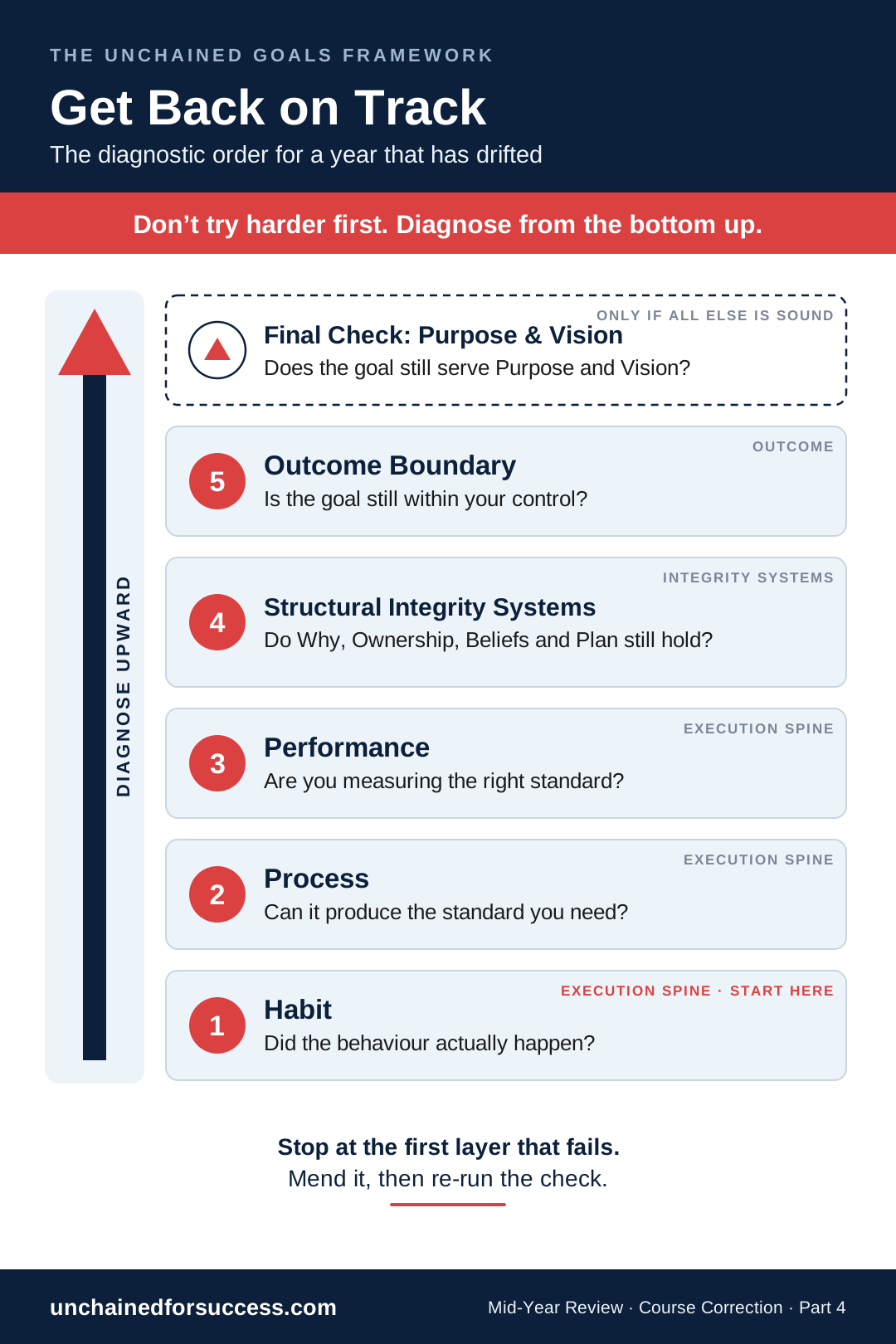
This is how to get back on track with your goals without scrapping them: diagnose before you redesign. Run these five checks in order, from the bottom up, and stop at the first layer that fails.
- Check the habit. Did the daily or weekly behaviour actually happen?
- Test the process. Is that behaviour capable of producing the standard you need?
- Check the measure. Are you tracking the right performance standard, often enough?
- Inspect the integrity systems. Has your Why weakened, Ownership become conditional, a Belief turned against the goal, or the Plan spread thin?
- Check the outcome boundary. Does the goal still sit within your control, and does it still serve your Vision and Purpose? Keep it only if it does.
Notice what this order prevents. It stops you redesigning the whole year when a single habit was the fault. Repair the lowest broken layer first, then re-run the check.
Common Mistakes When Getting Back on Track
Three mistakes stall most recoveries.
The first is trying harder before diagnosing. Effort poured into a structural fault drains energy and changes nothing. Find the broken layer first, then act.
The second is recovering everything at once. Over-correction spreads thin effort across too many goals and rescues none. Make deliberate trade-offs and protect what still serves your Purpose.
The third is stopping at insight. A diagnosis that never becomes a daily habit changes nothing. Name the broken layer, rebuild the action, and let the Control System hold it.
From Drift to Disciplined Recovery
A drifting year is not a verdict. It is simply a year that needs diagnosing, then governing back into shape. The people who finish strong are rarely those who never drifted. They are the ones who found the broken layer while others just tried harder.
So start the diagnosis now. Check the habit, walk up the structure, repair the lowest broken layer, and govern the rest of the year one week at a time until you are back on track. Faced with method, a drifting year still becomes one you are proud of.
You cannot get back the months that drifted. You can still govern every week that remains.
“A drifting year is not a willpower problem. It is a signal that one layer has weakened.”
Hashtags: #BackOnTrack #UnchainedGoals #GoalSetting #Productivity #Leadership #MidYearReset
References
- Locke, E.A. and Latham, G.P. (2002) “Building a Practically Useful Theory of Goal Setting and Task Motivation”, American Psychologist, 57(9), pp. 705-717. Available at: https://doi.org/10.1037/0003-066X.57.9.705
- Gollwitzer, P.M. (1999) “Implementation Intentions: Strong Effects of Simple Plans”, American Psychologist, 54(7), pp. 493-503. Available at: https://doi.org/10.1037/0003-066X.54.7.493
- Carver, C.S. and Scheier, M.F. (1982) “Control Theory: A Useful Conceptual Framework for Personality-Social, Clinical, and Health Psychology”, Psychological Bulletin, 92(1), pp. 111-135. Available at: https://doi.org/10.1037/0033-2909.92.1.111
- Kwegyir-Afful, Clement – Unchained: Success Unlocked – A Proven Framework for Achieving Your Goals