Design Recovery Habits That Sustain Your Performance

Introduction
The second half of the year rewards endurance, not intensity alone. Yet most driven people plan their work in detail and leave rest to chance. They never design recovery habits. So rest becomes whatever time survives the schedule. Energy drains, output dips, and effort rises to fill the gap. Then the cycle repeats until something gives.
There is a better way. You can design recovery habits with the same discipline you apply to your goals. This post shows you how. First, it explains why planned recovery supports results you can repeat. Next, it shows how the Unchained Goals Framework helps you build recovery into your Plan and Habits. Finally, it gives you five practical steps that make recovery deliberate rather than accidental.
Why You Should Design Recovery Habits
In Energy Management Beats Time Management Every Time, we saw that energy, not time, is what moves goals. In Sustain High Performance by Protecting Your Health, we showed that health is the base your results stand on. This post completes the series. Protection is defensive. Design, however, is deliberate. When you design recovery habits, rest stops being a reaction to burnout. Instead, it becomes part of the structure that delivers repeatable results.
The broader evidence points the same way. Writing in Harvard Business Review, Achor and Gielan (2016) argue that resilience is not about how long you endure. Rather, it is about how well you recharge between efforts. In short, stopping is not the opposite of performing. It is what allows the work to repeat.
Research on working life adds more detail. Sonnentag and Fritz (2007) identified and validated four distinct recovery experiences: psychological detachment from work, relaxation, mastery, and control over leisure time. In plain terms, real rest means switching off fully, not just leaving the desk. Their findings suggest that recovery is a skill with clear ingredients. Designing recovery habits turns those ingredients into daily behaviour.
Rest is not what happens when the work stops. Rest is what allows the work to continue.
The Core Concept: Recovery Is Designed, Not Assumed
The Unchained Goals Framework draws a sharp line between two kinds of capacity. Peak capacity reflects what could be achieved temporarily under ideal conditions. Sustainable capacity reflects what can be maintained consistently without structural breakdown.
Most plans are quietly built around peak capacity. They assume the January version of you will show up every day until December: fresh, motivated, and undistracted. But that assumption fails quietly. By July, the plan feels heavier than it should, even though nothing about it changed.
Strong plans are built around sustainable capacity instead. That is where recovery enters. Recovery is not slack in the schedule. It is what preserves sustainable capacity over time. The principle is simple: endurance is designed, not assumed. Motivation is not constant. Discipline is not infinite. Energy must be renewed. So the framework gives recovery a place in the structure itself.
The question, then, is not whether you will recover. Your body and mind will force the issue at some point. The real question is whether recovery happens by design, at moments you choose, or by collapse, at moments you do not. Recovery habits you design in advance settle that question for you.
How the Unchained Goals Framework Helps You Design Recovery Habits
Three framework components carry most of the practical design work: Plan, Habits, and the Control System.
Plan Sets the Structure
Planning defines sequence, trade-offs, dependencies, and risk management. A Plan built around peak capacity is fragile, because it cannot absorb pressure. So plan recovery deliberately. Place it in the delivery sequence as a protected commitment, not a leftover. Recovery blocks then appear in the calendar before the work expands to erase them.
Habits Make Recovery Dependable
Habit conversion turns Process Goals and Plan disciplines into automatic behaviour, so execution stops depending on motivation. Recovery must pass through the same conversion. A rest day you negotiate with yourself each week will lose that fight under pressure. Once converted into a habit, it needs far less weekly bargaining. As a result, it is more likely to survive busy periods. Recovery cycles help keep repetition sustainable. Habits designed without recovery eventually degrade performance. That is why you design recovery habits rather than merely intend them.
The Control System Keeps the Design Working
The Control System checks whether recovery commitments are being kept and whether performance stays within its expected range. Recovery can be watched at different levels. Sleep consistency may serve as a useful performance signal. You can also track what you control: was the shutdown routine completed, was the agreed stopping time kept, and did the protected rest take place?
When drift appears, diagnosis starts with Habit consistency: was the recovery behaviour actually performed? If it was, the Control System then checks whether the Process is valid and whether the Performance measure is right. Only then does diagnosis move through Plan, Beliefs, Ownership, and Why, before reaching the outcome control boundary where necessary. As a result, you fix the true fault instead of demanding more effort from the whole system.
Together, these components protect the Directional Execution Spine, the sequence that turns a goal into repeated action through Outcome Goals, Performance Goals, Process Goals, and Habits. The spine is the only part of the architecture that produces measurable movement, and it runs on repetition. Recovery maintains the capacity required for repetition. Remove adequate recovery, and the spine may not stop at once. Capacity can fade slowly before the damage shows in your results.
Habits designed without recovery eventually degrade performance. Design the rest, and the results repeat.
Practical Examples of Recovery Habits
Here is what designed recovery habits look like at three scales. These examples illustrate the principle rather than prescribe fixed rules.
Design Recovery Habits for the Individual
A consultant sets a hard stop at 6.30pm three evenings a week. A fixed shutdown routine turns the stop into a habit. She also keeps one weekend day fully detached from work, a recovery habit she designed in a quiet month and has defended since. Each week she records both indicators. Each month she reviews the pattern. If either falls below its minimum for two weeks in a row, she cuts commitments before tired energy hurts her results.
Design Recovery Habits for the Business
A leadership team designs recovery into the operating rhythm. Fridays carry no internal meetings. After major launches, the team schedules a lighter period that matches the pressure and the delivery risk. This is agreed in advance, not asked for only after people burn out. Compliance with the meeting-free period is reviewed quarterly alongside the team’s Performance indicators. Above all, the business treats recovery and performance as one system, because a depleted team cannot execute strategy reliably.
Design Recovery Habits for the Project
A project manager builds sprint and recovery cycles into the delivery plan. Each intense phase is followed by a lighter phase for notes, review, and tidy-up. The pace is honest about sustainable capacity. So the team finishes the project able to start the next one. The pace may look slower at first. However, it protects output across the year, keeps decisions sharp, and leaves the team ready for what comes next.
I have seen this pattern in my own programme delivery work. Working flat out without a pause increased rework and weakened later decisions. The answer was not reduced ambition. Instead, we built review, notes, and lower-intensity work into the delivery sequence. As a result, the team could sustain performance across the programme.
How to Design Recovery Habits in Five Steps
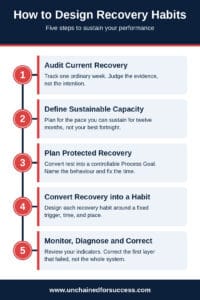
- Audit what recovery you actually get. Track one ordinary week. Record sleep, breaks, evenings, and detached time. Then judge the evidence, not the intention.
- Set your sustainable capacity line. Ask what pace you could hold for twelve months without breaking down. Plan to that line, not to your best fortnight.
- Write recovery into the Plan. Where recovery protects a defined performance standard, convert it into a controllable Process Goal. Name the behaviour, fix the time, and protect it as a commitment. For example, “sleep for eight hours” describes a result you want. It does not define the behaviour you will perform. “Complete my shutdown routine at 10pm and be in bed by 10.30pm” defines a controllable Process Goal.
- Convert recovery into habit. Design each recovery habit around a fixed trigger, time, and place. A shutdown ritual at 6pm beats a vague plan to finish earlier.
- Monitor recovery through your Control System. Choose two or three indicators and review them alongside your Performance Goals. When a below-range signal meets your agreed diagnostic trigger, start with Habit consistency. Then examine Process validity, Performance metric validity, Plan, Beliefs, Ownership, and Why in sequence, followed by the Outcome control boundary where necessary. Finally, correct the first layer that failed rather than demanding more discipline from the whole system.
Common Mistakes When You Design Recovery Habits
Treating recovery as a reward. Rest earned only after everything is finished never arrives, because ambitious work is never finished. Recovery is a requirement of the system, not a prize from it.
Confusing distraction with recovery. An evening of scrolling keeps the mind lightly tied to stimulation. However, the research suggests detachment, relaxation, mastery, and control do the restorative work. So choose activities that deliver them.
Cutting recovery first under pressure. When strain increases, durable habits contract in scope rather than disappear. Reduce or move the recovery commitment when you truly must. But do not let short-term pressure remove recovery from the structure altogether.
Planning at peak capacity. If your plan only works when everything goes well, it does not work. If you have seen the warning signs described in Outgrown Your Capacity? 7 Signs to Watch For, your plan is already telling you this.
Waiting for burnout to signal the need. By the time exhaustion shows in your results, the drift may have been building for weeks. Leading indicators let you act while correction is still cheap.
Conclusion: Make Rest Part of the Machine
High performance is not a sprint you win by refusing to stop. Rather, it is a rhythm you sustain by deciding when to stop. When you design recovery habits, you convert rest from an apology into an asset. Your plan gains honesty. Your habits gain durability. And your goals gain a full year of you, not just a strong January.
Build recovery habits now, while you still have the energy to build them. The second half of your year depends less on how hard you can push. It depends more on how well you can repeat the push.
Ambition sets the pace. Recovery decides how long you can keep it.
Ready to build goals that last the whole year? Explore The Unchained Goals Framework at unchainedforsuccess.com and read the rest of the Energy, Health, and Sustainability series on the blog. Then ask yourself: which recovery habit would protect your performance most during the second half of this year? Share your answer in the comments.
Shareable quote: “Ambition sets the pace. Recovery decides how long you can keep it.”
Hashtags: #RecoveryHabits #SustainablePerformance #EnergyManagement #HighPerformance #UnchainedGoalsFramework #UnchainedForSuccess #GoalFramework
References
Achor, S. and Gielan, M. (2016). “Resilience Is About How You Recharge, Not How You Endure.” Harvard Business Review, 24 June. Available at: https://hbr.org/2016/06/resilience-is-about-how-you-recharge-not-how-you-endure
Sonnentag, S. and Fritz, C. (2007). “The Recovery Experience Questionnaire: Development and Validation of a Measure for Assessing Recuperation and Unwinding From Work.” Journal of Occupational Health Psychology, 12(3), pp. 204-221. Available at: https://doi.org/10.1037/1076-8998.12.3.204
Internal Links Used
- https://unchainedforsuccess.com/energy-management-beats-time-management-everytime/ (Part 1)
- https://unchainedforsuccess.com/sustain-high-performance-by-protecting-your-health/ (Part 2, reciprocal cross-link needed from that post to this one)