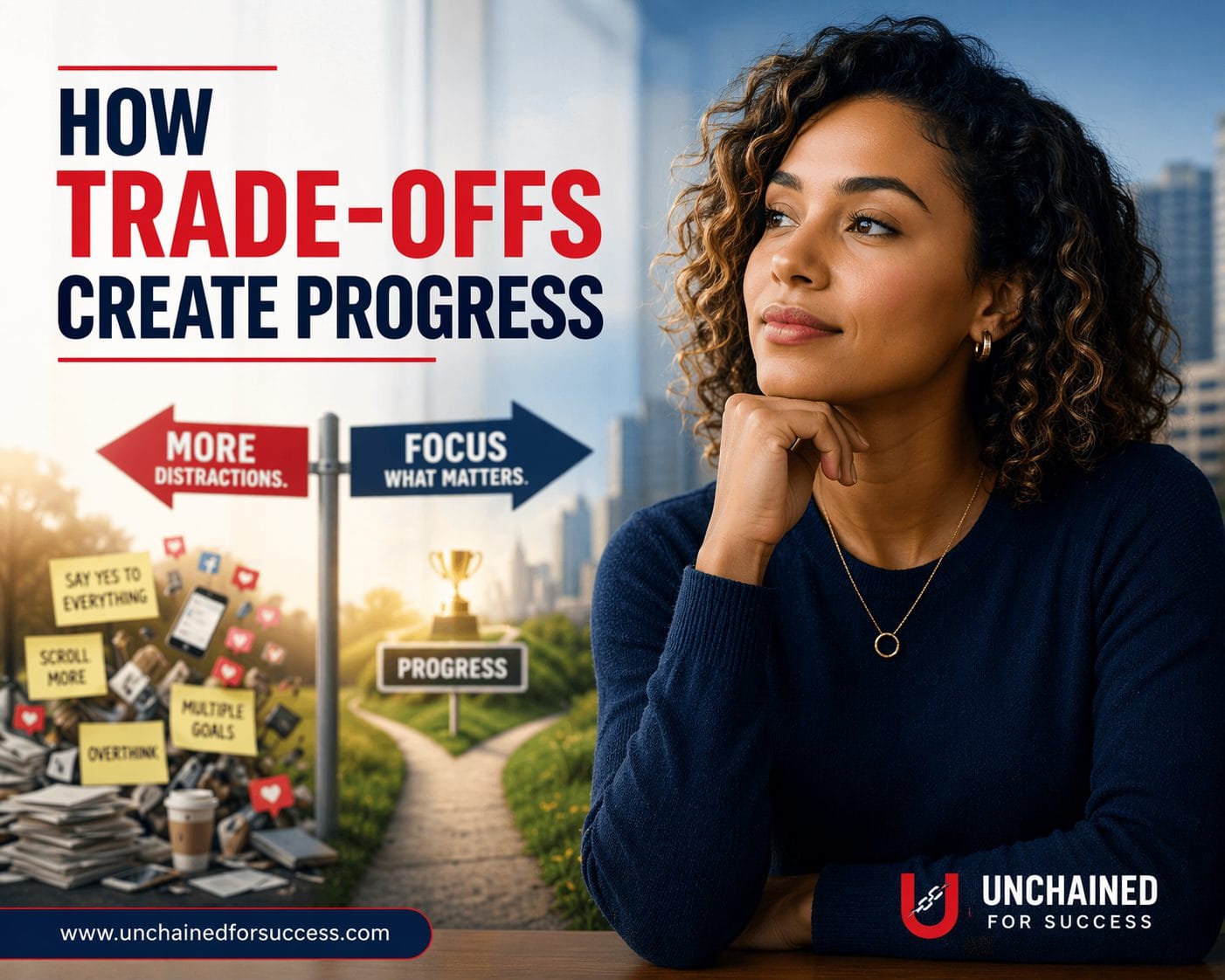

A trade-off means choosing what you will protect and what you will reduce, delay or give up, because your time and resources are limited. Trade-offs create progress for exactly that reason. Adding another commitment does not add capacity; it divides it. So the question every goal eventually asks is simple: what are you willing to give up to reach it?
This post follows The Hidden Cost of Yes, which looked at what each new commitment quietly takes. Here we go one step further. By the end, you will know how trade-offs create progress, what a declared trade-off looks like, and five steps for making one you can hold when pressure arrives.
Why Trade-Offs Create Progress
A goal needs concentrated effort. Concentration needs exclusion. Spread the same hours across six priorities and each one moves slowly, which is why a busy quarter can end with little to show.
Michael Porter put the same logic to competitive strategy in What Is Strategy?, his 1996 Harvard Business Review article. "Strategy is making trade-offs in competing," he wrote. "The essence of strategy is choosing what not to do." He describes three sources of trade-off: inconsistencies in image or reputation, the activities themselves, and limits on internal coordination and control.
Porter was writing about competitive position, not personal goals, and that is our extension rather than his claim. Still, the mechanism carries across. A position that tries to be everything defends none of it well.
Planning does not rescue a crowded list either. Amy Dalton and Stephen Spiller tested detailed planning against one goal and against several in the Journal of Consumer Research, across a series of experiments. Detailed plans helped people pursuing a single goal. For people pursuing several, planning drew attention to how hard the combination would be, which weakened their commitment. When the same set was framed as manageable, success recovered.
Their own remedy was the framing, not a shorter list. Our reading goes one step further: carry fewer goals at once, and decide in advance what each one costs.
What Avoiding Trade-Offs Really Costs
Avoiding the choice feels safe. Options stay open, and you refuse nothing. The cost simply arrives later, and in a form that is harder to trace.
Effort thins out across too many fronts, and standards can slip quietly, because everything runs late instead of anything stopping. Priorities also have to survive outside your own head. Donald Sull, Rebecca Homkes and Charles Sull surveyed 7,600 managers in 262 companies across 30 industries and reported the results in Harvard Business Review. Only half of middle managers could name any of their company's top five priorities.
That is a survey of what managers could recall, not a test of trade-offs. Our reading is that priorities nobody can name are priorities nobody can protect.
Where Trade-Offs Create Progress in the Unchained Goals Framework
Trade-offs are not a bolt-on to the Unchained Goals Framework. They sit inside the Plan, and they touch the layers above and below it.
Choose What Fits Your Direction
Trade-offs create progress from the top down, and a trade-off also tells you whether your Purpose and Vision are real. Purpose names the problem you accept responsibility for, so it should rule some attractive work out. Vision names the long-term position you have committed to, and it should lead you to decline at least one opportunity you could point at today. If nothing is being rejected, the commitment is not yet serious.
That is what makes the choice easier from the top down. When the direction is clear, the choice is not between two good things in the abstract. It is between one thing that serves the position you are building and one that does not.
Decide Where the Effort Goes
Strategy sits inside the Plan, and strategy decides what you will not pursue as much as what you will. The Plan then tests whether there is a credible path to the goal within sustainable capacity, judged against every other commitment drawing on the same capacity over the same period. If no credible path exists, the goal does not go ahead in that form.
Declaring trade-offs is one of the Plan's six structural elements. It means deciding, before pressure arrives, what you protect and what gives way. On a programme that might be: safety and compliance stay protected, scope can flex within defined limits, and the date can move only inside the funding window. The framework asks what is protected first, what yields and what may be paused, with a ranked order behind it.
Hold the Choice When Pressure Rises
Pressure is when a trade-off earns its keep. Without a declared hierarchy, decisions become reactive. Scope can expand, standards can quietly erode and dates can slip without anyone acknowledging it. With one, you agreed the answer in advance, so the argument stays short.
Two other layers hold the choice steady. Your Why explains why the goal is worth its cost, and Ownership means consciously accepting that cost and the consequences of pursuing the goal within your authority.
Beneath them, your Habits turn the protected work into routines that need less deciding each time. The framework calls that Habit Conversion. Meanwhile the Control System compares Performance with its agreed range. A reading below that range is a signal to investigate once it meets the trigger you agreed, not a reason to reopen the trade-off on a difficult week.
How Trade-Offs Create Progress in Practice
The people and organisations below are illustrations, not clients.
Trade-Offs Create Progress for an Individual
A project manager wants to qualify as a coach while holding a demanding job. Her Outcome Goal is to complete all eight course modules and submit her final assessment by 31 October. Her Performance standard is one module finished every three weeks, each checked against the course's published marking criteria before she submits it. Beneath that, her Process Goal is two study sessions a week, on Tuesday and Thursday evenings.
She declares the trade-off before she starts. Two evenings a week come out of family time until the end of October, agreed at home. Her running club drops to one session. The one thing she protects is sleep, because losing it would put both the course and her job at risk.
An Ordinary Week
Trade-offs create progress at home as much as at work. None of this needs a business behind it. You have set aside Tuesday evening for a course assignment, and a request arrives to help organise a community event over three evenings. The trade-off is the same: decide whether the event can wait, be shared with someone else, or replace something that matters less. Then say so, rather than letting both slide.
A Business Choosing One Service
A design studio offers three services and is strongest at one. The partners commit to leading in brand identity work.
Their Outcome Goal is to complete the move to identity work by 31 December, with every existing marketing contract honoured to its end date and identity work providing 70 per cent of fee income in the final quarter. That sits inside their authority on stated assumptions: they set prices, choose what to bid for, allocate their people and can correct the pipeline. They also watch total income, because a mix can improve simply because other work has collapsed.
The partners then set the standard and the routine.
Their Performance standard is at least six identity proposals issued each month, each followed up within five working days. The weekly rhythm below produces more than six in most months, which is the buffer they intended.
Beneath that sit the behaviours. On Monday and Wednesday mornings, a partner drafts proposals for qualified identity enquiries. At 4 pm each working day, that partner checks the proposal log and sends any follow-up due. Every second Friday, the partner reviews existing clients and contacts those with a suitable identity need.
Here, trade-offs create progress by narrowing the offer. They stop bidding for general marketing work from 1 May, keep existing clients until their contracts end, and accept a slower summer while the pipeline rebuilds. They protect delivery quality on the identity work, because that is what earns the referrals.
A Project With a Fixed Deadline
For a project, trade-offs create progress by fixing the order of what gives. A software team has a fixed regulatory deadline. Time, cost and scope cannot all hold, so the sponsor declares the order in advance: the deadline and the compliance requirements are fixed, scope beyond the regulator's minimum can move to a later release, and the sponsor can release a small budget contingency to protect the date.
The Outcome Goal is the compliant release live by 30 September. Its Performance standard is at least four regulatory requirements tested against the regulator's published criteria and recorded as passed every fortnight, with all of them complete two weeks before that date. That rate is only credible because the team has counted the requirements, judged their size and compared them with the weeks available; four small requirements and four large ones are not the same fortnight.
Beneath that, the Process Goals are the work itself and the guard around it. Each weekday, the assigned developers and testers implement and test the next priority requirement and record the evidence. Each Friday, a scope review checks every new request against the regulator's minimum.
Five Steps to Make Trade-Offs Create Progress
Trade-offs create progress only when you decide them; you do not discover them. You can work through these five steps in one sitting.
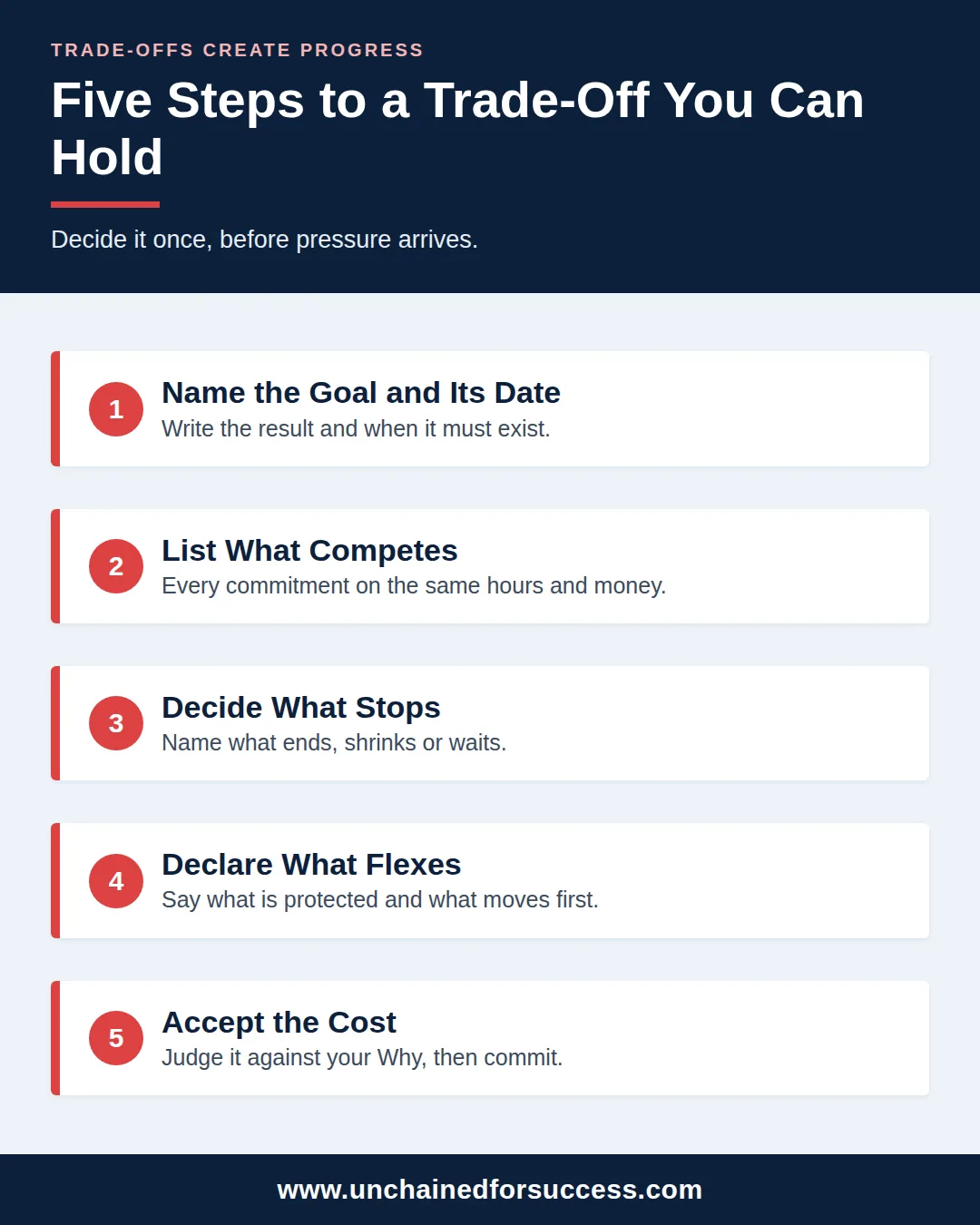
1. Name the goal and its date. Write the result you want and when it must exist. A vague goal cannot tell you what to give up, because anything can look relevant to it.
2. List what competes for the same capacity. Put down every commitment drawing on the same hours, attention and money over the same period, including the informal ones. This is the list your Plan has to fit inside.
3. Decide what stops, shrinks or waits. Something has to change, or nothing will. Be specific: which meeting ends, which project pauses, which optional activity can be reduced without breaching an agreed standard. If a standard itself has to change, decide that openly with whoever owns it, and check what it does to the result.
Declare It, and Let Trade-Offs Create Progress
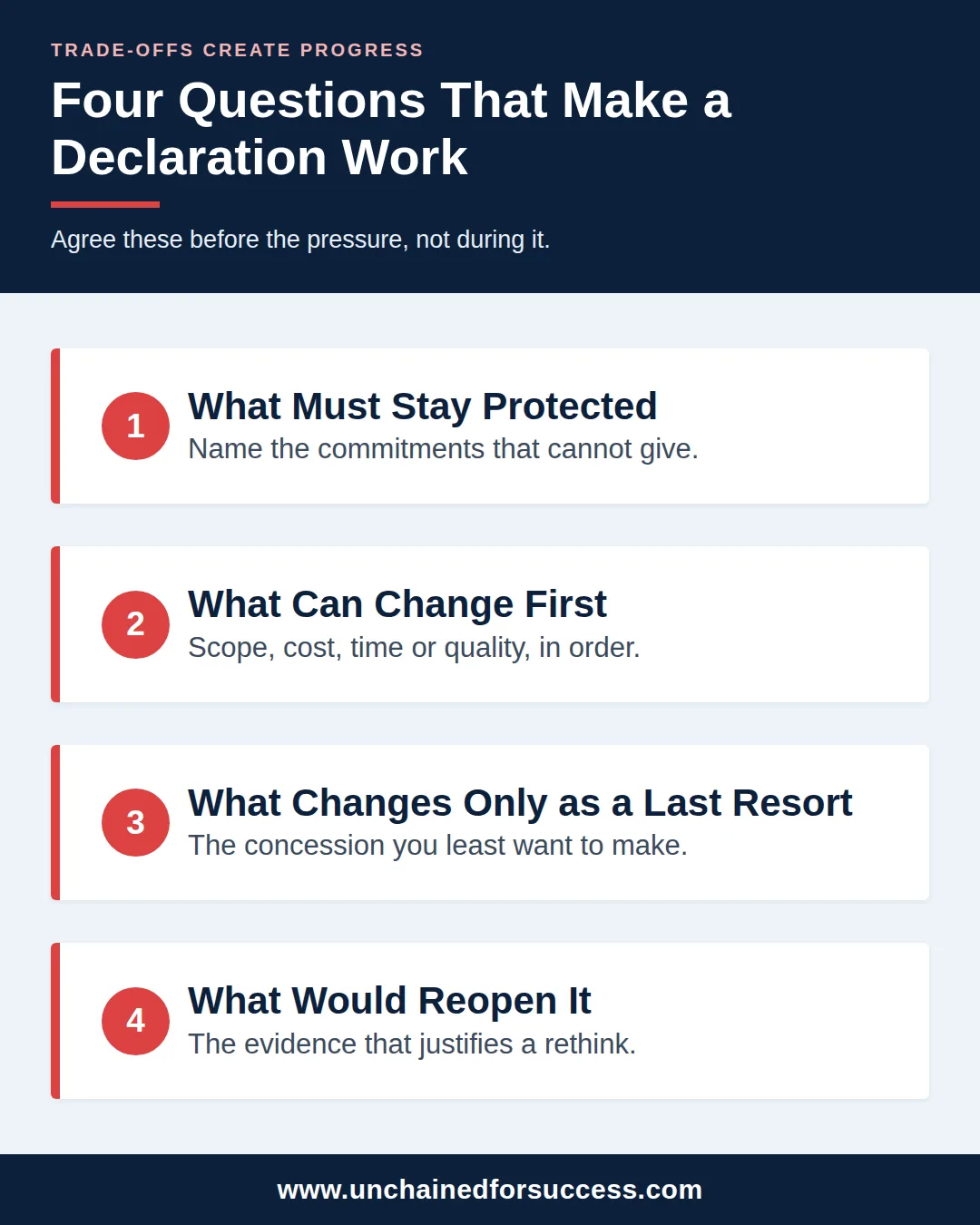
4. Declare what flexes before pressure arrives. Name the commitments that must stay protected, what can change first, what changes only as a last resort, and what evidence would reopen the decision. Those four questions are ours, a practical way into the framework's Trade-Off Declaration rather than a fixed set of boxes. Write the answers where the people affected can see them, and agree anything that touches them.
5. Test the cost against your Why, then accept it. Ask whether the result is worth what it takes, knowing what you know now. If it is, accept the cost deliberately. That acceptance is Ownership. If the cost turns out to be material, revisit your Why and your Ownership properly rather than pressing on. And if you change the goal or its date, test the revised goal again before you commit to it.
These five steps apply a trade-off to a goal you already hold. They are not the framework's full design sequence, which starts further up with Purpose and Vision.
Four Mistakes That Waste a Good Trade-Off
Softening every choice. A trade-off that takes a little from everything can leave nothing properly protected. Sometimes small reductions across several commitments are the right answer; the test is whether the change is large enough to release the capacity you need.
Keeping options open. Trade-offs create progress once they are made, and delaying the decision feels like flexibility. In practice it leaves the work unstarted while the deadline moves closer.
Leaving it in your head. A trade-off nobody else knows about is easy to overturn, and the next request is where that shows. Say it out loud, and write it down.
Reopening the choice every week. Trade-offs create progress when they hold. Revisit one when the evidence changes. That means a Performance measure below its agreed range, and a deviation serious enough or persistent enough to meet the trigger you set, and then only after you have checked whether the agreed actions happened and whether the process and the measure are sound.
Revisit it too when another goal joins the list, or when a capacity assumption you relied on has materially changed. A hard week on its own is not new evidence.
FAQs About How Trade-Offs Create Progress
Is a trade-off the same as giving something up for good? No. A trade-off can be about sequence rather than sacrifice. Trade-offs create progress more easily when you name the period, because a choice with an end date is easier to keep. The running club drops to one session until the end of October, and comes back afterwards.
What if I cannot decide what to cut? Start with the goal's date, because a fixed date tells you how much time you actually have to work with. Then look at the commitment least connected to the goal, and test whether it can stop, shrink or wait. If nothing can go, the honest conclusion is that the goal needs a longer timescale or a smaller scope.
How do I make trade-offs create progress when my manager adds work? Show what the new request would displace and ask which matters more. That turns a refusal into a shared decision about priorities, and it gives your manager information they do not have.
This Week, Let Trade-Offs Create Progress
Progress does not come from adding more. It comes from choosing what matters most, protecting it deliberately, and accepting what that costs.
Take your most important goal and run the five steps on it. That is how trade-offs create progress on the one thing that matters most this quarter. Write the date, list what competes, decide what stops, declare what flexes and accept the cost. Then tell the people it affects, because a trade-off that touches other people needs those people to know it exists.
For the full method, read the Unchained Goals Framework overview, and the glossary explains the individual terms. The Goals Readiness Score is a short self-assessment if you want one: 18 questions, under five minutes. Saying No Strategically covers what to do when the next request arrives, and Why Focus Drives Results and Busyness Doesn't shows what focus buys you.
Share the one thing you stopped, and what it made room for, in the comments.
What are you protecting this quarter, and what have you agreed can give way?
Sources
• What Is Strategy? by Michael E. Porter, Harvard Business Review, November to December 1996
• Too Much of a Good Thing: The Benefits of Implementation Intentions Depend on the Number of Goals by Amy N. Dalton and Stephen A. Spiller, Journal of Consumer Research, 39(3), 600 to 614, 2012
• Why Strategy Execution Unravels and What to Do About It by Donald Sull, Rebecca Homkes and Charles Sull, Harvard Business Review, March 2015
Continue Your Journey
Explore more resources from the Unchained Goals Framework: