

Everyone in the room agreed. The goal was sound, the reasoning held, and nobody argued against it. Six months later almost nothing had moved, and not one person had changed their mind about whether it mattered. Ownership changes everything about that gap, because it is the one part of a goal that nobody else can supply for you.
Last week's post argued that excellence is a decision rather than a trait. This one is about the decision underneath it: the moment somebody accepts what a goal will cost them.
What Ownership Actually Means
Most people use the word loosely, and the looseness is the problem.
In the Unchained Goals Framework, Ownership is the conscious acceptance of the cost of a goal and the consequences of pursuing it, within your authority. Narrower than the everyday sense, and harder.
Three things it is not.
It is not agreement. You can think a goal is right, argue for it in the meeting, and never accept what it will take from you.
Enthusiasm is not it either. Motivation asks whether you want the result. Ownership asks whether you will carry the cost of getting it. Those two questions get different answers, and only the second one survives a hard month.
And it is not accountability. Someone can assign you accountability, write it into your objectives, and escalate it when you miss. Nobody can hand you Ownership. You accept it, or it does not exist.
That last line is the one that matters, and it earns the rest of this article.
Why Work Nobody Owns Drifts
There is good evidence on what happens when responsibility goes vague, and the useful part is not the part people quote.
A meta-analysis pooled 78 studies of effort in groups (Karau and Williams, 1993). On average, people worked less hard together than alone. That much is well known.
The interesting result is where the effect disappeared. When someone's contribution was unique rather than interchangeable, the drop vanished. It also vanished when the task genuinely mattered to the person doing it.
Read what that says. The problem is not the group. The problem is that your particular contribution has become something anyone could have made, and nobody would notice if you had not.
Two honest limits. These were mostly laboratory tasks with students, and the work is now over thirty years old, so carry the mechanism across rather than the size. The authors also had to discard a large share of the results to make the set consistent, which tells you the effect is not one clean thing.
Be careful what you take from it. The studies show that effort holds up when a contribution is identifiable and matters to the person making it. They say nothing about accepting a cost, which is what Ownership means here. Naming an owner is a sensible response to the first problem. It is not the same act as that person accepting what the work will take.
Ownership Changes Everything Because It Cannot Be Assigned
People usually treat accountability as a mild form of ownership, as though holding someone answerable gets you the same result. The research does not support that.
The most thorough review of accountability found the effects run in several directions at once (Lerner and Tetlock, 1999). It improved judgement in some conditions, did nothing in others, and made it worse in the rest. What mattered most was the thing people had to answer for. Answering for how you reached a decision improved accuracy. Answering for the outcome reduced it, and made judgements less consistent.
There is more. When accountability arrives after someone has already committed, the effort it produces goes into defending the decision rather than re-examining it.
A later meta-analysis tested accountability against task performance directly, across nine experiments and 1,080 people, and found no overall effect (Sharon and colleagues, 2022). The authors concluded that accountability alone cannot serve as the sole motivator of better performance.
It did find that the useful kind depends on the work: accountability for the outcome fared better on complex tasks, and accountability for the process on simple ones. It is a small set of studies, mostly laboratory work, so treat all of it as a caution rather than a verdict.
What this does support is narrower and still useful. Being answerable for a result is a different thing from having accepted its cost, and the research gives no reason to expect the first to produce the second. Ownership works the other way round: the person who will carry it accepts it in advance, and it attaches to the cost rather than to the scoreboard.
The Six Costs You Are Actually Accepting
This is where ownership changes everything from something you feel into something you do.
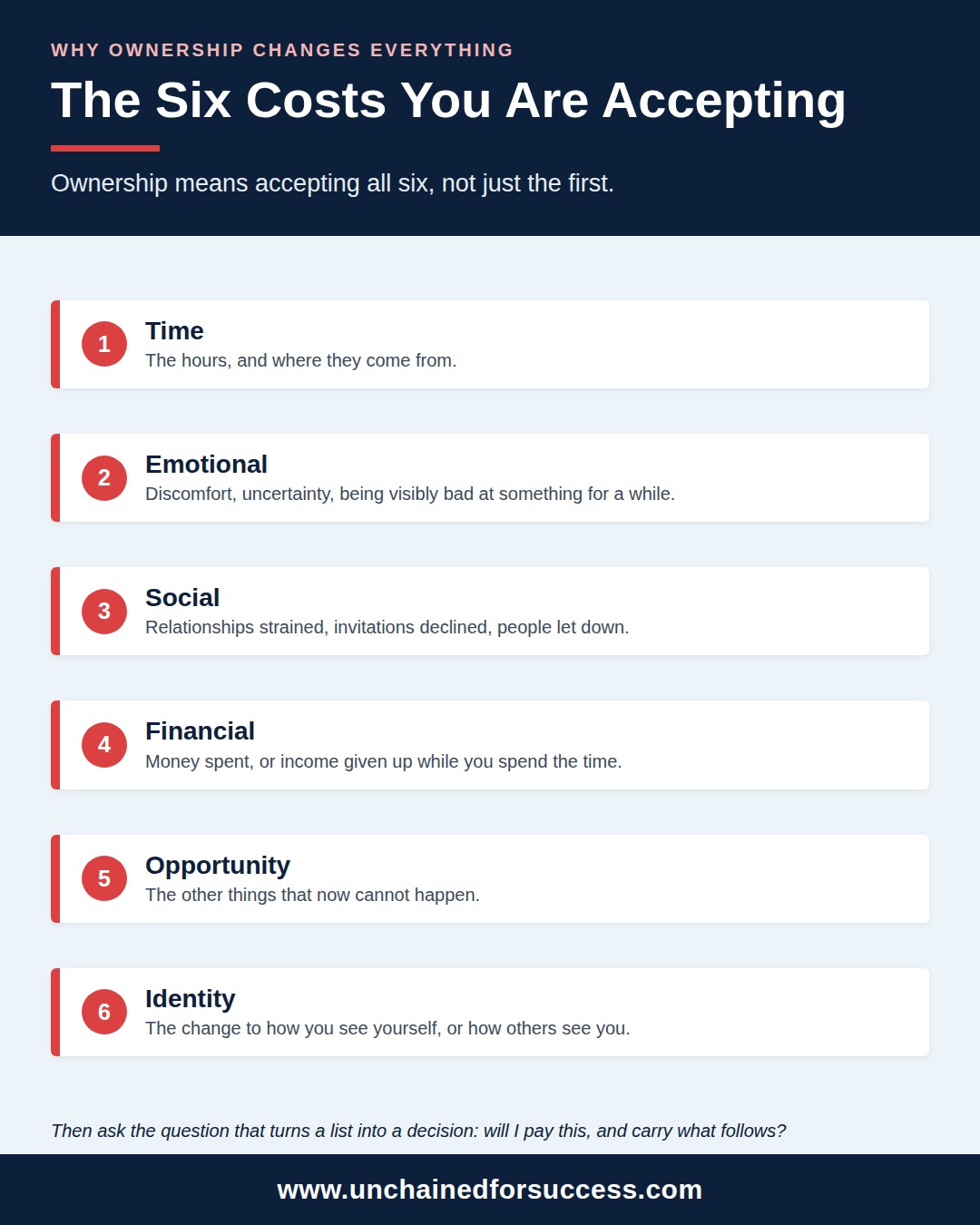
The framework sets out six kinds of cost a goal can carry:
1. Time. The hours, and where they come from.
2. Emotional. Discomfort, uncertainty, being visibly bad at something for a while.
3. Social. Relationships strained, invitations declined, people let down.
4. Financial. Money spent, or income given up while you spend the time.
5. Opportunity. The other things that now cannot happen.
6. Identity. The change to how you see yourself, or how others see you.
Ask someone what a goal will cost and you tend to hear about the first one. Social and identity costs are easy to overlook, because they are harder to put a number on. Writing them down makes them harder to dismiss later, which is why the list has six entries rather than one.
So write all six down before you start, as a list you can hold yourself to in three months when the cost stops being theoretical.
Then ask the question that turns a list into a decision. Not "is this worth it", which is your reason doing its job. The question is: will I pay this, and carry what follows? Write the answer down, and date it.
A cost you justified but never agreed to pay is how a sound goal stalls. The logic held. Nobody ever said yes. Saying it, on the record, is the point at which ownership changes everything downstream.
Ownership Only Works Inside a Boundary
There is a limit here, and ignoring it does real damage.
You can only own what you hold enough authority over. The framework calls this the control boundary: enough authority over the main causes of a result, and over the corrections when it drifts. Not certainty. Not independence from other people.
Hold someone to a result they cannot influence and you do not get ownership. The framework calls what you get instead conditional ownership, and it names the risk that follows: people manage their exposure rather than the work, and reporting becomes less candid. That is the framework's position on what to expect, not a measured finding.
The research nearby points the same way without settling it, and it is worth saying so plainly.
Across 96 studies, unclear expectations at work went with more tension, lower satisfaction, weaker commitment and a stronger wish to leave (Jackson and Schuler, 1985). A later meta-analysis found unclear expectations tracked lower performance. Simply facing competing demands barely did (Tubre and Collins, 2000).
Almost all of that is self-reported at a single point in time. The original authors warn that people who feel they are doing badly may describe their role as unclear afterwards. And nobody has directly tested the full claim that accountability beyond authority distorts reporting.
What the framework asks is practical either way. Before you accept ownership of anything, check five things: who controls the key decisions, who controls the resources, who controls the timing, who can remove the constraints, and whether raising a problem early is genuinely safe.
If those answers are unclear, the offer on the table is not ownership. It is exposure, and knowing the difference is what protects you.
What Ownership Looks Like in Practice
Consider a team leader asked to reduce errors in her department's monthly reporting. This is an illustration, not a client case.
She agrees the goal matters. Then, instead of stopping there, she works through the three steps.
She names the cost. Two working sessions a month for the first quarter. The discomfort of telling colleagues their work contains the errors. Saying no to a side project she wanted. And a change in how the team sees her, from the person who absorbs problems quietly to the person who raises them.
Then she checks the boundary. She controls the process, the checking rota and the deadlines. She does not control the budget for the reporting system everyone blames. So she narrows the goal: the errors that come from how the work is done are hers, and the system replacement is a separate case she will make to someone who can decide it.
And she sets the condition before she needs it. If the error rate has not moved after two monthly cycles, she reopens the approach rather than pushing harder on the same one.
None of that is dramatic, and all of it happens before the work starts. That is where ownership changes everything: same goal, same person, a different relationship to it.
When Ownership Changes Everything for the Worse
An honest article has to include this, because the popular version of ownership never does.
One risk of accepting ownership is becoming reluctant to change a decision you have already invested in. The accountability research above gives reason to watch for it: once someone has committed, the pressure to answer for the decision pushes effort into defending it rather than re-examining it. That work studied accountability after a decision rather than Ownership as the framework defines it, so read it as a risk worth naming rather than a measured property of ownership.
So ownership without a check becomes stubbornness in better clothes, and that is the one way ownership changes everything for the worse.
The answer is not to own less. It is to decide, at the point of acceptance, what result would tell you to stop or change course, and to write it down beside the cost. A condition you set while you can still think clearly beats any amount of resolve applied later.
That is what a scheduled check is for, and it is why handling a setback is a structural question rather than a test of character. Accepted with a condition attached, ownership holds you to the work. Accepted blindly, it just makes you harder to stop.
How Ownership Changes Everything This Week
Take one goal you have already agreed to, and do four things. None of them takes an hour, and this is where ownership changes everything in practice.
1. Write what it will cost across all six categories, not just time.
2. Check whether your reason for the goal still covers that cost.
3. Decide in writing whether you accept it, and date the decision.
4. Name the result that would tell you to change course, before you need it.
Then check the boundary. If the goal depends on decisions, money or timing you do not hold, either get the authority or narrow the goal to the part you can genuinely govern.
Narrowing is not abandoning the ambition. The ambition still sets your direction; what changes is which part of it you answer for this quarter, while you work on getting the authority for the rest. Leading yourself is largely the discipline of holding both at once.
Frequently Asked Questions
What if somebody else set the goal? Then the cost question matters more, not less. You can accept the cost of a goal you did not choose, and that acceptance is real ownership. It is also where ownership changes everything about work handed to you. What you cannot do is accept it silently and hope. If you are not willing to pay the cost, say so while the goal can still change.
Is this just commitment by another name? No, and the difference shows under pressure. Commitment is wanting the goal to happen. Ownership is having agreed to the specific price of making it happen, which is why it holds when the price falls due. Taking responsibility is the behaviour that follows.
Does owning something mean it is all my fault if it fails? No. Ownership means accepting the cost and the consequences within your authority. That is a boundary as much as a burden. It never means answering for an outcome you could not influence. A goal that asks you to do that is badly designed, not bravely accepted.
So here is the question worth sitting with, and the comments are open if you want to answer it out loud.
Which of your goals has your agreement but not your acceptance?
If you would like an outside view of how your goals are designed, executed and governed, the Goals Readiness Score scores each of the nine components separately and names the weakest one.
Sources on Why Ownership Changes Everything
1. Karau, S. J., and Williams, K. D. (1993). Social loafing: a meta-analytic review and theoretical integration. Journal of Personality and Social Psychology, 65(4), 681 to 706. https://doi.org/10.1037/0022-3514.65.4.681
2. Lerner, J. S., and Tetlock, P. E. (1999). Accounting for the effects of accountability. Psychological Bulletin, 125(2), 255 to 275. https://doi.org/10.1037/0033-2909.125.2.255 A narrative review rather than a meta-analysis, so it reports patterns across studies and not a pooled effect size.
3. Sharon, I., Drach-Zahavy, A., and Srulovici, E. (2022). The effect of outcome versus process accountability-focus on performance: a meta-analysis. Frontiers in Psychology, 13, 795117. https://doi.org/10.3389/fpsyg.2022.795117
4. Jackson, S. E., and Schuler, R. S. (1985). A meta-analysis and conceptual critique of research on role ambiguity and role conflict in work settings. Organizational Behavior and Human Decision Processes, 36(1), 16 to 78. https://doi.org/10.1016/0030-5073%2885%2990020-2
5. Tubre, T. C., and Collins, J. M. (2000). Jackson and Schuler (1985) revisited: a meta-analysis of the relationships between role ambiguity, role conflict, and job performance. Journal of Management, 26(1), 155 to 169. https://doi.org/10.1177/014920630002600104
Continue Your Journey
Explore more resources from the Unchained Goals Framework: