


The cost of yes is easy to miss, because each individual yes looks reasonable. A new client project, a speaking invitation, a colleague who needs an hour. Taken one at a time, each of them looks worth doing. Taken together, they decide how your quarter goes, and nobody sat down and chose that.
This post shows where the cost of yes hides, why it grows quietly, and how to decide the next request on purpose. It follows Why Focus Drives Results and Busyness Doesn't, which made the case that a full week and a productive week are not the same thing.
Why the Cost of Yes Compounds Quietly
Overcommitment does not look like overcommitment at the start. It looks like ambition, or generosity, or being useful to the team.
The trouble is that a request never stands on its own merits alone. You have to weigh it against everything already on your plate. Your week absorbs the first extra commitment easily. It does not absorb the eighth, and by then the earlier seven are hard to unwind.
Timing makes this worse. Gal Zauberman and John Lynch ran seven experiments on how people treat future time and money. People expected more spare time in the future than they felt they had in the present, and that expectation was stronger for time than for money.
Their participants were weighing investments of time and money in a study, not requests from colleagues. The pattern is still familiar. A request for three days next quarter feels cheap today. Next quarter, those three days cost exactly what they always would have.
Four Hidden Parts of the Cost of Yes
The obvious price is lost hours. Four less visible parts of the cost of yes can do more damage.
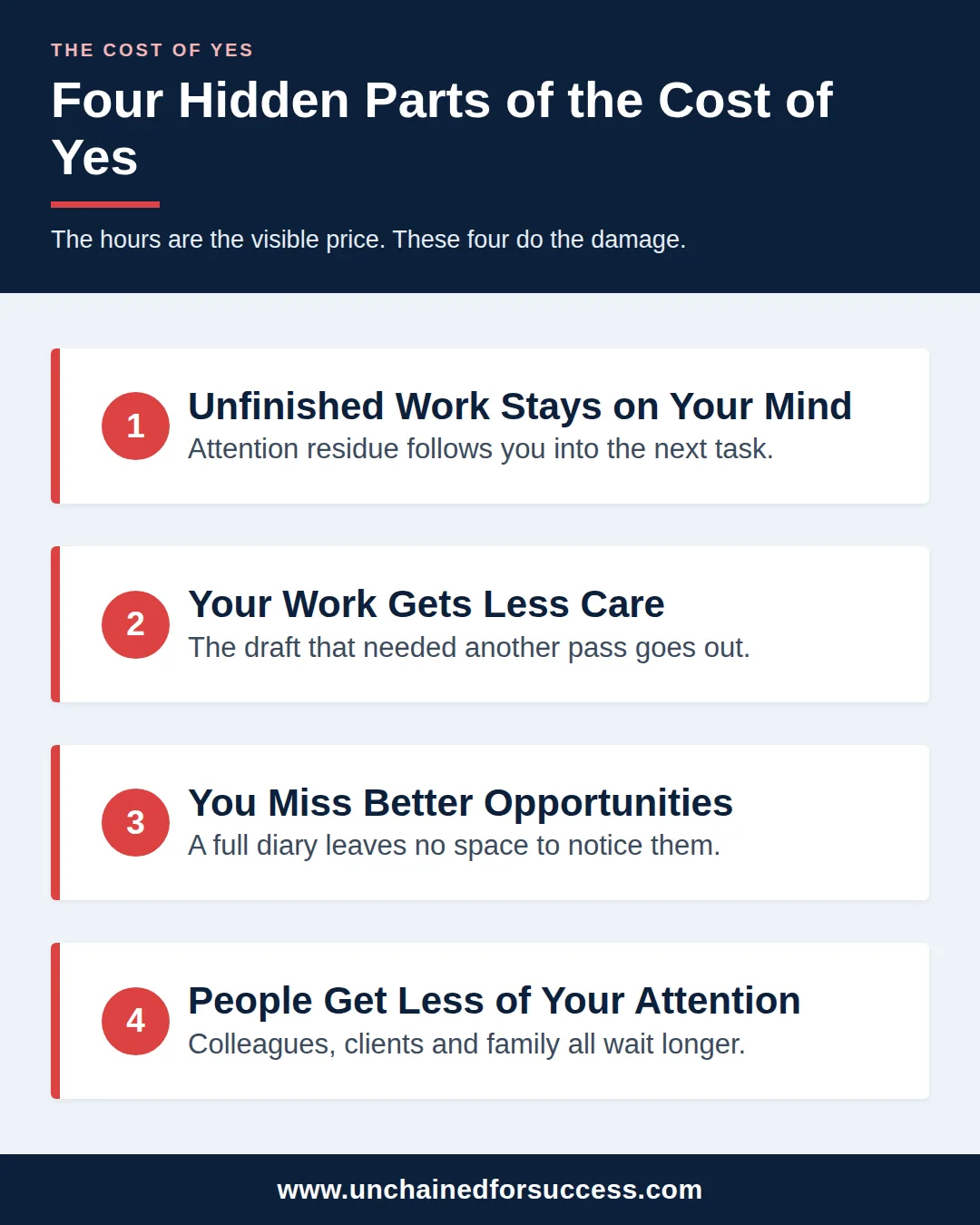
Attention residue. Sophie Leroy's two experiments on attention residue found that people who switch away from an unfinished task carry part of their attention with them, which is what she calls attention residue. As she puts it, "people need to stop thinking about one task in order to fully transition their attention and perform well on another".
Her later work with Theresa Glomb found that a short plan for how you will resume the first task reduces that residue. So before you switch, write down the next step and where to pick it up.
Quality erosion. When everything must fit, nothing gets room to breathe. The proposal that needed another draft goes out as it is. Over time, that gap between what you can do and what you deliver is what other people see of your work.
Opportunity blindness. A full diary does not only stop you taking new things on. It also leaves little space to notice them, so an opportunity that could have changed your year passes while you are catching up.
Relationship strain. Colleagues get half your attention, clients wait longer for replies, and family gets whatever remains. A yes given in order to be helpful can end up leaving you less helpful to everyone.
Why the Arithmetic Goes Wrong
Two research findings point to why the arithmetic behind the cost of yes goes wrong.
First, we underestimate how long our own work will take. Roger Buehler, Dale Griffin and Michael Ross asked students to predict when they would finish their honours thesis. The average prediction was 33.9 days and the average reality was 55.5 days. Fewer than a third finished within the time they gave as their most accurate estimate.
Researchers call this the planning fallacy. Those figures describe one study of students and their thesis, not a multiplier to apply to every task, and the bias sits in predictions of your own completion times.
Second, absorbing extra work does not simply slow you down. Gloria Mark, Daniela Gudith and Ulrich Klocke studied 48 people working with and without interruptions. In the experiment, participants completed the main task faster after interruption time was excluded, but reported greater pressure and effort: "more stress, higher frustration, time pressure and effort". That is not a finding that interruptions improve overall productivity.
Neither study tests the advice in this post. Together, though, they explain a familiar pattern. We accept work on an estimate that is too optimistic, then protect the deadline by paying in pressure instead.
The Cost of Yes in the Unchained Goals Framework
In the Unchained Goals Framework, the cost of yes is not only a diary question. A new commitment lands on the Plan.
The Plan tests whether there is a credible path to your goal within sustainable capacity, weighed against every other commitment drawing on the same time and energy over the same period. The framework's rule is to reassess the Plan when another Goal is introduced or a material capacity assumption changes.
Treating a significant yes as that kind of change is our reading of the rule, and it is the practical point of this post. The days come out of capacity that something else is already using.
When that reassessment shows a material extra cost, the framework sends you back to two of its components. Your Why explains why the goal is worth its cost, and Ownership means consciously accepting that cost and the consequences of pursuing the goal within your authority. A cost you never counted is a cost you never accepted.
Further down, Habit Conversion makes the behaviours that matter consistent, so they need less deciding each time. Interruptions make those routines harder to keep, so the cost of yes can reach your execution while your results still look unchanged.
The Cost of Yes in Practice
The people and organisations below are illustrations, not clients. Each one shows the cost of yes being counted before the answer is given.
An Individual Who Priced Four Requests
A senior analyst is asked to join two steering groups, mentor three managers and support an extra bid, all in one quarter. None of it looks unreasonable on its own.
Her result is a tested forecasting model handed over to the finance team by 30 June. She checks progress against the scheduled build stages. Every Monday, Wednesday and Friday from 9 am to noon, she builds and tests the next scheduled section before opening email.
In framework terms the model is her Outcome Goal, stage completion by its planned date is her Performance standard, and the scheduled build-and-test session is her Process Goal. Repeating it at the same times is what turns it into a routine she does not have to decide about.
Then she prices the four requests. Each steering group is a two-hour meeting with an hour of papers, monthly. Each mentoring pair is an hour a month with preparation. The bid needs about two days across six weeks. Together they take roughly six of her build mornings a month.
So she accepts one steering group, which needs her decisions. She agrees to mentor one manager rather than three, and declines the bid with a reason, before anyone has planned around a yes. The model keeps its mornings.
A Business That Checked Capacity First
A consultancy takes every project that comes, and margins are falling. The partners add a rule: they accept no new engagement unless a named consultant has the days free in the delivery plan.
Their Outcome Goal is to lift the average margin on engagements they start from 1 May to 30 per cent by 31 December. They set the prices and decide which work to accept, so the main causes sit inside their authority. Their Performance standard is every project staffed to plan on day one and delivered within its budgeted days. Beneath it, their Process Goal is a Monday staffing review of the next eight weeks.
A Project That Made the Cost Visible
A programme team receives a steady flow of small requests from stakeholders, each carrying its own cost of yes. Each one is minor, and together they push the delivery date.
The sponsor makes the cost visible. Every request gets a written estimate in days and a named source of those days, either contingency or something already in the plan that moves.
The Outcome Goal stays the phase one release by 31 October, the Performance standard is each milestone hit on its planned date, and the Process Goal is a fortnightly change board that decides every request with its cost attached. The board meets at the same hour every fortnight, so preparing for it takes less deciding each time.
How to Weigh the Cost of Yes Before You Answer
You do not need a system. You need a few minutes and the same four questions every time.
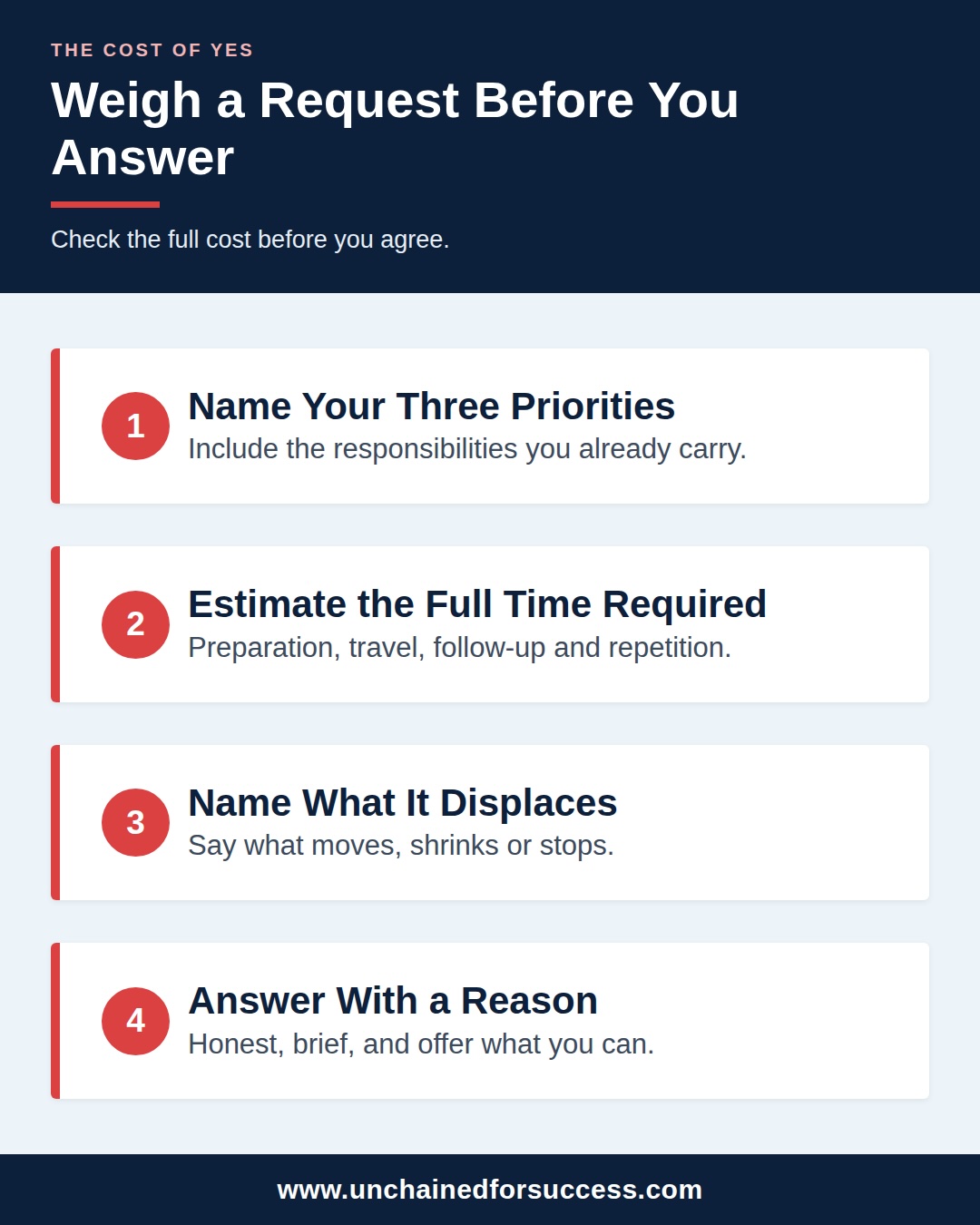
1. Name your three priorities for the quarter. Write them where you can see them, and include the responsibilities you carry whatever your goals: family, essential duties, promises already made. A request that serves none of them starts from a different place.
2. Estimate the full time required. Count the preparation, the travel, the follow-up and the repetition, not just the hour in the diary. Judge it against what comparable commitments actually took you, rather than adding an arbitrary percentage.
3. Name what it displaces. This is the Plan's Trade-Off Declaration applied to one request, which is our reading of it. If the request cannot fit within genuine spare capacity, name what will move, shrink or stop before you agree. Avoid using the recovery time or contingency your plan already needs.
4. Answer with a reason, not an apology. "I am protecting three commitments this quarter, so I cannot take this on until July" is honest, and it leaves the door open.
A no that arrives late leaves the other person less time to find another route, so answer while the choice is still yours to make. Saying No Strategically goes further into how to decline well.
Margin Is What Protects the Work
Reducing the cost of yes starts with margin. Designers call it white space: the empty area that makes everything else readable. A week needs the same thing.
Margin is not wasted time. It is where the thinking happens, where you notice the pattern you have been too busy to see, and where the unexpected lands without knocking over the rest of the plan.
Start with an audit of what you already carry. List every commitment, including recurring meetings and informal agreements from months ago. Then ask two questions about each one. If this came to me today, knowing what I now know, would I still say yes? What is this stopping me from doing?
Some commitments will have outlived their purpose. Others were sound ideas that no longer need you. Releasing those is where your margin comes from, and How Trade-Offs Create Progress covers how to make the choice stick.
Frequently Asked Questions About the Cost of Yes
Is the answer simply to say no more often? No. The aim is to make each yes deliberate, with the cost of yes counted first. A yes you have priced and can deliver builds your reputation. A yes you cannot honour costs you more than the refusal would have.
What if saying no could harm my career? Show the trade-off rather than refusing flatly. Tell your manager what the request would displace and ask which matters more. That is a priorities conversation, and it gives them information only you hold.
How do I escape commitments I have already made? Deal with the largest one first. Give as much notice as you can, offer a handover or a smaller version, and be clear about what you can still do. Late notice narrows the other person's options, which is what makes leaving late expensive.
Make the Cost of Yes a Decision, Not an Accident
You pay the cost of yes either way. The only question is whether you choose where it falls, or let the next request choose for you.
Pick one commitment this week that you would not accept today. Give as much notice as you can, agree the change with the people it affects, and offer a handover or a smaller version. Then protect the time it frees for the work that moves your goal.
For the full method, read the Unchained Goals Framework overview, and the glossary explains the individual terms. The Goals Readiness Score is a short self-assessment if you want one: 18 questions, under five minutes.
Which yes in your diary would you not agree to if it arrived today? Share it in the comments.
Sources
• Resource Slack and Propensity to Discount Delayed Investments of Time Versus Money by Gal Zauberman and John G. Lynch Jr, Journal of Experimental Psychology: General, 134(1), 23 to 37, 2005
• Why Is It So Hard to Do My Work? The Challenge of Attention Residue When Switching Between Work Tasks by Sophie Leroy, Organizational Behavior and Human Decision Processes, 109(2), 168 to 181, 2009
• Exploring the Planning Fallacy: Why People Underestimate Their Task Completion Times by Roger Buehler, Dale Griffin and Michael Ross, Journal of Personality and Social Psychology, 67(3), 366 to 381, 1994
• The Cost of Interrupted Work: More Speed and Stress by Gloria Mark, Daniela Gudith and Ulrich Klocke, CHI 2008 Proceedings
• Tasks Interrupted: How Anticipating Time Pressure on Resumption of an Interrupted Task Causes Attention Residue and Low Performance on Interrupting Tasks, and How a Ready-to-Resume Plan Mitigates the Effects by Sophie Leroy and Theresa M. Glomb, Organization Science, 29(3), 380 to 397, 2018
Continue Your Journey
Explore more resources from the Unchained Goals Framework: