


On the last day of July, an accountant counts the words in her manuscript. In January she set out to finish the first draft of a book on cash flow for small business owners by today: every chapter, about 60,000 words. She has 31,000, and she has not opened the file since May. She calls it a failure, and the word is fair. Yet failure isn't the real problem.
The real problem is failing to learn from it, and failing to act quickly on what you learn. Learning means finding out what worked, what did not, and when it first went wrong. She thinks the trouble began in May. Her calendar will show the first sign in February.
Without that lesson, you can carry the same weakness into the next attempt. She is an invented example, but you may recognise her. Here is how she found her lesson, and what she did with it.
Four Responses to Failure That Block the Lesson
After a failure, four responses are tempting. Each one skips the evidence, so the lesson goes unlearned.
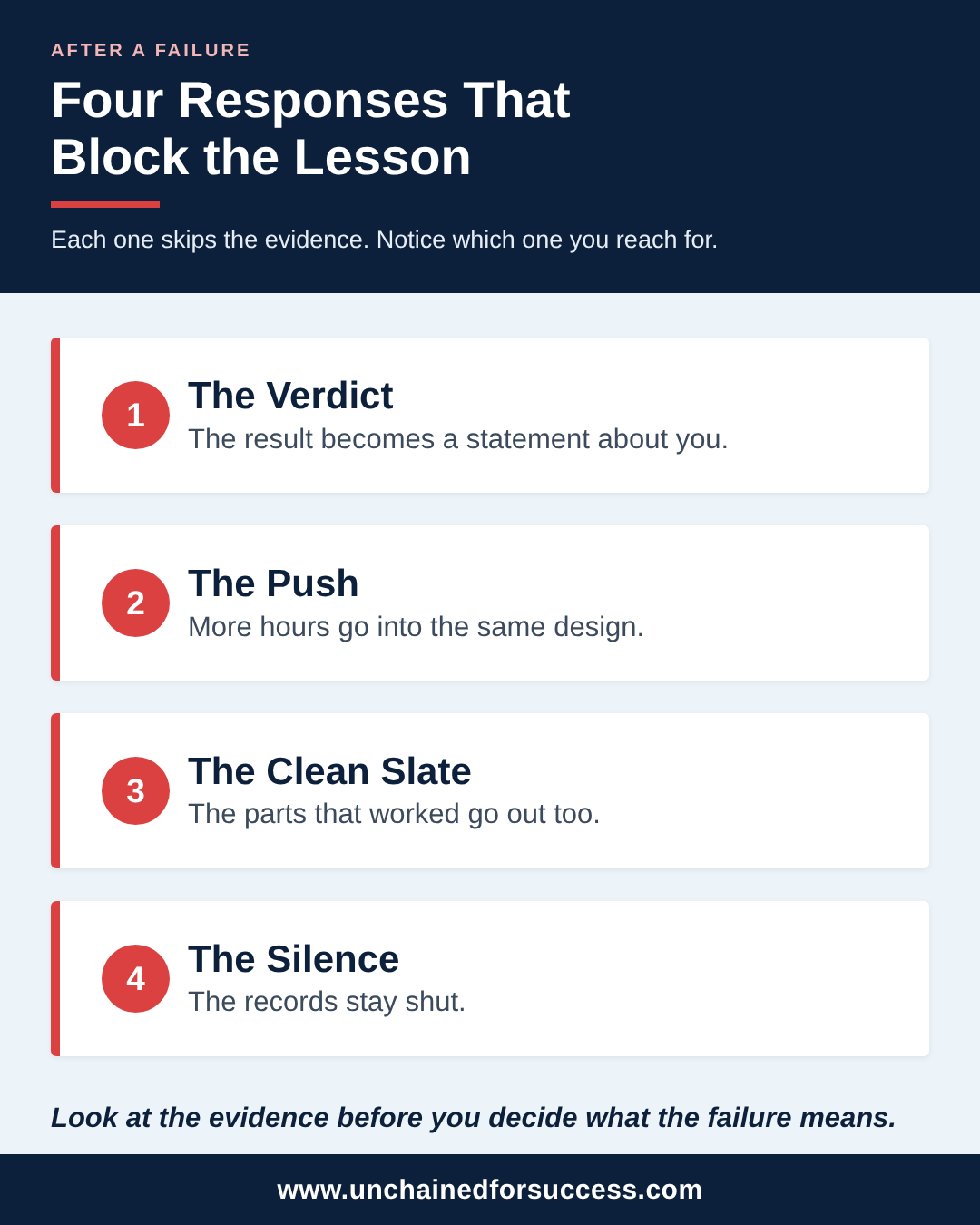
The verdict. The result becomes a statement about you. Her first reaction was to tell a friend she was not a writer. A verdict feels like honesty, but it closes the question before you have looked.
The push. More hours go into the same design, and it feels like commitment. Next she resolved to write 1,000 words every day until the draft was done, starting on Monday. But if the design was the weakness, a bigger effort on the same design can fail for the same reason. So do not just add hours. Keep going, but first find out what needs to change.
The clean slate. Everything goes: the plan, the method, sometimes the goal. You start again from a blank page, and throw away the parts that worked along with the parts that did not.
The silence. You never mention it again, and the records stay shut. Whatever went wrong is left in place for the next attempt.
Steps One and Two: Find the First Sign of Failure
That weekend, before Monday came, she put both the resolution and the verdict aside and opened her calendar.
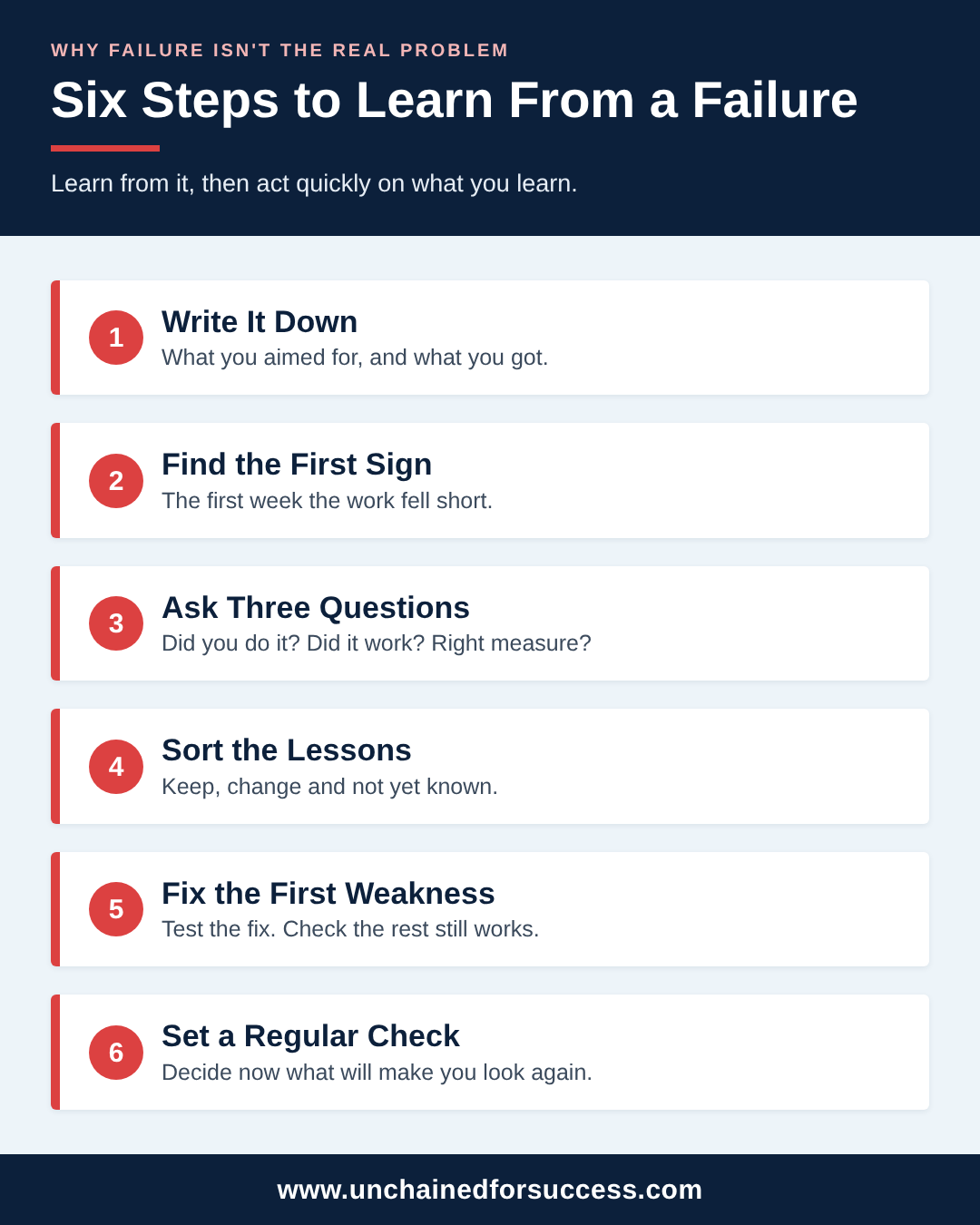
1. Write down what you aimed for and what you got. Use numbers where you can. Hers: a full first draft of about 60,000 words by the end of July, and 31,000 words written.
2. Find the first sign. Go back through your records for the first week the work fell short. From the middle of January she had planned to write for 45 minutes at 6.30 am on each weekday: about 500 words a session, and 2,500 a week.
Her calendar, where she ticked each morning she wrote, showed two ticks in the first week of February and three in the second. So by the middle of February she had missed her weekly standard two weeks running. Those two weeks did not sink the plan, which had a month to spare. But they were the moment to look. She was ticking the calendar and not reading it.
February showed the first warning, not a failure that was bound to happen. By July the shortfall had grown, because she had not looked into it.
A result can be slow to move. The weekly measures beneath it can show trouble sooner.
Step Three: Find the Lesson in the Failure
3. Ask three questions, in order.
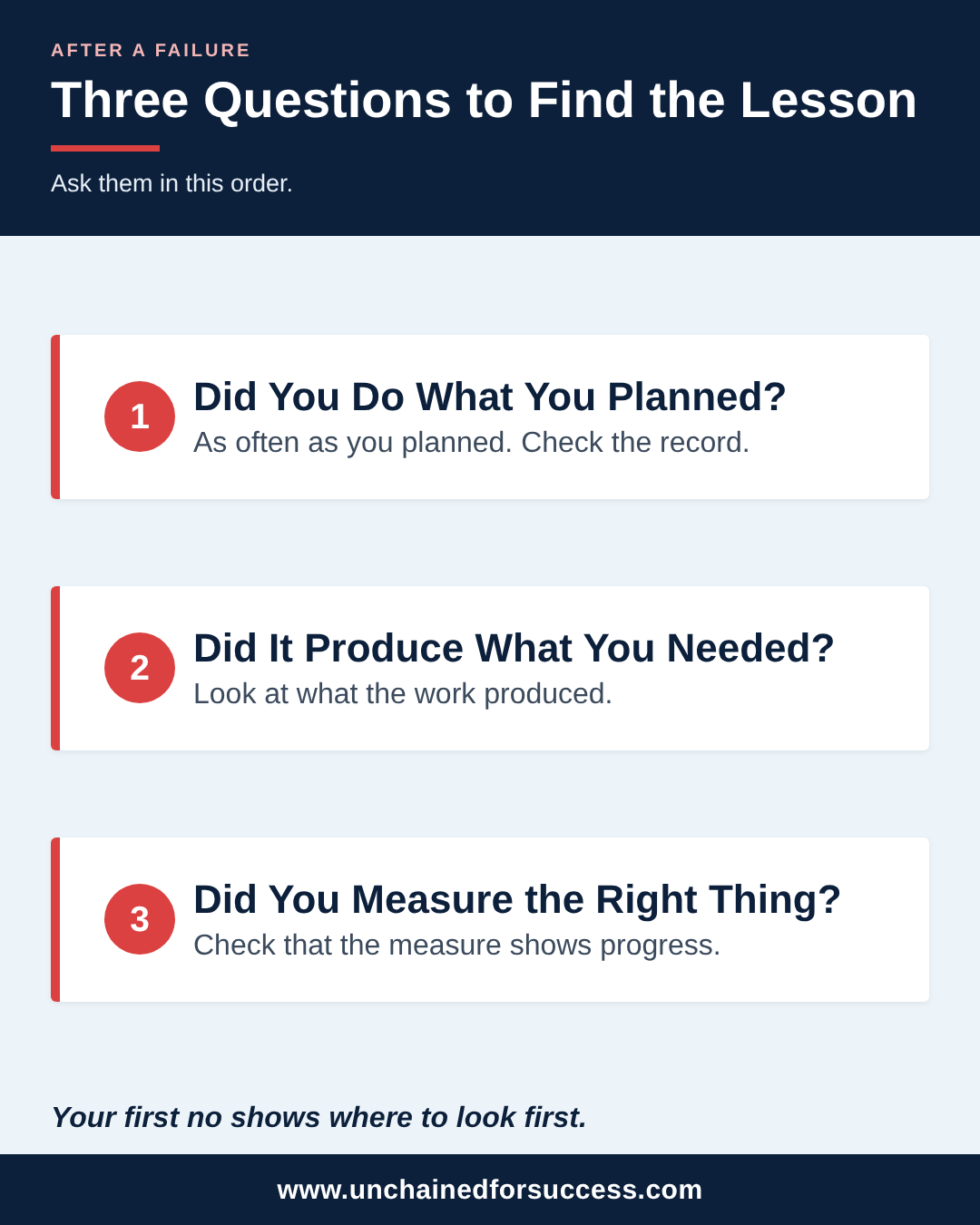
Did you do what you planned, as often as you planned? She had completed 62 of her 140 planned mornings, and none after the end of May.
When you did it, did it produce what you needed? Each session produced its planned words: 62 sessions at about 500 words account for her 31,000.
Was that the right thing to measure? Nearly. A word count does not show which chapters are finished.
Your first no shows where to look first. Hers came at the first question. If yours comes at the second, as it can after months of steady exam revision that still left you short, change the method before you add hours.
When she put the calendar beside her work diary, almost every missed morning followed a late finish at the office. By the end of May the gaps had joined up. The writing had not become a habit, because each morning depended on the night before.
Steps Four and Five: Act on the Lesson Quickly
4. Sort the lessons into three lists: keep, change and not yet known. What worked goes under keep. She kept the 45-minute session, which had produced its 500 words, and the weekly standard, which would have shown the trouble first had she looked. She would change the time, and start noting each week which chapters were finished.
What she did not yet know was which time would hold. For anything not yet known, choose a small test that would help answer it, and start it this week.
5. Fix the first weakness, then check that the rest still works. Her first idea was lunchtime at her desk. She tested it for two weeks, and work kept taking the hour: she managed four sessions out of ten.
So she tried straight after work from Monday to Thursday, before going home, with a fifth session on Saturday morning. A late finish now pushed a session back, where before it had cost her the next morning. Over two weeks she kept nine of the ten, and each session still produced about 500 words. She also checked that the new times left room for home and rest.
By then the draft stood at about 37,500 words. Only then did she set a new date for the rest: eleven weeks away, with two of those weeks to spare. Within a month of opening her calendar she had tested two fixes and was writing again. She did not wait for January.
Step Six: Catch a Shortfall Before It Becomes a Failure
6. Set a regular check, and decide now what will make you look again. Two better weeks do not prove a fix, because her January plan began well too. So every Sunday she counts the week's sessions and words against her standard, and notes which chapters are finished. If she falls short two weeks in a row, she opens the calendar that day.
Nothing guarantees the draft. But a shortfall should now show within a fortnight, not at the deadline.
Your case may be harder than hers: the occasion has passed, the date cannot move, you kept no records, or this is not your first attempt. Each has an answer.
If Your Failure Is Harder Than Hers
What if the occasion has passed? A particular race or family trip will not come round again. The lessons are still there, so work through the first three steps. Then ask whether you still want the result for its own sake. If you do, find the next opportunity, and test a fix before you commit to a plan for it.
What if my date cannot move? An exam sitting or a wedding will not wait. If the date is still ahead, work through the first three steps now, while there is time to change something. If the time left cannot hold the work left, say so early. Take a later sitting where there is one, or decide which part matters most and do that part well. If the date has passed, the answer above applies.
What if I kept no records? Rebuild what you can from your diary, messages, bank statements and any app you used. Then start a simple record today: a tick for each session you complete, and a note of what it produced.
What if this is not my first attempt? Find the first sign in each attempt. If it is the same one every time, look at what you changed in response. Was a fix made? Was it kept up? Did it deal with the cause? Start with the first of those that gets a no. If all three get a yes, go on to the next section.
When the Cause of Failure Is Not the Daily Work
Suppose the three questions in step three all get a yes: you did the work, it produced what you needed, and you measured the right thing. If you still fell short, look beyond the daily work. Ask five more questions, in order.
Did the plan ever fit your time and energy? Do you still believe you can do it? Are you still willing to pay what it costs and to live with what follows? Does your reason still hold? Was the result yours to deliver? Start with the first one that gets a no. If that is the last, set the goal again on the part you control.
A Trap I Fell Into Myself
The last of those questions asks whether the result was yours to deliver. It names a trap I have fallen into myself.
I set myself a goal: to win a four-year contract for our organisation from a particular client. A couple of months in, I realised that I did not control whether the client would give us that contract. It depended on the client's direction at the time, and on which year of their cycle they were in. In the terms of my own framework, what I had set was a dream, not a goal.
Even after troubleshooting for programmes and organisations for so long, I saw how easy it is to fall into the trap of setting yourself a dream instead of a goal. So I translated it into goals we controlled: completing the proposals, making the contacts and showing the client the value. I also reminded them of targets we had achieved together that had looked impossible.
We achieved those goals, and they brought us advisory work, which was what the client wanted. The four-year contract was not their direction, and we did not get it. But because we had recognised it as a dream, our identity was intact when it did not come. Missing it was not a verdict on us.
If your no comes at that question, do the same.
What a Failure Can and Cannot Take
A failure costs time, money and confidence, and some of that does not come back. It helps to be exact about what it can take.
It can take the date. The accountant did not have her draft by the end of July. She may still finish the same draft by a later date.
It can take your confidence for a while. Rebuild it with weekly targets small enough to meet. Then meet them, and keep a record of each one.
It can even take the goal. Suppose her book is never written. The book was one route to her vision: becoming the person small business owners turn to about their cash. A course or a series of talks could lead to the same place.
When one route closes, look for another that leads the same way. A failure cannot take your vision unless you decide to give it up. And it leaves you a lesson, if you go and get it.
Failure Isn't the Real Problem. Failing to Learn and Act Is
The failed attempt cannot be undone. What stays open is whether you learn from it, and how soon you act on what you learn. A verdict, a push, a clean slate and a silence all leave the lesson where it lies.
So choose one result from this year that went wrong. This week, write down what you aimed for and what you got. Then find the first sign, and write down its date. Share what you find in the comments.
What will you keep, what will you change, and what do you not yet know?
Further Reading on Failure and Setbacks
The six steps draw on the Unchained Goals Framework. The Goals Readiness Score is 18 questions about how your own goals are set up. An earlier post shows how to write a standard like hers. Two more posts:
• Handling Setbacks Without Losing Direction goes further into the harder cases, and into keeping a result and your identity apart.
• Taking Responsibility covers what owning your part of a result involves.
Does Research Agree That Failure Isn't the Real Problem?
In part. Three pieces of research sit behind this post. Each supports one part of it.
Look at what happens between attempts. A study in Nature examined failure in three large sets of records, including 776,721 grant applications and 58,111 start-up companies. It compared those who failed and went on to succeed with those who failed and then made no recorded attempt for at least five years. It found no clear difference between the two groups in how many times they had failed.
What differed came between attempts. Among those who went on to succeed, later attempts performed better than the first, and the gaps between attempts shortened. The lesson I draw, in support of this post's title: look at what changes between attempts, not at the number of failures.
Do not assume failure teaches by itself. Eleven studies reported in the Journal of Experimental Psychology: General found that people overestimated how often others put things right after a failure. The lesson I take is that the learning has to be done on purpose.
A setback does not settle what comes next. A study in Nature Communications followed 1,184 early-career scientists who landed just either side of the funding line for a major US research grant. The authors estimated that, for those who narrowly missed, there was more than a one in ten chance of leaving that funding system for good.
Yet those who stayed went on to publish a higher share of highly cited papers over the next ten years than those who had narrowly won funding. Both results followed the same setback, so the setback alone did not decide what came next.
Sources and Their Limits
None of the studies below tests the six steps. They support the thinking behind them, and each has limits, which are set out here.
• Yin, Y., Wang, Y., Evans, J. A. and Wang, D. (2019). "Quantifying the dynamics of failure across science, startups and security." Nature, 575, pp. 190 to 194. Available at: https://doi.org/10.1038/s41586-019-1725-y. Limits: three sets of records (grant applications, start-ups and, in the third, attacks by terrorist organisations). The comparison of performance is among those with several failures in a row, and the group that did not succeed made no further recorded attempt for at least five years. These records show a pattern, not a cause, and none concerns an everyday goal. The authors' explanation, that people who reuse too little of their earlier attempts stay stuck, is a model.
• Eskreis-Winkler, L., Woolley, K., Erensoy, E. and Kim, M. (2024). "The exaggerated benefits of failure." Journal of Experimental Psychology: General, 153(7), pp. 1920 to 1937. Available at: https://doi.org/10.1037/xge0001610. Limits: the finding concerns what people expect. It does not say that failure never helps.
• Wang, Y., Jones, B. F. and Wang, D. (2019). "Early-career setback and future career impact." Nature Communications, 10, article 4331. Available at: https://doi.org/10.1038/s41467-019-12189-3. Limits: it covers narrow misses among early-career scientists in one funding system, and may not hold beyond them. It tracks activity in that system only, so it cannot say where those who left went next. The authors concluded that the departure of weaker applicants could not explain the whole gap, and that the result is no argument for putting obstacles in a junior scientist's way.
Continue Your Journey
Explore more resources from the Unchained Goals Framework: