


Stretch goals carry a reputation as the gold standard of ambition. Aim higher. Push further. Refuse the comfortable target. Yet stretch goals can fail quietly, not for lack of effort, but because nobody built the goal for execution. A target that sits outside your authority creates pressure without direction, and pressure without direction does not produce progress. It produces patchy effort, frustration and defensive behaviour in place of disciplined execution.
Last week's post, Growth Without Burnout, looked at how lasting progress depends on managing stretch wisely. This week the focus moves upstream. Before energy management matters, the goal itself needs the right design. By the end of this article, you will know the five tests every stretch goal must pass. You will also know how to tell a goal from a dream, and how to turn ambition into a system you can actually run.
Why Structured Stretch Goals Matter
Ambitious targets are everywhere. "Double the business." "Get promoted within the year." "Reach financial independence." Each sounds impressive at a leadership offsite or in a New Year diary. Any of them can fade once the work starts. The reason is not always a lack of will. It can be structure.
Sim Sitkin, Chet Miller and Kelly See describe a paradox in a Harvard Business Review article drawing on their research into organisational goals. The organisations best placed to benefit from stretch goals, those with recent wins and spare resources, "seldom employ them", they write. Meanwhile, "businesses in trouble often adopt them in a desperate attempt to turn things around, and they nearly always fail".
The authors name two conditions that make a stretch goal appropriate: recent strong performance, and slack resources to draw on. Resources, they say, are the more critical of the two. One caution before we go further: the authors mean goals that seem impossible with current capability. The framework's Stretched condition stops short of that, for reasons the next section explains.
Their evidence is organisational, but the same pattern is easy to recognise in an individual life, and this reading is ours. A person in difficulty reaches for the largest possible goal, and the gap between intention and execution grows wider every week.
If you cannot act on a stretch goal at the cadence it needs, you cannot review it with evidence. If you cannot measure progress, you cannot govern it. So the aim of this article is practical, not motivational. A stretch goal is good. One without structure is a dream.
Stretch Goals Need a Structure to Match the Ambition
A stretch goal, properly understood, pushes you beyond what you can do today. It also stays within reach of deliberate action. The stretch sits in the ambition. Discipline sits in the structure. Strip out the structure and what remains is not a goal at all. It is an aspiration.
Goal-setting research backs the ambition. Edwin Locke and Gary Latham reviewed 35 years of studies in American Psychologist.pdf). Across well over 100 tasks and more than 40,000 participants, people given specific and difficult goals performed better than people simply asked to do their best. The effect was strongest when they were committed to the goal and received feedback on progress.
Our reading of that finding is that a specific goal has to name a result you can measure. The Unchained Goals Framework then asks a question the research does not: does the person who holds the goal have enough authority to govern its result? That is the test a stretch goal is easiest to skip, and it is the subject of the next section.
The Five Tests Stretch Goals Must Pass: SSMTC
Every Goal in the framework must pass SSMTC. A proposed outcome that fails any one of the five is not yet a goal.
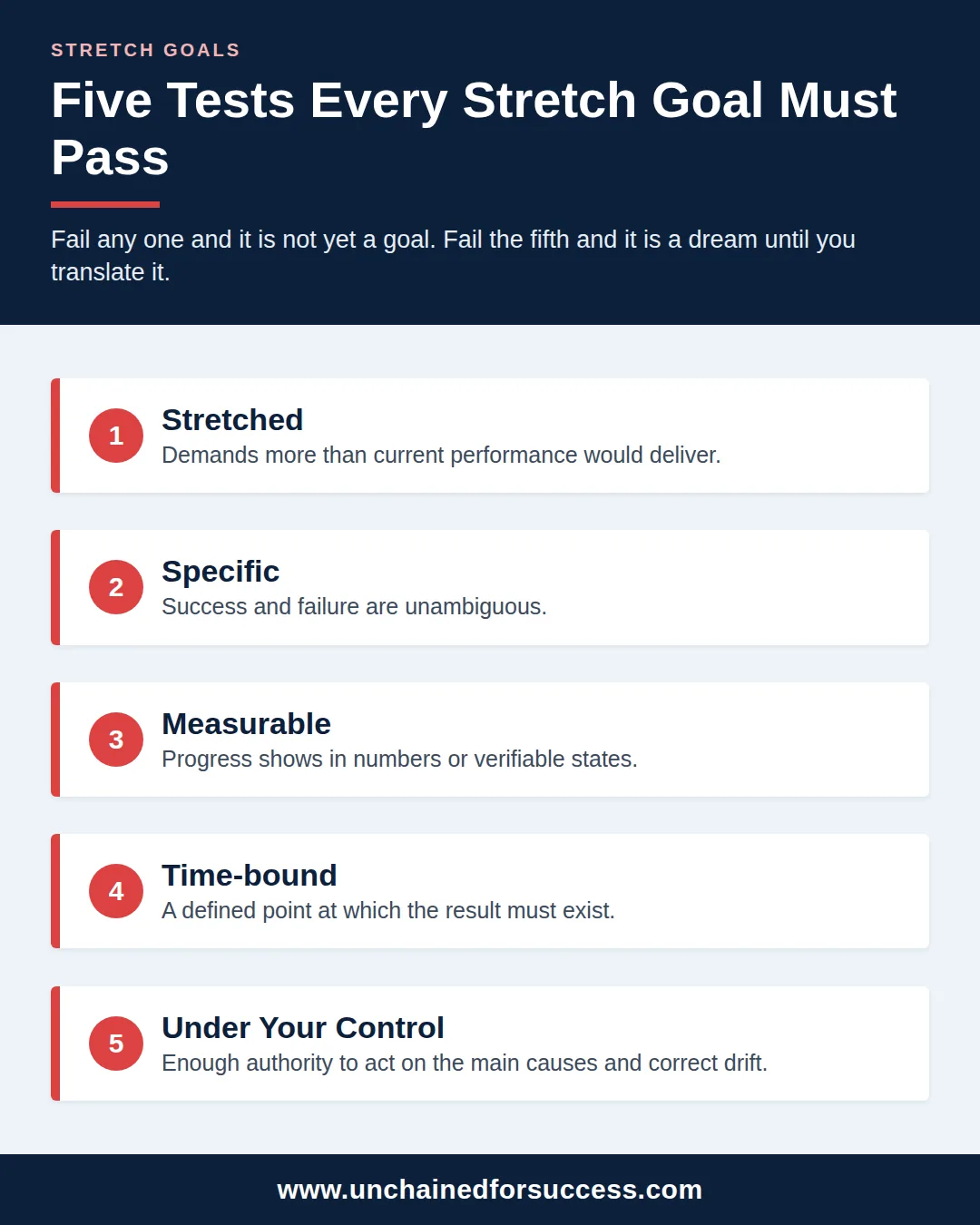
Stretched. It demands more than current performance would deliver. Comfortable targets do not change behaviour. The framework is careful here. A stretched goal extends beyond current comfort without exceeding what you believe is possible, because a goal that feels impossible collapses effort rather than raising it.
Specific. The result has a definition precise enough that success and failure are clear, and two people would describe it the same way.
Measurable. You can show progress and completion in numbers or verifiable states, not opinion.
Time-bound. There is a defined point at which the result must exist. Open-ended commitments invite delay.
Under your control. You hold enough authority over the main causes of the result, and over the decisions needed to correct it, to govern the outcome. This does not mean controlling every external event. It means that if the result drifts, you can act on its main causes and make the material decisions needed to recover it.
Why the Fifth Test Separates Stretch Goals From Dreams
That fifth test is the clean break from the familiar SMART criteria. A target can satisfy every SMART condition and still be, in the framework's language, a dream. A dream is a proposed outcome that sits outside the Control Boundary of whoever holds it. Influence alone is not enough. Hope is not enough. A dream can shape your Vision, but it cannot anchor execution until you translate it into a result you can govern.
How Stretch Goals Fit the Unchained Goals Framework
The framework has nine components: Purpose, Vision, Goals, Why, Ownership, Beliefs, Plan, Habits and the Control System. A stretch goal touches all of them, and the ones below decide whether the stretch survives.
Goals sit inside Purpose and Vision. Your Purpose, the problem you have taken responsibility for, decides whether the goal deserves your capacity at all. Your Vision, the long-term position you have committed to, decides whether it points the right way. A stretch goal that serves neither is ambition without direction.
The Outcome Goal heads the execution spine. Beneath it, the Performance Goal sets the operating standard that shows you are on track. Process Goals then name the controllable behaviours that produce that standard, and Habit Conversion turns those behaviours into routines that need less deciding each time. The ambition lives at the top of the spine, the daily work lives at the bottom, and a standard you can measure connects the two.
What Holds Stretch Goals Steady Under Pressure
Around the spine sit the parts that hold it steady under pressure. The Why justifies the goal's cost, which for a stretch goal is high. Ownership is the conscious acceptance of that cost and of the consequences of pursuing it within your authority.
The Plan tests whether there is a credible path within sustainable capacity. The Control System then governs the whole. It compares your Performance measures with their agreed range, and opens a diagnosis when a result falls below range and meets the trigger you set. A stretch goal costs more than a comfortable one, so declare the trade-offs before the pressure arrives, as How Trade-Offs Create Progress explains.
Three Worked Examples
The people in these examples are illustrations, not clients.
An Individual Whose Stretch Goals Became Governable
James, a senior account manager, sets a stretch goal to "grow his client portfolio significantly this year". Six months later he is busy, exhausted, and cannot point to a single measurable improvement. The goal fails Specific and Measurable, and a portfolio that grows only when clients decide to spend more fails the fifth test at his level.
He translates it. His Outcome Goal becomes a manager-approved growth proposal presented to every one of his twenty accounts by 31 March next year, each backed by a written account plan. He can write the plans, build the proposals and present them. Whether a client buys is outside the goal.
The Performance standard is two proposals a week passing his manager's quality check, with none more than a fortnight behind the plan. Beneath that, his Process Goal is a protected ninety-minute account-planning block every weekday morning, and a meeting request sent to every account each month, with the follow-up logged.
The extra revenue he wants is the result he hopes the system produces. The goals he governs are the plans, the proposals and the calls.
A Consultancy Whose Stretch Goals Stayed Inside Its Authority
A consultancy's founder declares a stretch goal to "become the regional market leader within two years". Market leadership depends on competitors, client cycles and the economy, so at her level it is a dream. She translates it into an Outcome Goal she can govern: triple recurring revenue within 24 months. Her authority over pricing, positioning, hiring and outreach, and the demand her current pipeline already shows, let her act on the main causes when the result drifts.
The Performance standards are qualified pipeline value at three times the next quarter's revenue target, and a pitch conversion rate that stays within an agreed range. Her Process Goals are ten qualified outreach approaches, two thought-leadership pieces published and one pipeline review every week. The ambition survives. The execution is finally possible.
A Programme Whose Stretch Goals Fit the Working Week
A digital programme commits to "deliver world-class customer experience by year end". The intent is good, but you cannot track "world-class" on a Tuesday. Reframed, the Outcome Goal becomes cutting the average time to resolve a customer issue from 48 hours to four within twelve months. That is governable here because the programme owns the service workflow, the tooling and the procedures the agents follow. A programme that only supplied the software would have to translate it again.
The Performance standard has two parts: resolution time on each automated issue type below eight hours within one sprint of go-live, and three workflow automations deployed and tested per sprint.
Beneath it, the Process Goals are a protected build session on the next automation every working day, and one pilot test of each automation with the agents who will use it before it goes live. The team now knows what to do on Monday morning, and the Control System can see by the second sprint whether the work is moving the result.
How to Keep Stretch Goals Within Your Control
Four moves turn a stretch target into a goal you can run.
1. Run the Five Tests
Write the proposed outcome down and test it against SSMTC, one condition at a time. Do not stop at the first four. Ask the fifth honestly: if this result drifts, can I act on its main causes and make the decisions needed to recover it?
2. Translate a Dream Into Stretch Goals You Can Govern
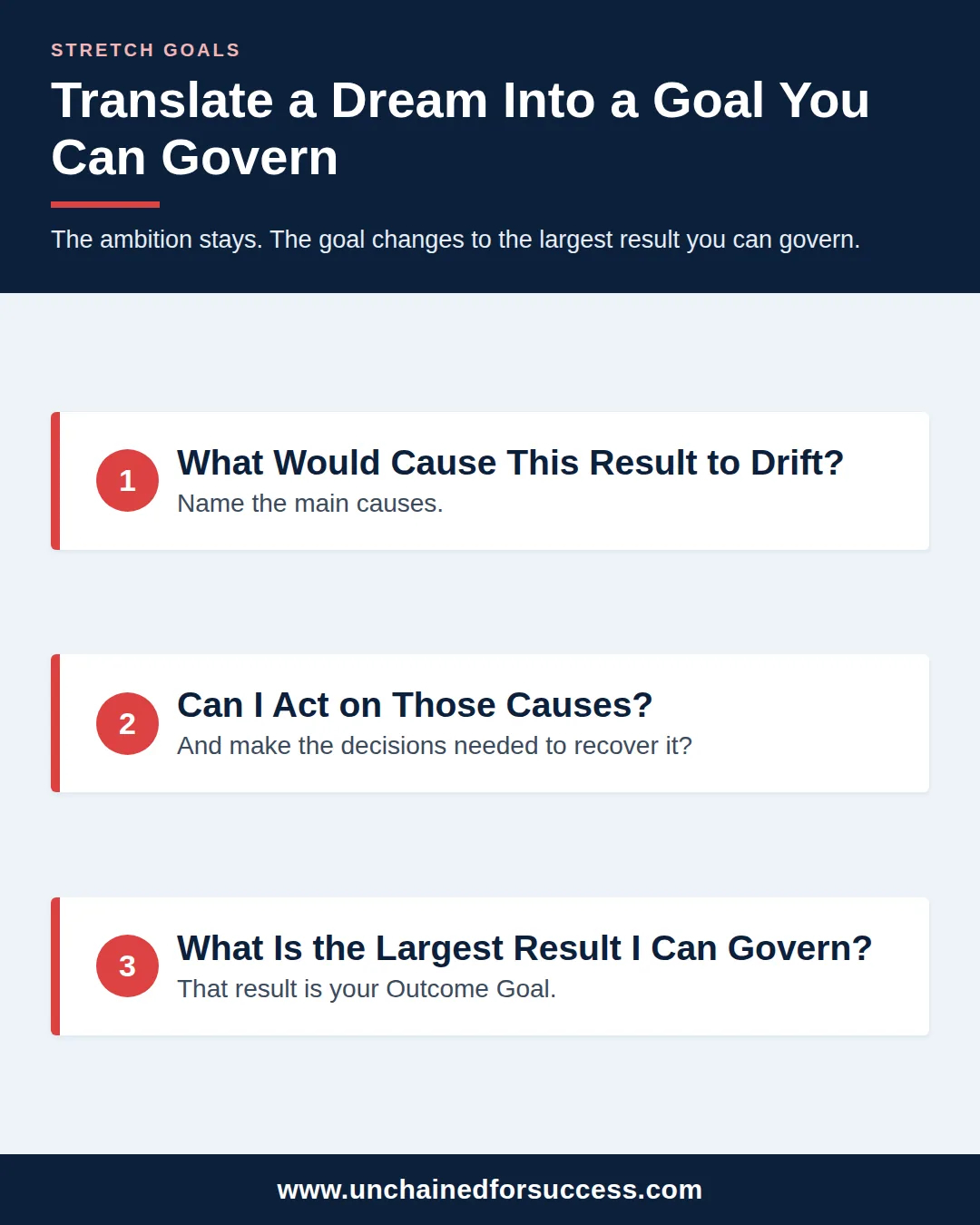
If the fifth test fails, do not abandon the ambition and do not pretend the test passed. Translate it. The framework's Control Boundary Assessment asks three questions. If the result drifts, what are its main causes? Can the named owner act on those causes and make the decisions needed to recover it? If not, what is the largest result the owner can govern?
That largest governable result is your Outcome Goal, provided it still passes the other four tests. The original ambition stays as the result you hope the system produces.
3. Build the Spine Beneath Stretch Goals
Give the Outcome Goal a Performance standard that shows you are on track. Add one or two Process Goals that produce that standard. Then convert the Process behaviours into routines with a fixed time, a clear cue and a minimum version for hard weeks. "Do more outreach" is not a routine. "Account planning at 9 am every weekday, before opening email" is.
4. Govern Stretch Goals With the Control System
Agree the range for each Performance measure, the review rhythm, and the trigger that opens a diagnosis. When a result falls below range and meets the trigger, diagnose in the framework's fixed order, starting with whether the agreed actions happened. When results exceed the range and meet the trigger, check that the improvement is genuine, repeatable and sustainable before you raise the standard.
Common Mistakes That Undermine Stretch Goals
Confusing ambition with structure. A bigger number does not make a goal stronger. It widens the gap between intention and execution unless the structure grows with the ambition.
Owning a result you cannot govern. Promotions, market share and client decisions are things you influence. Hold yourself accountable for them without the authority to act on their causes, and responsibility exceeds control. Anxiety then replaces execution, even when your work is excellent. That gap between accountability and authority is exposure, not Ownership, and the framework says to redesign it.
Skipping the Performance layer. Outcome Goals feel inspiring and Process Goals feel practical, so the standard in between is the easiest layer to skip. Without it, you cannot tell whether the daily work is producing the result until the deadline comes.
Treating "under your control" as "only what I do myself". The fifth test is about authority to govern a result, not about limiting goals to your own actions. A founder with authority over offer, price and pipeline can govern a revenue outcome; an account manager whose clients decide the spend cannot. The test is who holds the authority, not whether other people are involved.
Frequently Asked Questions
Is a stretch goal that depends on other people always a dream? No. Involving other people does not make a result a dream. The test is whether you hold enough authority over the main causes and the correcting decisions to govern the result. A team leader can govern a delivery date her team controls; she cannot govern whether a client renews.
What is the difference between a stretch goal and one that is simply too big? A stretched goal extends beyond current comfort while remaining attainable through disciplined effort. The framework avoids judging a goal by whether it feels sensible today, because that test is limited by what you currently believe. A goal that exceeds what you believe is possible collapses effort.
The framework tests this twice. First, the Stretched condition asks whether the goal stays within what you believe is possible. Then the Plan asks whether there is a credible path to carry it within sustainable capacity. If there is not, the goal does not go ahead in that form.
What if my employer sets the stretch goal for me? Translate it at your level. The framework calls this Control Boundary Translation. An outcome passed down without redesign becomes a dream for the person who receives it, because it sits outside what they can govern. It may still be a valid Goal for your manager. Agree with your manager the largest result you can govern, and let the original target stay as the result the wider system is aiming at.
Stretch Goals Turn Ambition Into Achievement
Stretch goals are not the problem. Stretch goals without structure are. Put the goal within your authority. Let a Performance standard show at each review whether you are on track, and let a process you can repeat at the cadence the goal requires produce that standard. Then ambition becomes momentum. Take any of those away, and ambition becomes anxiety in a different costume.
This week, take the most ambitious target you hold and run the five tests. If the fifth fails, answer the three translation questions and write down the largest result you can govern. If you want an outside view of how your goals are designed, executed and governed, the Goals Readiness Score is an optional next step: 18 questions, under five minutes.
Share the stretch goal you translated, before and after, in the comments.
Which of your ambitions is a goal, and which is a dream you have been calling one?
Sources
• The Stretch Goal Paradox by Sim B. Sitkin, C. Chet Miller and Kelly E. See, Harvard Business Review, January to February 2017
• Building a Practically Useful Theory of Goal Setting and Task Motivation: A 35-Year Odyssey.pdf) by Edwin A. Locke and Gary P. Latham, American Psychologist, 57(9), 705 to 717, 2002. DOI 10.1037/0003-066X.57.9.705
Continue Your Journey
Explore more resources from the Unchained Goals Framework: