Future-Proofing Your Skills and Goals
Introduction: The Urgency of Future-Proofing Your Skills
Future-proofing your skills is not optional anymore — it is essential.
The World Economic Forum’s Future of Jobs Report 2025 reveals that 44% of workers’ core skills will change within five years. Technology, automation, and shifting markets are redefining how we grow.
However, when you start future-proofing your skills and goals, you take control of change. You learn, adapt, and stay relevant no matter what happens next.
This article draws from the Unchained Goals Framework and global research to show you how to stay ready for the future — not just to survive, but to thrive.
Why Future-Proofing Your Skills and Goals Matters
The rules of success are shifting fast.
According to McKinsey & Company, 375 million workers will need to reskill by 2030. The Harvard Business School Skills-Based Hiring Report confirms that employers now care more about competence than degrees.
In simple terms, your future depends on how quickly you can learn, apply, and grow.
Moreover, when your new skills align with your life’s direction, you multiply your impact.
As shared in Starting 2025 with Clarity: Define Your Vision and Purpose, clarity gives power. Future-proofing your skills and goals ensures that every effort moves you closer to your purpose instead of away from it.
The Core Skills for Future-Proofing Your Success
Let’s explore the five most important skill areas that can help you stay ahead of change.
- Analytical Thinking and Problem-Solving
The World Economic Forum ranks analytical thinking as the top skill for the next decade. Machines process data, but humans interpret meaning.
For example, asking “Why did this happen?” five times — the 5 Whys technique — uncovers root causes and builds insight.
Analytical thinkers stay calm under pressure and act on facts, not fear. Therefore, this mindset is key to future-proofing your skills.
- Learning Agility and Adaptability
Adaptability keeps you relevant when everything else changes.
The Harvard Extension School highlights continuous learning as a permanent advantage.
Start with small daily learning habits:
- Read or watch something useful for 10–15 minutes a day.
- Reflect weekly on how that learning helps your goals.
As I wrote in Small Steps, Big Impact: Building Consistent Habits, small actions repeated daily create massive transformation.
- Communication and Emotional Intelligence
In a world of AI, people skills matter more.
Harvard Business Review shows that empathy, listening, and collaboration remain the most “future-proof” abilities.
For example, a leader who inspires through clear communication can unite a team during uncertainty.
Likewise, professionals with high emotional intelligence maintain influence when others lose focus.
- Digital Fluency and AI Literacy
The World Economic Forum defines a “New Skills Triad”: sustainability, AI fluency, and virtual collaboration.
You do not need to code, but you should understand how technology helps you work smarter.
For instance, use AI tools to summarise reports or speed up research. Future-proofing your skills and goals requires using tech as a partner, not a threat.
- Resilience and Growth Mindset
Resilience turns obstacles into progress.
Psychologist Carol Dweck’s research shows that people who view setbacks as lessons always move forward.
To strengthen resilience:
- Reframe failure as feedback.
- Celebrate small wins often.
- Surround yourself with encouraging people.
This mindset was central to Mindset Reset: Tools to Reframe Your Thinking.
When your mindset grows, your future follows.
Turning Learning into Daily Action
Learning without application changes nothing.
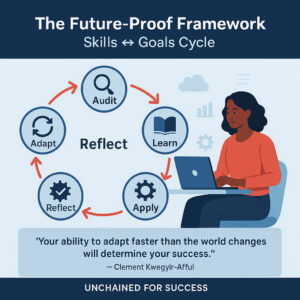
To make future-proofing your skills a practical routine, follow this five-step cycle:
- Audit – Review your current goals and abilities.
- Learn – Choose one new skill to improve this month.
- Apply – Use it immediately in work or daily life.
- Reflect – Ask what worked and what didn’t.
- Adapt – Adjust your goals and repeat.
This loop is simple but powerful. Over time, it builds confidence, consistency, and momentum.
If you need structure, revisit Mid-Year Goal Reset: Realign and Refocus to help you review progress regularly.
Real-World Example: Adapting Through Change
Consider Leila, a marketing manager who saw her company moving toward AI analytics. Instead of resisting, she took a short Harvard Digital Strategy course.
After three months, she was leading the new data-driven campaign team.
Her story shows that future-proofing your skills and goals works best when you learn early and apply fast.
Common Challenges and How to Overcome Them
| Challenge | Solution |
| Trying to master too many new things | Focus on one skill per quarter. Quality beats quantity. |
| Losing motivation | Use accountability partners and celebrate small wins. |
| Skills becoming outdated again | Build meta-skills like adaptability and problem-solving. |
| Fear of change | Replace fear with curiosity — learn something small each day. |
When you treat learning as a lifestyle, change stops being a threat and becomes an opportunity.
Conclusion: Lead the Change, Don’t Chase It
Future-proofing your skills and goals is about choosing growth over comfort.
Start today. Learn one skill, apply it, and review your progress.
The world is moving quickly — but with clear goals, consistent learning, and courage to adapt, you will always stay one step ahead.
References
Internal
- Starting 2025 with Clarity: Define Your Vision and Purpose
- Small Steps, Big Impact: Building Consistent Habits
- Mid-Year Goal Reset: Realign and Refocus
External
- World Economic Forum. Future of Jobs Report 2025 – Skills Outlook
- Harvard Extension. Future-Proof Job Skills
- Harvard Business School. Skills-Based Hiring Research
- McKinsey & Company. Reskilling for the Future of Work
- Psychology Today. The Science of Adaptability