Outgrown Your Capacity? 7 Signs to Watch For

Most ambitious people assume that when growth stalls, the goal was wrong. So they reset the target, push harder, and wait for momentum to return. Yet the goal is often fine. The real problem is quieter and harder to see. You may have outgrown your capacity, and the systems, habits, and energy that once carried you can no longer carry what you are now trying to do.
This article gives you seven warning signs to watch for, so you can tell when you have outgrown your capacity before the limit breaks something. The promise is simple. By the end, you will be able to tell whether you need a new goal or a rebuilt capacity, and you will know which part of your approach to repair first.
Why It Matters
Growth rarely collapses in a single dramatic moment. It erodes. Effort keeps rising while results quietly flatten, and most people respond by working even harder. That instinct is understandable, but it accelerates the damage. When you have outgrown your capacity, more effort does not restore progress. It simply drains the reserves you have left.
The cost is real and measurable. Harvard Business Review research on midsize firms found that leaders who scale by replicating what worked, rather than building for sustainable growth, eventually get swept away when the wave they were riding crests. That same trap catches individuals and teams alike. Borrowed capacity, rather than built capacity, will always reach a ceiling.
Recognising the signs early changes the outcome. A limit you can name is a limit you can fix. A limit you ignore becomes burnout, missed commitments, and a slow loss of trust in your own ability to deliver.
The Core Concept: Capacity Can Expire
We tend to think of capacity as a fixed trait. In reality, it is a living system that suits a particular stage and then expires when the demands change. The capacity that carried you through one level of ambition was built for that level. Once the demand increases, the same structure can shift from engine to constraint.
Capacity is also far more than time. It includes your skills, your systems, your energy, your habits, your decision-making, your delegation, your recovery, and your belief systems. When growth outpaces any one of these, the whole structure strains. You can have plenty of hours in the day and still be operating well beyond what your habits, decisions, or recovery can support.
This is why the question matters. Last week we looked at how to grow faster without losing control. This week the question is different and more diagnostic. How do you know the capacity that once carried you is no longer enough? The seven signs below are how you tell.
The 7 Signs You Have Outgrown Your Capacity
Sign 1: Effort is rising but progress is flat
You are putting in more hours, more energy, and more attention, yet the results barely move. This is the clearest signal that input and output have decoupled. The work you are doing no longer converts into progress at the rate it used to, because the goal has grown beyond what your current approach was built to deliver.
Sign 2: Quality drops as effort increases
When you push harder and the standard of your work falls rather than rises, the system carrying that work has reached its ceiling. More effort poured into a maxed-out capacity does not raise quality. It introduces mistakes, rework, and inconsistency.
Sign 3: Recovery disappears and decisions feel harder
You no longer switch off, and even routine choices feel heavy. This is decision fatigue, and it is well documented. Roy Baumeister and colleagues’ work on ego depletion suggests that prolonged decision-making can reduce the quality of later choices, especially when recovery is missing. When recovery vanishes, your decision-making degrades long before you notice it in the results.
Sign 4: You keep adding commitments without removing anything
Every new opportunity gets a yes, and nothing ever comes off the list. This is the surest sign that no cost is being accepted. Real capacity is protected by trade-offs, and when you add without subtracting, you are pretending the limit does not exist. It does, and it will collect what it is owed.
Sign 5: Your habits no longer support your current goals
The routines that built your earlier success now quietly work against you. Habits are sized for the goals they were formed around, and when the goals grow, old habits become friction. If your daily defaults no longer move you towards what you are now trying to achieve, the habit layer has expired.
Sign 6: The system or team depends too heavily on one person
When progress stops the moment one person is unavailable, capacity was replicated rather than built. A structure that rests on a single point of dependence cannot scale, because it has no resilience. This is the organisational version of borrowing capacity instead of building it.
Sign 7: You feel busy, but outcomes are not improving
This is the felt experience of an expired capacity. You are fully occupied, your days are packed, and yet nothing meaningful is shifting. Busyness has detached from outcome. Where Sign 1 is the measurable gap between input and output, Sign 7 is the subjective sense of motion without movement, and it is often the first thing you feel before the data confirms it.
How This Fits the Unchained Framework
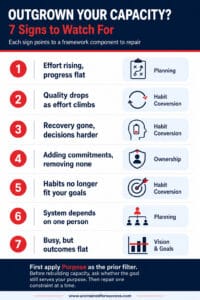
These seven signs are not a new model. Each one points to a specific component of the Unchained Goals Framework that has reached its limit, which is what makes the diagnosis actionable. The signs tell you where to look, and the framework tells you what to repair.
Signs 1 and 6 point to Planning, the component that both sizes goals to your current capacity and sets deliberate goals to build capacity over time. A flat return on rising effort, or a structure that depends on one person, means Planning has not kept pace with the goal. Signs 2, 3, and 5 point to Habit Conversion, the layer where intention becomes repeatable action, and where energy and recovery are either protected or spent. Sign 4 points to Ownership, the structural point where intention converts into responsibility under cost. Refusing to remove anything is a refusal to accept that cost. Sign 7 signals drift in Vision and Goals, where the work has lost its line of sight to the outcome.
Before you repair any of these, apply Purpose as the prior filter. Purpose comes before Planning, Ownership, and Habit Conversion, because it decides whether the goal still deserves your capacity at all. There is no sense rebuilding capacity to chase a goal that no longer serves your purpose. First ask whether the goal is still right. Only then ask which component needs rebuilding. This is the discipline we explored in Capacity Before Goals, and it is the difference between scaling the right things and scaling the wrong ones.
Capacity that is borrowed rather than built will always reach a ceiling.
Practical Examples
Individual. A consultant takes on more clients each quarter and works longer to keep up. Income rises, then plateaus, while errors creep in and weekends disappear. Signs 1, 2, and 3 are all present. Growing the practice is a perfectly good goal. What has expired is the capacity, specifically the habits and recovery sized for a smaller client list. The fix sits in Habit Conversion, not in chasing yet another client.
Business. A founder builds a team that runs smoothly only while she personally approves every decision. Growth stops whenever she is away. This is Sign 6, and it points squarely at Planning. The business has replicated her output instead of building independent capacity. The repair is structural delegation, not a harder-working founder.
Project. A project team keeps absorbing new requirements without dropping any, and the deadline quietly slips while everyone stays frantically busy. Signs 4 and 7 together. Ownership has not been exercised, because no trade-off has been accepted, and Vision has drifted from the original outcome. The fix is to name the cost and choose.
How to Apply This
Start by reading the seven signs honestly against your own situation. To know whether you have outgrown your capacity, mark each sign as present, emerging, or absent. Be specific, because a vague sense of being stretched is not a diagnosis.
Next, group the signs you marked and trace them to their framework component using the mapping above. Two or three signs usually cluster around a single component, and that cluster is your real constraint. Resist the urge to fix everything at once.
Then apply the Purpose filter before you change anything. Ask whether the goal that exposed this limit still serves your wider purpose. If it does not, the answer is to drop or reshape the goal, not to rebuild capacity for it. If it does, move to the single component your signs point to, and rebuild there first. Deliberate, sequenced repair beats scattered effort every time, a principle we covered in Stretch Goals Must Stay Within Your Control.
Common Mistakes
The first mistake is treating the symptom as the problem. Working longer to fix flat progress, or hiring faster to fix a one-person dependence, addresses the surface and ignores the structure underneath.
A second error is changing the goal when the goal was never the issue. If your purpose still backs the goal, resetting the target simply resets the same trap at a new number.
Third, many people try to rebuild every component at once. Capacity is rebuilt in sequence, one constraint at a time, exactly as you would grow it deliberately rather than all at once. The approach we set out in Grow Faster Without Losing Control applies here too: controlled, sequenced change is what protects growth from collapse.
Conclusion
Capacity is not a fixed possession. It is built for a stage, and capacity can expire when the demands move beyond it. The seven signs are how you catch that expiry early, while it is still a diagnosis rather than a crisis.
So before you reset your goals again, run the check for the signs that you have outgrown your capacity. Growth does not always fail because the goal is wrong. Sometimes it fails because the capacity that once carried you has expired.
Want the full system behind these signs?
Read Unchained: Success Unlocked by Clement Kwegyir-Afful for the complete Unchained Goals Framework, and explore the weekly blog at unchainedforsuccess.com.
References
- Kwegyir-Afful, C. (2023). Unchained: Success Unlocked. A Proven Framework for Achieving Your Goals.
- Gulati, R. and DeSantola, A. (2016). “Midsize Companies Shouldn’t Confuse Growth with Scaling.” Harvard Business Review, 25 July 2016. Available at: https://hbr.org/2016/07/midsize-companies-shouldnt-confuse-growth-with-scaling
- Baumeister, R.F., Bratslavsky, E., Muraven, M. and Tice, D.M. (1998). “Ego Depletion: Is the Active Self a Limited Resource?” Journal of Personality and Social Psychology, 74(5), pp.1252–1265.