

Ambitious people want to grow faster. They want stronger results, quicker progress and bigger opportunities. Yet speed without structure tends to produce the opposite of growth: broken systems, missed promises, falling quality and quiet exhaustion. The issue is not ambition. The issue is control.
This article shows how to grow faster without breaking the system that carries your growth. It puts four questions in front of every new commitment, in the order the Unchained Goals Framework builds them: Purpose, Ownership, Plan and Habits. It follows the earlier posts in the Growth Without Burnout series.
Why Learning to Grow Faster Matters
Going faster is not the same as making progress. It is easy to mix the two up, and the price is steep: taking on more, sleeping less, and treating exhaustion as proof of ambition. Quality drops. Deadlines slip. Trust erodes. Speed without structure produces decline disguised as effort.
Controlled growth, by contrast, builds on itself. Each gain protects the next. One commitment fits the system that has to carry it, and the next layer of ambition rests on a base strong enough to bear it. That is the difference between scaling and straining, and between growth you can hold for years and a sprint that resets after a few months.
Jim Loehr and Tony Schwartz made the case for the person in the Harvard Business Review. Their evidence is two decades of work with athletes and executives rather than a controlled study. The real enemy of high performance, they wrote, is not stress but the absence of disciplined, intermittent recovery. Chronic stress without recovery drains energy reserves and leads to burnout.
Ranjay Gulati and Alicia DeSantola made a related case for the company in the same journal. They drew on case studies. Start-ups that scale well, they argue, hire specialists, add management structure, set up a framework of plans and goals and keep their culture alive. Without that structure, improvising may amount to what they call aimless riffing.
Speed is only useful when the system can carry it. Anything else is a managed fall, however fast you appear to grow.
The Core Problem: You Cannot Grow Faster Without Filtering First
Plateaus and breakdowns can share a root. Ambition runs ahead of the structure that delivers it. The deeper problem sits further back: too many of the wrong commitments get in, because nothing filtered what deserved a yes. A new goal is added before the previous one has settled. A new responsibility arrives before the last one runs cleanly. New routines stack up before old ones have settled.
The pattern produces four failures. Priorities go to the wrong things. Costs go unowned. Plans become wishful. New routines never settle. Each failure traces back to one chain. When Purpose does not filter what enters, Ownership, the Plan and Habits all carry commitments that should never have been on the list.
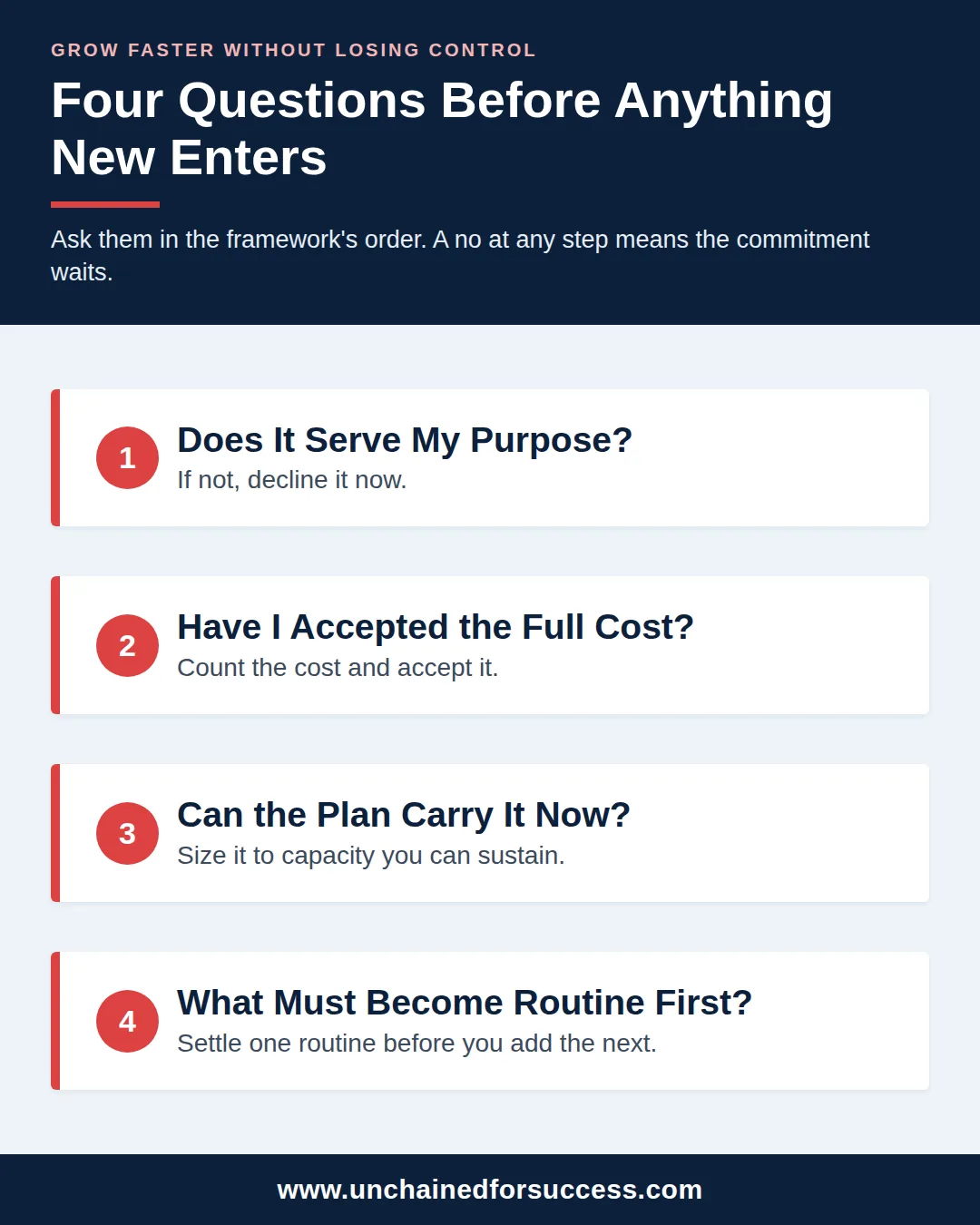
The fix is not to slow down. To grow faster and keep control, ask four questions, in order, before anything new enters.
The Four Questions That Let You Grow Faster Without Losing Control
The framework has nine components and builds them in a fixed order. This post applies four of them to one decision: whether to add a commitment at all. A commitment that passes all four still needs the rest of the design sequence before it becomes a goal you govern. That means a Vision it serves, an Outcome Goal that meets SSMTC, a written Why, a check on the Beliefs that could resist it, and a Control System.
Purpose Is the First Filter When You Want to Grow Faster
Purpose comes first in the framework because it is the problem you have taken responsibility for, and it rules things out. Without Purpose, every opportunity looks much the same and every yes feels fair. The system fills with commitments that drain rather than build.
The commitments that break a growing system can be good on their own merits. They simply do not serve the problem you exist to solve. This is the filter that is easiest to skip, because every candidate looks reasonable on its own. So the question is plain. Does this commitment serve what I am here to do? Only commitments that pass enter the next three questions, and that is where the room to grow faster comes from.
Ownership: Accept the Cost Before You Grow Faster
Ownership is the conscious acceptance of what a commitment will cost, and of the consequences of pursuing it within your authority. Your Why names that cost and explains why it is worth paying. Ownership is the step after it: accepting the cost and its consequences as yours. It is not enthusiasm, and it is not agreement.
A new commitment can look light on its own while carrying a cost you have not yet counted. When Ownership is a show rather than real, that cost shows up somewhere else: in quality, relationships or health.
Kendra Okposo argues in the Harvard Business Review that forced accountability produces compliance without commitment, and weaker results over time. Real accountability needs three things: people who choose to own the work, a clear link to purpose, and systems that make stepping up safe and expected. That is an argument from consulting practice with one case example, not a study, and it matches the framework's position.
So test every Purpose-aligned commitment against the cost it will demand, knowing what you know now. If you cannot accept that cost and its consequences, Ownership has not occurred, and the commitment is not yet real.
Plan to Capacity, Then Build the Capacity to Grow Faster
The Plan is where ambition becomes a credible path. One of its six elements does most of the work here: constraint identification and sustainable capacity. It has two parts. First, it tests whether there is a credible route to carry the new commitment within sustainable capacity. That is the pace you can hold without breaking down, after allowing for every other goal and commitment drawing on the same capacity over the same period.
Second, it may build, acquire, free or release capacity before you need it. That future capacity must have a credible route, a timing and an owner, or it does not count.
Some plan for the system they wish they had. Others treat current capacity as a permanent ceiling. Both fail. Size the next stage to what the system can carry today, then write the capacity-building goal that lets it carry more next quarter. The earlier post in this series, Capacity Before Goals, sets out how.
If the Plan uncovers a cost you had not counted, go back to your Why and to Ownership. Decide whether the fuller cost is still worth paying and accept it again, or decline the commitment. The framework says so in as many words: when planning identifies material additional cost, revisit Why and Ownership.
Settle One Routine Before You Grow Faster Again
Habits are the repeated behaviours in a Process Goal, at whatever cadence the goal needs. Habit Conversion turns them into routines that need less deciding each time. It reduces the need for motivation; it does not remove it. Until then, you still carry the behaviour on discipline, and fatigue wears discipline down in the end.
The habit research supports patience here. Ben Singh and colleagues pooled 20 studies with 2,601 people in a systematic review and meta-analysis in Healthcare. In the four studies that reported timing, the median time to form a habit was 59 to 66 days, with wide variation between people, from four days to nearly a year. Behaviours done often, done in the morning or chosen by the person themselves tended to become stronger habits.
Jan Keller and colleagues ran a 12-week randomised controlled trial with 192 adults, reported in the British Journal of Health Psychology. Each person chose one everyday eating behaviour. Repeating the planned behaviour was a key predictor of it becoming automatic, and for those who did form a habit the median time to peak was 59 days.
Neither study tested starting several new routines at once; each Keller participant worked on one behaviour. The advice that follows is not a finding of either study. It is our application of the framework's sequencing principle, which at individual level means settling a foundational habit before layering more on top. Embed one new routine at a time. Protect its repetition until it is easier to start and more consistent, then add the next.
Practical Examples: How the Four Questions Let You Grow Faster
The people in these examples are illustrations, not clients.
An Individual Who Chose Two Commitments, Not Four
Sarah leads a regional sales team and wants to move towards a senior role. Left to instinct, she would add coaching calls, a course, a certification and a new project in the same quarter. The four questions change the picture.
Purpose: her domain is leading high-performing sales teams, so the unrelated certification fails the filter. Ownership: she names the cost of the coaching cadence, two protected hours a week taken from her own selling. She accepts it, along with the knock-on that her own quarter may be thinner.
Plan: two commitments this quarter, not four, and the new project waits. The coaching cadence starts now and the course once the cadence has settled. She adds one capacity-building goal, developing a direct report into a deputy, with Sarah as owner and 30 September as the date. Habits: she embeds the coaching cadence first and starts the course only once that routine is easier to start and more consistent.
She will grow faster by carrying less. Her Outcome Goal for the coaching commitment is every rep holding an agreed, written development plan, reviewed fortnightly, by 30 September. The Performance Goal is a recorded fortnightly coaching conversation with every rep, with no more than one missed session a month. Beneath it, her Process Goal is two protected coaching hours every Tuesday morning.
The deputy is her separate capacity-building goal, with its own owner and date. The stronger quota figures she wants are the result she hopes that system produces, not the goal she governs.
A Consultancy That Chose to Grow Faster in Sequence
A consultancy plans to double revenue in two years. Without a filter, leaders sign contracts faster than delivery can grow, quality drops and client trust fades. With the four questions, the partners decline delivery work outside the firm's senior-led strategy domain, whatever its size, because it falls outside the problem the firm exists to solve.
Ownership means the existing partners accept the leadership time each new engagement will take from them, and the consequence that their own billable hours fall while the new partners settle. The Plan matches new contracts to delivery capacity and writes in a capacity-building goal: two senior partners hired and settled in by 31 March next year, owned by the managing partner.
Its Outcome Goal for delivery is every engagement taken on this year delivered to the senior-review standard by its contracted date. The Performance Goal is that every engagement passes a senior quality review before delivery, and that no partner carries more than three live engagements. Beneath that, its Process Goal is a fortnightly quality review and a fixed onboarding routine for each hire. Habits: those two routines settle before each rise in intake.
Doubling revenue stays the commercial result the firm wants. It depends on clients deciding to buy, so the firm cannot govern it directly. The framework treats it as a result to translate into goals the firm can govern, which is what the goals above are.
A Product Team That Descoped to Ship
A product team wants to launch a new onboarding feature in six weeks. Without a filter, every member adds the work on top of their existing load, and three other pieces of work slip.
With the four questions, the team drops a tempting add-on for advanced users, because the product exists to make onboarding clear. Ownership means the team lead accepts the cost, three other pieces of work move back a sprint, and the job of explaining that to stakeholders now rather than later.
The Plan checks current commitments, declares that trade-off in advance, and writes in a capacity-building goal: two manual release processes automated by the end of week three, owned by the lead engineer.
The Performance Goal is a working increment shown every Friday with no open critical defects. Beneath it, the Process Goal is a daily fifteen-minute stand-up and a Thursday review. Habits: the team runs that rhythm from week one, before pressure peaks. The feature ships in week six because the team sized the system to carry it, which is how a team can grow faster without breaking.
How to Grow Faster This Week: A Five-Step Rhythm
Five steps, repeated weekly, turn the four questions into a practice.
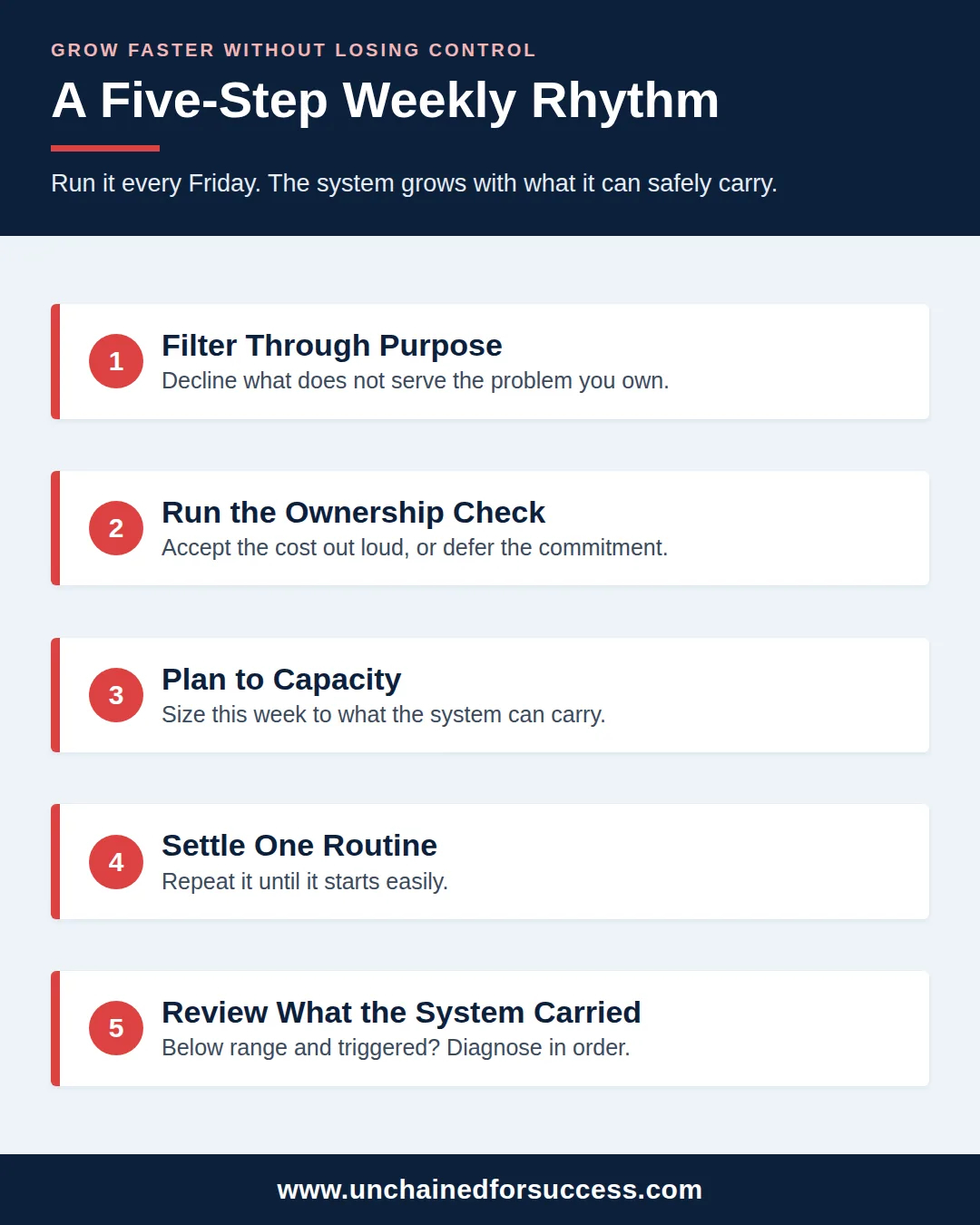
Step 1. Filter every candidate commitment through Purpose. Before sizing or scheduling anything, ask whether it serves the problem you exist to solve. If it does not, decline it now.
Step 2. Run the Ownership check. Name the cost of each commitment that passed, knowing what you know now, decide whether it is worth paying, and accept it out loud, consequences included. If you cannot, decline it, defer it, or move something else to make room.
Step 3. Plan to capacity. Size the immediate plan to what the system can carry today, then keep one goal that deliberately builds capacity for next quarter, with a route, a timing and an owner. If the Plan reveals a cost you had not counted, return to step 2.
The Last Two Steps That Let You Grow Faster Every Week
Step 4. Settle one routine at a time. Identify the single most important behaviour forming now. Protect its repetition until it is easier to start and more consistent. Only then add the next.
Step 5. Review what the system actually carried. At the end of each week, compare what you planned with what happened, and run the four questions again on the week ahead. Then let the Control System do its job. If an agreed measure has fallen below its range and met your trigger, diagnose in order before you add anything else.
The rhythm matters more than any single decision, because it is how you grow faster for years rather than for one quarter. It is a standing practice of review that keeps speed in step with what the system can do.
Common Mistakes When You Try to Grow Faster
Skipping Purpose. Without the filter, you cannot grow faster safely: the other three questions still run, but on commitments that should never have entered. The Ownership check becomes a cost calculation on the wrong candidates.
Treating the Plan as a fixed fit to today's capacity. The Plan may also build, acquire, free or release capacity before you need it. If it never does, the ceiling never lifts.
Applying only one of the four. Purpose without Ownership gives clarity nobody has paid for. Ownership without a Plan gives an accepted cost and no route. A Plan without Habits gives a route nobody walks consistently.
Confusing felt busyness with real capacity. A system that feels stretched can be the same system producing little. Measure capacity by what the system takes on and delivers, not by effort spent. A related post explains why being busy does not mean progress.
Questions Readers Ask About How to Grow Faster
Why only four of the nine components? Because these four are the ones that screen a commitment before you design it in full. Vision, Goals, Why, Beliefs and the Control System still apply to every goal you keep; the four questions are a screen at the door, not a shorter framework.
What if a commitment passes Purpose but fails the Plan? It waits. Write the capacity-building goal that would let the system carry it, give that goal an owner and a date, and revisit the commitment when the capacity exists. A commitment that gets in before the capacity does is how systems break.
How is this different from simply saying no more often? Saying no is the output. The four questions give you the reason, in the same order every time. A yes becomes a choice you can defend, and a no becomes a delayed chance rather than a missed one. If you want the underlying discipline, see Saying No Strategically.
Grow Faster by Letting Structure Lead Speed
Fast growth is not the enemy. Uncontrolled growth is. When Purpose filters what enters, Ownership accepts the true cost, the Plan sizes what the system can carry, and Habits turn effort into routine, you get growth you can keep. The framework already names the path. It needs applying, not adding to.
This week, list every commitment you are considering and run the four questions on each, in order. Keep the ones that pass all four; that is the list you can grow faster with. If you want an outside view of how your goals are designed, executed and governed, the Goals Readiness Score is an optional next step: 18 questions, under five minutes.
Share the one commitment you will decline or defer after running the four questions in the comments.
What entered your system this quarter that Purpose would have turned away?
Sources
• The Making of a Corporate Athlete by Jim Loehr and Tony Schwartz, Harvard Business Review, January 2001
• Start-Ups That Last by Ranjay Gulati and Alicia DeSantola, Harvard Business Review, March 2016
• Accountability Must Be Chosen, Not Mandated by Kendra Okposo, Harvard Business Review, 29 April 2026
• Time to Form a Habit: A Systematic Review and Meta-Analysis of Health Behaviour Habit Formation and Its Determinants by Singh, Murphy, Maher and Smith, Healthcare, 12(23), 2488, 2024. DOI 10.3390/healthcare12232488
Continue Your Journey
Explore more resources from the Unchained Goals Framework: