


A major rail infrastructure programme had started to slip, and handling setbacks had become the client team's whole job. The delivery partner had mobilised, the relationship had turned defensive, and blame for the delay was in dispute. When the client team's project manager did the arithmetic, the remaining work, under the delivery arrangements then in place, needed far longer than the time left.
A setback on that scale tests everything you believe about goals. The programme recovered, and this post explains how, because the same method works for a failed exam, a missed promotion or a lost client.
Some setbacks do their worst damage at once. Many are compounded by a rushed or badly judged response: a target quietly dropped, a plan abandoned, a decision made under pressure that cannot be undone. This post helps you decide what to protect, what to investigate and what to change. It teaches several terms from the Unchained Goals Framework along the way, because you cannot diagnose a goal properly without understanding how its parts connect.
One line holds throughout. Not losing direction does not mean never changing direction. It means the setback, the emotion and the urgency do not get to make the decision.
In this post on handling setbacks: what a setback reveals, checking the trigger, the four phases (stabilise, diagnose, decide, rebuild), a student's worked example, translating a result you cannot govern, the real programme and what to do this week.
What a Setback Reveals
A setback arrives suddenly: the failed module, the promotion that went elsewhere, the client who left. Because it arrives suddenly, we assume it began suddenly. Often it did not. Decision cycles had slowed down. Exceptions had multiplied. Tracking had become occasional. Nobody had said out loud who owned the result. The visible failure was the last stage of a weakness that had been present for weeks.
Not every setback works that way. Sometimes the groundwork was sound and the world changed anyway, and handling setbacks of that kind is a different task. A regulation shifts, a market moves, a key person leaves, an illness arrives. The original approach now has to absorb conditions it was never built for.
So a setback tells you one of two things. Either it exposes a weakness that was already there, or it introduces a new condition the goal must now absorb. In both cases the response should follow the evidence rather than the mood. The rest of this post is about how to find that evidence.
Design, Track, Diagnose
Three things make handling setbacks easier, and the order matters.
Design the goal well. Make it yours to drive, accept what it will cost, and name the behaviour that produces it. An earlier post shows how standards define outcomes before the work starts. A well-designed goal usually loses one route when a setback hits, rather than the whole undertaking.
Track it well. Agree in advance what an acceptable result looks like, and agree the point at which a dip stops being noise and becomes a signal. Then you meet the setback while it is still small and cheap.
Diagnose it well. When something breaks, locate the part that broke instead of guessing. Question your direction only when the evidence demands it, never by reflex.
Most of us only ever do the third one, and only once the damage is visible. If you never set clear goals, measures and review points, diagnosis is harder, because there is less to compare the result against. It is not impossible. Later in this post there is a way to start handling setbacks from where you are.
Handling Setbacks as Information, Not a Verdict
Two terms carry the whole argument, so here they are first. In the Unchained Goals Framework, Purpose is the problem or domain you have accepted responsibility for. Vision is the long-term position you have committed to holding within it. Together they are your direction. Neither is a target, and neither moves when a target moves.
A setback usually exposes a weakness below Purpose and Vision: in the goal, in the routines and plan that support it, or in the way progress was tracked. It rarely invalidates the direction itself. So the first test in handling setbacks is this. Has my direction become invalid, or has one route towards it failed? More often than people expect, it is the second.
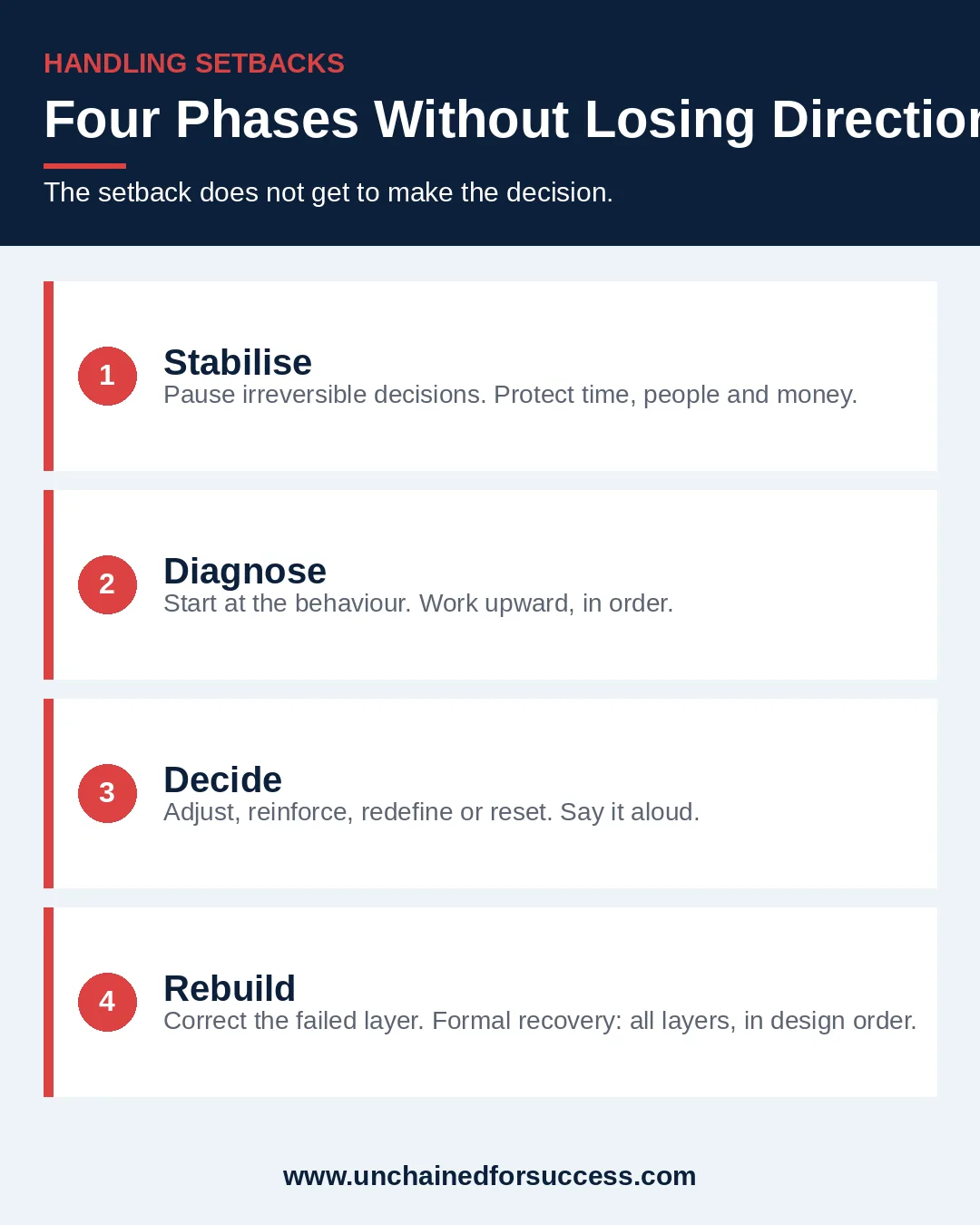
When a setback does land, handling it has four phases, in this order. Stabilise. Diagnose. Decide. Rebuild. You stabilise before you analyse, diagnose before you decide, and decide before you rebuild. The framework calls this the Recovery Architecture. Under pressure, the instinct is to run that order in reverse, and that is what makes setbacks so expensive.
Handling Setbacks Without Making Them About You
If the direction is intact, why do so many of us abandon it? Part of the answer is where you have attached your identity.
When your sense of yourself rides on the result, a setback sounds like "I failed" or "we are incapable". At that moment diagnosis gets harder, and often stops, because attention has moved from the goal's structure to self-judgement. The only apparent fix is to change everything, since if the problem is you, then everything you do must be wrong. That is how people abandon a direction that was never the problem.
Crocker and colleagues followed 122 engineering and psychology students across a term, and reported the results in the Journal of Personality and Social Psychology. Self-esteem rose on days with good grades and fell on days with poor ones. The fall was larger for students who based their self-worth on academic performance.
It is a study of students and of self-esteem, not of what people did next, so read it as a pattern rather than a proof. Even so, the point is worth taking. The more a result carries your identity, the harder it hits, and the harder it is to examine calmly.
A Sentence That Keeps Diagnosis Open
So here is the disciplined alternative, in one sentence from the framework. The system, as configured, failed under the load applied to it. In plain terms: the goal, the plan, the routines and the checks you had in place were not enough for the conditions you met.
That is neither an excuse nor a verdict. It is a description you can work with, because you can examine and change every part of it. Results are instruments, and you redesign instruments. Purpose endures unless you choose to redefine it.
This does not soften accountability. It sharpens it, because responsibility now points at redesign rather than self-defence. A previous post on taking responsibility covers what owning your part of a result looks like in practice.
Why More Effort Is Not a Way of Handling Setbacks
One pattern recurs in individuals, projects and organisations alike. The goal looks well formed, but material parts of it sit outside your authority: an income target that rests on other people's decisions, or a team held to an approval it cannot grant itself. Under stable conditions you never notice. Under stress the gap shows, because a goal you cannot drive through your own actions is fragile.
Strain of that kind weakens belief, and weakened belief wears down commitment. More intensity repairs none of it. Once drift has been present for weeks, more pressure at the result usually makes things worse, because it adds load to a structure that is already failing. So if the answer is not more effort, and it is not changing direction, what is it? It is diagnosis, and diagnosis has a fixed order.
Check the Trigger First
Not every disappointment is a setback. Handling setbacks starts with a gate, and the gate stops you running a full recovery on one bad week.
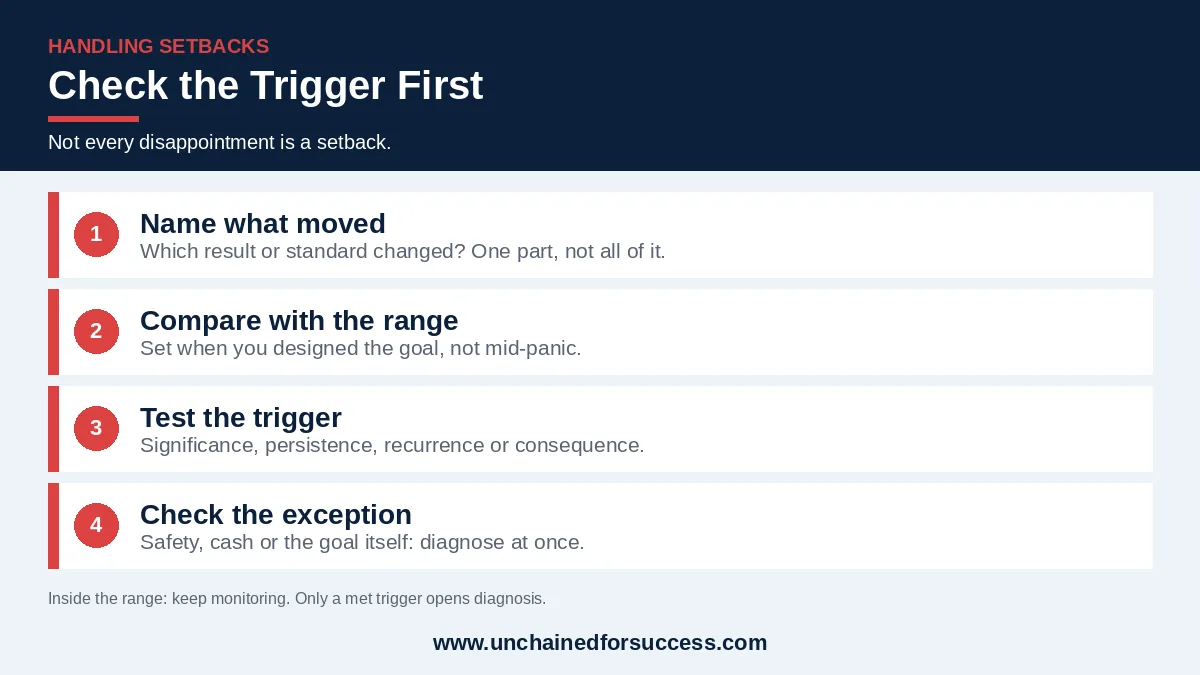
First, name what has actually moved. Which result, or which performance standard, has changed? A setback is a signal from one part of the system, not a verdict on all of it.
Second, compare it with the range you agreed. You set that range when you designed the goal, not in the middle of the panic. A result can disappoint you and still sit inside it. Inside the range, normal monitoring continues; formal diagnosis is not required.
Third, test the trigger you agreed in advance. The framework sets no fixed number of misses. Instead, the trigger reflects the significance, persistence, recurrence or consequence of the signal, in proportion to the measure. Only a met trigger opens diagnosis.
Fourth, the exception. Anything that threatens safety, cash or the goal itself justifies immediate diagnosis without waiting for a pattern.
To make that concrete: a student agreed that two missed study blocks in a row would open diagnosis. One missed block in a hard week is a signal to watch. The second miss in a row meets the trigger, and diagnosis begins there, not after a third. Waiting for a third miss is ignoring the trigger you set.
Handling Setbacks When You Never Set a Trigger
You may not have agreed a range or a trigger when you started. Most people have not. You can still start from where you are, in five steps.
Write down what you expected to happen by now. Write down what actually happened, in numbers where you can. Then decide which of three things you are looking at: a one-off miss, a shortfall that has persisted, or one that keeps coming back. Next, ask whether its consequences need action now, or whether you have time to investigate. Finally, set clearer measures and a trigger for the next review, so you are never doing this from memory again.
One warning. Do not invent a convenient threshold after the event to excuse a poor result. The point of writing down what you expected is to stop that happening.
Handling Setbacks in Four Phases
Handling setbacks is not improvised. The framework does not change under pressure, because if it did, it would not be structural. The four phases run in a fixed order, and the second does most of the work.
Stabilise Before You Analyse
The first phase of handling setbacks is restraint. The aim is not to restore performance. It is to stop further damage while you diagnose. Four things follow from that.
Pause decisions that are not essential, because the common failure is to adjust targets, abandon commitments and make announcements before anyone understands what happened. Protect the time, people and money that produce the result. Keep the essential activity going, even in a reduced form, because stopping entirely is what turns a setback into a fracture. And continue your scheduled reviews. The review earns its place when the news is bad.
There is a reason this phase comes first. Staw, Sandelands and Dutton reviewed evidence on how people, groups and organisations behave under threat, and published it in Administrative Science Quarterly. Under threat, attention narrows, people draw on fewer sources of information, and control moves to the top.
It is a review of existing evidence rather than a single experiment, and it does not test this recovery method. What it supports is narrower and still useful: pressure can make careful diagnosis harder, because it shrinks the range of information you consider. Stabilising buys back the room to think.
Be precise about what waits. Reversible action is fine, and often urgent: chase the receivables, book the calls, have the conversations. What waits is the irreversible: closing the business, resigning, signing something you cannot unsign. Where delay would cause unacceptable safety, legal, financial or irreversible harm, contain the damage first. Containment protects the system, but it does not tell you what broke.
Diagnose in the Right Order
When handling setbacks, diagnosis begins at the lowest layer you control, never at the result. You skip no layer, review none out of order, and move up only once the layer below proves sound. The framework calls this Ordered Diagnosis. As questions, with a note on how to answer each one, it runs like this.
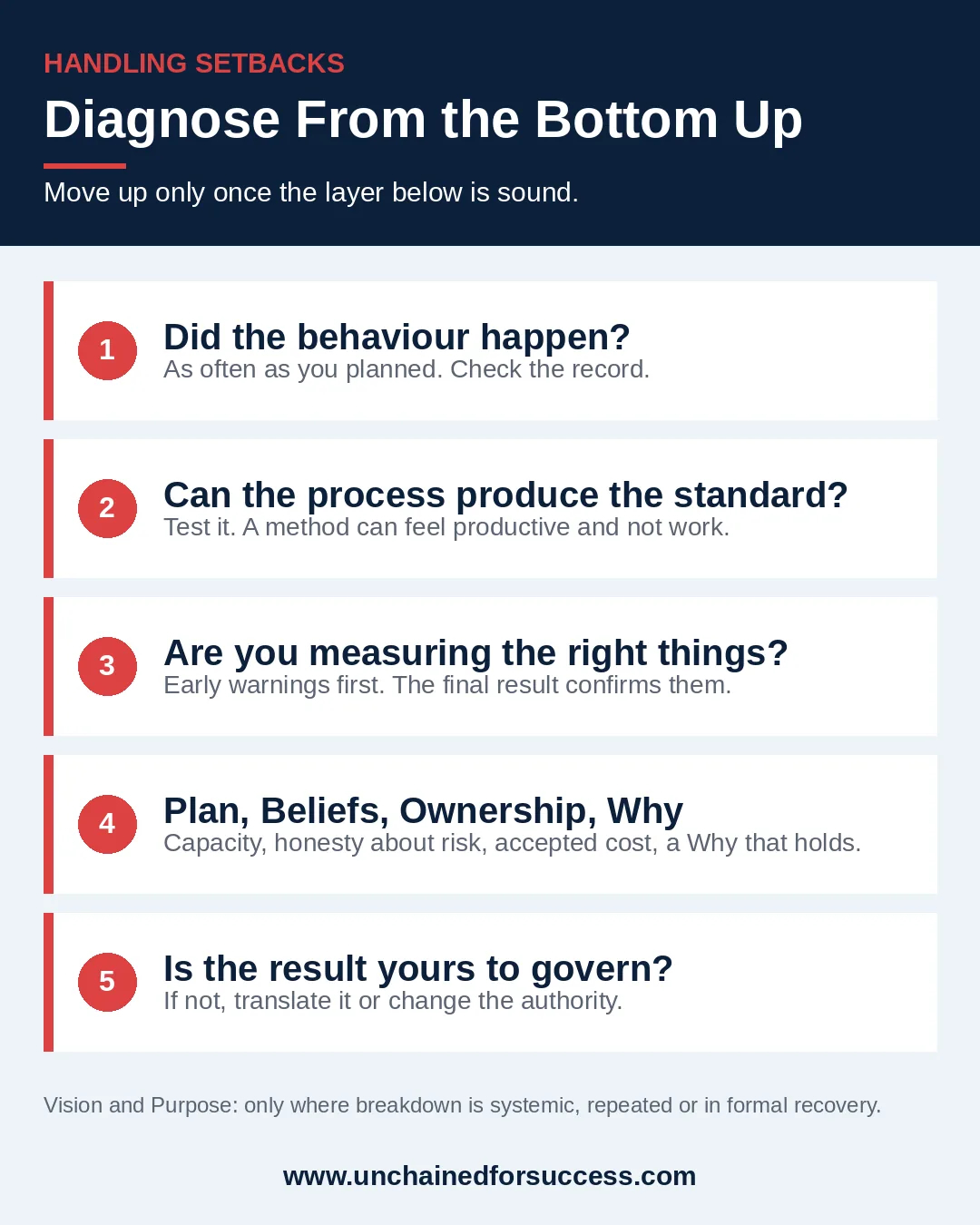
Did the behaviour actually happen, as often as planned? Not roughly. Check the record: the calendar, the log, the tracker. In practice the sequence stops here more often than anywhere else.
Can the process produce the required standard? Test it rather than assume it. A method that feels productive may not be building the performance you need, and the only way to know is to measure the performance it produces.
Are you measuring the right things? A good measure warns you early, before the final result is known. The final result still matters, because it confirms whether the early measures were telling the truth.
The Supporting Layers and the Control Boundary
Then the supporting layers, which the framework calls the Structural Integrity Systems, in reverse design order. Does the Plan still match the capacity you actually have? Have your Beliefs shifted, so that risks go unspoken and effort quietly shrinks? Do you still accept the cost and its consequences, which is what the framework means by Ownership? And does your Why, the reason this goal is worth its price, still hold?
Finally, does the result still sit within your authority to govern? The framework calls that line the Control Boundary. It means having enough authority to act on the main causes of a result and to correct things when they drift. It does not mean controlling every external event.
If the result sits outside that line, then at this layer it has become a dream rather than a goal, and the response is to translate it into something you can drive, or to change who holds the authority.
Normal diagnosis stops at that boundary. Vision and Purpose come into question only where the breakdown is systemic, repeated, or part of formal recovery. The instinct is to jump straight to "is my purpose wrong?", and the sequence is built to stop that. An earlier post on recovering a drifting year works the same sequence over a longer horizon.
A Student Handling Setbacks Through the Sequence
Here is a worked example of handling setbacks, carried through the whole method. It is a composite, not a client.
What happened. A student failed a core module. That failure was the setback, and the goal it belonged to has ended. She has one resit in November, so she designed a new goal for it. Her Outcome Goal is to pass the resit with at least 60 per cent.
The Performance Goal is staged, because improvement takes time: timed practice papers scoring at least 40 per cent by week two, 50 per cent by week four and 60 per cent by week six. Beneath it, the Process Goal is three study sessions a week. And the trigger for diagnosis is two weeks in a row below the staged standard for that week.
The standard for each week is the next staged target: 40 per cent in weeks one and two, 50 per cent in weeks three and four, 60 per cent in weeks five and six. By week four she had scored in the low thirties for two weeks in a row, below the 50 per cent that applied to weeks three and four. That met her trigger.
What the Student Checked
What she checked. She stabilised first: she did not withdraw from the course, and she kept the sessions going. Then she opened the log for the resit preparation, weeks one to four; the original module's records were not the question, because that goal was over.
The sessions had happened, so the behaviour was sound. Next she tested the process. Her sessions were spent re-reading notes, so she sat two timed practice questions under exam conditions and marked them against the scheme.
What the evidence showed. Both answers scored below 40 per cent. The method felt productive and was not building the performance the exam required. The process was the weak layer, and the sequence stopped there. Her Plan, Beliefs, Ownership and Why did not need questioning, because a lower layer had already explained the result.
What the Student Decided and Changed
What decision followed. She chose to reinforce the process layer: keep the three sessions, but rebuild their content around timed questions marked against the scheme, with re-reading limited to the topics the marking exposed. This is reinforce rather than adjust. Adjust is for a sound structure with weak behaviour, and her behaviour was consistent. It was the process that needed rebuilding.
What changed and how she assessed it. Her staged Performance Goal stayed the same and became her review point: one timed paper scored each week against that week's standard. Two weeks in a row below it would reopen diagnosis, starting again at the behaviour. By week six she was scoring in the mid-sixties, and the Control System, the routine of comparing results with the agreed range, returned to normal monitoring.
Notice what she did not do. She did not decide she was "not an exams person", she did not double her hours at a method that was not working, and she did not change the goal.
Handling Setbacks at Three Scales
The same five questions serve handling setbacks in three very different situations. Only the nouns change. The cells in the table are questions to investigate, or findings from worked examples. They are not what you should assume whenever an exam is failed, a promotion missed or revenue lost.
|
|
Student, failed a core module |
Professional, passed over for promotion |
Business owner, lost 40% of revenue |
|
1. Behaviour |
Did the planned sessions happen? |
Did the monthly feedback conversation happen? |
Did the weekly outreach block survive a busy month? |
|
2. Process |
Was re-reading ever tested against timed answers? |
Did the extra hours reach the people who decide? |
Did onboarding keep clients past the early months? |
|
3. Measure |
Hours revised, or practice scores? |
Hours worked, or visibility with decision-makers? |
Revenue alone, or the activity that leads it? |
|
4. Structure |
Belief: "I am not an exams person"? |
Ownership: was the cost of visibility accepted? |
Plan: did capacity match ambition? |
|
5. Boundary |
Marks: inside the boundary (see below) |
Promotion: the employer decides |
Client purchase: the client decides |
Three short notes sit beneath the table. In the student example, the finding was a process fault: re-reading felt productive and did not produce marks, and only a timed test revealed it.
With the professional, the question is whether longer hours were ever likely to produce visibility with the people who make the decision, and whether the cost of that visibility had ever been consciously accepted. And with the business owner, the question is whether revenue was the only thing being tracked, when the earlier signals were the outreach that leads it and the onboarding that keeps a client.
Is the Result Yours to Govern?
Row five needs care, because it is the easiest part of handling setbacks to overstate. Control does not mean certainty. Another party being involved does not by itself make something a dream. What matters is whether another party holds discretion over the result.
In the student example, the resit is marked against published criteria by a marker applying those criteria. Her preparation largely determines the mark, so the result sits inside her boundary and can stand as her Outcome Goal. A promotion is different: two identical performances can produce two different decisions, because the employer retains discretion. A client's purchase is the same: the client decides.
That does not make wanting a promotion or wanting the business to grow inappropriate. "Not a Goal" is the framework's classification, from its distinction between dreams and goals. It means the desired result cannot be the Outcome Goal you hold yourself to, because you cannot govern it. The framework's answer is Control Translation: restate the result as something you can govern, without swapping it for an unrelated activity count.
Translating a Result You Cannot Govern
For the professional, that might look like this. The Outcome Goal becomes a documented case for promotion, meeting the published criteria for the grade, presented at the next review. That result is hers to govern.
Her Performance Goal defines the standard that shows the drivers are working: by the end of each quarter, evidence against at least three of the five published criteria, reviewed and signed off by her manager.
Beneath it, the Process Goal names the repeatable behaviours within her control: a fortnightly request for feedback, a monthly request for a one-to-one with the evidence prepared, and a monthly written update to her manager.
The one-to-one itself needs her manager to take part, so it belongs to the review arrangements rather than to the process she holds herself to. The promotion decision still belongs to the employer. Her goal now makes it more likely, and she can tell every month whether she is on track.
The Business Owner's Three Levels
For the business owner, a conversation needs another person to take part, so it is not fully within his control either. What he controls is the invitation and the follow-up. So his Process Goal is a weekly outreach block that issues a set number of invitations and follows each one up.
His Performance Goal is the standard that tells him the drivers are working: a minimum number of qualified conversations held and proposals issued each month, and clients completing the onboarding milestones at weeks one, four and twelve. Conversations held depend partly on other people, which is why they sit here as an indicator rather than below as a process he controls.
His Outcome Goal is a result he can govern and demonstrate: a documented onboarding and retention process, in use with every new client by a stated date, with the three milestone checks recorded for each one. Revenue remains the thing he wants. The Control System cannot make it arrive; what it can track is whether the controllable work is contributing to it, month by month, so that he knows early if it is not.
Decide, and Say It Out Loud
Diagnosis without decision produces paralysis, and handling setbacks stalls there. Once you have named the layer that fractured, a deliberate choice follows, and you say it aloud, write it down or minute it. There are four.
Adjust. The structure was sound and the behaviour or cadence was not, so you change execution. Reinforce. You rebuild a weakened layer, usually Beliefs, Ownership or Process. Redefine. You restate the result inside a clearer boundary, so what was a dream becomes a goal. Reset. You change the goal's set-up on purpose, or in rare cases its direction, because the evidence shows the current set-up no longer serves your Purpose.
The decision must be clear, because a vague one leaves you hanging between persistence and retreat. You neither commit nor stop, so you carry the cost of both and get the benefit of neither.
Persistence for the Right Reason
The governing question is not "can the target still be hit?" It is "does this still serve the Purpose that justifies its cost?" That question does not push you to abandon things at the first difficulty. It guards against carrying on for the wrong reason, and the wrong reason has a strong pull.
Staw asked 240 business students to play a finance executive allocating funds, and he reported the results in Organizational Behavior and Human Performance. The students who had made the first investment decision, and then watched it go badly, put the most new money into the failing division. It was a role-play rather than a live business, and it does not test the framework, but the pull will be familiar.
We keep paying for a decision because it was ours. Justified persistence rests on evidence that the goal still serves its Purpose. Persistence because the decision was originally yours is a different thing, and the governing question is how you tell them apart.
When a Reset Is Right
When is it right to stop or change course? Reset is not surrender, and the difference between them is not the decision itself. Two people can make an identical decision, and one has surrendered while the other has reset. The difference is process.
Surrender is a decision made to escape pressure: no diagnosis, no clarity, taken in the moment. Reset follows a careful look at the evidence and the consequences, and a conscious choice. Discomfort is not the enemy here. Discomfort is often useful information about cost, and a reset can feel every bit as uncomfortable as a surrender. The question is whether the decision follows that look at the evidence, or is an immediate attempt to make the pressure stop.
Reset is required in four situations. The environment has permanently altered the assumptions beneath the goal. Or the Control Boundary was misjudged and cannot be adjusted back. Perhaps the Why no longer holds under revised circumstances. Or alignment with Purpose has fractured.
Only that last one touches direction, and in practice it is rare. A reset more often changes the goal's set-up, its scope, its timeline or its target, while staying anchored to Purpose. Changing the goal's set-up and changing the direction it serves are different decisions, and most resets are the first kind.
A sound process gives you a decision you can defend and explain. It does not promise that you will feel no doubt or regret afterwards; it gives you a reason to trust the decision when the doubt arrives. The post on reassessing direction covers the evidence that justifies the rarer kind.
Rebuild and Review
What rebuilding involves when handling setbacks depends on what diagnosis found, and the two cases should not be confused.
Routine correction is for a limited problem: a routine that lapsed, a process that needs changing, a measure that needs replacing. Correct that layer, then check what depends on it. In the student's case, rebuilding the process changed nothing about her Plan, and her Performance Goal already existed, so she resumed and reviewed weekly.
Formal recovery is for a breakdown of the goal's structure: several layers unsound at once, or the same drift returning after correction. A missed result does not by itself require it; what matters is what diagnosis finds.
When a goal has ended, as the student's original module had, you do not recover it. You design its successor afresh, which is Design Mode by definition.
In formal recovery you return to Design Mode, the framework's build sequence, and reconfirm every component in design order: Purpose, Vision, Goals, Why, Ownership, Beliefs, Plan, Habits, with no layer skipped, including the ones you feel sure about. Then the Control System, the routine of comparing results with the agreed range that has been running throughout, is adjusted to fit the rebuilt goal.
In both cases, set a review point that suits the issue. A weekly practice score suits a student, a monthly review suits a promotion case, and a daily check suited the programme below. Either way, recovery is not a pep talk. It is rebuilding, and you know it worked when the evidence says so.
A Real Application of the Recovery Process
Return to the programme from the opening. This is a real, anonymised application of the method for handling setbacks.
The project manager's first conclusion was that the delivery partner's programme director could not deliver. That conclusion was wrong, and the two later developed real mutual respect. For several weeks the client team's response was more pressure, more reporting and more escalation. Nothing changed. That is the pattern from earlier in this post: intensity applied at the result, on top of a structure that was already failing.
So the project manager went back to the delivery plan and started at the bottom. The client team broke the work down to what had to happen on site and tested the design, the site access the client provided, the processes and the day-to-day behaviour.
At execution level, the work was happening, but thinly. The site teams were following a process, and the design and the access were not holding them back. The method was technically capable of producing the rate the programme needed. What the deployment did not provide was the capacity to run it at that rate: there were not enough people, plant and work fronts. So the behaviour and the process were not the fracture.
Where Measurement Was Weak
Measurement was a weakness too. The programme reported against milestones, which is how anyone saw the slip at all, but nobody measured daily output against the rate the date required. Drift only showed once a milestone had already gone. That did not cause the shortfall, but it explains why the shortfall arrived as a shock rather than as a trend.
The team recognised the measurement weakness, but better reporting alone could not supply the missing capacity. Formal recovery therefore had to address both measurement and the planning and ownership problems beneath it. Capacity was the fracture, and capacity is a question for the Plan and for Ownership. Only then did the review escalate.
One more thing explains why the review went on to check every layer rather than stopping at the first weak one. Once the slip was visible, it became clear that several parts of the goal's structure had never been properly put in place at all. Where that is true, diagnosis has to confirm each layer in turn, because nothing can be assumed sound.
What the Evidence Showed
Three pieces of evidence settled it, and evidence is what handling setbacks turns on. The client compared the labour, plant and work fronts the plan required with what the delivery partner was actually deploying. It reviewed the tender against the true cost of the work. And the delivery partner said plainly that it could not add resource without making a loss.
The fracture sat in Ownership and Planning: the work had been underpriced, so the programme had never had the resources to meet the commitment its plan described.
Commitment had become conditional in a specific sense. Everyone still spoke of the completion date as the target, but nobody had accepted the cost of holding it. The contractor could not fund the people the date needed without making a loss. The client had not yet recognised that the true cost of its own goal was higher than the contract said.
By then the delay had damaged belief too. People no longer thought the date was possible. What looked like a failure of leadership was a weak structure around the leader.
Why It Needed Formal Recovery
This is why the programme needed formal recovery rather than a local fix. No fix at the resource layer was possible without changing the commercial basis of the contract. Ownership had to be rebuilt, because named owners with accepted costs did not exist. And belief had collapsed across the programme, so the Why had to be re-established and proved. Several layers were unsound at once, which is the definition of formal recovery given above.
What the Recovery Changed
The recovery changed the delivery arrangements rather than compressing the same work into the same set-up, and it started with the Why. The problem was the context: a bottleneck on a main line, with the delays it caused spreading along the route, which is why the completion date mattered to the client and to government. The Why was the justification that followed from it: removing that bottleneck on time was worth more than the extra cost of doing so.
Because that Why was clear, the client could identify the real cost of holding the date and decide, consciously, to meet it. That decision is Ownership in the framework's sense: accepting the cost of the goal and its consequences, rather than hoping the contract price would somehow turn out to be enough.
So the client closed the financial gap: the contract was changed so that the contractor recovered the money it had underbid. Until then the contractor could not provide the resources the programme needed, because every extra person on site deepened its loss. With the gap closed, the contractor could resource the work. The client stayed in firm control of the recovery rather than handing it over.
Rebuilding the Programme in Order
With the resources in place, the programme was rebuilt on that footing, in the order handling setbacks always follows. The client team divided the work into defined parts and gave named individuals explicit ownership of each. Every discipline received outcomes that fed the programme goal.
The recovery kept the site processes that already worked. What it added was the missing measurement layer: daily targets for each part, output measures against the required rate, and a daily check of the evidence, so that drift would show the same day rather than at the next missed milestone. And the Why was re-established with everyone on the programme, so that people understood what the completion date meant and what holding it would cost.
Belief Rebuilt Through Evidence
Belief was not rebuilt with encouragement. It was rebuilt with evidence. As the teams met their daily and weekly commitments, people could see the programme moving, and belief returned because performance showed it could. The programme completed on time. Its direction was never the problem. The structure beneath it had failed, and handling setbacks in order is what exposed it.
Handling Setbacks: Frequently Asked Questions
How do I know whether a bad week is a setback or just variation? Compare the result with the range you agreed when you designed the goal, then test it against your trigger.
Inside the range, keep monitoring and carry on. Only a met trigger opens diagnosis, unless safety, cash or the goal itself is at risk. If you never set a range, write down what you expected and what happened, and judge whether the miss is isolated, persistent or recurring.
Should I change my goal after a setback? Not before you have run the sequence.
Start with whether the behaviour happened and whether the process could produce the standard. A change to the goal is justified when diagnosis shows one of four things: the circumstances have permanently changed, the result was never yours to govern, the Why no longer holds, or the goal no longer serves your Purpose. Most such changes alter the goal's scope, timeline or target. Few change its direction.
When is stopping the right decision? When the full sequence shows one of those four conditions, and stopping follows a careful look at the evidence and the consequences rather than an urge to escape the pressure.
That is a reset. A decision taken to make the discomfort stop, without diagnosis, is a surrender, and it teaches you that pressure decides.
Handling Setbacks: What to Do This Week
A setback is a loss, and nothing here asks you to welcome it. It does bring information you did not have before. Strain shows you where you assumed control rather than confirmed it, which measures were too slow to warn you, and whether your Ownership was conviction or convenience. But strain does not strengthen a system by itself. Only analysed strain does.
So follow the method for handling setbacks, in order. Protect what needs immediate attention: contain any harm that cannot wait, and keep the essential activity going. Then work through the diagnostic sequence, starting at whether the behaviour happened, and stop at the first layer the evidence shows to be unsound. Write down that evidence. Choose the response the evidence supports: adjust, reinforce, redefine or reset.
Then set a review point suited to the issue, and decide now what result at that review would reopen diagnosis.
The nine-component audit is a different tool for a different moment. Scoring Purpose, Vision, Goals, Why, Ownership, Beliefs, Plan, Habits and the Control System from one to five checks the health of a whole goal at a scheduled review. It does not replace Ordered Diagnosis for the setback in front of you. Use it later, once this one is handled, to find where the next one is likely to come from.
If you want an outside view of how your goals are designed, executed and governed, the Goals Readiness Score is an optional next step: 18 questions, under five minutes.
When the system breaks, the response is not retreat, and it is not panic. It is clarity. Structure remains the constant.
Share the layer you think fractured, and what makes you unsure, in the comments.
What decision have you been sitting on without making?
Sources
● When Grades Determine Self-Worth: Consequences of Contingent Self-Worth for Male and Female Engineering and Psychology Majors by Crocker, Karpinski, Quinn & Chase, Journal of Personality and Social Psychology, 2003
● Threat Rigidity Effects in Organizational Behavior: A Multilevel Analysis by Staw, Sandelands & Dutton, Administrative Science Quarterly, 1981
● Knee-Deep in the Big Muddy: A Study of Escalating Commitment to a Chosen Course of Action by Barry M. Staw, Organizational Behavior and Human Performance, 1976. DOI 10.1016/0030-5073(76)90005-2
Continue Your Journey
Explore more resources from the Unchained Goals Framework: