


A quantity surveyor has failed the final assessment of her professional qualification, and the resit requires her to complete eight refresher modules first. She writes her goal for the next attempt: do not fail again. Approach goals name something to move towards; hers names something to escape.
Six weeks later she has studied twice. Most evenings she opens the course notes, the goal reminds her of the last result, and she closes them. The goal is honest. It is also an avoidance goal, and that is part of the problem.
She rewrites it in one evening. Her new result: pass the final assessment at the next scheduled attempt, submitting the required work by 31 March. The eight modules will be finished by the end of February, with three one-hour study sessions a week to get there. Nothing about her ability changed. What changed was that the rewritten goal came with a standard to meet and a session to do on a Tuesday morning.
This article explains what approach goals and avoidance goals are, what the research does and does not show about them, and a four-step method for turning a goal written as something to avoid into one you can act on.
A goal that names what to escape can keep your attention on what you fear. A goal that names what to reach, and the behaviour that produces it, tells you what to do next.
What Approach Goals and Avoidance Goals Are
The distinction is about direction. An approach goal is aimed at bringing about something you want: a skill learned, a standard reached, a project delivered. An avoidance goal is aimed at keeping something you do not want from happening: a failure, a complaint, a penalty.
Researchers on achievement goals add a second split. Some achievement goals concern mastering the task or improving your own capability. Others concern performing better than other people. Either can focus on achieving success or avoiding failure, so Elliot and McGregor (2001) set them out as a two-by-two model. Trying not to misunderstand the material, or not to leave the learning incomplete, is a mastery goal written as avoidance.
You can write the same aim either way. "Do not fail again" and "pass the final assessment at the next attempt" point at the same qualification. The difference is what the goal puts in front of you each day.
Direction is not the same as clarity, though. Approach goals can still be vague: "become successful" points the right way and tells you nothing to do. Changing the wording is only the first step; defining the result, the standard and the behaviour makes it executable.
What the Research Says About Approach Goals
Van Yperen, Blaga and Postmes (2015) pooled 19 papers, 79 effect sizes and 3,482 participants from experiments that put people into a goal state and then measured how they performed on tasks such as word games, reasoning problems and golf putting. Approach goals generally led to better task performance than avoidance goals, although not every comparison between them was equally conclusive.
Because the researchers created the goals in experiments, this is evidence about cause in those settings, not only association. Carrying the finding to a qualification, a project or a team is my application, not something the studies tested.
A second line of work looks at the personal goals people set for themselves. Elliot, Sheldon and Church (1997) followed people's own goals across a semester in two studies. Those who held a larger share of avoidance goals reported lower well-being, and their well-being fell over the semester. Part of the link ran through how much progress they felt they were making.
The goals were people's own rather than assigned, so this is an association, not proof that avoidance goals caused the decline.
My reading for the quantity surveyor is that an avoidance goal is hard to see progress against, because success looks like nothing happening. The study did not test her situation.
Mastering a Skill or Beating Others?
The same meta-analysis compared the two kinds of approach goals. Goals about mastering the task did slightly better than goals about outperforming others. The average advantage was small. Separate analyses found a clearer advantage without anticipated feedback and without time pressure. Against having no stated goal at all, only the goal about mastering the task made a clear difference.
For a reader, the practical point is modest. Where you can, write approach goals around mastering the work rather than around beating someone.
Sometimes comparison comes with the work, such as a ranked bid or a league table. There, the paper found that approach goals aimed at doing better than others led to better performance than aiming not to do worse than them.
Where Avoidance Goals Creep Into Work
Avoidance goals can arrive in disguise. "No complaints this quarter", "do not miss the deadline" and "stay out of liquidated damages" all sound like targets. These statements identify what must be prevented, but do not, on their own, specify the work needed to prevent it.
On construction programmes the contract itself can carry the last one. A liquidated damages clause gives the contractor a strong reason to avoid a late date. It does not say what the team should do each week to deliver on time.
In my view the risk is that a team chasing only the avoidance target protects the date at the expense of what the date was for, such as quality or safe handover. That is my practitioner judgement; the studies above did not test contracts.
The same pattern appears at home. "Stop overspending" and "do not put on weight" are avoidance goals. They feel serious, and on their own they do not say what to do on a given evening.
Turning an Avoidance Goal Into Approach Goals: Four Steps
The same four steps for writing approach goals apply to a person, a team or a contract. They do not ask you to pretend the risk has gone; they ask you to state what you will move towards, and then make it executable.
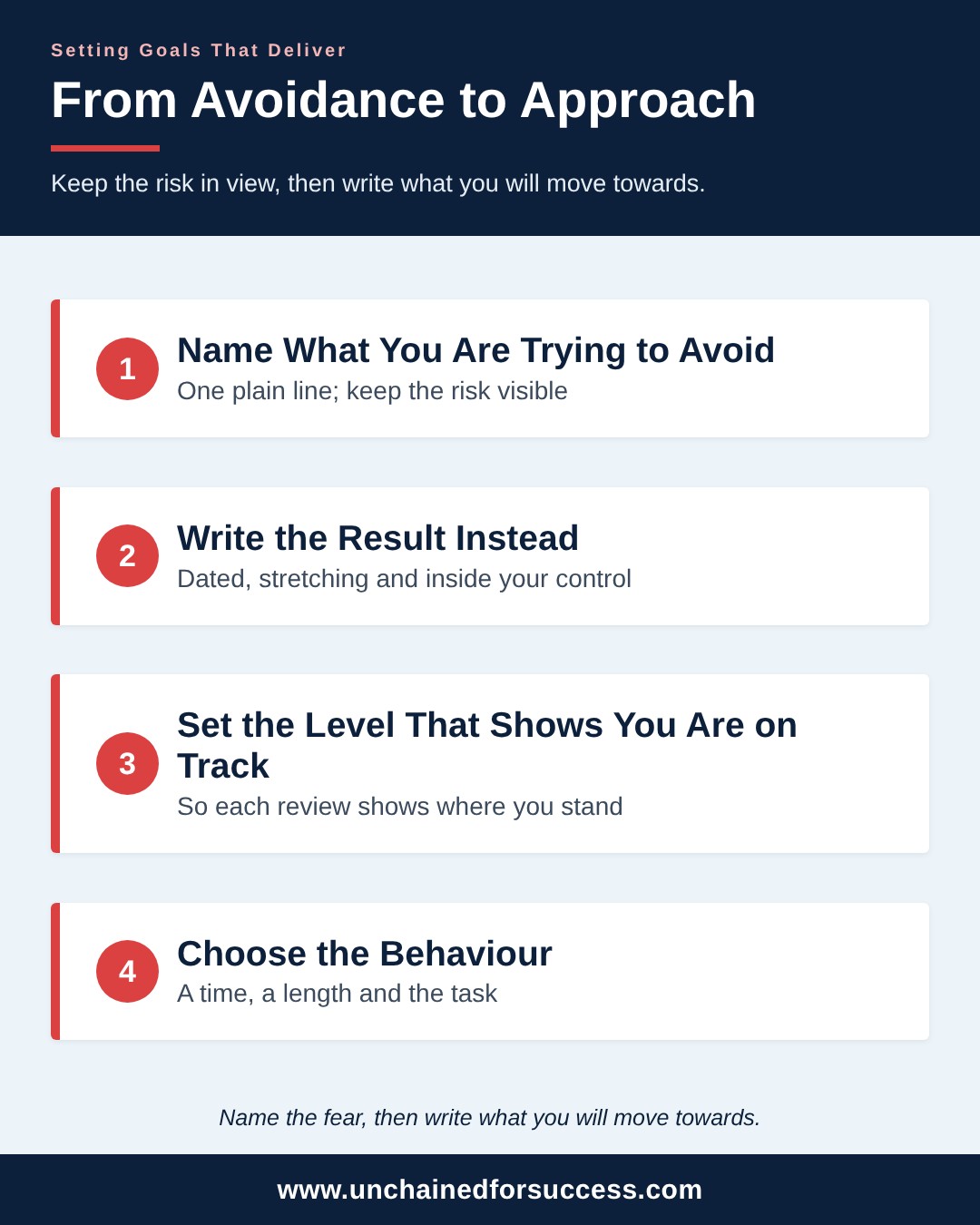
Name what you are trying to avoid. Write it down plainly: "failing the assessment again". Keep the risk visible; it tells you what the plan has to protect against. The Unchained Goals Framework does not ask you to ignore it.
Write the result you want instead, inside your control. Pass the final assessment at the next scheduled attempt. The assessment is marked against defined criteria and an established body of knowledge. Her preparation, competence and answers are the primary inputs she can govern in meeting those criteria, so passing is hers to deliver. Submitting the required work by 31 March is a milestone on the way.
The result is also a stretch: she has studied twice in six weeks, and this asks for about twelve hours a month. The framework calls this the Outcome Goal, and tests it with the five conditions of SSMTC: stretched, specific, measurable, time-bound and under your control.
How She Knows She Is on Track
Set the level that shows you are on track. Two modules a month from November to February, each finished only when she can answer its end-of-module questions without her notes. That is a goal about mastering the work, not about getting through it. Four months at two modules a month covers all eight, and March is kept for the assessment work itself.
Choose the behaviour that produces it. Three one-hour sessions a week, at seven in the morning on Tuesday, Thursday and Saturday, before the house wakes, each working through the current module's material and questions. The course provider estimates about six hours per module, so she needs twelve hours a month, and three sessions a week supply about thirteen.
When she sets the plan, she also reads the assessment requirements and makes a provisional estimate of the work: about fifteen hours for drafting, checking and submission. March's sessions give about thirteen, so she protects two one-hour Sunday morning sessions as well, and she refines the estimate as the modules show her how long the work really takes. That scheduled behaviour is what the framework calls a Process Goal.
Checking Progress at the End of Each Month
The risk does not disappear; it stays visible. What the four steps add is something to do and a way to see progress. She can tick off a session on Tuesday, which "do not fail again" never let her do.
She decides in advance that one module behind at the end of a month opens a check, and sooner if a shortfall would put the assessment at risk. First: did each one-hour session happen?
Where sessions did not happen, she asks what interrupted them and moves them to slots she can protect. To recover the module she is behind, about six hours, she checks that her other commitments allow it and adds a one-hour session at seven on Monday and Wednesday for the next three weeks.
Suppose instead the sessions happened and the modules did not. Then she asks whether six hours a module was the right estimate; if it was wrong, she adds sessions now to finish the module she is behind on, then adds the hours later modules actually need and checks they fit before the next month starts.
If the estimate holds, she works up the rest in order. Is two modules a month the right measure? Does the plan still fit her other commitments? Next, her belief that she can pass. Then whether she still accepts the cost and consequences, and whether the expected benefits still justify them. Last, whether passing at the next attempt is still hers to deliver. The defined standard and her record of sessions make this check possible.
In the months that work, she notes what kept the sessions happening and what the month cost her, and keeps the design rather than changing it.
When an Avoidance Frame Still Has a Place
Approach goals are not the whole story. Some aims are naturally about prevention: safety on site, compliance, protecting a reputation. A safety aim of "no one gets hurt" is an avoidance aim and a sound one.
Keep the protective aim. Define the operating standards that show the relevant risks are being controlled, then specify the checks and actions needed to maintain those standards. Completing the checks is not, by itself, evidence that the risk is controlled; meeting the standards is. The same applies to complaints, deadlines and overspending: clarify the action while keeping the required result and its limits.
Approach Goals for Optimal Success: Start With One
No study here establishes an optimal goal for every situation. What these studies support is narrower and still useful: a goal aimed at reaching something generally did better on task performance than one aimed at avoiding failure, and a goal about mastering the work did slightly better than one about outperforming others. The method below turns that direction into something you can act on.
Pick one goal you have written as something to avoid, then:
1. Name what you are trying to avoid, in one line.
2. Write the result you will deliver instead, with a date, inside your control, and enough of a stretch to matter.
3. Set the level that shows, at each review, whether you are on track.
4. Choose the behaviour, with its time, its length and its task, that produces that level.
Approach goals will not remove the risk you were worried about. Defined well, they give you something to do about it this week.
Write down the one goal you have phrased as something to avoid, and the result you will move towards instead.
Which of your current goals tells you what to fear rather than what to do?
Further Reading
Three related posts from this series: Standards Define Outcomes: 5 Tests to Apply This Week, Long-Term Thinking in a Short-Term World and Why Ownership Changes Everything. The framework page sets out how the result, the standard and the behaviour fit together. If you want to see where your own goal design is weakest, the Goals Readiness Score is 18 questions, about ten minutes.
Frequently Asked Questions
Are approach goals always better than avoidance goals?
Not in every case. In experiments, approach goals generally led to better task performance, but some aims, such as safety, are naturally protective. Keep the protective aim and define the standards and actions that achieve it.
What is the difference between mastery goals and goals about beating others?
Mastery goals concern the task itself or your own capability; the other kind concerns how you compare with other people. In the meta-analysis, goals about mastering the task did slightly better than goals about outperforming others, and only the approach goal about mastering the task clearly beat having no stated goal.
Can a team or a contract set approach goals?
Yes, and the four steps for approach goals are the same. A contract may carry a penalty for lateness; the team's own goal can still name the result it will deliver, the weekly standard that shows it is on track and the work that produces it.
Does Research Support Approach Goals?
None of the sources tests the four-step method here; the method is my application of them. Van Yperen, Blaga and Postmes (2015) pooled experiments that created goal states and measured task performance. Elliot, Sheldon and Church (1997) followed people's self-chosen goals across a semester and measured well-being and perceived progress, not performance. Elliot and McGregor (2001) set out the two-by-two model of achievement goals.
Sources
• Van Yperen, N. W., Blaga, M. and Postmes, T. (2015). "A meta-analysis of the impact of situationally induced achievement goals on task performance." Human Performance, 28(2), 165-182. Available at: https://doi.org/10.1080/08959285.2015.1006772.
• Elliot, A. J., Sheldon, K. M. and Church, M. A. (1997). "Avoidance personal goals and subjective well-being." Personality and Social Psychology Bulletin, 23(9), 915-927. Available at: https://doi.org/10.1177/0146167297239001.
• Elliot, A. J. and McGregor, H. A. (2001). "A 2 x 2 achievement goal framework." Journal of Personality and Social Psychology, 80(3), 501-519. Available at: https://doi.org/10.1037/0022-3514.80.3.501.
Continue Your Journey
Explore more resources from the Unchained Goals Framework: