

A project engineer is partway through a part-time master's when the first module result comes back: a fail. Her young family still needs her evenings, and work has not slowed down. The instinct is to push harder and hope the first module was a bad night, but treating resilience as a skill offers a better path.
She does not push harder. She had prepared for this moment two months earlier.
A skill is not a feeling that arrives. It is a response you have practised before you need it.
Resilience as a Skill Begins Before the Setback
In October, while things were still calm, she sat down and drew two lines.
For academic results: any mark below 60 per cent, or a fail in any component. For study behaviour: any week where she did not complete her planned work, including preparing for tutorials and practising the material she found most difficult.
She set a line for results and a line for behaviour, each one specific enough that she could not argue with it later. She wrote both on a card and put it where she would see it when results came in. Her commitment was four focused study sessions a week, each on the hardest topic she was avoiding.
The behaviour line matters because it catches the problem before it reaches the results. A missed study week is easier to correct than a failed module, but only if you have drawn the line that makes it count.
Building resilience as a skill begins when things are calm. A line drawn in advance removes a decision from the worst moment. When a miss arrives, you do not have to decide whether it counts. It counts. The response starts.
If you cannot tell at a glance whether a result has crossed your line, the line is not specific enough. Set one for results and one for behaviour. Write them where you will see them when the moment comes.
The Four Questions
When the fail came in December, it crossed her results line. Her behaviour line should have caught the problem sooner: she had written it in October, but she had not used it when a study week slipped in November. She sat down the same evening and wrote four answers on her card.
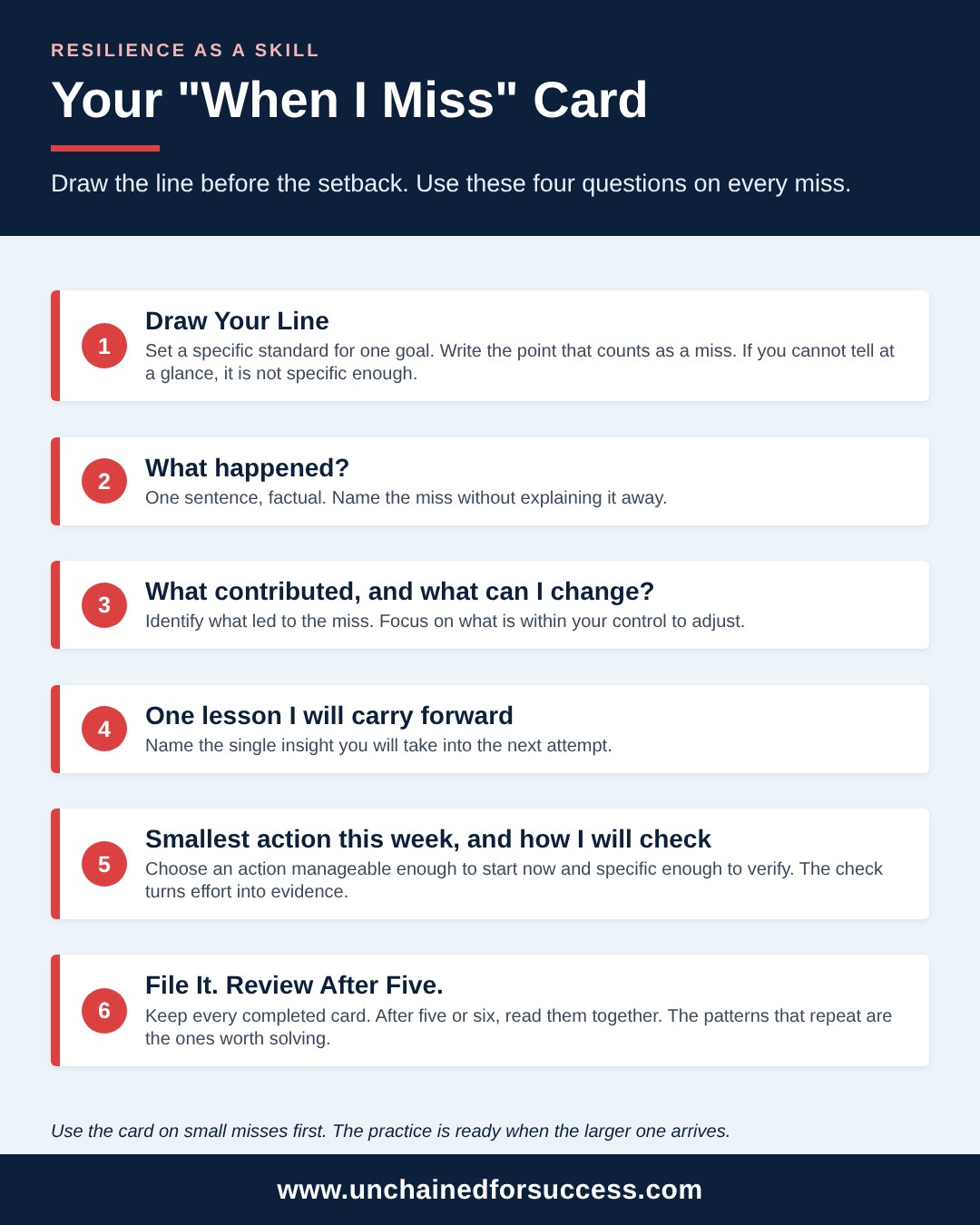
• What happened? (One sentence, factual.)
• What contributed to the miss, and what can I change?
• One lesson I will carry into the next attempt.
• The smallest piece of work I will do this week to act on the lesson, and how I will check whether it helped.
The structure stays the same each time. The answers will vary with each situation, and they should. What stays constant is that you sit down, answer all four, and write it down.
Her answers that evening were not comfortable. But they were honest.
The exam had asked for a design justification she had not practised. She had spent her revision time on calculation, which she was comfortable with, and avoided the justification questions, which she was not. That was the lesson.
The smallest piece of work: download two past papers with justification questions and attempt one before Friday. The check: compare her answer against the marking criteria and a tutor's model response.
She did not redesign her entire study plan. The action came from the lesson, not from a promise to try harder. A first recovery action works when it is manageable enough to start this week and specific enough to check. Some setbacks call for a larger change, but a vague commitment to work harder is never the answer.
Practising Resilience as a Skill on Small Misses
In the spring term, she used the card six times: three missed study sessions, one weak assignment, one unprepared tutorial, and one evening spent revising comfortable material instead of difficult material. None of them felt like a crisis. That is the point.
You do not wait for a serious setback. You use the card on more manageable ones: a missed session, a rejected draft, a week that fell short. Practising the response before the pressure arrives means it is familiar when something larger does. Every small miss you answer with the card is a repetition. Every repetition can make the next one easier to start.
After each card, she checked whether the corrective action had helped. Her first justification answer was weak, but by the third attempt the structure was sound. Without the check, she would have known she had practised, but not whether the practice was working. The check step is what turns effort into evidence.
Practise resilience as a skill on smaller setbacks, so the response is ready for the one that demands it.
What the Record Showed
File each card somewhere you will find it: a photo on your phone, a note in whatever app you use, or a physical folder. Without a record, small misses go unnoticed because they do not feel dramatic enough to act on. After five or six cards, take twenty minutes to read them together. A Sunday morning or a quiet commute is enough.
By March she had six filed cards and three patterns: she avoided the hardest work, she underestimated how long justification answers took, and morning study worked better than evening study. Those patterns might not have surfaced as quickly without the record.
You might find you keep avoiding the same type of work, underestimating the same kind of task, or losing focus at the same point in the week. The record makes the pattern visible. Without it, you are working from memory, and memory is kind to you in ways that a written record is not.
When her second module result came back at 64 per cent, she had passed her results line. The result did not call for a recovery review. But she chose to sit down with the card anyway, because she wanted to understand what had improved and what still needed work. Treating resilience as a skill had become part of how she worked, not just a reaction to failure.
After six checked reviews, she had something she did not have after zero: evidence that she could find the lesson, act on it, and check whether the action improved things.
Your Resilience as a Skill Card
Resilience as a skill has three moving parts. A line that tells you when to start. Four questions that turn a miss into a lesson. And a record that lets you see what the practice has produced.
Write yours this week. It takes ten minutes. One side holds your line: the standard you are working to and the point that counts as a miss. The other side holds the four questions above. You do not need a special format. A note on your phone is enough. What matters is that you can reach it when the miss arrives and find it again when you want to review.
Use it on the next small miss. File each card. After five or six, read them together and look for the pattern.
The Goals Readiness Score is 18 questions on how your goals are set up. If the pattern on your cards points to a structural problem, the score can help you identify areas to examine.
Resilience as a Skill Starts This Week
Nothing here waits for a crisis. Building resilience as a skill runs on small misses, in calm, before the large one arrives. Start with one goal. The method works whether you are studying for a degree, leading a project, or building something of your own.
• Draw the line for one goal.
• Write the four questions on a card.
• Use it on the next small miss.
• Take the action and check whether it helped.
• File it, and read the cards together after five.
Resilience as a skill is not the card. It is the practice. And the only way to own it is to start.
What is one goal you will draw the line for this week? Share it in the comments.
Further Reading
These ideas draw on the Unchained Goals Framework, which treats resilience as a skill you design and practise rather than something you hope for. Three related posts from this series: Why Failure Isn't the Real Problem, Recovering Momentum After Disappointment and Handling Setbacks Without Losing Direction.
Does Research Support Resilience as a Skill?
Two meta-analyses sit behind this post. Neither tests the four-question card or the specific method taught here.
Joyce and colleagues (2018) analysed 11 randomised controlled trials and found modest improvements in measured resilience from programmes using cognitive behavioural approaches, mindfulness, or combinations of the two. No study tested whether participants coped better with subsequent adversity; improvement was measured only by questionnaire scores, and sample sizes were small.
Leppin and colleagues (2014) reviewed 25 randomised trials and found a similar moderate effect for generalised stress-directed programmes within three months, though with low confidence, citing small trials at moderate to high risk of bias.
The evidence suggests that resilience can be developed through training. The practical method in this post comes from the framework's architecture, not from these trials.
Sources
• Joyce, S., Shand, F., Tighe, J., Laurent, S. J., Bryant, R. A. and Harvey, S. B. (2018). "Road to resilience: a systematic review and meta-analysis of resilience training programmes and interventions." BMJ Open, 8(6), e017858. Available at: https://doi.org/10.1136/bmjopen-2017-017858.
• Leppin, A. L., Bora, P. R., Tilburt, J. C., Gionfriddo, M. R., Zeballos-Palacios, C., Dulohery, M. M., Sood, A., Erwin, P. J., Brito, J. P., Boehmer, K. R. and Montori, V. M. (2014). "The efficacy of resiliency training programs: a systematic review and meta-analysis of randomized trials." PLoS ONE, 9(10), e111420. Available at: https://doi.org/10.1371/journal.pone.0111420.
Continue Your Journey
Explore more resources from the Unchained Goals Framework: