Energy Management Habits for Consistent High Performance
Introduction: Why Energy Management is the Hidden Key to High Performance
Many people fail to maintain consistent results—not because they lack skill, but because they run out of energy. Even the best plans stall when your mental, physical, and emotional reserves are drained. The solution is to develop energy management habits that keep your performance levels steady and your execution sharp.
In this month’s theme of execution and performance habits, we’re exploring how to fuel your productivity over the long haul. If you’ve read my blog Small Steps, Big Impact: Building Consistent Habits, you’ll know that habits shape results over time. The same principle applies to your energy—it needs daily, intentional investment.
As Harvard Business Review explains in “Manage Your Energy, Not Your Time”, performance isn’t just about hours worked—it’s about the quality of energy you bring to those hours.
Why Energy Management Matters More Than Time Management
Time is finite. You can’t create more of it, but you can renew and expand your energy. When your energy is high, you execute tasks faster, make better decisions, and maintain focus.
Stanford University research on cognitive fatigue shows that fatigue slows thinking, increases errors, and reduces creativity. This means the most disciplined energy management habits—not just a good diary—are what keep your execution sharp.
In my blog Daily Practices to Strengthen Empowering Beliefs I discussed how your mindset fuels your actions. Energy works the same way—without it, even strong intentions fade.
The Four Types of Energy You Must Manage
1. Physical Energy
Your body is your performance engine. Sleep, nutrition, and movement determine whether you have the stamina to execute consistently.
2. Mental Energy
Your focus capacity is limited. Reducing distractions, batching similar tasks, and avoiding constant context-switching preserves mental sharpness.
3. Emotional Energy
Positivity fuels resilience. Emotional drains—such as toxic relationships—sap your ability to perform under pressure.
4. Purpose-Driven Energy
When your daily actions connect to your deeper “why,” you tap into a renewable energy source. Alignment with values makes even hard work feel meaningful.
The Energy Project highlights that elite performers across industries master all four of these energy domains—not just one.
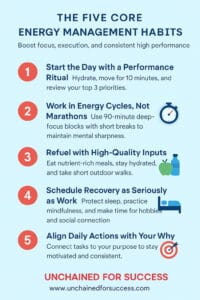
Five Core Energy Management Habits for High Performance
1. Start the Day with a Performance Ritual
Hydration, 10 minutes of movement, and a quick review of your top 3 priorities primes your body and mind for execution.
2. Work in Energy Cycles, Not Marathons
Use 90-minute deep focus blocks followed by short breaks. Your brain works best in natural rhythms, not constant grind.
3. Refuel with High-Quality Inputs
Avoid energy crashes by eating nutrient-rich meals and staying hydrated. A short outdoor walk can recharge both physical and mental energy.
4. Schedule Recovery as Seriously as Work
High performers protect sleep and downtime. Mindfulness, hobbies, and social connection are not luxuries—they are strategic recovery tools.
5. Align Daily Actions with Your Why
Link tasks to your purpose to sustain motivation. When you know why something matters, you’ll find the energy to follow through.
How Energy Management Habits Improve Execution
Your energy determines whether your habits stick. In From Limiting to Liberating: How to Rebuild Your Belief System I showed how beliefs drive action. Energy is the bridge between belief and execution—it fuels the habit loop.
Public figures like Oprah Winfrey and Tim Cook have sustained decades of high performance by combining disciplined routines with consistent recovery. They protect their energy with the same focus they protect their schedules.
Overcoming Common Energy Drains
- Poor Sleep: Prioritise 7–8 hours nightly.
- Digital Distractions: Limit notifications and batch communications.
- Toxic Relationships: Set boundaries and seek positive influences.
- Over commitment: Learn to say no to non-essential work.
Small changes here can reclaim hours of high-quality energy each week.
Action Plan: Building Your Energy Management System
- Identify your peak energy times.
- Choose one new habit to implement this week.
- Track your energy daily for two weeks.
- Schedule breaks and recovery.
- Review and adjust monthly.
Conclusion: Your Energy Is Your Execution Fuel
Time is fixed, but energy is renewable. To sustain your performance habits, you must master the art of replenishment. Start small—introduce one or two energy management habits this week, and build from there.
When your energy is high, your execution becomes effortless, and consistent high-performance stops being a struggle—it becomes your default.
References
- Kwegyir-Afful, C. (2023). Unchained: Success Unlocked – A Proven Framework for Achieving Your Goals.
- Harvard Business Review – “Manage Your Energy, Not Your Time”
- Stanford University – Research on cognitive fatigue
- Schwartz, T., & Loehr, J. (2003). The Power of Full Engagement.
- Psychology Today – “The Science of Energy Management”