


You meant to do it. You knew it mattered. Three weeks later it has quietly stopped. That pattern is easy to read as a fault in yourself. In fact consistency fails for reasons you can point at and fix.
This post sets out why consistency fails, what the framework does about it, and how to rebuild a behaviour that keeps breaking. It follows Process Goals, which covers how to write the behaviour in the first place.
Why Consistency Fails When Nothing Holds the Behaviour
A behaviour that is decided fresh each time has to win an argument every day. Some days it wins. On a hard day it loses, and the argument gets no easier the next day.
So consistency fails less where the behaviour has support around it. A fixed cue. Then a slot nothing else can take. Then a version small enough to do badly. None of that is willpower. All of it is design, done in advance.
You still need effort. What changes is how much of it goes into deciding, and how much is left for the work itself.
Intention Sets the Aim. Structure Decides What Survives
Intentions are genuine. They also carry no price tag. When you form one, you may not ask what it will displace, what will trigger it, or what happens in the week it clashes with something urgent.
Pressure answers those questions for you. That is where consistency fails: not at the decision, but at the first clash. Under load, attention moves to what is immediate, and anything still up for negotiation is the first thing to go.
That is not necessarily a character problem. It is what happens to a behaviour with nothing holding it in place. Consistency fails there, in the design, rather than in the person.
Where Consistency Fails Inside the Framework
The Unchained Goals Framework treats this as a structural question rather than a personal one.
A Process Goal is the behaviour you can schedule and repeat, at a set cadence, because it produces the standard your result needs. Turning that behaviour into one that takes less deciding each time is what the framework calls Habit Conversion. It reduces how much you have to decide, rather than removing the decision.
The framework asks you to define five things before execution starts: the behaviour, its cue, its cadence, the friction you will remove, and the minimum version for a bad day. Skip those and the behaviour is an intention wearing a schedule.
The Plan is built before the behaviour and keeps protecting it afterwards. It is the decision about what to protect first: the approach, the constraints and your sustainable capacity, the order of work, and the trade-offs you accept in advance. A behaviour that exceeds sustainable capacity does not fail through weakness. It fails because it was never affordable.
The Control System then governs by evidence. It watches the Performance standard against a range agreed before pressure, with a trigger that says when a miss is worth investigating. The framework sets no universal number of misses. You decide that in advance, based on how much the miss matters, whether it keeps happening, and what it would cost if it continued. Without a range and a trigger, consistency fails quietly, because nothing tells you when to look.
What the Evidence Shows About Cues and Settings
Three sources are useful here, and their limits matter as much as their findings.
Repetition in a stable setting builds ease. Wendy Wood and Dennis Rünger's review of habit research describes habits as "context-response associations in procedural memory". Once formed, seeing the setting brings the response to mind. It is a review of other people's studies rather than a new one.
A stable setting can keep a familiar response running even when the immediate reward changes. David Neal, Wendy Wood and colleagues tested this with cinema popcorn. In a cinema, people with weak popcorn habits ate about 30 per cent less of a week-old batch than of a fresh one. People with strong popcorn habits ate about the same of each.
A separate group ate the same popcorn in a meeting room, and there the strong-habit group ate about 23 per cent less of the stale batch. The setting carried the behaviour. Habit strength was measured rather than assigned, so read that half as a pattern.
When the Setting Changes
Change the setting and the behaviour breaks. Wendy Wood, Leona Tam and Melissa Guerrero Witt followed 115 students transferring to a new university. Strong exercise habits held when people kept exercising in the same place, and not when the place changed. The authors call their design essentially correlational, so read it as a pattern rather than proof.
We read that as one reason consistency fails after a house move, a new shift pattern or a new job, though the study itself covered only a university transfer.
Why Consistency Fails Before a Behaviour Feels Automatic
Timescales vary far more than the popular figure suggests. Phillippa Lally and colleagues tracked 96 volunteers doing one simple daily behaviour. Among the 39 whose data fitted the model well, the time to reach near-automatic performance "ranged from 18 to 254 days". The often-quoted 66 days is the median of that small subgroup, and the study itself ran 84 days, so the longer figures are projected rather than observed.
One detail from the same study is worth keeping. Missing a single opportunity "did not materially affect the habit formation process". A gap is not a collapse.
Plans that name a cue beat plans that name only a time. Paschal Sheeran, Olivia Listrom and Peter Gollwitzer pooled 642 tests of if-then plans in 2025. The average benefit was small, and smaller again once they allowed for the tendency of positive results to reach publication.
Plans in the form "when this happens, I will do that" did better than plans tied to a time slot. Treat it as a modest edge from naming the cue, not a method that carries a behaviour on its own.
Six Design Faults Behind Why Consistency Fails
Here are six design faults, each with the change that answers it. Each one is a place where consistency fails for a reason you can do something about.
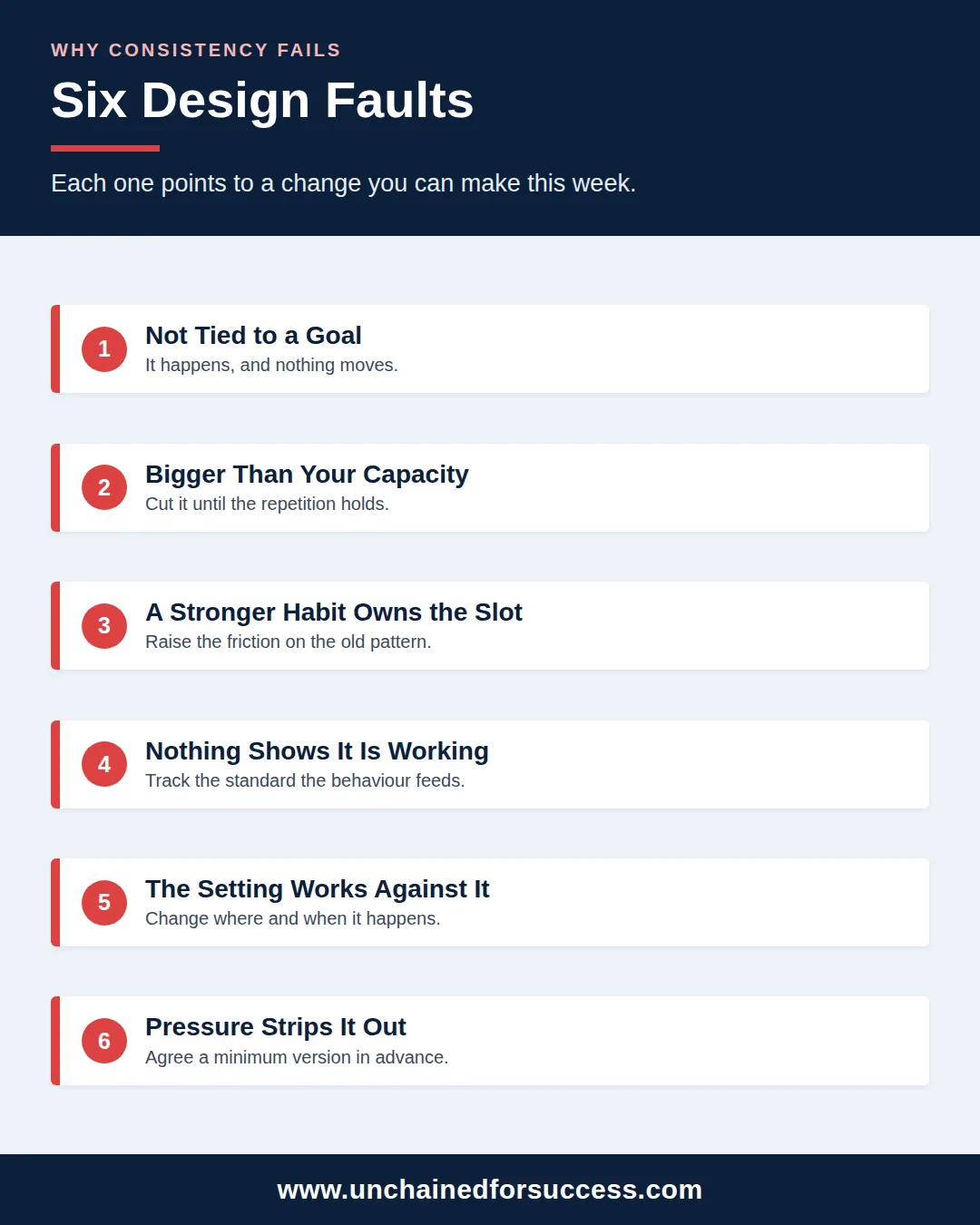
The behaviour is not tied to a goal. It happens, and nothing moves. A weekly meeting that ends without decisions is the standard example. Trace every behaviour to a standard, and that standard to a dated result, or drop it.
The load is bigger than your capacity. An hour a day looks fine on the day you plan it. Cut the behaviour until the repetition holds, then grow it. Starting intensity hides how fragile a pattern is.
A stronger habit already owns the slot. New behaviour has to win a slot an old one already holds. Raise the friction on the old pattern and lower it on the new one. The framework's own reading is that replacing a habit often works better than adding one.
Three More Places Consistency Fails
Nothing shows it is working. A behaviour with no visible link to progress gets harder to repeat. Track the standard it feeds, so the connection is in front of you.
The setting works against it. Focused work in an interrupt-heavy room is a design problem, not a discipline problem. Change what you can about where and when.
Pressure strips it out. This is the sixth, and the one people judge themselves for. It bites even when the other five are sound. When the week turns, the behaviours that lean on energy and mood are sacrificed first. The framework describes two responses, and both weaken the pattern: dropping the behaviour, or pushing harder than your capacity allows. The answer is a minimum version agreed in advance.
Why Consistency Fails in Practice
The people and teams below are illustrations, not clients. Each shows what was actually breaking, and what changed.
An Individual With Two Free Evenings
Marcus works shifts and collects his daughter on Mondays and Wednesdays. His Outcome Goal, the dated result he is working towards, is to complete a 10 kilometre run by 30 April. That is his to govern, because it rests on his own training and his own entry.
The standard that produces it is three sessions a week of at least thirty minutes, held for twelve weeks. His Process Goal is to train on Tuesday and Thursday evenings and on Saturday mornings.
His first version failed because it assumed five free evenings. The rebuilt version uses the two he actually has, plus Saturday morning. On Tuesday and Thursday his cue is the end of his shift, with his kit already in the car. On Saturday it is clearing the breakfast table.
His minimum version is fifteen minutes, which keeps the pattern alive on a hard day. It will not deliver the thirty-minute standard, so if he is using it most weeks, that is a signal to reopen the plan rather than to let the standard quietly slip.
Nothing about his motivation changed. The design stopped arguing with his week.
A Consultancy That Stopped Reviewing Its Pipeline
A small firm agreed to review its pipeline every Friday. Within two months the review had stopped, and nobody could say when.
The cause was ordinary. Friday afternoons carried client deadlines, so the review always lost. Moving it to Tuesday at 09:00, with a standing agenda and one named owner, fixed it. Under delivery pressure it shrinks to twenty minutes rather than vanishing.
The review exists to protect a dated Outcome Goal: a written delivery plan for the next quarter, built from the reviewed pipeline and submitted to the partners by 30 June. The standard it feeds is every live opportunity reviewed and given a next action within seven days, which the firm can meet whatever a client decides.
A Project Team That Shortened Its Risk Review
A delivery team kept its weekly risk review in the calendar. Attendance held. Its Outcome Goal was to complete phase one and submit the handover pack by 31 October, with every critical risk logged and owned before submission. The standard was every new risk logged and owned within five working days of being raised.
Yet risks still arrived late.
Here the behaviour was consistent and the result still missed, which points somewhere else. The team checked the process next and found the review had no preparation step, so it discussed whatever people remembered. Adding a pre-read owned by the risk lead changed what the same hour produced.
How to Rebuild a Behaviour That Keeps Breaking
Take one behaviour where consistency fails and rewrite it in five lines. Do it on paper, not in your head.
Name the behaviour so someone else could tell whether it happened. Attach it to something that already occurs at the same point every week. Set the lowest cadence that still produces the standard. Remove one piece of friction in advance. Then write the smallest version you would still count on a bad day.
Do one behaviour at a time. Each new pattern draws on the same capacity, and consistency fails fastest when three of them start in the same week. Capacity Before Goals covers why that order matters.
When the Behaviour Happens and the Result Still Misses
Here consistency fails as an explanation, because the behaviour did happen. Trying harder is tempting, and it adds effort to a system that may not have an effort problem. Where consistency fails is not always where the miss shows up. The framework checks the structure instead, in a fixed order that starts at the bottom.
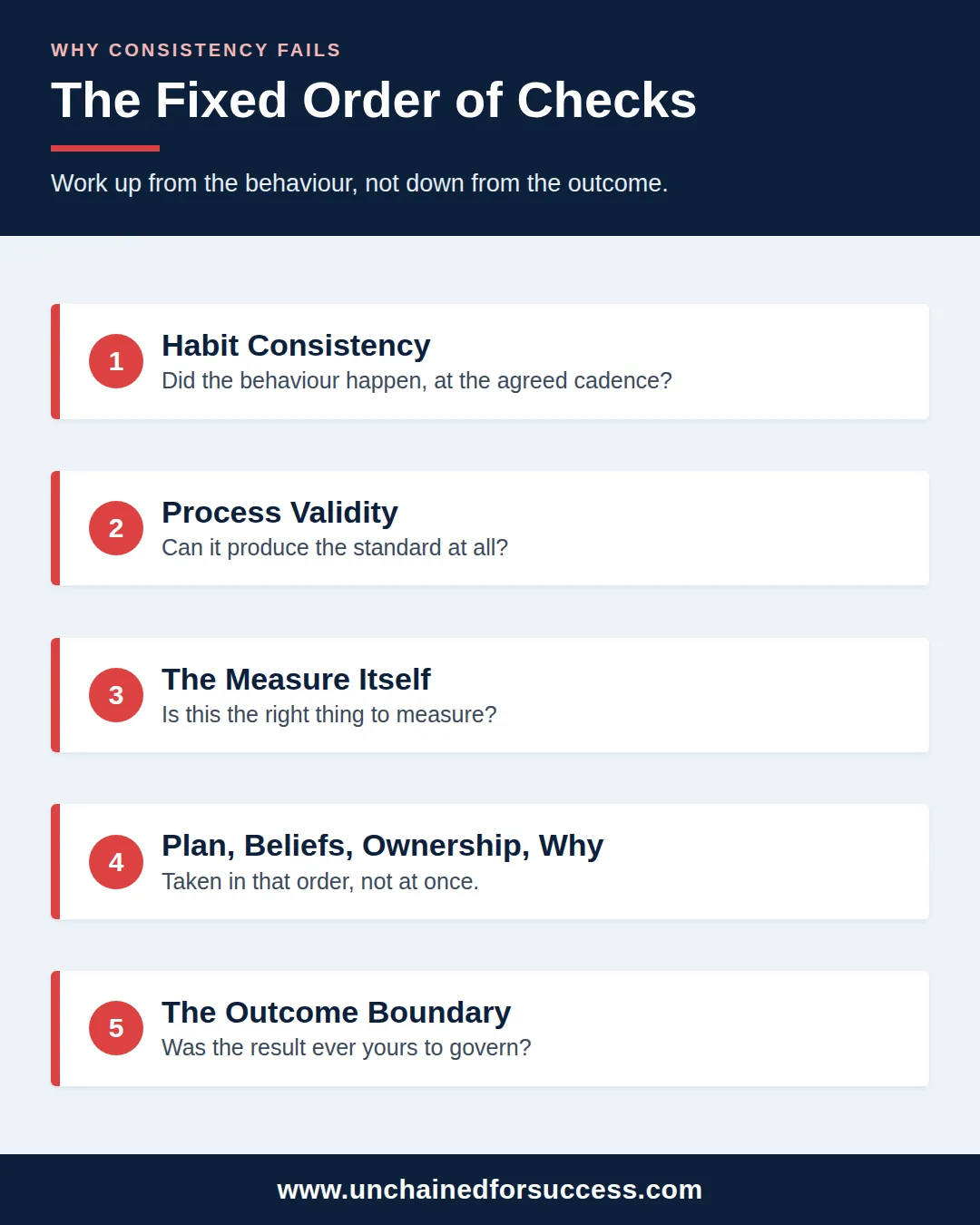
First, habit consistency. Did the defined behaviour actually happen, at the agreed cadence? Restore it before changing anything above.
Second, process validity. The behaviour happened, so can it produce the standard at all? The risk review above failed this test.
Third, the measure itself. Is this the right thing to measure, and is the range still sensible? A poor measure sends every later check in the wrong direction.
Fourth, the supporting layers. Take the Plan, then Beliefs, then Ownership, then Why, in that order. Is the sequence sound? Is a belief about what is possible quietly working against the goal? Have you accepted the cost and the consequences? And does the goal still justify that cost?
Last, the outcome boundary. Only now do you ask whether the result was ever yours to govern. Stretch Goals Must Stay Within Your Control covers that test in full.
When a below-range result meets the trigger, do not start by redefining the outcome or escalating effort. Work up from the behaviour instead.
Frequently Asked Questions About Why Consistency Fails
Is this just a polite way of saying I lack discipline? No. Some of what looks like weak discipline is a behaviour that was never designed. Consistency fails there: no cue, no protected slot, no smaller version. Discipline pays a cost every time you use it. Design lowers that cost, so the same discipline goes further. Both matter, in that order.
How long until it feels normal? The honest answer is that it varies widely. The most useful real-world study we have found reports a range from 18 to 254 days for one simple daily behaviour, so treat any single number with caution.
I missed a day. Do I start again? No. In that study, missing one opportunity to perform the behaviour did not materially affect habit formation. Return to the minimum version at the next cue. A run of missed days is worth looking at, and the place to look is the design rather than yourself.
When Consistency Fails, Check the Design First
Illness, grief, a sudden caring demand and a genuine emergency can break a behaviour that was well designed. No amount of structure prevents that.
Short of those, consistency fails for reasons in the design: no link to a goal, a load beyond your capacity, a stronger habit in the slot, nothing showing it works, a setting that fights it, or no smaller version for a hard week. Every one of them is something you can change.
Pick the one behaviour you most want back. Rewrite it in the five lines above, then run it past the six faults. Then put the first occurrence in the calendar before the week fills up.
For the full method, read the Unchained Goals Framework overview, and the glossary explains the individual terms. The Goals Readiness Score is a short self-assessment if you want one: 18 questions, under five minutes. How to Build Habits That Stick covers the design in more depth, and Why Habits Matter More Than Motivation covers what to rely on instead of mood.
Which behaviour would you bring back first? Share it in the comments.
Sources
• Psychology of Habit by Wendy Wood and Dennis Rünger, Annual Review of Psychology, 67, 289 to 314, 2016
• Changing Circumstances, Disrupting Habits by Wendy Wood, Leona Tam and Melissa Guerrero Witt, Journal of Personality and Social Psychology, 88(6), 918 to 933, 2005
• How Are Habits Formed: Modelling Habit Formation in the Real World by Phillippa Lally, Cornelia H. M. van Jaarsveld, Henry W. W. Potts and Jane Wardle, European Journal of Social Psychology, 40(6), 998 to 1009, 2010
• The When and How of Planning: Meta-Analysis of the Scope and Components of Implementation Intentions in 642 Tests by Paschal Sheeran, Olivia Listrom and Peter M. Gollwitzer, European Review of Social Psychology, 36(1), 162 to 194, 2025
• The Pull of the Past: When Do Habits Persist Despite Conflict With Motives? by David T. Neal, Wendy Wood, Mengju Wu and David Kurlander, Personality and Social Psychology Bulletin, 37(11), 1428 to 1437, 2011
Continue Your Journey
Explore more resources from the Unchained Goals Framework: