

It is Thursday evening. A consultant's course module is due with her reviewer tomorrow, and it still falls below the quality standard she agreed. Sending it would meet the deadline. Correcting it could put the deadline at risk. Excellence is a decision, and this is the moment for it. The decision comes far more easily, though, when you have agreed in advance how you would handle a moment like this.
A familiar belief can get in the way. Some people are excellent, and the rest of us do our best. That belief is comfortable, because it takes the decision out of our hands.
An earlier post in this series showed that standards define outcomes before the work begins. Last week's post asked who carries the result once the cost arrives. So this post asks the question in between. When you have set a standard but the week becomes demanding, what makes you hold it?
The short answer is that you decided to, and you decided before the pressure arrived. These five choices will help you protect the quality of your work when time and pressure tempt you to let it slip. You decide the standard. Next, you agree what happens when work falls short of it. You choose the actions that produce it, and make them easier to repeat. Then you review the results against evidence rather than feeling.
You cannot change your starting point today. You can decide how you prepare, practise, check your work and respond when something falls short. That difference is the whole argument of this post.
What It Means to Say Excellence Is a Decision
A trait is something you have. A decision is something you make, and can make again tomorrow. If you see excellence as something you must be born with, you may overlook what you can improve. Say instead that excellence is a decision, and the question becomes what you will do next.
That is not a motivational slogan. It is a description of where the work actually happens, and it is why excellence is a decision before it is anything else. You do not meet a standard in general. You meet it, or miss it, on one piece of work, on one day, with one choice in front of you. Deciding is the beginning of that work, not proof that excellence has arrived.
Excellence Is a Decision About What You Control
The Unchained Goals Framework asks whether you have enough authority to act on the main causes of a result and correct things when they drift. That defines your Control Boundary. It does not mean controlling every external event. For the consultant, it means being able to organise the work, correct weaknesses and make the decisions needed to create and launch her course.
That matters for goal design. A goal built on a trait asks you to be someone. A goal built on a decision asks you to do something. Only the second kind can you meet on purpose, so build your goal around a result you have the authority to act on, and the actions that produce it.
A Thursday When Excellence Is a Decision
Return to the consultant we have followed through this series. She is an illustrative example rather than a client, and her situation will be familiar.
Her Vision, the long-term position she has chosen and holds to, reads: "Build a nationally recognised coaching business that helps individuals across the UK achieve meaningful goals through consistent action." She refined the wording in August, and it has held since.
Her Outcome Goal states the result: create and launch a six-module online course by 30 November. Next, her Performance Goal sets the standard. Finish one module each fortnight, scoring at least four out of five on the quality checklist, with no critical review actions left open.
Her Process Goal names the actions she controls: sessions every Monday, Wednesday and Friday, and a script, video and worksheet sent by alternate Fridays. Habit Conversion keeps those sessions steady, so each one starts at 9.00 am with the task list open.
Now it is Thursday. Module four scores three out of five, with one critical action still open: the worksheet asks learners to complete a task the lesson has not yet explained. The module is due with the reviewer tomorrow, and this is a submission expected to meet the agreed standard, not a rough draft sent for early comment.
Why Excellence Is a Decision She Made in August
Here is what made the difference. Back in August, before the deadline pressure arrived, she set a clear quality rule and agreed a delivery allowance with the reviewer. A module that misses the standard does not go. And, for this project, a module may run up to three working days late, no more than twice.
So on Thursday she tells the reviewer what needs correcting, and that she may need the allowance. In Friday's session she rewrites the lesson so it teaches the task, then scores the module again. It now meets the standard, so she sends it by the Friday deadline, and the allowance stays unused. At her next review, she examines why she only found the missing explanation so close to submission.
She still had to act on Thursday, but she already knew what to do. That is what it means to say excellence is a decision.
Why Excellence Is a Decision: What the Research Says
Two studies of expert performance pull in different directions, and both are worth knowing. Neither tests the five choices in this post directly. Together, though, they show why the deciding part deserves your attention.
Ericsson, Krampe and Tesch-Römer studied violinists at a Berlin music academy and published the result in Psychological Review. The two best groups practised alone for about 24 hours a week. Music teachers managed about nine. From that, the authors argue that many qualities we file under innate talent are the product of sustained, deliberate practice over at least ten years.
Deliberate practice is not repetition. It is work at the edge of your current ability, on a defined weakness, with feedback.
Two decades later, Macnamara, Hambrick and Oswald pooled 88 studies and published the result in Psychological Science. Deliberate practice explained about a quarter of the difference in performance for games, a fifth for music, and less for sport, education and professional work.
So practice matters, and it is not the whole story. Other things count too, and some of those you did not choose. That is an honest reading, and it is also the point. Whatever your starting point, you can choose purposeful practice, seek feedback and use it to improve your work. Excellence is a decision made on top of whatever you started with.
Excellence Is a Decision About a Standard
Excellence is not a mood you wait for. It is a standard you write down, and then hold when it costs you something. A clear standard helps people recognise whether the work is good enough.
Locke and Latham summarised 35 years of goal research in American Psychologist. Across more than 100 tasks and 40,000 participants, specific and difficult goals produced higher performance than telling people to do their best. "Do your best" is a vague instruction. A specific standard is a decision.
In the Unchained Goals Framework, the Performance Goal states the standard your work must meet. For the consultant, that means a module scoring at least four out of five, with no critical issues unresolved. Her working sessions are the actions intended to produce that result. Keep the two apart, and you can tell people what excellent looks like rather than asking them to be excellent.
One balancing point. Excellence means meeting a clear standard that serves the goal. Once the work meets that standard, send it. Continuing to polish it without a useful reason delays the result you are trying to achieve, and the framework treats that as pushing too hard, not as high standards.
Excellence Is a Decision: Five Choices to Make This Week
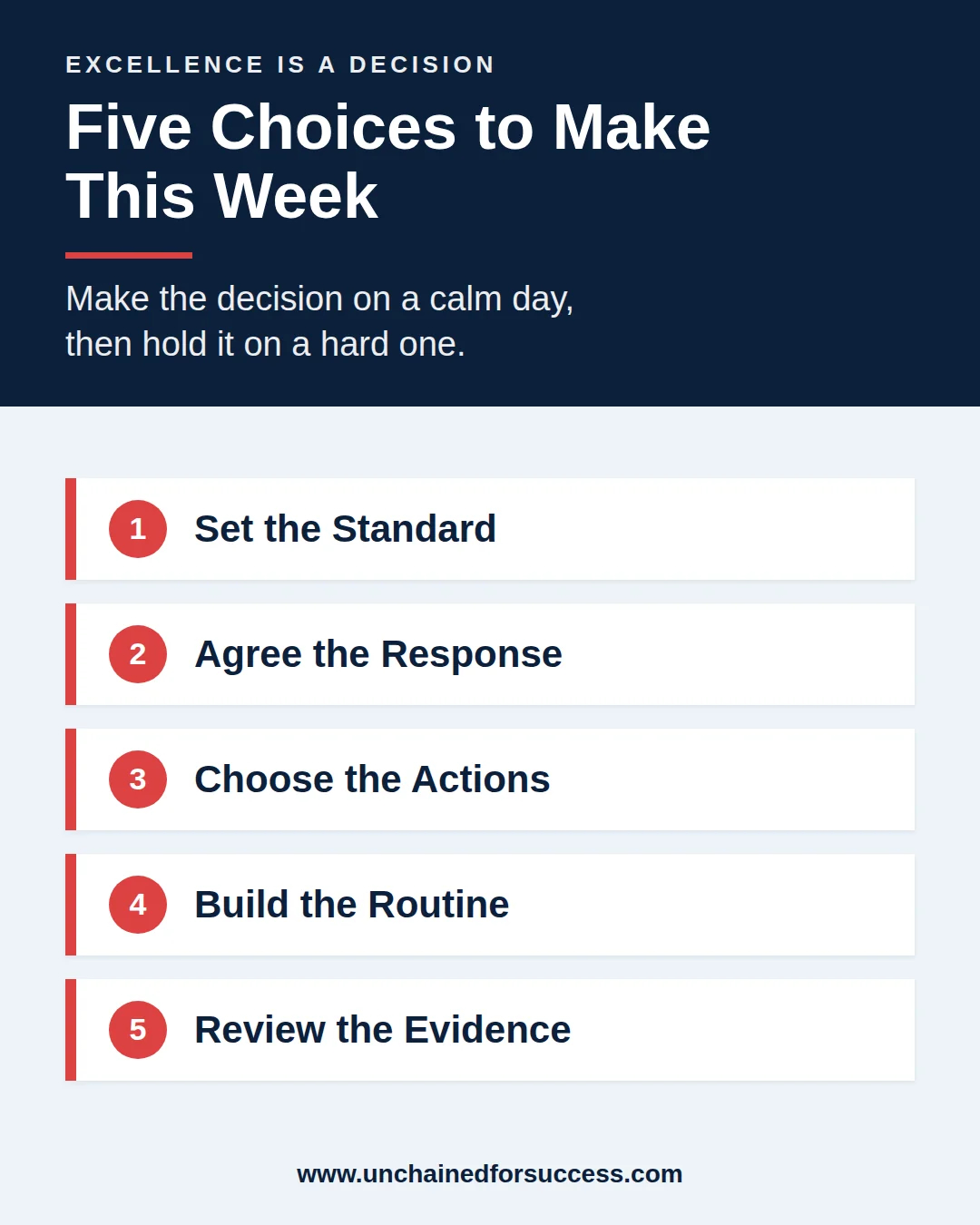
None of this needs a new system, because excellence is a decision you can make with what you already have. Here are five choices you can make this week, and each one moves the decision out of the hard moment and into a calm one.
1. Decide the Standard Before You Start
Write the standard before you start the work. Not "good enough", but a statement a second person could check: four out of five on the checklist, no critical actions open, sent by the agreed date. The SSMTC Goal Design Canvas gives you a place to write it. If you cannot write it, you have not decided it yet. You have only hoped for it.
2. Agree What Happens When Work Falls Short
This is the choice that is easiest to skip, and it is the most valuable one here. Decide now what you will do when a piece of work misses the standard. Does it go anyway? Or does it wait a day, or a week? Write the answer down before the pressure arrives, and agree any delivery allowance with the people affected.
The consultant and her reviewer agreed that a module may run up to three working days late, no more than twice across the project. Beyond that, the Control System flags it. She then checks whether the sessions happened, and whether they could produce the standard, before she touches the standard itself.
3. Excellence Is a Decision About Actions, Not Intentions
An intention to do excellent work is not a Process Goal. A Process Goal names what you will do, when, and how often. "Three drafting sessions a week, Monday, Wednesday and Friday, at 9.00 am" is a decision. "Take the course seriously" is not. Choose the actions that produce the standard, then protect the time they need. Even clear goals can stall when nobody has defined the actions needed to achieve them.
4. Make the Right Actions Easier to Repeat
Willpower alone means deciding the actions again every time something tests them, and each test is a chance to miss. So decide, in advance, how the actions will become routine. Same time, same place, same first step. The framework calls that Habit Conversion, and it is the stage where a repeated decision becomes the default.
Once starting at 9.00 am becomes routine, you spend less effort deciding whether to begin. You still need to check whether the work meets the standard. Motivation is what you feel at the start; routine is what carries you after it fades, and judgement is what you keep.
5. Excellence Is a Decision You Check Against Evidence
Set a date to compare actual Performance with the operating range you agreed. Check the quality score and the submission date, not how the work felt. That is the job of the Control System, and it stops two mistakes at once. Do not lower the standard simply because the month was hard, or raise it because the work felt easy.
When results fall below the agreed range and meet the agreed trigger for action, investigate the cause before changing the standard. When results exceed the range and meet that trigger, check that the improvement is genuine, repeatable and sustainable before raising the standard. Excellence is a decision you confirm with evidence, in both directions.
Finally, review whether the standard remains appropriate if the Outcome Goal changes, or if evidence shows that the measure no longer tells you whether you are on track.
Excellence Is a Decision to Carry a Cost
Every one of those five choices costs something, and the cost usually arrives when the pressure does. Holding a standard may mean correcting a weakness, asking for help, setting aside another task or having an honest conversation about delivery. That is why the framework separates the decision from the wish. Your Why explains why the goal is worth its cost. Ownership means consciously accepting that cost and the consequences of pursuing the goal within your authority.
So the question to ask is not whether you are the sort of person who does excellent work. It is whether you accept what this standard will cost, knowing what you know now. Consider the likely cost before you commit, and decide whether you are willing to accept it.
A yes is a decision you can act on. A no is useful too, and last week's post showed how to take responsibility for it without blaming yourself. If the no comes from a belief that you could never do this kind of work well, that belief is worth testing on its own.
Excellence Is a Decision for Teams and Organisations
When teams fail at this, the reason tends to be structural rather than personal. Where the standard lives in people's heads, each person makes the decision alone under pressure, and each makes it differently. Excellence then depends on who happened to be on shift.
The fix is the same five choices, made together and made visibly, so that excellence is a decision the team has already taken. Write the standard where the work happens. Agree in advance what happens when a piece of work misses it. Name the actions and protect the time. Build the routine that carries them. Then review actual Performance against the agreed range on a fixed date, with one accountable name against the result.
A team can agree these decisions together, then apply and review them consistently. The team view and the organisational view of the framework cover how to apply those decisions across teams without turning them into a slogan.
Excellence Is a Decision: Frequently Asked Questions
Is excellence really a decision if some people are naturally better? People differ in their starting abilities and circumstances. You can still decide how you prepare, practise, seek feedback and respond when your work falls short. Those choices support improvement, although they do not guarantee a particular result.
How is this different from simply setting high standards? A standard tells you what excellent looks like. The decision is what you do when the work does not look like that. Choice two, agreeing in advance what happens when work falls short, is what separates a standard on paper from one in practice.
What if I keep deciding and keep failing to follow through? Do not assume the standard is the problem. First check whether the agreed actions happened, and whether those actions could produce the required result. Use those findings to decide what needs changing before revising the goal.
Excellence Is a Decision You Can Make This Week
Excellence rarely arrives as a trait you discover in yourself. It arrives under pressure, as a choice you already made on a calm day, held now because you decided it would be. Excellence is a decision, and the five choices above put it back inside your control.
So choose one piece of work you need to complete this week. Write down the standard it must meet and what you will do if it falls short. Make that decision before the pressure arrives.
To see how well you design, execute and govern your own goals, take the Goals Readiness Score. It runs to 18 questions and takes under five minutes. If you would rather see how the framework applies to your own goals first, the individual view is the place to start.
Share the one standard you have decided to hold this week in the comments.
What will you do when the work scores three out of five?
Sources
The Role of Deliberate Practice in the Acquisition of Expert Performance by Ericsson, Krampe and Tesch-Römer, Psychological Review
Deliberate Practice and Performance in Music, Games, Sports, Education, and Professions: A Meta-Analysis by Macnamara, Hambrick and Oswald, Psychological Science
Building a Practically Useful Theory of Goal Setting and Task Motivation: A 35-Year Odyssey by Locke and Latham, American Psychologist
Continue Your Journey
Explore more resources from the Unchained Goals Framework: