


You were sure about it. Three weeks later it has quietly stopped, and nothing obvious went wrong. The usual explanation is that your motivation ran out. That explanation is popular, and it is only half right. Why habits matter more than motivation is not because motivation is weak. It is because motivation is easy to spend on the wrong job.
This post sets out where motivation actually helps, what carries a behaviour through a bad week, and how to design one that needs no persuading. It follows How to Build Habits That Stick, which covers the build itself.
Why Habits Matter More Than Motivation in an Ordinary Week
Habits do matter more than motivation, though not for the reason usually given. The popular version says motivation is emotional and therefore untrustworthy. The research points somewhere narrower and more useful.
Habits and deliberate effort are not rivals. A major review of the field describes the two guiding action together, with habit as the efficient, default mode (Wood and Rünger, 2016). The same review notes that habits form in the first place while people pursue goals and repeat a response in the same setting.
So motivation is not the opponent. It starts the behaviour often enough for anything to form at all. Habits matter more only for the daily job of getting it done.
The Part of the Story Most Articles Leave Out
One further finding sharpens the point. Researchers recently pooled 642 tests of planning in advance (Sheeran, Listrom and Gollwitzer, 2025). The average benefit was modest, and smaller still under the most conservative correction they applied.
The interesting part is who it helped. Plans worked much better for people who strongly wanted the goal in the first place.
Read that carefully, because it cuts both ways. Structure without wanting the result does very little. Wanting the result without structure tends to fade on the first difficult week.
The useful question is therefore not whether habits beat motivation. It is what each one is for. Answer that, and why habits matter stops being a slogan and becomes a design decision.
Why Habits Matter When Motivation Is Doing Something Else
Motivation is at its most useful early, before anything has hardened. Four decisions belong in that window:
• what deserves the slot
• how small the behaviour has to be
• where it sits in the week
• what you will do on a bad day
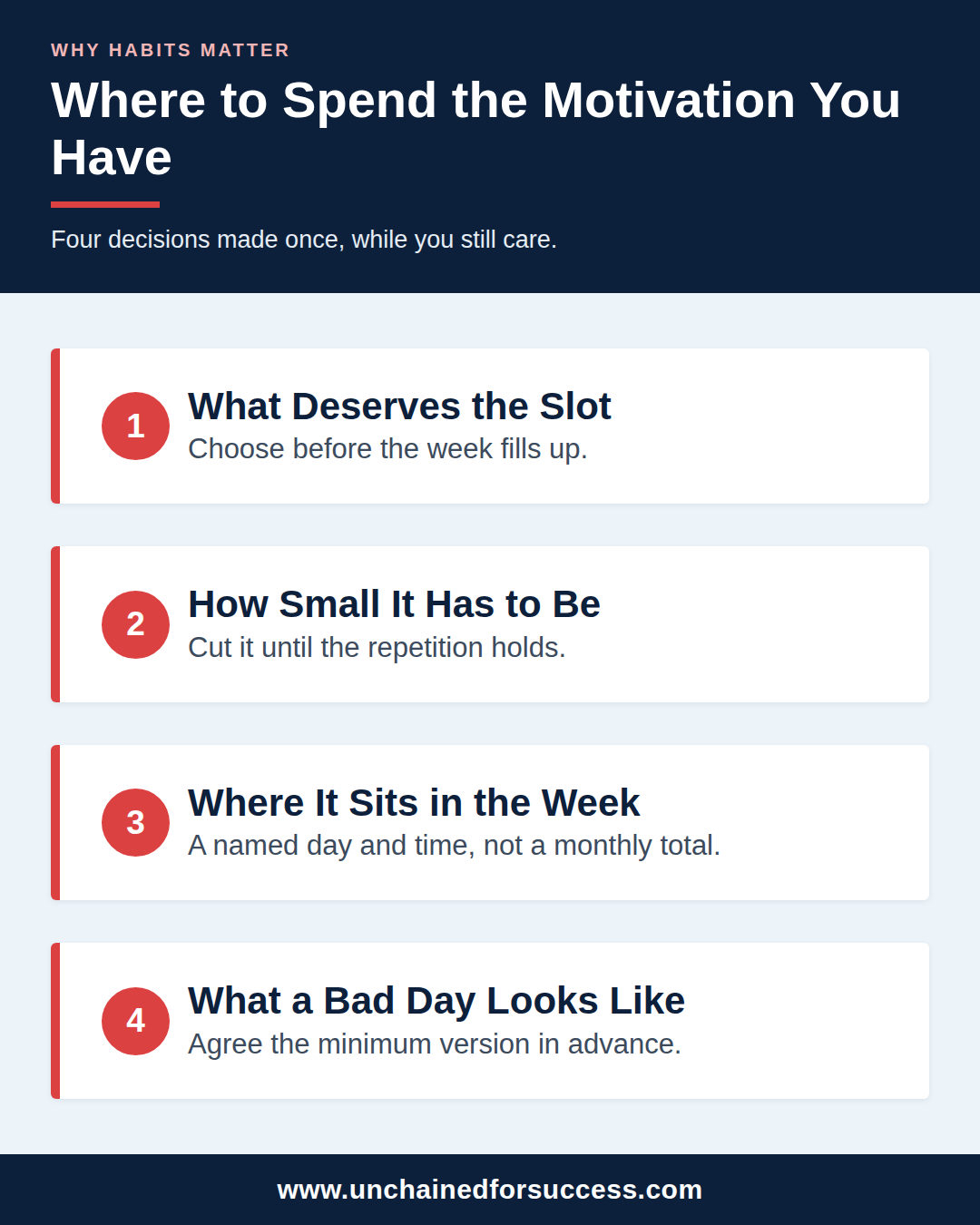
Each of those is a decision you make once, while the want is loud. Each keeps working on the days the want is quiet.
This is why habits matter more than motivation for daily execution. The behaviour still happens on the flat days, because the arguing already happened.
Spend enthusiasm on design and it compounds. Spend it on persuasion and you have to find it again tomorrow.
What Actually Carries a Behaviour Through a Bad Week
The study behind the number everyone quotes asked 96 volunteers to repeat one everyday behaviour in the same context, daily, for 12 weeks (Lally and colleagues, 2010). That number deserves a closer look.
Eighty-two people gave usable data. The curve the researchers fitted matched 62 of them, and fitted well for 39. Among those 39, reaching 95 per cent of their own automaticity plateau took a median of 66 days, with a range from 18 days to 254.
Two honest conclusions follow. The popular "66 days" figure describes a subset of one study rather than a law. More usefully, the time varied enormously between people.
So a behaviour that still feels effortful after a month is not evidence of failure. That spread is a reason not to ask every week whether it should feel automatic yet. Keep checking the standard the behaviour is meant to feed, which is a different question.
It is also part of why habits matter. A behaviour you keep re-deciding rarely accumulates the repetition the curve depends on.
Why Habits Matter Once the Deciding Stops
Something specific changes when a behaviour repeats in a stable setting. It stops needing a fresh decision each time.
In two diary studies, 35 per cent and 43 per cent of the behaviours people recorded were things they did almost every day, usually in the same place (Wood, Quinn and Kashy, 2002). Those were undergraduate studies, and the measure was frequency plus a stable location rather than anything about awareness.
Automatic does not mean effortless, and it does not mean unconscious. It means the behaviour starts before you have finished arguing about it. That is a smaller claim than the popular one, and it is the claim that holds.
Four Things That Make a Behaviour Repeatable
A behaviour that collapses often was never repeatable to begin with. Two of the four decisions above become properties you can check later, and two more join them.
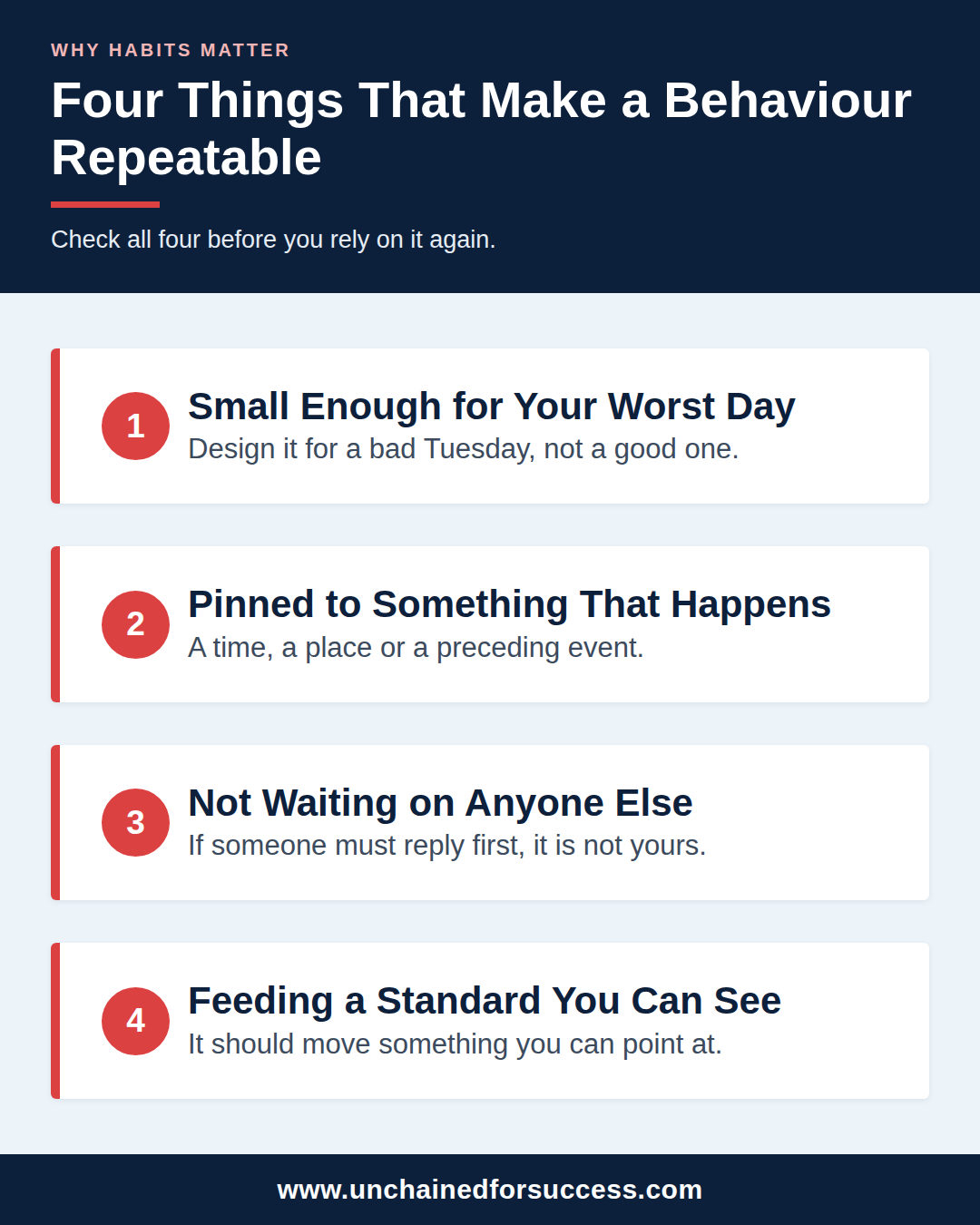
Small enough for your worst day. Design for a Tuesday when you slept badly and the day overran. If it only works on a good day, expect it on good days.
Pinned to something that already happens. A time, a place, or the thing you reliably do just before it. A behaviour with no anchor competes with everything else in the day. One with an anchor usually competes with one thing.
Not waiting on anyone else. If it needs a colleague to reply or a room to be free, it is only partly yours to keep. At team scale the same property becomes: it runs with whoever turns up.
Feeding a standard you can see. A behaviour that changes nothing you can point to tends to lose to something that does.
Two Tests People Skip
Two further checks catch most of the rest. Ask what this behaviour displaces, because it will displace something. Then agree the minimum version now, while the week is calm, so that a bad day produces a short session instead of no session at all.
A minimum version protects continuity rather than the full standard. Reaching for it repeatedly is a signal to reopen the plan, not a way to hide a shortfall.
Those six checks are the practical answer to why habits matter. They turn a good intention into something the week can actually hold.
Why Habits Matter: Three Redesigns That Held
One ordinary, one at work, and one at organisational scale.
A Parent Studying Alongside a Job
A parent studying for a professional qualification set out to revise five evenings a week. By week three it was happening twice a week. Evenings were the problem, because evenings were never reliably theirs.
The redesign moved revision to 40 minutes before the household woke. Three slots rather than five, because the failed plan had shown what the week actually had room for: Tuesday, Thursday and Saturday. The minimum version was one past paper question.
That is two hours a week where the original plan promised five evenings. Less revision that happens beats more that does not, and the parent allowed a longer run-up to the exam for exactly that reason. Nine weeks later the three slots were holding.
This is why habits matter more than a bolder plan. The bolder plan had produced two sessions a week and a sense of failure.
A Delivery Team That Stopped Reviewing Risk
A delivery team had a standing risk review that kept slipping whenever the schedule tightened. Attendance depended on who happened to be free.
They fixed it to 30 minutes every Wednesday at 9am, gave it a named owner, and agreed a two-item minimum for severe weeks. The review then survived the weeks that mattered most, which were exactly the weeks it used to disappear.
An Organisation That Reviewed Strategy Only When Calm
One organisation held strategy reviews whenever the diary allowed. In practice that meant quiet quarters, which are the quarters least in need of a review.
Moving it to a fixed date, with a short agenda that runs even when the full team cannot attend, changed what the review was for. It became a control rather than a reward for a quiet quarter.
At that scale, why habits matter is easy to see. An organisation that only reviews when calm has little early warning when it needs it most.
Why Habits Matter After a Missed Day
A missed day feels like a verdict. The evidence says otherwise.
In the Lally study, missing a single opportunity to perform the behaviour did not materially affect the process of forming the habit. One miss is a gap, not a reset.
What matters is the pattern. A miss that repeats, clusters, or arrives with a reason that is not going away is worth reading. It tells you about the design, not about you.
Some weeks break anyway. Illness, bereavement, caring demands and emergencies can interrupt a well-built behaviour, and no design prevents that. The aim is a behaviour that restarts easily, not one that never stops.
When the Habit Holds and the Result Still Misses
Sometimes the behaviour happens as designed and the standard it feeds still comes in short. That is useful information, and it puts the fault above the behaviour rather than inside it.
In the Unchained Goals Framework, the behaviour you schedule and repeat is a Process Goal. Reducing how much you have to decide each time carries its own name, Habit Conversion. It is deliberately not the same thing as the standard the behaviour serves, which is why a behaviour can hold while the result misses.
Check the behaviour, then whether it was the right behaviour, then whether the measure reflects the result you actually want. Why Consistency Fails works through that order in full.
Having a fixed order is another reason why habits matter. A behaviour you can trust gives you a clean starting point when the result disappoints.
Frequently Asked Questions About Why Habits Matter
Does this mean motivation is useless?
No. Motivation supplies the energy to make the design decisions, and the planning research suggests structure works best for people who genuinely want the outcome. The design then reduces how often the behaviour has to draw on that energy again.
How long before a behaviour feels automatic?
It varies widely. In the study everyone quotes, the median was 66 days among the 39 participants whose curves showed a good fit, with a range from 18 to 254 days.
I have broken the chain again. Is it worth restarting?
Yes. A single miss did not materially affect habit formation in that study. Restart at the minimum version rather than at full size.
If habits matter this much, why do I still need goals?
Because a behaviour with nothing above it just happens. The standard tells you whether the repetition is worth keeping, which is why habits matter most when they feed something measurable.
Why Habits Matter More Than a Fresh Start
Fresh starts are easy to find and cheap to spend. A behaviour that survives a bad week is neither, and it is worth more.
If one thing has kept slipping, do not go looking for more enthusiasm. Cut it until it fits your worst day, pin it to something that already happens, make sure it depends on nobody else, and tie it to a standard you can point at. Then settle the minimum version now, while the week is calm.
That is ultimately why habits matter more than motivation. Motivation decides. Habits carry the days when deciding would have gone the other way.
Sources
• Wood, W. and Rünger, D. (2016). Psychology of Habit. Annual Review of Psychology, 67, 289 to 314. https://doi.org/10.1146/annurev-psych-122414-033417
• Lally, P., van Jaarsveld, C. H. M., Potts, H. W. W. and Wardle, J. (2010). How are habits formed: Modelling habit formation in the real world. European Journal of Social Psychology, 40(6), 998 to 1009. https://doi.org/10.1002/ejsp.674
• Sheeran, P., Listrom, O. and Gollwitzer, P. M. (2025). The when and how of planning: Meta-analysis of the scope and components of implementation intentions in 642 tests. European Review of Social Psychology, 36(1), 162 to 194. https://doi.org/10.1080/10463283.2024.2334563
• Wood, W., Quinn, J. M. and Kashy, D. A. (2002). Habits in everyday life: Thought, emotion, and action. Journal of Personality and Social Psychology, 83(6), 1281 to 1297. https://doi.org/10.1037/0022-3514.83.6.1281
Continue Your Journey
Explore more resources from the Unchained Goals Framework: