


You said you would start on Monday. Monday came, and it did not happen, and by Thursday you had stopped mentioning it even to yourself. The cost is not the missed session. It is the quiet note your mind files afterwards, that your word to yourself did not hold this time. To rebuild self-trust you have to answer that note with evidence, and evidence is built differently from intentions.
This post sets out what self-trust is actually made of and five reasons promises to yourself break. It ends with a seven-day restart small enough to survive a difficult week.
How to Rebuild Self-Trust When the Promise Was to Yourself
A promise to another person has help holding it up. They remember. They might ask. There is a cost to letting them down that arrives from outside you.
A promise to yourself has none of that. Often nobody notices. The only cost is internal, and it arrives slowly, as a growing suspicion that you are unreliable in private.
That suspicion is costly, because of what it does to what you attempt next. So the repair matters more than the individual promise ever did. The good news is that you rebuild self-trust through ordinary, unglamorous actions rather than through a change of character.
What Self-Trust Is Actually Made Of
Self-trust is not a feeling you can talk yourself into. It is closer to a record than a mood.
Bandura identified four sources of belief in your own capability: what you have actually accomplished, seeing others succeed, what other people tell you, and how your body feels at the time (Bandura, 1977). He singled out the first as especially influential, because it rests on personal mastery experiences.
This is awkward and useful at the same time. Awkward, because talking yourself into it is the weaker route, and the weaker route is the one most advice offers. Useful, because the stronger one is clear. You rebuild self-trust by doing small things you said you would do, and letting the record accumulate.
Why the Promise Broke, and Where to Look First
A broken promise to yourself usually gets filed under willpower. Look at what actually happened, and more often it reflects how the promise was built than anything fixed about your character.
Five are worth checking first.
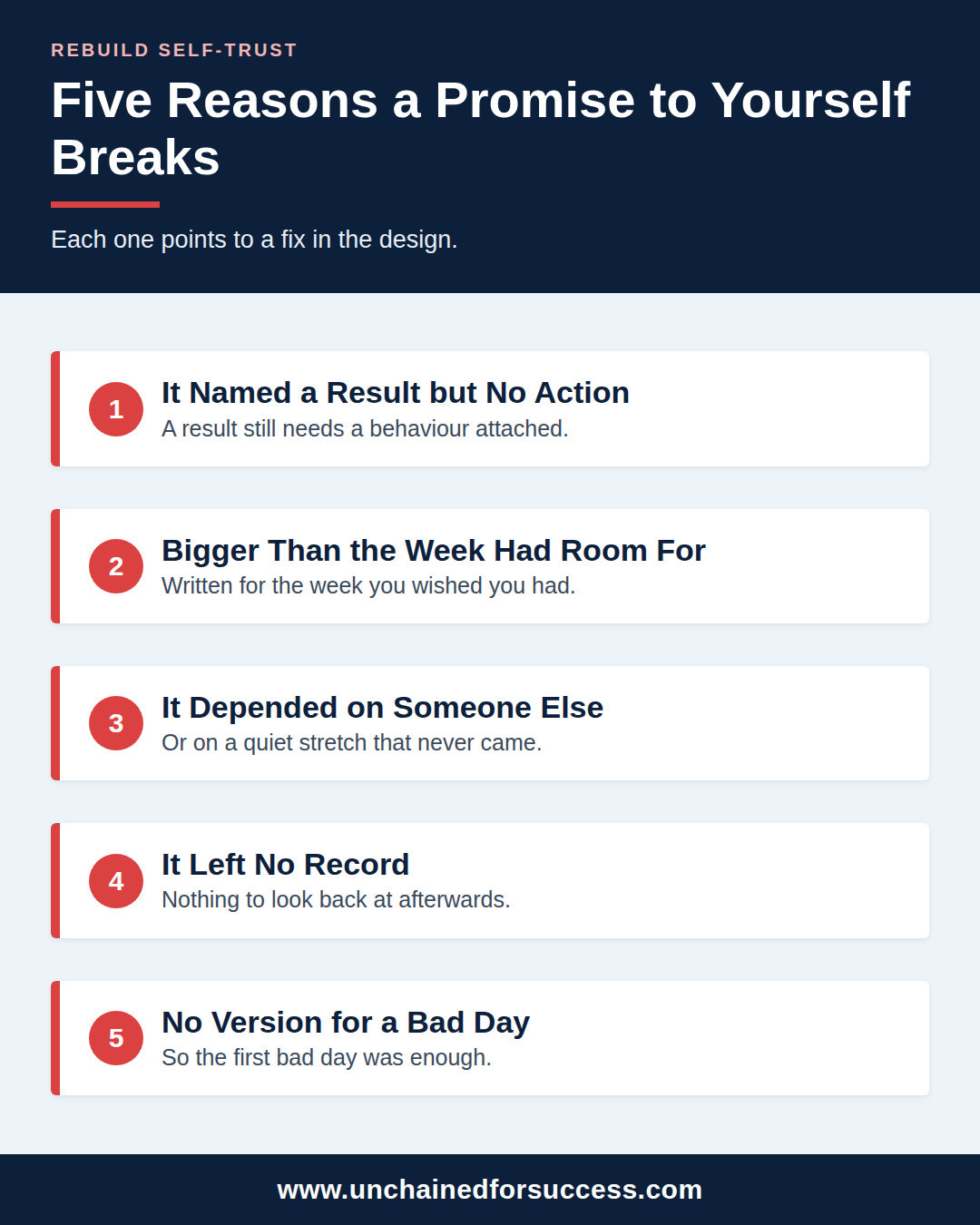
It named a result but no action. A dated result is necessary, and on its own it is not enough. "Get fitter by June" asks nothing of any particular day, so no particular day is the day you broke it. The result still needs a behaviour you can schedule and perform.
It was bigger than the week had room for. The plan was written for the week you wished you had.
It depended on someone else. Or on a quiet stretch that never arrived.
It left no record. Nothing showed whether you had kept it, so there was nothing to look back at.
It had no version for a bad day. So the first bad day was enough to end it.
None of those is a verdict on your character. Each has a fix, and the fixes are how you rebuild self-trust from here. Take them in order, starting with the size of the promise.
Rebuild Self-Trust by Making the Promise Smaller
The instinct after breaking a promise is to promise harder. Five sessions become six. The new plan is more ambitious than the one that just failed.
That is the wrong direction. You need completions, because completions are the evidence. A promise you are likely to keep is worth more than an impressive one you probably will not.
So cut it until keeping it is the likely outcome. Ten minutes. One page. One call. If the size feels almost too easy, that is a reasonable sign you have cut far enough, because the point this month is the record rather than the output.
Bandura also proposed that once repeated success has built strong expectations of your own capability, the negative impact of occasional failures is likely to be reduced. That buffer is what you are building. It does not exist yet, which is exactly why the first promises need to be small. Start below what you think you can manage, and you rebuild self-trust with room to spare.
The Small Detail That Decides Whether You Rebuild Self-Trust
There is a field experiment that makes this concrete, and the result is sharper than most advice on the subject.
Researchers sent vaccination reminders to 3,272 employees (Milkman and colleagues, 2011). In the control group, 33.1 per cent were vaccinated. One treatment group was prompted to write down the date they planned to go. Another was prompted to write down the date and the time.
Writing a date alone lifted the rate by 1.5 percentage points, a difference that did not reach statistical significance. Writing a date and a time lifted it by 4.2 points, and that difference did.
One extra thing to write down separated those two groups. If your promise to yourself currently names a day but not an hour, that is one of the cheapest changes available to you, and one of the quickest ways to rebuild self-trust this week.
Rebuild Self-Trust With an Answer Ready for the Obstacle
You already know what will interrupt this. The late meeting, the tired evening, the child who will not settle. Deciding in the moment is where the promise is most often lost, because in the moment the interruption usually looks reasonable.
Plans in the form "if X happens, then I will do Y" outperform plans that simply schedule the behaviour, according to a 2025 meta-analysis covering 642 independent tests (Sheeran, Listrom and Gollwitzer, 2025). Plans rehearsed at least once also did better than plans made and forgotten.
Keep the claim in proportion. The average benefit was modest, and the paper's most conservative estimate put it at under half the headline figure. That same review found the effect largest where the underlying intention was already strong, so planning sharpens motivation rather than replacing it.
Two or three if-then plans are enough: if the meeting overruns, then I do the ten-minute version before dinner; if the morning slot goes, then it moves to 7.00 pm the same day rather than tomorrow; if I want to skip entirely, then I start anyway and reassess after five minutes.
Written that way, the obstacle you named already has an answer. That is one way people rebuild self-trust without having to decide it while tired.
A Seven-Day Restart
Seven days is long enough to produce evidence and short enough to finish. The aim is a kept promise, not a transformation, because you rebuild self-trust in completions rather than in breakthroughs.
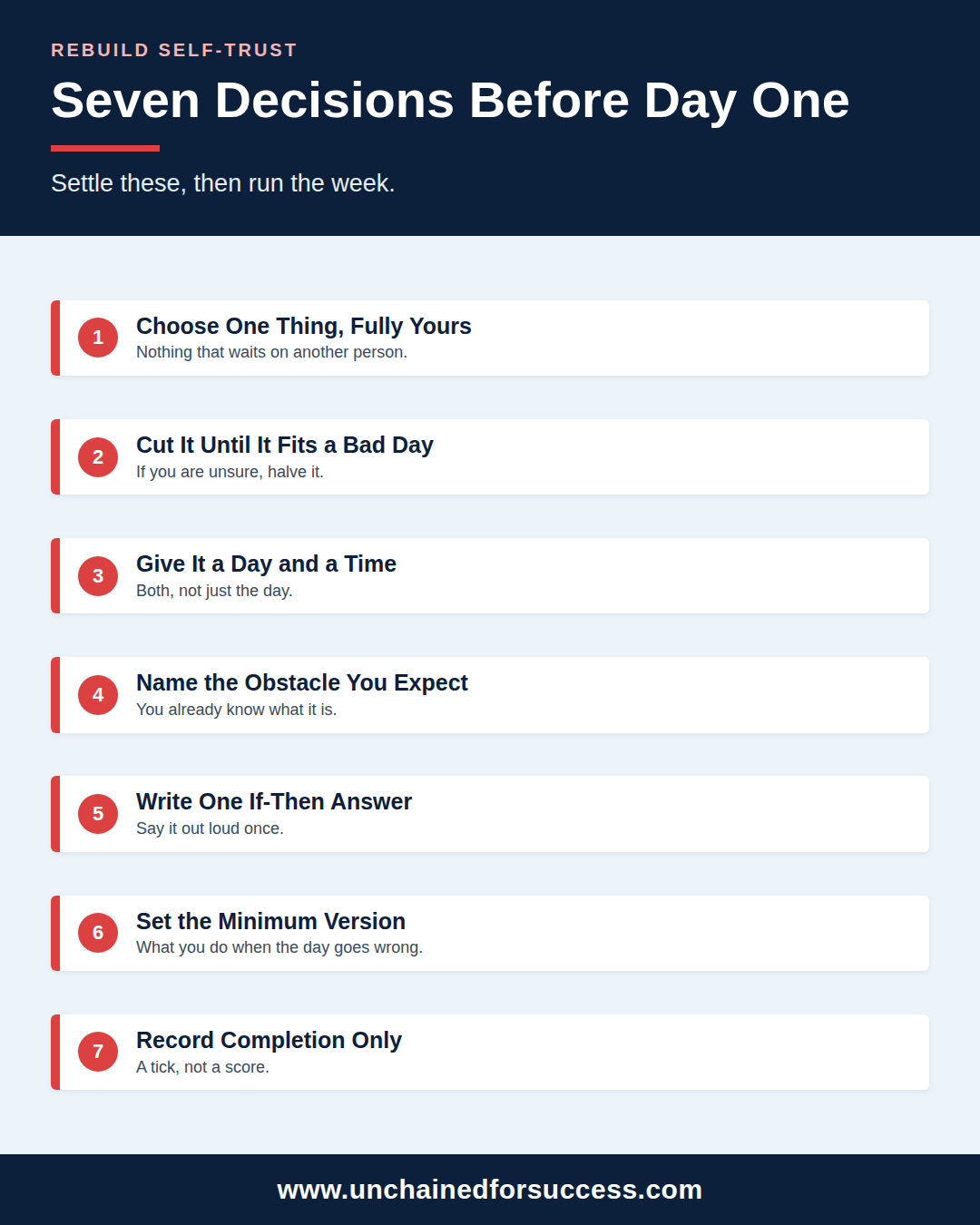
Seven decisions, all settled before the week starts.
1. Choose one thing, fully yours. No waiting on a reply, a room or another person's diary.
2. Cut it until it fits a bad day. If you are unsure, halve it.
3. Give it a day and a time. Both, for the reason above.
4. Name the obstacle you expect. You already know what it is.
5. Write one if-then answer to it. Say it out loud once.
6. Set the minimum version. The thing you do when the day has gone wrong.
7. Record completion only. A tick, not a score.
What to Measure at the End of the Week
Count kept promises, because that is the number that tells you whether you rebuild self-trust this week. Not progress, not output, not how it felt. Recording completion is what makes the promise visible, and it is deliberately not a measure of progress, because progress is the thing you are not yet in a position to judge.
The aim is a reliable pattern, not a perfect score. Seven from seven is a strong week. So is five from seven with two minimum versions, because the pattern held. One from seven is usually a sign the promise is still too big, and the response is to cut it again rather than to try harder.
A minimum version protects continuity rather than the full standard. Using it every day is a signal to reopen the plan, not a way to hide a shortfall. Either way the week still counts towards the record, and the record is how you rebuild self-trust.
One limit is worth stating. During this restart, completion is the evidence you are collecting, and it is not a measure of whether the underlying goal is on track. Once the pattern holds, go back to the standard the behaviour is meant to feed and check whether it is producing enough progress.
Rebuild Self-Trust in Practice
Two examples, both illustrative rather than clients, one personal and one professional.
A Manager Who Kept Promising to Exercise
A manager had promised himself five gym sessions a week every January for four years. Each attempt lasted about three weeks, and each stop added to the belief that he lacked discipline.
He did not try to repair the gym promise. He set it aside and made a smaller one he could keep while the record was thin: a 20-minute walk after dinner, daily, with an indoor minimum of ten minutes when it rained or dinner ran late.
Week one produced seven. Week two produced seven again, as five full walks and, on the two wet evenings, the ten-minute indoor version. By week four the gym was still not happening, and that was not the point. What had changed was what he could say about himself with evidence behind it. That shift is what it looks like to rebuild self-trust in practice.
A Consultant Who Kept Missing Her Own Deadlines
A consultant kept setting Friday deadlines for proposals and delivering them the following Tuesday. Clients noticed. What stayed with her was her own account of it.
The deadline was not the fault. "Submit the completed proposal by Friday at 4pm" is a perfectly good result to commit to, and it was hers to deliver. What was missing sat underneath it. Nothing said what had to be true by Tuesday, and nothing said when the writing would actually happen.
So she added both. Outline and evidence done by Tuesday, first draft by Thursday morning, and the behaviour that produces them: draft for 45 minutes at 8.00 am on Tuesday and Thursday, with a 15-minute minimum.
The kept promise was the drafting session. The Friday deadline stayed exactly where it was. When two sessions turned out to be too few for a larger proposal, that was information about the plan rather than about her, and she added a third rather than moving the deadline.
What One Broken Promise Actually Costs
Less than it feels like, and one study looked directly at this.
Lally and colleagues tracked 96 volunteers forming a new daily routine, and modelled the curves of the 39 whose data fitted well. In that group, missing a single opportunity to perform the behaviour did not materially affect the process (Lally and colleagues, 2010).
What carries weight is the pattern. One missed day does not undo the record behind it. Misses that repeat, cluster, or come with a reason that is not going away are telling you about the design.
Some weeks break regardless. Illness, bereavement and caring demands interrupt well-built commitments, and no amount of design prevents that. Aim for something that restarts easily.
If the self-criticism is loud and constant rather than occasional, that is worth taking seriously in its own right. A better-designed promise is not the answer to everything.
When You Keep the Promise and Still Feel Unreliable
Sometimes the record is good and the feeling has not caught up. That can mean the promise being kept is not the one that was broken.
There is a difference between the behaviour you schedule and the thing you actually agreed to. Scheduling a walk is one commitment. Agreeing in advance to what a walk every evening will cost you, in time, in evenings, and in the things you will not do instead, is another.
The Unchained Goals Framework calls that second one Ownership, and it is the harder of the two. It means accepting the cost and the consequences up front, for the part that sits within your own authority, without the conditional language that leaves a way out.
"I will try this for a while" is not a promise. It is a way of avoiding one, and it is hard to rebuild self-trust on a commitment that was never quite made. Replace it with a stated period and a stated standard, and the feeling tends to follow the record. Why Consistency Fails works through what to check when it does not.
Frequently Asked Questions About How to Rebuild Self-Trust
Should I tell someone, for accountability?
It can help, though it changes what you are rebuilding. External accountability adds a cost that comes from someone else. The record you keep for yourself is the part that rebuilds self-trust, which is why step seven is a tick you write rather than a report you send.
What if I break it on day three?
Restart on day four at the minimum version. One miss did not materially affect habit formation in the study above, and restarting small protects the record.
Is this not just lowering my standards?
The result you are aiming at is unchanged. What changes is the size of the step you commit to while the record is thin. A small step you complete beats a large one you abandon.
Rebuild Self-Trust One Kept Promise at a Time
Talking is not what gets you back to trusting yourself. You rebuild self-trust by accumulating evidence, and evidence comes from promises small enough to keep on a bad day.
Pick one thing this week. Make it yours alone, cut it until it fits a bad day, and give it a day and a time. Write one if-then answer to the obstacle you already expect, set the minimum version, and record only whether you did it.
That is how to rebuild self-trust, and it is slower and duller than a fresh burst of resolve. It holds up better, because at the end of it you are holding evidence rather than intent. For the behaviour side of this, How to Build Habits That Stick and Process Goals go further.
Sources
• Bandura, A. (1977). Self-efficacy: Toward a unifying theory of behavioral change. Psychological Review, 84(2), 191 to 215. https://doi.org/10.1037/0033-295X.84.2.191
• Milkman, K. L., Beshears, J., Choi, J. J., Laibson, D. and Madrian, B. C. (2011). Using implementation intentions prompts to enhance influenza vaccination rates. Proceedings of the National Academy of Sciences, 108(26), 10415 to 10420. https://doi.org/10.1073/pnas.1103170108
• Sheeran, P., Listrom, O. and Gollwitzer, P. M. (2025). The when and how of planning: Meta-analysis of the scope and components of implementation intentions in 642 tests. European Review of Social Psychology, 36(1), 162 to 194. https://doi.org/10.1080/10463283.2024.2334563
• Lally, P., van Jaarsveld, C. H. M., Potts, H. W. W. and Wardle, J. (2010). How are habits formed: Modelling habit formation in the real world. European Journal of Social Psychology, 40(6), 998 to 1009. https://doi.org/10.1002/ejsp.674
Continue Your Journey
Explore more resources from the Unchained Goals Framework: