


You gave the update. It was clear, it was well structured, and people nodded. A fortnight later the work has not changed, and two of the people who nodded are doing the opposite of what you asked. Teaching on communication mastery tends to treat it as a delivery skill, which leaves this outcome unexplained for people who deliver well.
What follows is what the evidence actually supports. That includes one very large finding which cuts hard against the idea that more and better communication always helps. Some of it is uncomfortable.
The Message That Landed and Made Things Worse
Start with the result nobody quotes. It comes from one of the largest meta-analyses in the field, and it sets the price of communication mastery.
Researchers pooled 607 effect sizes covering 23,663 observations of feedback interventions (Kluger and DeNisi, 1996). On average, feedback improved performance. But more than a third of the effects they measured were negative. Performance after the feedback was worse than before it.
That is not a small qualification. Feedback is not a reliably helpful act. It has two possible directions, and a sizeable share of the measured attempts went the wrong way.
Read the scope honestly. Those are effects across a research literature, much of it laboratory work. They are not a probability attached to your next conversation. What they do establish is that the downside is common enough to design against, which is where communication mastery has to start.
Why Feedback Turns Against You
The authors offer a mechanism, and it is useful because you can act on it.
Feedback moves attention. Point it at the task and it tends to help. Point it at the person, at what this says about who they are, and it tends to hurt. The further attention travels from the work, the worse the effect.
The authors call this a preliminary theory rather than a settled finding. That is the right weight to give it. Note also what it does not say. It is not about being harsh or kind. On this account praise aimed at the self fares no better, because it moves attention in the same direction.
So the practical rule for communication mastery is narrow and easy to apply. Talk about the work in front of you, not about the person doing it.
What Communication Mastery Has to Survive
Here is the second finding. It explains something that looks like bad luck, and it sets a limit on what communication mastery can do for you.
Researchers studied 136 teams across two large organisations, with 802 people responding (Ateş and colleagues, 2020). They looked at managers who communicate a compelling vision to their teams.
Where a manager's strategic priorities matched the chief executive's, that communication went with higher agreement and commitment inside the team. Where the manager's priorities were out of line with the chief executive's, compelling communication went with lower agreement about what to do.
Read that carefully. Skill did not rescue the misalignment. It went with a worse result, not a better one.
This was a path model across two European service firms, so read it as the pattern in the data rather than a proven cause. The direction is the useful part.
Communication Mastery Amplifies Whatever Is Behind It
Put those two findings together and you get a conclusion much communication advice avoids.
Delivery behaves like a multiplier rather than an input. It carries whatever you already hold, and the sign of the result depends on what you are holding. A sound understanding of the work, communicated well, is very good. A misreading, communicated well, is worse than a misreading nobody found convincing.
Both of those readings go beyond what either study measured. So treat the multiplier as a way of holding two findings together, rather than as a demonstrated law.
Which means the first question is not how to say it better. It is whether you have understood the thing you are about to say well enough to be worth amplifying. That ordering is unfashionable, and it saves a great deal of rework. Communication mastery begins one step earlier than most advice puts it.
What Listening Actually Does
Now the part of communication mastery that does hold up, at its measured size rather than the size it is usually sold at.
A meta-analysis pooled 144 independent samples covering some 400,000 observations of how people perceive being listened to (Kluger and colleagues, 2024). People who felt listened to reported better relationships, better mood and better job performance.
The authors are unusually honest about the catch. About three quarters of that research rests on self-report. The same person rates both the listening and the outcome. Strip those studies out and the link with job performance falls from .36 to .21. The authors still call that substantial.
Better designs exist than surveys alone. Two workplace studies used control groups and trained staff to listen over several sessions (Itzchakov and colleagues, 2023). Burnout fell, and so did reported intention to leave. Both effects were still present three weeks later.
Read the limits with it. The samples were small, at 51 and 73 people. Staff were not randomly assigned. And the outcomes are still what staff reported about themselves.
And What Listening Does Not Do
One more result, because it corrects the common claim that listening well brings people to a decision.
Across four laboratory experiments, people on the receiving end of high quality listening became more aware of their own contradictions (Itzchakov, Kluger and Castro, 2017). They did not feel more torn about holding them. The paper's title makes the point: aware of my inconsistencies, but able to tolerate them.
That is valuable, and it is not the same as reaching a conclusion. Good listening opens a question up. What it buys you is a person who can look at the awkward part of their own position without defending it.
These were laboratory studies rather than workplace ones. So carry the direction across, not the size. If you need a decision by Friday, communication mastery is the start of that process and not the whole of it.
Where Communication Mastery Does Its Real Work
This is where the framework adds something the research does not, and it narrows communication mastery to two acts.
The Unchained Goals Framework runs a dated result down through a measurable standard, then down again to the behaviour that produces it. A control layer sits over the whole chain, checking each part on a schedule against a rule agreed in advance. Standards define outcomes, and the part of that machinery communication touches has two acts it cannot do without.
First, the standard has to arrive. A standard that people cannot state back to you in their own words is not yet a standard, whatever the document says.
Second, bad news has to return. A scheduled check only works if the person closest to the work will say the number is wrong. When that stops happening, the whole governance layer is reporting on itself.
Lose either one and the checking still happens, on the wrong information. That is worse than no checking, because it looks like assurance.
That is a narrower definition of communication mastery than leadership writing usually offers. It has the advantage of naming two things you can actually check this week, rather than a quality you either have or lack.
It also explains the opening. A message can be clear, well structured and warmly received, and still fail both tests. People nodded because they understood the words. Nothing in the nodding told you whether the standard had arrived, or whether anyone would tell you when it slipped.
A Programme Example From My Own Work
On major programmes I have repeatedly seen the same pattern, and nobody involved lacked communication skills.
A team reports green for three periods. Then it turns red in a single step, and everyone involved turns out to have known for weeks. Nobody lied. The reporting route simply gave an early, partial, awkward observation nowhere to go, unless somebody was willing to look like they had failed.
What fixed it was never a better template or a more inspiring briefing. It was changing what the report asked for, so that naming an emerging problem was the expected behaviour rather than an admission.
Note what changed. Not how anyone spoke. What the structure made it safe and normal to say. That is communication mastery doing its work through the reporting route rather than through the speaker.
Practising Communication Mastery This Week
Take one message you are about to deliver and run it in this order. This is communication mastery reduced to four checks and one decision.
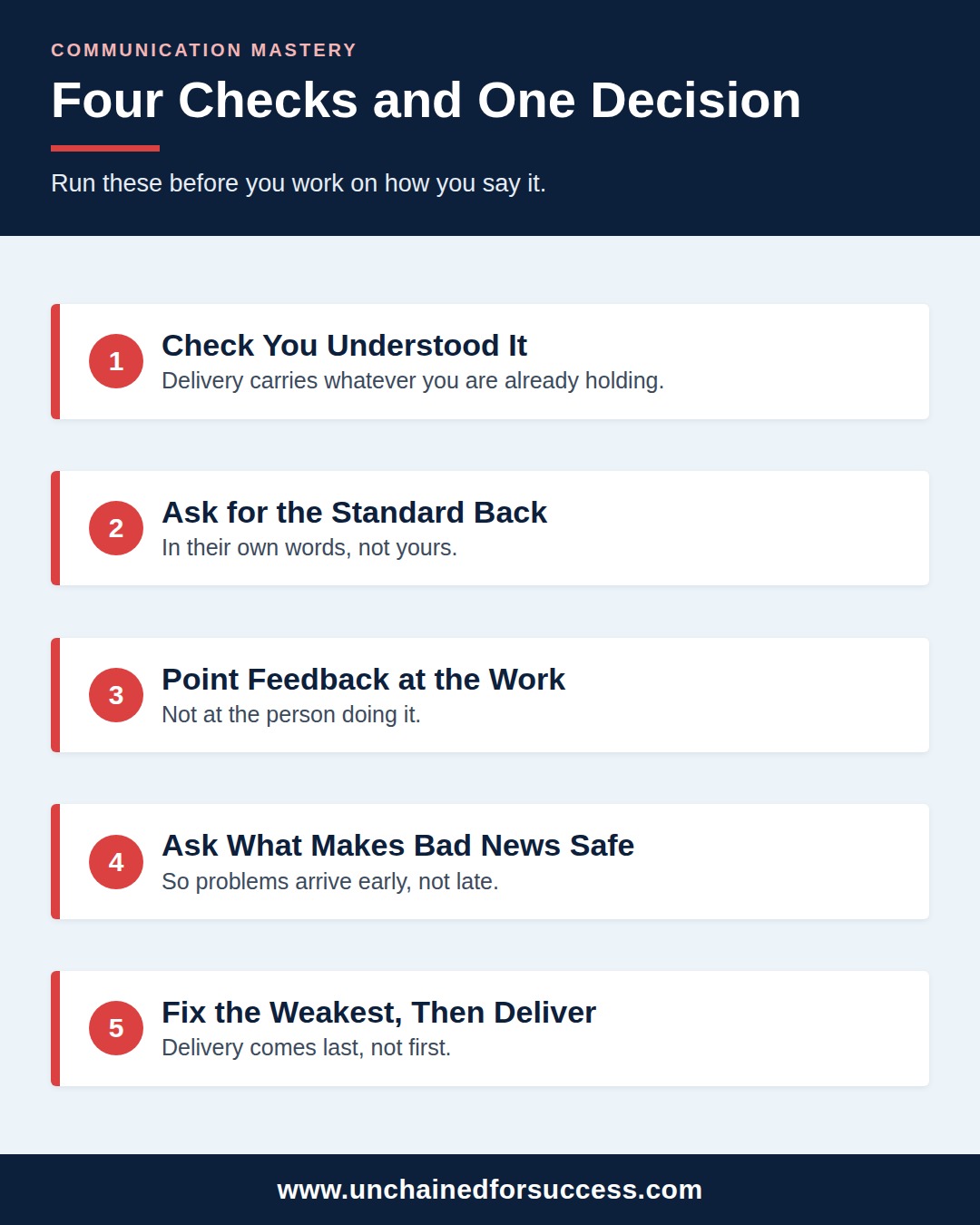
1. Check you have understood the thing itself, before improving how you say it.
2. Ask one person to state the standard back to you in their own words.
3. Where you give feedback, point at the work rather than at the person.
4. Ask what would have to be true for someone to tell you bad news early.
5. Fix whichever of those four came back weakest, and only then worry about delivery.
Step four is the one that usually goes unasked, and it is the one that protects everything else. The resource library has planners if you want a structure to work inside.
Frequently Asked Questions
Should I give less feedback, then? Not necessarily less, but differently aimed. The evidence is that feedback pointed at the task tends to help. Feedback pointed at the person tends not to. So the first change to make is where you point it.
How do I know whether my message actually landed? Ask someone to tell you what they will do differently. Listen to the answer without correcting it. If what comes back is a summary of your words rather than a change in their work, it has not landed yet.
What if I am not a natural communicator? Then start with the two acts, because neither depends on charisma. Understanding the work before you speak about it, and making it safe to report a problem early, are things you arrange rather than things you perform. Excellence is a decision rather than a trait here too.
Share one message you delivered well that still did not change anything, and what you think was actually missing, in the comments.
If you want an outside view of how your goals are designed, executed and governed, the Goals Readiness Score scores each of the nine components separately and names the weakest one.
Who on your team would tell you first that something was going wrong, and what makes you sure?
Sources on Communication Mastery
- Kluger, A. N., and DeNisi, A. (1996). The effects of feedback interventions on performance: a historical review, a meta-analysis, and a preliminary feedback intervention theory. Psychological Bulletin, 119(2), 254 to 284. https://doi.org/10.1037/0033-2909.119.2.254
- Ateş, N. Y., Tarakci, M., Porck, J. P., van Knippenberg, D., and Groenen, P. J. F. (2020). The dark side of visionary leadership in strategy implementation: strategic alignment, strategic consensus, and commitment. Journal of Management, 46(5), 637 to 665. https://doi.org/10.1177/0149206318811567
- Kluger, A. N., Lehmann, M., Aguinis, H., Itzchakov, G., Gordoni, G., Zyberaj, J., and Bakaç, C. (2024). A meta-analytic systematic review and theory of the effects of perceived listening on work outcomes. Journal of Business and Psychology, 39(2), 295 to 344. https://doi.org/10.1007/s10869-023-09897-5
- Itzchakov, G., Weinstein, N., and Cheshin, A. (2023). Learning to listen: downstream effects of listening training on employees' relatedness, burnout, and turnover intentions. Human Resource Management, 62(4), 565 to 580. https://doi.org/10.1002/hrm.22103
- Itzchakov, G., Kluger, A. N., and Castro, D. R. (2017). I am aware of my inconsistencies but can tolerate them: the effect of high quality listening on speakers' attitude ambivalence. Personality and Social Psychology Bulletin, 43(1), 105 to 120. https://doi.org/10.1177/0146167216675339
Continue Your Journey
Explore more resources from the Unchained Goals Framework: