


Something changes. The restructure lands, the client leaves, the technology you built a career on stops being the thing people want. And the advice arrives immediately: embrace it. An innovation mindset will carry you through.
That is a sentiment, not an instruction. This article sets out what the evidence actually supports about adapting well, starting with a correction that removes most of the fear this subject trades on.
The Statistic This Subject Rests On
You have met the claim that 70 per cent of change initiatives fail. It appears in books, consultancy decks and business school slides.
A researcher went looking for its source (Hughes, 2011). He traced the five publications usually cited for it. His conclusion: no valid and reliable empirical evidence supports the figure. The number circulates because people keep citing each other.
That matters in practice, not just on paper. A frightening statistic sells urgency, and urgency sells solutions. Start from folklore and you will reach for the wrong remedy.
What an Innovation Mindset Actually Means Here
Time to be straight about the phrase innovation mindset, because a lot of writing on this subject is not.
An innovation mindset, as this article uses it, is a plain-English description of a stance: treating a change as something to work with rather than something to wait out. It is a useful phrase. It is not an established construct.
The one academic instrument I could find, published in 2025, measures how far an innovation mindset develops in STEM students on experiential programmes (Kulturel-Konak and colleagues, 2025). Its authors say it is the first of its kind. That tells you how thin the ground is.
You will see it presented as a third stage beyond a fixed mindset and a growth mindset. That progression is business writing rather than science. Nobody has demonstrated a third tier, and the two-part original is weaker than most people assume.
Saying so costs nothing and buys a great deal. A reader who checks will find exactly what this paragraph says.
Why an Innovation Mindset Is Not Enough on Its Own
The honest position on attitude research is narrower than the popular one.
Two large reviews have deflated the growth mindset literature (Sisk and colleagues, 2018; Macnamara and Burgoyne, 2023). Effects on achievement are small. They concentrate among lower-achieving and lower-income students. In the strictest analyses they do not survive a correction for publication bias. That is a long way from the claim that belief reshapes outcomes.
None of that makes attitude irrelevant. It makes attitude a contributor rather than a mechanism, and an innovation mindset is no exception. Treat it as one input among several, not as the thing that decides the outcome.
So if attitude is not the lever, what is?
Two things, and neither is a mood. The first is how the work around you is set up. The second is whether you find out early. An innovation mindset rides on both, rather than replacing either.
That is a less stirring answer than most writing on change offers. It has the advantage of being true, and of giving you something to do on a Monday.
What Actually Predicts Good Adaptation
Here the evidence is much better. It also points somewhere unfashionable.
Researchers reviewed 79 studies of how people respond to change at work, across six decades (Oreg, Vakola and Armenakis, 2011). What their reactions tracked most consistently was the change process itself. Two things stood out: whether people took part in it, and how well anyone explained it.
Note where the association sits. Not in the disposition of the people involved. In the conditions around them.
This is a review rather than a pooled analysis, so it gives no single number. Most of the studies in it rest on what people said about themselves. The direction holds, though, across a long stretch of time.
The Lever Is the Work, Not the Attitude
One further result makes the point sharply, and it is the most useful thing in this article.
One analysis pooled 136 samples covering more than 22,000 people (Frazier and colleagues, 2017). It looked at psychological safety: the shared sense that a team is a safe place to speak up. That sense tracked task performance at .43, and how freely people shared what they knew at .52.
Now the part that should change what you do. Two things tracked psychological safety more strongly than it tracked performance: how the work itself was arranged, at .53, and whether the surrounding context supported people, at .49.
These are correlations, so take the next step as my reading rather than a demonstrated cause. If you want people to handle change well, the evidence points at the work and the context before it points at anyone's attitude.
No study here sets attitude advice against work redesign and measures which wins, so I will not rank them. The narrower point stands on its own: attitude advice leaves the strongest known associations untouched.
The idea traces back to a study of 51 teams in a single manufacturing firm (Edmondson, 1999), which found that psychological safety supported team learning, and that learning was what carried through to performance.
Google's internal Project Aristotle later ranked psychological safety first among five team dynamics across 180 of its own teams. Treat that as a hint rather than a finding. No journal reviewed it, it covers one company, and it shows links rather than causes.
An Innovation Mindset Needs a Scheduled Check
This is where the framework adds something the research alone does not.
The Unchained Goals Framework treats your assumptions about what is possible as a structural component, called Beliefs, sitting alongside the plan and the reason for doing the work. An unexamined assumption does not announce itself. It quietly rules options out.
Separately, the framework installs a Control System. That is a scheduled check of what is happening against the standard you agreed, with a rule set in advance for when to look harder. The framework glossary sets out both in full.
That combination is what an innovation mindset needs to be more than a slogan. Beliefs decide what you will consider. The Control System decides when you look, so you catch a change while responding to it still costs little.
Change punishes people who find out late. It rarely punishes people who scheduled the check. That, rather than enthusiasm, is what an innovation mindset buys you.
Building an Innovation Mindset in Ordinary Conditions
Here is what an innovation mindset looks like on an ordinary week, rather than in a keynote.
Take a team whose main reporting tool disappears in six months. The unhelpful response is a conversation about attitude. The useful response has three parts.
First, they name what they actually control: which replacement they trial, how early they start, who learns it first. Second, they run a small trial rather than a plan, and they set the date they will judge it. Third, they make it safe to report that the trial went badly, because a trial nobody can criticise teaches nothing.
They are an illustration rather than a client. Note that no step there involves anybody's mindset. All three change what the team can notice, and when.
What to Do This Week
Pick one change you can already see coming. Not a hypothetical one. An innovation mindset is worth nothing until it meets a real date.
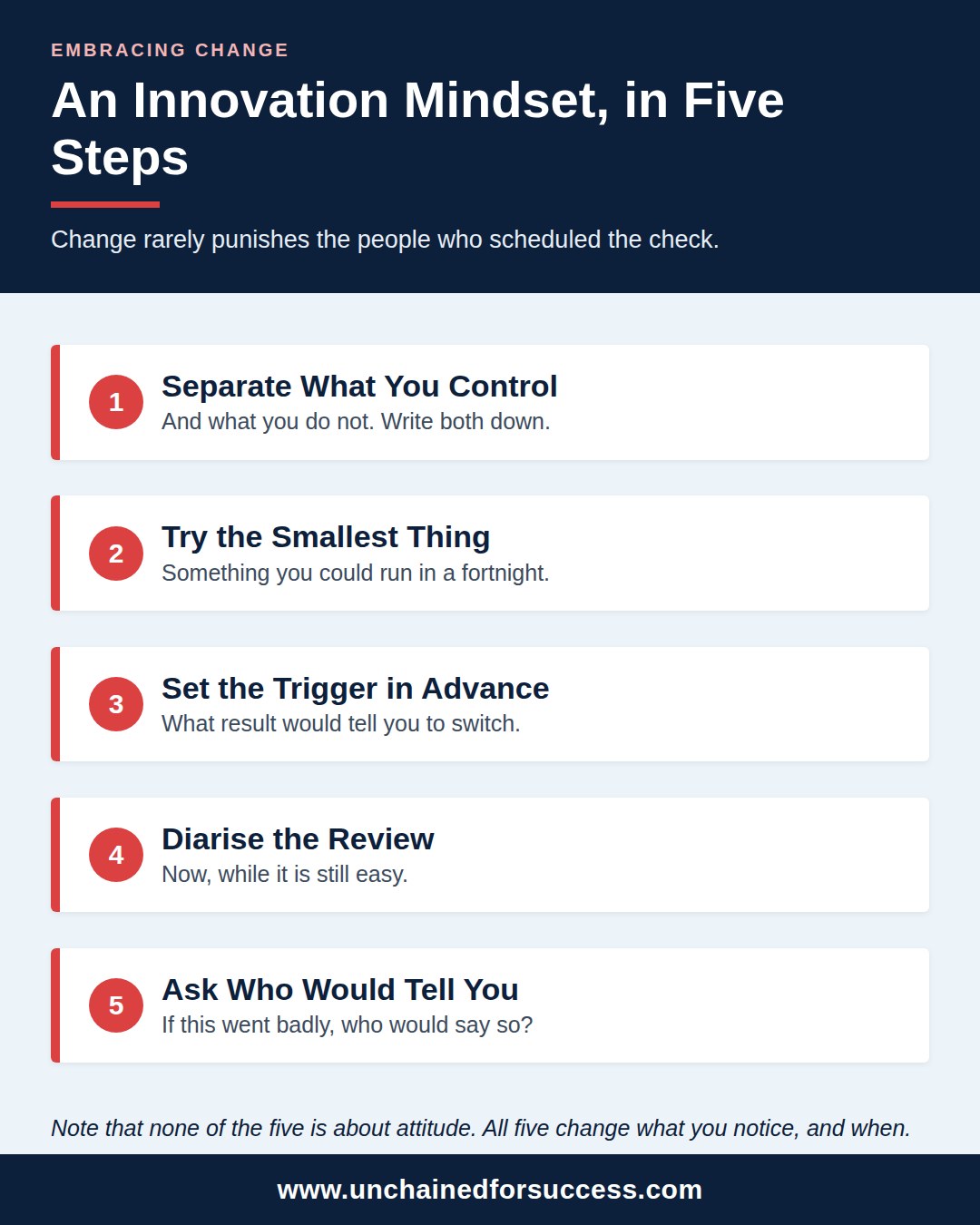
1. Write what you actually control about it, and what you do not.
2. Name the smallest thing you could try in the next fortnight.
3. Decide what result would tell you to change approach.
4. Put the review date in the diary now.
Then ask who would tell you if this were going badly, and whether anything in how you run the work makes that easy. If nothing does, that is the thing to fix first, and handling setbacks covers what happens when the answer comes back unwelcome.
Frequently Asked Questions
Is an innovation mindset something you can learn? You can certainly practise it, in the way any routine becomes easier with repetition. What the research does not support is the idea that adopting it is the main thing standing between you and adapting well, because the conditions you work in track that more strongly.
What if my organisation punishes failed experiments? Then start with an experiment small enough that failing it costs little, and report the result honestly anyway. That will not fix a culture by itself, and it is one of the few things you can do without waiting for permission.
How do I stay open to change without chasing every new thing? By deciding in advance what would make you change course. A pre-agreed trigger lets you ignore noise with a clear conscience, which is the opposite problem to the one most advice addresses.
Share one change you can see coming, and the smallest thing you could try about it this fortnight, in the comments.
If you want an outside view of how your goals are designed, executed and governed, the Goals Readiness Score scores each of the nine components separately and names the weakest one.
What would have to happen for you to find out that your current approach has stopped working?
Sources on the Innovation Mindset
- Hughes, M. (2011). Do 70 per cent of all organizational change initiatives really fail? Journal of Change Management, 11(4), 451 to 464. https://doi.org/10.1080/14697017.2011.630506
- Oreg, S., Vakola, M., and Armenakis, A. (2011). Change recipients' reactions to organizational change: a 60-year review of quantitative studies. The Journal of Applied Behavioral Science, 47(4), 461 to 524. https://doi.org/10.1177/0021886310396550
- Frazier, M. L., Fainshmidt, S., Klinger, R. L., Pezeshkan, A., and Vracheva, V. (2017). Psychological safety: a meta-analytic review and extension. Personnel Psychology, 70(1), 113 to 165. https://doi.org/10.1111/peps.12183
- Kulturel-Konak, S., Konak, A., Alexander, P. A., Mehta, K., and Schneider, D. R. (2025). Measuring transformative learning in STEM: validating the transformative learning scale for the innovation mindset (TLSIM) in experiential programs. Entrepreneurship Education, 8(3), 431 to 460. https://doi.org/10.1007/s41959-025-00147-8
- Sisk, V. F., Burgoyne, A. P., Sun, J., Butler, J. L., and Macnamara, B. N. (2018). To what extent and under which circumstances are growth mind-sets important to academic achievement? Two meta-analyses. Psychological Science, 29(4), 549 to 571. https://doi.org/10.1177/0956797617739704
- Macnamara, B. N., and Burgoyne, A. P. (2023). Do growth mindset interventions impact students' academic achievement? Psychological Bulletin, 149(3 to 4), 133 to 173. https://doi.org/10.1037/bul0000352
- Edmondson, A. C. (1999). Psychological safety and learning behavior in work teams. Administrative Science Quarterly, 44(2), 350 to 383. https://doi.org/10.2307/2666999
Continue Your Journey
Explore more resources from the Unchained Goals Framework: