


You hit the target. The work was real, the result arrived, and for about a day it felt like something. Then it went flat. You are not ungrateful and you have not gone soft. That flatness is a question about meaning in life arriving in the only language it has, and it is worth answering rather than outrunning with the next target.
Here is the answer, and it is shorter than you expect. Meaning in life is not a separate thing you go away and find. It is what it feels like when your effort is pointed at a problem you have agreed to own.
Ordinary success is reaching the goal. True success is reaching one that was yours to reach. On the day, the two look identical. About a day later they stop, and that is what the flatness is telling you.
Meaning in Life Is Another Name for Purpose
There is no separate compartment for this. What you are calling meaning in life is what the framework calls your Purpose.
When I wrote Unchained: Success Unlocked in 2023, I defined purpose as what you were put on this earth to accomplish. That is a description of meaning in life. It says your life has a job attached to it.
The framework now puts the same idea in a form you can use. Purpose is the problem you accept responsibility for, and it decides which of your goals are legitimate and which are distractions.
Those are not two ideas. The second is the first made usable. You cannot hold a goal up against what you were put here to accomplish, because you would need the answer already. You can hold it against a named problem and get an answer this afternoon.
So "does my life have meaning?" and "what problem have I accepted?" are the same question asked from two directions. The first is how it feels. The second is how it works.
Notice who never asks the first question. Not the person whose life is going smoothly, but the person with a problem in front of them that they have agreed to carry. They are not above the question. They answered it already, in the only way anyone answers it.
Which is why you cannot go out and find meaning. You can only go and pick the problem.
But Surely Not All Meaning in Life Is a Problem
Not all of it is, and the objection deserves a straight answer rather than a footnote. Raising a child, playing in an orchestra, sitting with an old friend: none of that solves a named problem and none of it is empty.
That is true, and it leaves this argument standing, because the question here is narrower. Meaning of that kind does not go flat the day after an achievement, for the simple reason that it never depended on one. The flatness belongs to the effort you spend on goals, and that is all the sentence below is for.
Why a Goal Goes Flat Without Meaning in Life
Asking the question is not the same as having lost the answer. Researchers measure the search for meaning and the presence of it separately, which is a technical way of saying that wondering about this is not a symptom.
Here is what actually happened, and it has nothing to do with a shortage of meaning in life. An achievement pays you at the end only if something outside it changes. A goal attached to a named problem has somewhere to send the result: the problem is smaller than it was. An unattached goal ends where it ends, so nothing is waiting to receive it, and the flatness arrives about a day later.
There is a second reason, and it is the harder one. When a goal serves no problem, the only thing you can judge it against is itself. You hit the number or you did not. When it serves a named problem, you judge it against the problem instead, and the problem does not lower its standard to suit you. That is the difference between finishing something and finding out that it worked.
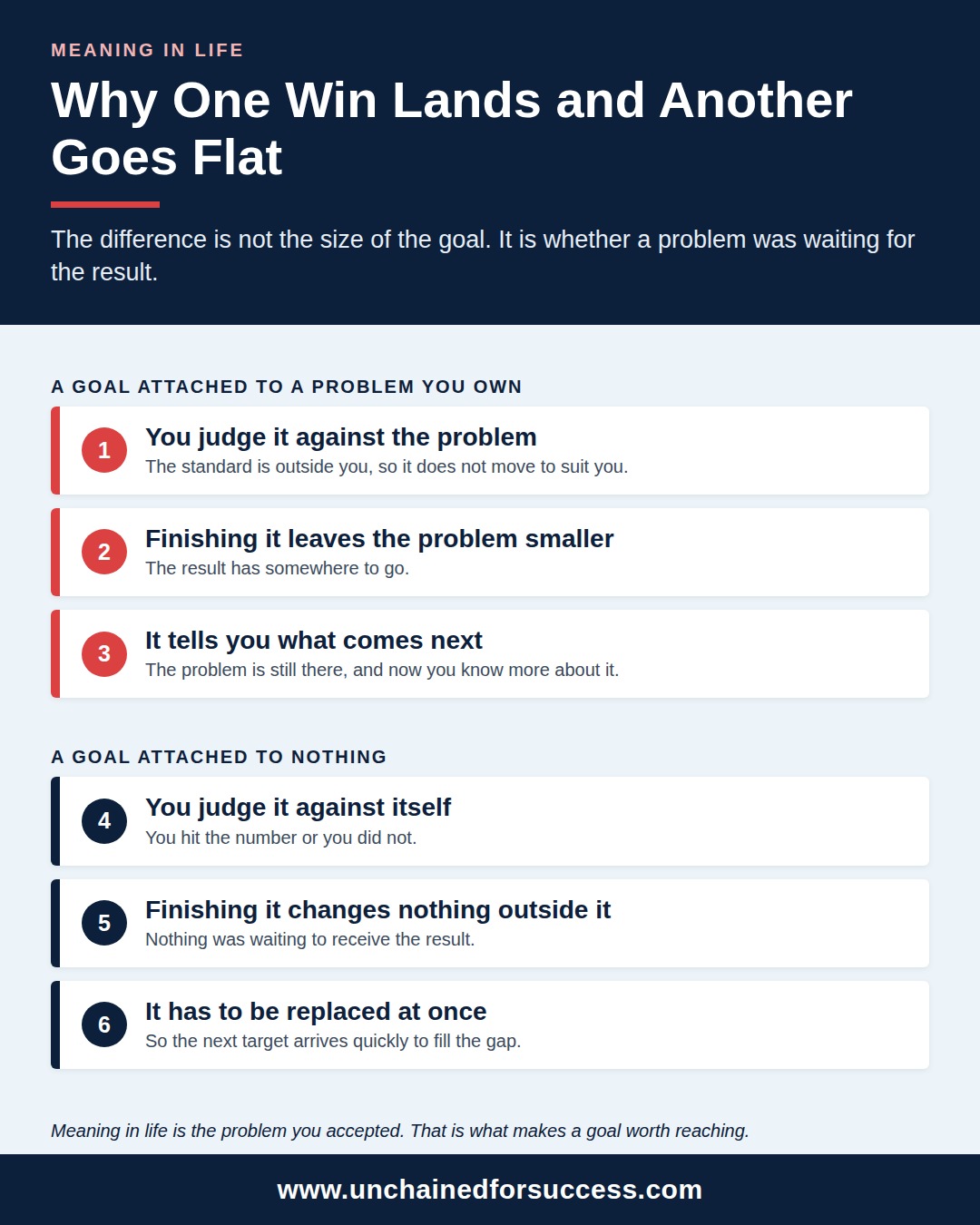
So the next target has to arrive quickly to fill the gap, and from outside that looks like ambition rather than the treadmill it is.
There is one more possibility worth naming, because it is common and it is kinder than the others. The goal may have been fine. You may simply have been asking it to supply a meaning in life it was never going to supply. A promotion is a change of role. It was never a verdict on whether your life counts, and it quietly gets asked to be one.
None of this makes achievement suspect. It makes an unexamined goal expensive, and the bill arrives later than the decision that caused it.
Write the Sentence
This is where meaning in life stops being a mood. Tonight, do one thing. Open a blank page and write one sentence describing a problem you are willing to take responsibility for. Everything else is what you do with it afterwards.
Name the problem, not the feeling. "I care about young engineers" is a feeling. "Capable engineers get promoted with no preparation, and their teams absorb the cost" is a problem. The first endorses everything. The second rules things out.
Copy that shape. Name who is affected, what happens to them, and who pays for it. If you cannot name who is affected, you have written a topic rather than a problem.
Expect to rewrite it. Draft one: people are badly managed. That disqualifies nothing. Draft two: managers here are badly trained. Better, but nobody is visibly hurt in it. Draft three is the sentence above, and it tells you where your best hours belong.
Then hold your goals against it. Write down the three or four taking your best capacity this quarter, and mark the ones your sentence does not serve.
If those goals are objectives somebody else signed off, the test still works. It runs differently. You are not crossing them out, because they are not yours to cross out. You are finding which of them your sentence actually serves, and that tells you where your discretionary hours go, which project you fight for next year, and which one you stop volunteering for.
Your sentence is working the moment it changes where something goes. Until then it is a nice thought.
One Illustration: Two Good Options
A regional director has two strong offers of extra responsibility. One is a high-visibility transformation programme. The other is a smaller remit rebuilding how the business trains its supervisors.
Both feel meaningful, which is exactly why a sense of meaning in life cannot settle it on its own.
So she stops consulting the feeling and names the problem: supervisors in her business are promoted on technical skill and left to work the rest out alone, and the cost lands on their teams.
This costs her something, and it is worth being honest about what. The transformation programme is the one her director will remember. The supervisor remit is the one nobody will ever ask her about. She takes it anyway, not because she is noble, but because her sentence gave her an answer she could not argue with.
This is an illustration rather than a client case.
The Same Sentence on Your Team's Work
The sentence does not only work on your own life. Meaning in life at work follows the same rule, which is where this stops being a private question.
Hold it against the project you are running. Where the team can say what problem the delivery solves, the milestones tend to carry weight. Where they cannot, they are hitting dates for the sake of the dates, and everyone on the team already knows it. The same goes one level up, where a strategy that serves a named problem gives people a reason to hold on through a hard quarter.
That is an observation about how work behaves rather than a finding from research.
This Is Not a Soft Idea
If you suspect meaning in life is all a bit soft, the evidence says otherwise.
One review pooled ten studies that followed more than 136,000 people over time. Those reporting a stronger sense of purpose were less likely to die during the follow-up period, and less likely to have a heart attack, a stroke or another serious cardiac event (Cohen, Bavishi and Rozanski, 2016).
Two honest notes, because they matter. Researchers call this purpose in life, and their scales ask how much direction a person feels rather than which problem they have taken on. These are also observational studies, so healthier people may simply find direction easier to hold.
So the evidence supports a smaller claim than this post makes, and it is worth saying which. It shows that this territory is not a mood. Something in it is large enough to show up in the data, which is reason enough to take the question seriously rather than outrun it.
What Meaning in Life Does Not Do on Its Own
Meaning in life tells you which goals are yours. It does not deliver them, and expecting it to is where the disappointment starts.
It does not tell you a particular goal is worth its particular price. That is a separate decision, made one goal at a time, and it is usually the harder one. In the framework it is your Why.
It does not make you carry the cost once you have accepted it. That decision is Ownership, and nobody can supply that part for you.
So here is the title of this post, paid in full. True success is not the goal you reached. It is the goal that was yours to reach, and meaning in life is what tells you which one that was.
And that is not a verdict on what you have already done. A goal you reached without naming the problem underneath it still built something real: the skill, the standing, the credibility, the room you now have to choose differently.
What it could not do was pay you on the day. Name the problem now and the years behind you become the thing that lets you act on it. That is not a consolation prize. It is most of the advantage.
Frequently Asked Questions
What if my sentence rules out the job I am in? Then you have learned something expensive and useful, and you do not have to act on it this month.
A sentence that indicts your current work usually means one of two things. Either the job is genuinely wrong, or the job is fine and you have been asking it to supply something it was never going to. Those need different answers, and you cannot tell which is which until the sentence exists.
Are my other goals now illegitimate? No. Some goals serve the mortgage rather than your meaning in life, and they are supposed to. The filter is for the ones competing for your best capacity, where choosing one means the others do not happen.
Can the sentence change? Yes. You are naming the problem you accept now, not signing something. Revisit it when the work you are capable of changes, and settle any change on evidence over time rather than on one hard month.
Two More
How do I know it is the right problem and not just a narrow one? Ask what you have already done about it when nobody paid you or asked. If the honest answer is nothing, you may admire the problem rather than own it, and admiration does not hold through a hard quarter.
If you want to go further with the question of what you are here to do, the companion post covers how to find your life purpose. For an outside view of how your goals are designed, executed and governed, the Goals Readiness Score names the weakest of the nine components.
You came here flat after something that should have felt like more. That feeling is not a fault to correct, and it is not a shortage of meaning in life either. It is the most accurate reading you have had in a while, and it is asking for one sentence. Write it tonight. The comments are open if you want to answer out loud.
Which of your current goals would still be worth the cost if nobody ever knew you had achieved it?
Sources on Meaning in Life
1. Cohen, R., Bavishi, C., and Rozanski, A. (2016). Purpose in life and its relationship to all-cause mortality and cardiovascular events: a meta-analysis. Psychosomatic Medicine, 78(2), 122 to 133. https://doi.org/10.1097/PSY.0000000000000274 Ten prospective studies, 136,265 participants. Pooled relative risk 0.83 for all-cause mortality and 0.83 for cardiovascular events. Observational, so it establishes association rather than cause.
2. Hill, P. L., and Turiano, N. A. (2014). Purpose in life as a predictor of mortality across adulthood. Psychological Science, 25(7), 1482 to 1486. https://doi.org/10.1177/0956797614531799 MIDUS longitudinal sample, roughly 7,000 adults aged 20 to 75 followed for fourteen years, 569 deaths. The association held after allowing for other psychological and affective wellbeing measures, and was not confined to older or retired adults. Observational.
3. Boyle, P. A., Barnes, L. L., Buchman, A. S., and Bennett, D. A. (2009). Purpose in life is associated with mortality among community-dwelling older persons. Psychosomatic Medicine, 71(5), 574 to 579. https://doi.org/10.1097/PSY.0b013e3181a5a7c0 1,238 older adults without dementia, mean 2.7 years follow-up, 151 deaths. Hazard ratio 0.60, 95 per cent confidence interval 0.42 to 0.87, adjusted for age, sex, education and race. Observational.
4. Steger, M. F., Frazier, P., Oishi, S., and Kaler, M. (2006). The Meaning in Life Questionnaire: assessing the presence of and search for meaning in life. Journal of Counseling Psychology, 53(1), 80 to 93. https://doi.org/10.1037/0022-0167.53.1.80 A measurement validation paper, cited here only for the fact that presence and search are scored separately.
5. Kwegyir-Afful, C. (2023). Unchained: Success Unlocked: A Proven Framework for Achieving Your Goals.
Continue Your Journey
Explore more resources from the Unchained Goals Framework: