


Her course was three weeks late, and she had a good reason ready. The reviewer had gone quiet. The client had changed the brief. August had swallowed a fortnight. Each word of it was true. None of it moved the work. Growth begins with taking responsibility for the part of the result you hold.
That sounds harsh, though it is not. To own a result is not to be at fault for it.
An earlier post in this series showed that standards define outcomes before the work starts. Another showed that being busy spends time without proving movement. So this post asks the next question. Once the standard is set and the week is full, who carries the result?
The short answer: growth follows ownership. Name the part of the result inside your control. Accept what it will cost to hold. Then the work is yours to move. Leave it unnamed, and each setback comes with a reason attached.
Growth from taking responsibility means something specific here. You see your own part in a problem sooner. Commitments get cleaner, because you know what they will cost. You ask for help earlier. And you learn from a setback rather than filing it under bad luck.
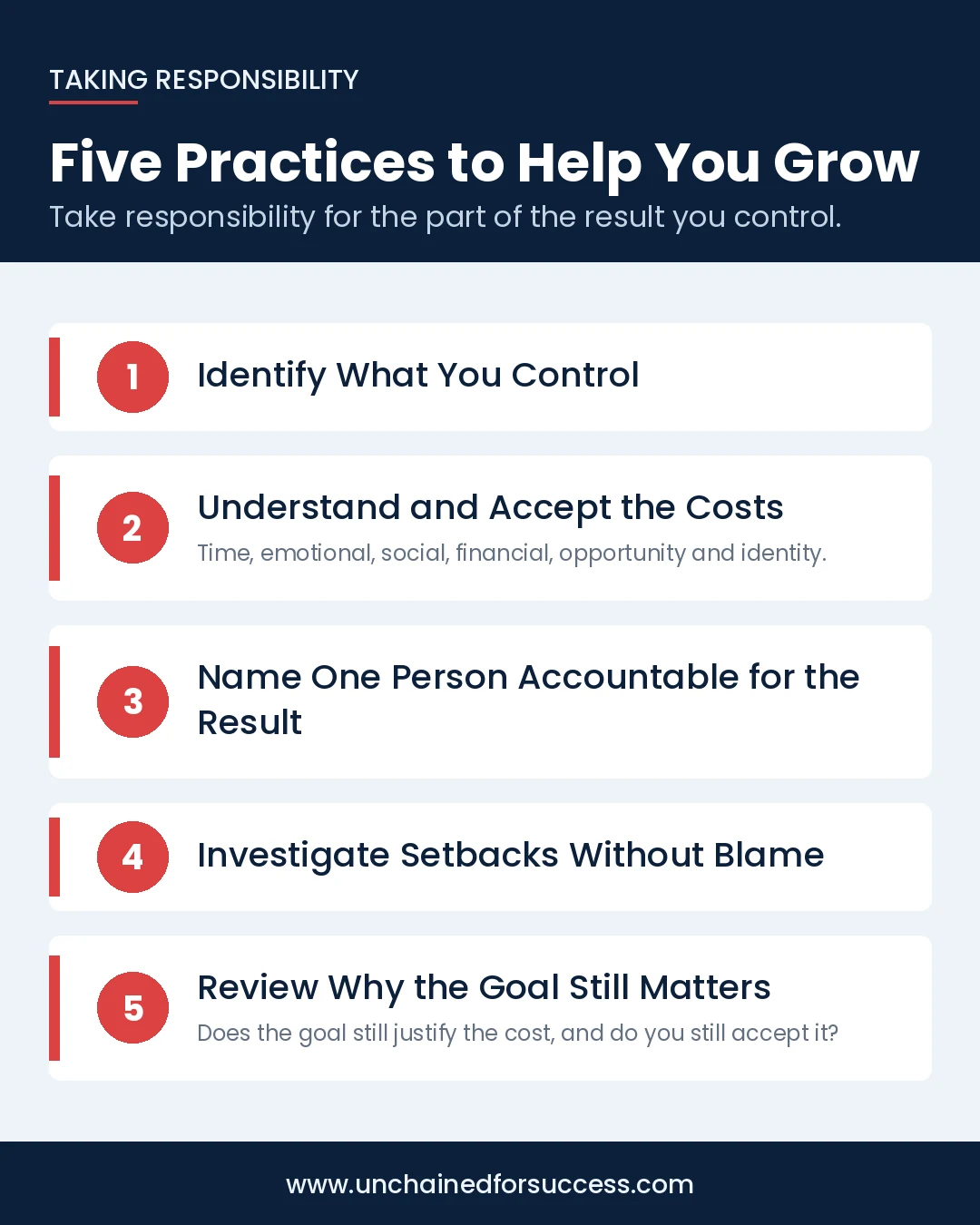
The following five practices give you a practical starting point. Find the part you control. Accept the cost. Name who is accountable. Investigate what caused the setback. Then review whether you still accept the price.
What Taking Responsibility Actually Means
Owning a result means two things at once. You choose it on purpose, rather than drifting into it. And you agree, in advance, to carry what it costs you.
The second half is where most of us come unstuck. Wanting a goal is easy. Agreeing to pay for it is the part that gets tested in a hard week.
The Unchained Goals Framework keeps those halves apart, and the framework glossary names them separately for a reason. Your Why is what makes the goal worth its price. Ownership is you accepting that price. Blur the two and the goal survives right up until the bill arrives.
Taking Responsibility Is Not the Same as Taking Blame
Blame looks back and asks whose fault this was. Taking responsibility looks ahead and asks what you will do next. One shuts a talk down. The other opens it up.
There is a second split, and it counts for more. Blame spreads with no edge. Ownership has one. The framework calls that edge the Control Boundary. It is the line between what you truly control and what you do not. To claim it all is not humble, then. Rather, it is a design fault, since it hands you a target you cannot move.
The Consultant Who Stopped Explaining
Return to the consultant from earlier posts. Her Vision, the long-term position she has chosen and holds to, reads: "Build a nationally recognised coaching business that helps individuals across the UK achieve meaningful goals through consistent action." She refined the wording in August, and the Direction held.
Her Outcome Goal states the result: create and launch a six-module online course by 30 November. The Performance Goal sets the standard. Finish one module each fortnight. Each must score at least four out of five on the quality checklist, with no critical review actions left open.
Beneath it, the Process Goal names the actions she controls. She holds course sessions each Monday, Wednesday and Friday. She sends the script, video and worksheet by alternate Fridays. Habit Conversion then keeps those actions steady, so each session begins at 9.00 am with the task list open and distractions removed.
None of that was wrong in August. Yet she had quietly handed her dates to her reviewer. Then she asked which part of the slip sat inside her own boundary. The answer took ten seconds. She had sent three of six drafts late.
So she changed what sat inside that line. She now protects the drafting sessions, sends each draft on the agreed date, and raises a review delay on the day it happens rather than a fortnight later. The reviewer still runs at their own pace. Her part no longer waits on them.
Why Taking Responsibility Is Harder Than It Sounds
We are not fair judges of our own work. Deflection is the default, and it is a comfortable one. That is why this needs a practice rather than good intent.
What the Research Says About Taking Responsibility
Mezulis and colleagues pooled 266 studies of how people explain what happens to them, and published the result in Psychological Bulletin. The pattern is consistent, and you will recognise it. A good result is something we caused, and something that says who we are. A bad one is something that happened to us.
That habit is comfortable. It also costs you the only thing you could have changed. File a setback under someone else's failing and you never look at your own part, so your own part stays exactly as it was.
None of that makes you dishonest. It makes you normal, which is worth knowing before you trust your own account of a bad month. So check it. Ask which piece of last month you could still have moved.
Blame Costs More Than It Saves
Edmondson studied 51 teams inside a manufacturing business and reported it in Administrative Science Quarterly. Where people felt safe to admit a mistake, teams learned more, and that learning was what showed up in their results.
These were real teams at work rather than a controlled trial, so read it as a pattern and not a proof. What you can use is the direction of it. Where people expect blame, you hear about problems late, and late is what makes them expensive. The same is true of the conversation you have with yourself.
What Taking Responsibility Changes Day to Day
Most goal systems tell you how to plan the work. Very few tell you who carries it once the plan starts costing something.
The change from taking responsibility is small, and it shows up in ordinary decisions. A date slips, and you ask what you can still move rather than who caused it. Someone asks you to commit, and you work out the price before you say yes. You are handed something you cannot control, and you say so rather than quietly absorbing it.
None of that needs a new system. It needs you to know which part is yours. The framework separates the machinery that produces movement, meaning your result, your standard, your actions and the routine that keeps them steady, from the thing that keeps you at the wheel when the work gets expensive. In the consultant's example, her four levels were the machinery. The rest of this is about the wheel.
Taking Responsibility When the Cost Arrives
Motivation will not keep a commitment. Motivation is what you feel at the start, and it has usually gone by the third hard week. What keeps a commitment is having decided in advance, on purpose, that the goal is worth its price.
That is why the framework treats Ownership as a thing of its own rather than a feeling. And it only holds when three things line up: the authority to act, the work you are responsible for, and your acceptance of what it will cost. Give someone the second without the first and you have not given them ownership. You have given them exposure.
So when a commitment starts costing more than you expected, the useful question is not whether you still feel like it. It is whether the price is still one you would accept, knowing what you know now.
When Taking Responsibility Stops Feeling Worth It
The goal still stands. The plan still works. Yet the appetite has gone. That state catches people out, and it helps to know it has a name: the framework calls it Exhausted Ownership.
You have not changed your mind, and you are not lazy. You have spent what you were willing to pay, and nothing has topped it up. Pushing harder now makes it worse, which is the trap pushing too hard sets in a second form.
Do this instead. Write down what the goal is costing you now, rather than what you thought it would cost when you started. Then ask whether that price still buys something you want. A yes is a real renewal rather than a grim one. A no is information, and sometimes the honest answer is to hand the goal to someone else.
Taking Responsibility Beyond Yourself
Teams and firms fail at this for reasons built into the structure, not for want of will. Two of those reasons are worth naming.
Taking Responsibility for Goals You Do Not Fully Control
You have probably been handed a target you could not actually move. A number that depends on someone else's pricing. A date that depends on a supplier. Being measured on it does not make it yours, and pretending otherwise helps nobody.
The fix is to translate it. Take the result from the level above and turn it into something the person at this level genuinely controls, before anyone puts a name to it. The framework calls that Control Translation.
Skip the step and you get defensiveness instead of good work. That is not a flaw in your team. It is what people do when they are held to something out of reach, and the organisational view of the framework treats it as a fault in the design rather than a fault in them.
What It Costs When Nobody Is Taking Responsibility
Dame Judith Hackitt's independent review of building regulations and fire safety, Building a Safer Future, set out the causes it found. Next to ignorance and indifference sat a plain line: "there is ambiguity over where responsibility lies".
That ambiguity is expensive. Van Dyck and colleagues looked at how organisations handle mistakes, across 65 Dutch and 47 German organisations, and reported it in the Journal of Applied Psychology. The ones that talked about errors openly and put them right quickly performed better than the ones that did not. It is a pattern across organisations rather than proof that one causes the other.
The practical reading is the same either way. Where nobody knows who holds a result, nobody raises the problem early, and it arrives later at full size.
Five Practices for Taking Responsibility This Week
None of this needs a new system. Here are five practices you can start this week.
1. Taking Responsibility Starts Inside Your Control Boundary
Write the result at the top, then draw a line down the page. On the left, list what you control. On the right, list what you sway or simply receive. Own the left side whole. Manage the right side as a risk. This one task turns a vague sense of failure into two or three clear moves. The SSMTC Goal Design Canvas gives you a place to hold both lists.
2. Accept the Cost, Because Taking Responsibility Has a Price
Name the price before you claim the goal. The framework lists six kinds of cost, and each needs a line of its own. Time is the hours the work will take. Emotional cost is the strain of doing it. Social cost is what it asks of the people around you.
Financial cost is the money it needs. Opportunity cost is what you postpone or give up to make room. Identity cost is the discomfort of changing how you see yourself, such as being a beginner again or asking for help.
Write one line against each. A goal tends to stall at its heaviest unnamed cost. So the kind you skip is the one to check first.
3. Put One Accountable Name Against the Outcome
UK government guidance states that there can be only one accountable person for an outcome. The role of the senior responsible owner draws the line clearly. That accountability cannot be shared or delegated, although responsibility for completing the work can be shared. So put one accountable name against the outcome, then identify everyone responsible for delivering it. That is guidance rather than research.
4. Replace Blame With Ordered Diagnosis
When results drift, the instinct is to find who slipped. Do something duller and far more useful. Start at the bottom and work up.
Did the agreed actions actually happen, week after week? Could those actions produce the standard you set, even done perfectly? And does your measure capture that standard, or something easier to count? Most of the time the answer is in those three.
If it is not, keep climbing: the plan, then your beliefs, then your ownership, then your Why, and last the goal itself. That order is the framework's Ordered Diagnosis, and working it in order stops you rewriting a goal when a quietly abandoned routine was the whole problem. Your direction only comes into question when the same thing keeps happening.
Work it that way and you get a cause you can act on, which is what a structured recovery rests on.
5. Reaffirm Your Why Before Taking Responsibility Again
Set a date to revisit the cost, not just the progress. Ask two things at that review. Does this goal still justify its price? And do I still accept that price? A yes renews ownership on purpose. A no is useful news, not a failure. It may point towards reassessing direction, or towards rebuilding self-trust after a run of broken promises.
Taking Responsibility as a Team
Teams need one addition, and the team view of the framework covers the rest.
Put one accountable name against each result where the whole team can see it. Then confirm that the owner has the authority required to act. Other people may share responsibility for delivery, but accountability for the outcome must remain clear. Finally, agree in advance how the team will respond when performance moves outside the agreed range.
Taking Responsibility: Frequently Asked Questions
Is taking responsibility the same as admitting fault? No. Fault is a call about the past. Ownership is a promise about what comes next.
You can own a result you did not cause. Indeed, much of leading is exactly that.
What if the real cause sits outside my control? Then say so, and own how you respond to it.
The Control Boundary exists so that you can be exact. To own your part is honest. To own it all is a belief problem rather than a strength.
How do I build ownership in a team without blaming people? Split the person from the diagnosis.
Ask what the structure allowed, rather than who let it slip. Then work the ordered sequence. Blame stops information reaching you, and you need that far more than you need a name to pin it on.
Growing by Taking Responsibility Starts This Week
Growth rarely comes from one burst of effort. Instead, it comes the moment you stop explaining a result and start owning your part of it. Taking responsibility is what turns a good plan into work someone actually carries. It settles who accepts the cost when the week gets heavy.
So start small, and start now. Write the result. Draw the boundary. Name the price. Put one name against it. To see how your own goals are designed, executed and governed, take the Goals Readiness Score. It runs to 18 questions and takes under five minutes. If you would rather begin with the architecture itself, the individual view of the framework is the place to start.
Share the one result you are going to put your name against this week in the comments.
Which part of last month's disappointment was yours to hold?
Sources
● Is There a Universal Positivity Bias in Attributions? A Meta-Analytic Review of Individual, Developmental, and Cultural Differences in the Self-Serving Attributional Bias by Mezulis, Abramson, Hyde & Hankin, Psychological Bulletin
● Psychological Safety and Learning Behavior in Work Teams by Amy Edmondson, Administrative Science Quarterly
● Organizational Error Management Culture and Its Impact on Performance: A Two-Study Replication by van Dyck, Frese, Baer & Sonnentag, Journal of Applied Psychology
● Building a Safer Future: Independent Review of Building Regulations and Fire Safety by Dame Judith Hackitt
● The Role of the Senior Responsible Owner from the UK Government Project Delivery Function
Continue Your Journey
Explore more resources from the Unchained Goals Framework: