


At some point the question arrives: what am I actually here to do? It can arrive while you are busy, capable and doing well by every outside measure. That is where the search for a life purpose starts, and the first useful thing to say is that the search itself is normal.
The companion post on why meaning in life defines true success covers why this matters at all. This one covers what a life purpose is, what it is not, and how to narrow it down to something you can use.
What Life Purpose Meant to Me First
I came to this question through my faith before I came to it through my work.
For years I held one view. A life purpose is what you were put on this earth to accomplish. That conviction is scriptural, I believe the scriptures, and I wrote it down in that form in Unchained: Success Unlocked in 2023. I hold it still.
It gave me something solid to stand on. It said my work was not an accident.
What it did not give me was a test. You do not have to share the conviction to use what follows, and if you do share it, nothing in what follows asks you to set it aside.
From Conviction to Something You Can Use
Here is what changed as I applied the framework on real programmes.
A conviction tells you that your work matters. It does not tell you which work to take. I needed something that could rule things out, because the problem I kept meeting was not a shortage of options. It was too many reasonable ones.
So my definition of life purpose sharpened. In the Unchained Goals Framework, Purpose is the problem you accept responsibility for, the one that decides which goals are legitimate and which are distractions.
Read the two together and they do not fight. The conviction says the work is not an accident. The structural definition says which work. They answer different questions, and only the second one can settle a decision.
The difference is what you can do with it. You cannot hold a goal up against what you were put here to accomplish and get an answer, because you would need the answer already. You can hold a goal up against a named problem and get an answer.
The 2023 book set out the principles and walked a reader through them, in a form closer to self help. The framework as it now stands is architectural, which is what makes it more applicable in organisations and on projects rather than only in a reader's own head. None of that makes the earlier book wrong. It makes the current version easier to use.
Why Life Purpose Is Hard to Name
Two things make this harder than it looks, and both are about how the question is built rather than anything fixed about you.
The first is that you build a sense of purpose more than you find it, which is the reading I take from the research rather than a finding in it.
Park's review separates global meaning, which is your standing beliefs, goals and sense of purpose, from situational meaning, which is the sense you make of a particular event. She argues that when the two disagree, distress follows, and that closing the gap can end in a restored sense of life purpose (Park, 2010). Her own conclusion is that the theory runs ahead of the evidence, so read it as a map rather than a result.
The second is uncertainty itself. Hirsh, Mar and Peterson argue that clear goals and beliefs reduce uncertainty by cutting down the number of competing options a person holds open at once (Hirsh, Mar and Peterson, 2012). That paper sets out a theoretical framework and reports no study of its own.
Neither paper tests this on a reader deciding what to do with their life. But the reading I would offer is that uncertainty while you work out your life purpose is not a sign that something is wrong with you. It is what an unresolved question feels like.
The Questions That Narrow It Down
Because Purpose works as a constraint, the useful questions are the ones that narrow rather than inspire.
Ask yourself four.
1. Which problem do I keep returning to, even when nobody asks me to?
2. What do people bring to me without anyone directing them?
3. Which work still feels worth doing on a bad week?
4. Which of these am I willing to take responsibility for, rather than only care about?
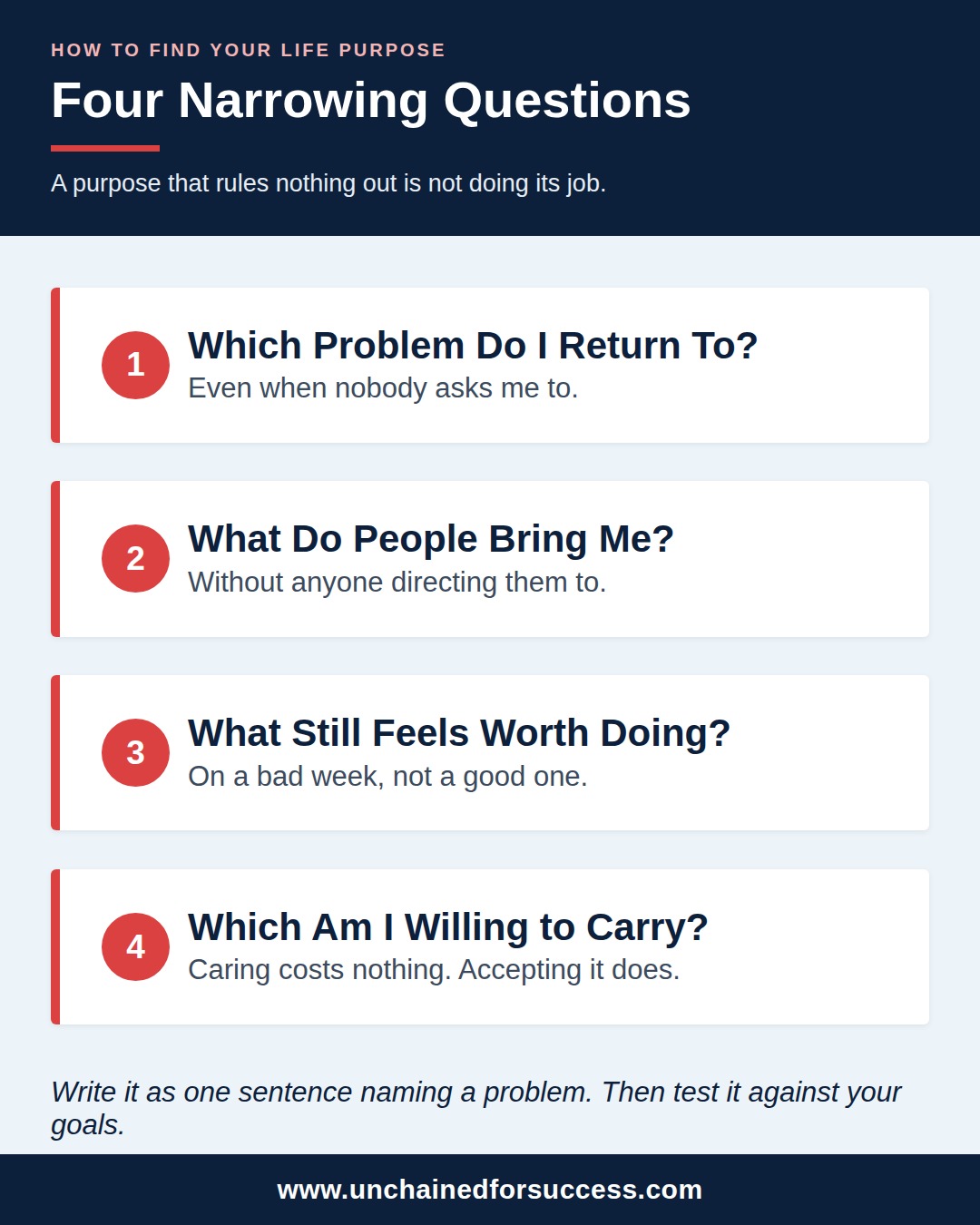
That last question does most of the work. Caring about a problem costs nothing. Accepting responsibility for it rules out the other things you might have done instead, which is precisely why it can function as a filter.
Write your answer as one sentence naming a problem. Then test it against the goals already on your list. If it does not disqualify any of them, it is still too broad.
One Illustration: Narrowing It Down
Consider an operations manager who has read widely on this and still cannot name hers. This is an illustration, not a client case.
Her first attempt is "to help people grow". It sounds right and rules out nothing, so every opportunity still qualifies.
She tries the fourth question instead. Which of these would she take responsibility for? The answer that survives is narrower and less comfortable to say out loud: capable people in her industry get promoted into management with no preparation, and they struggle alone. That is a problem, and she is willing to own it.
Now the sentence does work. A committee seat that flattered her does not serve it, so she declines. A course on first-line management she had dismissed as too junior turns out to carry exactly the content her people are missing, so it moves up. She books it to see whether she could run a version of it herself.
Notice what changed. Her enthusiasm did not increase. Her list got shorter, which is the same pattern that makes excellence a decision rather than a feeling. That is what a working life purpose does from the inside. It shortens a list rather than staging a moment.
What Happens When You Test It in Practice
The four questions give you a candidate. They cannot confirm one. Clarity arrives from acting on the candidate and watching what happens.
Ibarra interviewed thirty-four consultants and investment bankers adapting to senior roles, and described a pattern she called provisional selves. Those thirty-four observed others in the role. They tried out versions of themselves. Then they judged the results against their own standards and against the feedback they received (Ibarra, 1999).
Two limits worth stating. That study looked at professional identity and image rather than purpose, and it interviewed thirty-four people at two firms in 1994. The mechanism is what I am carrying across to a life purpose, not the finding.
Still, the mechanism is the point. You do not settle a life purpose and then act. You act, and the acting tells you whether you had it right.
So make it a short loop rather than a vague instruction. Write the problem in one sentence. Choose one small commitment that serves it and nothing else. Set a review date that gives you enough time to actually try the commitment. Then review what you did, what you avoided, and what you learned about the problem, and rewrite the sentence.
Repeat the exercise if the evidence is still unclear. This gives you evidence to refine your proposed life purpose, rather than relying on reflection alone.
A Life Purpose for a Project or an Organisation
The same constraint works above the individual.
On projects where we have shifted what looked impossible, we started by helping the team reach a clear understanding of the project's purpose and why the milestone truly mattered. We then linked that purpose to the personal purpose of key individuals, and to the broader purpose of our suppliers.
What that changed, in my experience, was the argument. Purpose did not supply the effort. It settled what the work was for, so the cost could be accepted rather than debated every week.
For an organisation, the test is the same as the individual one. A purpose that cannot rule out a tempting piece of work is decoration.
So write it as a problem the organisation has accepted responsibility for. Then check it against the decisions the organisation has actually taken. If it would have changed none of them, it is not yet doing its job.
What a Life Purpose Does Not Do
It is easy to hand a life purpose three jobs that belong elsewhere in the framework. Each one costs you something specific.
Purpose is not direction. Direction is Vision, the long-term position you commit to holding inside the domain Purpose defines. Treat purpose as direction and you get a statement that inspires without deciding anything.
A life purpose is not the reason a particular goal is worth its cost. That is your Why, which justifies the price of one specific goal. Confuse the two and you end up justifying a goal that was never yours to take.
Nor is it the decision to carry that cost. That is Ownership: consciously accepting the cost of a goal and its consequences, inside your own authority to act. Skip it and you have a purpose you can describe but have not agreed to pay for.
Keep Purpose, Vision, Why and Ownership separate and each does its own work. Blur them and you end up with a sentence that feels meaningful on Sunday and changes nothing on Tuesday.
Frequently Asked Questions
What if I cannot name a single problem? Name the smallest one you are sure about and work from there. A narrow purpose you can test beats a broad one you cannot. A goal that feels empty is worth checking against a named problem, because that check is the one most easily skipped.
Does a life purpose change? The words you use for it will change. The problem underneath is what you are testing for stability. If the problem itself no longer holds, settle that on repeated evidence over time rather than on a hard month, because a purpose kept out of loyalty stops ruling anything out.
Is this just motivational language? No, and the test tells you. A motivational purpose statement makes you feel better. A structural one makes you take responsibility for a problem and drop work that does not serve it. Only one of those shows up in your calendar.
So here is the question worth sitting with, and the comments are open if you want to answer it.
Which problem have you accepted responsibility for, and which goal on your list does it disqualify?
If you would like an outside view of how your goals are designed, executed and governed, the Goals Readiness Score scores each of the nine components separately and names the weakest one.
Sources on Finding Your Life Purpose
1. Park, C. L. (2010). Making sense of the meaning literature: an integrative review of meaning making and its effects on adjustment to stressful life events. Psychological Bulletin, 136(2), 257 to 301. https://doi.org/10.1037/a0018301 An integrative review rather than a meta-analysis, and the author's own conclusion is that empirical support lags the theory.
2. Hirsh, J. B., Mar, R. A., and Peterson, J. B. (2012). Psychological entropy: a framework for understanding uncertainty-related anxiety. Psychological Review, 119(2), 304 to 320. https://doi.org/10.1037/a0026767 A theoretical framework paper reporting no study of its own.
3. Ibarra, H. (1999). Provisional selves: experimenting with image and identity in professional adaptation. Administrative Science Quarterly, 44(4), 764 to 791. https://doi.org/10.2307/2667055 A qualitative study of nineteen management consultants and fifteen investment bankers at two firms, interviewed in 1994, concerning professional identity and image rather than purpose.
4. Kwegyir-Afful, C. (2023). Unchained: Success Unlocked: A Proven Framework for Achieving Your Goals.
Continue Your Journey
Explore more resources from the Unchained Goals Framework: